Liquidity plays an important role in determining how much traders actually pay to enter or exit a position. Highly liquid markets generally have more buyers and sellers competing near the current price, resulting in tighter bid-ask spreads, less slippage, and more efficient execution. When liquidity is limited, even a relatively small order can become more expensive, regardless of how low the platform's trading fees are.
On BingX, understanding liquidity helps traders evaluate the full cost of trading beyond commissions. Available order-book depth, position size, trading hours, and execution prices can all affect profitability, particularly for larger orders or leveraged positions. This guide explains how liquidity influences trading costs, compares a $10,000 order under different market conditions, and explores practical ways to manage spreads, slippage, and fees across BingX Stocks and TradFi perpetual futures.
Key Takeaways
- Deeper liquidity helps reduce trading costs: More buy and sell orders near the market price generally mean tighter spreads, less slippage, and more efficient trade execution.
- Low trading fees do not always mean lower costs: Wider bid-ask spreads and unfavorable execution prices can outweigh savings from low commissions.
- Order size and leverage affect execution costs: Larger trades may execute across multiple price levels, while leverage magnifies the impact of slippage relative to the initial margin.
- Compare total trading costs on BingX: Review bid-ask spreads, order book depth, trading fees, and potential funding payments before opening a position in TradFi perpetual futures.
How Does Liquidity Affect Trading Costs?
Market liquidity describes how easily an asset can be bought or sold without significantly moving its price. Higher liquidity generally means more buyers and sellers near the current market price, resulting in tighter bid-ask spreads, less slippage, and lower execution costs. When liquidity is limited, the same trade can become more expensive even if trading fees remain unchanged.
For example, a stock may have 20 shares available at $100, but buying 500 shares could require paying higher prices for the remaining shares. The larger an order is relative to available liquidity, the greater its potential price impact. The table below compares four trading costs and how they relate to market liquidity.
|
Trading Cost |
What It Means |
High Liquidity |
Low Liquidity |
|
Bid-ask spread |
Gap between the best buying and selling prices |
Smaller gap; cheaper to buy and sell |
Larger gap; more expensive to trade |
|
Slippage |
Difference between the expected and actual execution price |
More likely to trade near the quoted price |
Greater chance of getting a worse price |
|
Trading fees |
Platform commissions or product-specific charges |
Same fee rate for the same order type |
Same fee rate for the same order type |
|
Funding payments |
Periodic payments made or received on perpetual futures |
Depend on the contract's funding rate |
Depend on the contract's funding rat |
The key difference is that liquidity directly affects spreads and slippage, while trading fees and funding payments follow separate pricing mechanisms. For example, a stock quoted at $99.95 bid and $100.05 ask has a $0.10 spread. Buying and immediately selling 100 shares at these prices costs $10 before fees. If the spread widens to $0.50, the same trade costs $50, even though the platform's fee rate has not changed.
Read More: What Is Liquidity in TradFi Trading and How Does It Work on BingX?
How Much More Can You Pay When Liquidity Is Low?
Suppose a trader buys and immediately sells 100 shares of a stock trading around $100. Both scenarios assume an unchanged market midpoint and the same 0.05% trading fee per side. The difference is how many buyers and sellers are available near the market price.
1. Bid-Ask Spread: The Cost of Buying and Selling
When many buyers and sellers compete, quoted prices tend to stay closer together. With fewer competing orders, the difference between the buying and selling prices can widen.
- High liquidity: ($100.05 ask − $99.95 bid) × 100 shares = $10
- Low liquidity: ($100.25 ask − $99.75 bid) × 100 shares = $50
2. Slippage: The Additional Cost of Limited Order Depth
In the low-liquidity scenario, there are not enough shares available at the quoted prices. The trader therefore pays an average of $100.40 instead of $100.25 when buying and receives $99.60 instead of $99.75 when selling.
- Buying slippage: ($100.40 − $100.25) × 100 shares = $15
- Selling slippage: ($99.75 − $99.60) × 100 shares = $15
- Total slippage: $15 + $15 = $30
In the high-liquidity scenario, enough shares are available at the quoted prices, resulting in no additional slippage.
|
Trading Cost |
High Liquidity |
Low Liquidity |
|
Buying price per share |
$100.05 |
$100.40 |
|
Selling price per share |
$99.95 |
$99.60 |
|
Cost from bid-ask spread |
$10 |
$50 |
|
Extra cost from slippage |
$0 |
$30 |
|
Trading fees (buy + sell) |
$10 |
$10 |
|
Total Trading Cost |
$20 (0.20%) |
$90 (0.90%) |
The same trade costs $20 in a highly liquid market but $90 in a less liquid market, a difference of $70. Of that difference, $40 comes from wider bid-ask spreads and $30 from additional slippage. Both traders pay the same fees, showing why liquidity can matter more than commissions when comparing trading costs.
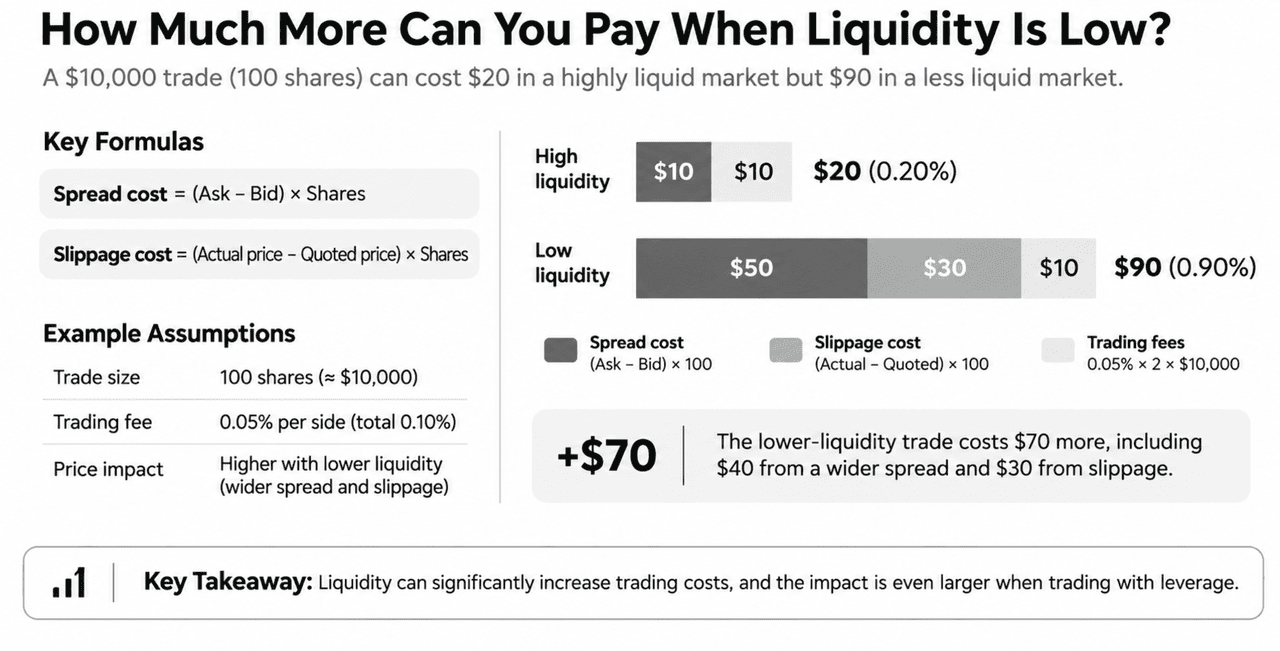
The difference becomes more significant when trading with leverage. For example, a $10,000 futures position backed by $1,000 in initial margin has 10x exposure. A 0.20% unfavorable execution difference costs $20, equivalent to 2% of the initial margin before fees and funding. Liquidity therefore matters not only for trading costs, but also for managing leveraged positions.
How Does BingX Help Traders Manage Liquidity and Trading Costs?
BingX combines deep order-book liquidity with competitive trading fees to help traders reduce execution costs across traditional financial markets. According to BingX's September 2026 liquidity report, the platform ranked No. 1 in TradFi perpetual futures order-book depth across selected popular assets, based on its comparison with major exchanges. Greater liquidity near the market price can help traders execute larger orders with tighter spreads and less slippage.
How Deep Is BingX TradFi Liquidity?
BingX's analysis compared order-book depth within 0.1%, 0.5%, and 1% of market prices, reporting up to 2.2x deeper liquidity than the second-ranked exchange across selected TradFi assets. This depth helps traders execute larger orders with less slippage, while access to over 600 TradFi perpetual contracts provides broad market coverage across stocks, commodities, forex, and indices.
|
TradFi Market |
Examples |
Order-Book Depth vs. Second-Ranked Exchange |
|
Commodities |
Gold, silver, WTI and Brent crude |
1.6x deeper |
|
AI and semiconductor stocks |
GOOGL, AVGO, SKHYNIX, INTC |
1.7x deeper |
|
Major U.S. stocks |
AAPL, TSLA, SPCX |
2.2x deeper |
How Do Trading Costs Compare Between BingX Stocks and TradFi Futures?
BingX offers two ways to access traditional financial markets: BingX Stocks Trading for actual securities ownership and TradFi perpetual futures for leveraged price exposure.
|
Feature |
BingX Stocks Trading |
BingX TradFi Futures |
|
Available markets |
7,000+ U.S. stocks and ETFs |
600+ TradFi perpetual contracts |
|
Trading access |
24/5, subject to execution rules |
24/7 for many contracts |
|
Liquidity |
U.S. securities execution through Alpaca |
Deep order books across selected TradFi assets |
|
Trading fees |
Promotional 0.04% spread-based charge |
Eligible users: 0.006% maker / 0.015% taker |
|
Other costs |
Market spread and slippage |
Market spread, slippage, and funding |
|
Ownership |
Actual stocks and ETFs |
No underlying asset ownership |
The following examples show how BingX's platform charges apply to a $10,000 trade:
- BingX Stocks Trading: The stock fee guide lists a promotional 0.04% spread-based charge through December 31, 2026, equal to approximately $4 per $10,000 filled. The standard 0.08% rate would equal $8. The charge is included in the execution price, so it should not be counted twice.
- BingX TradFi Futures: An October 2026 promotion offers eligible traders 0.006% maker and 0.015% taker fees, equivalent to 0.60 USDT or 1.50 USDT per 10,000 USDT filled. Actual rates depend on account eligibility, while funding payments may apply to open positions.
BingX's deep liquidity and competitive fees help reduce trading costs, although spreads and slippage remain separate from platform charges. To manage total costs, compare live spreads, order-book depth, trading fees, and funding payments, while using suitable position sizes and limit orders to control execution prices.
Read More: What Is BingX Stocks Trading? A Beginner's Guide to Trading U.S. Stocks and ETFs With Crypto
How to Trade NVIDIA and Google Stock Futures on BingX
BingX TradFi offers USDT-margined perpetual futures on leading AI stocks, including NVIDIA (NVDA) and Alphabet (GOOGL). Traders can open long or short positions without owning the underlying shares, while accessing deep liquidity across selected U.S. stock contracts.
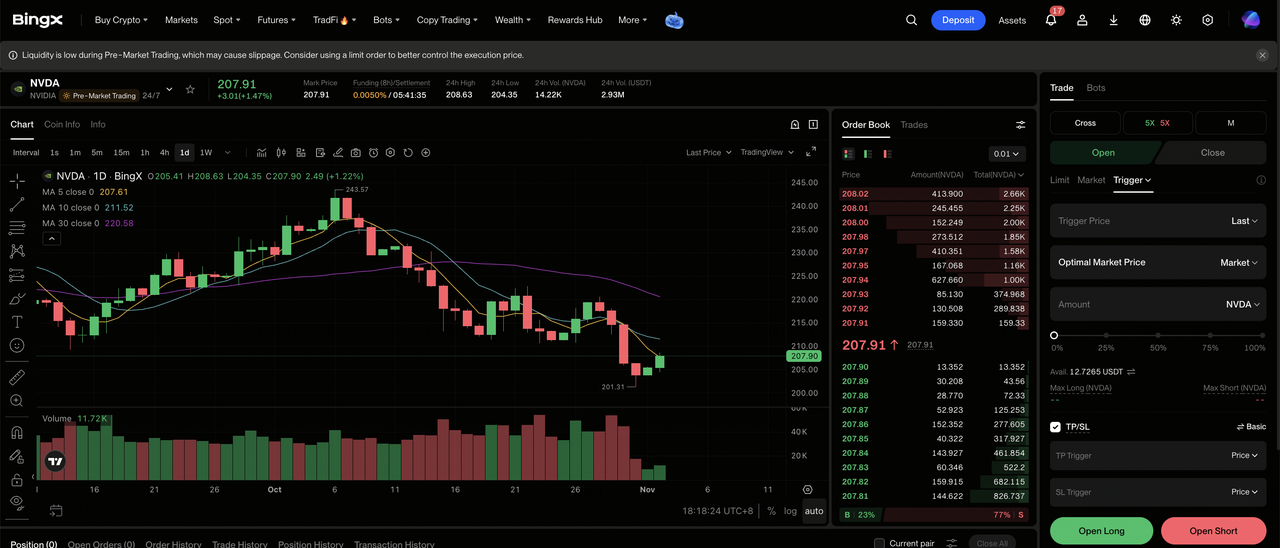
Step 1: Access BingX TradFi. Sign up or log in to BingX, complete the required identity verification, and open BingX TradFi. Confirm that stock perpetual futures are available in your region.
Step 2: Select an AI Stock Contract. Search for NVIDIA (NVDA) or Google (GOOGL) perpetual futures. Review the current bid-ask spread, available order-book depth, and contract specifications to assess liquidity and potential execution costs.
Step 3: Prepare USDT Margin. Transfer USDT into your Futures account and choose Isolated or Cross Margin. Check the available leverage, margin requirements, and estimated liquidation price before trading.
Step 4: Place Your Trade. Select Open Long or Open Short based on your market outlook. Enter your position size, choose a market or limit order, and review the estimated trading fees before confirming.
Step 5: Manage Your Position. Set Take-Profit and Stop-Loss levels to manage potential gains and losses. Monitor funding payments, available margin, and market liquidity before adjusting or closing your position.
4 Ways to Reduce Liquidity-Related Trading Costs
Managing liquidity helps traders reduce spreads, slippage, and unnecessary execution costs. These four strategies can help improve trade execution on BingX.
- Use limit orders to control execution prices: A buy limit sets the maximum purchase price, while a sell limit sets the minimum selling price. This helps avoid unfavorable fills during volatile or less liquid conditions, although limit orders may remain partially or completely unfilled.
- Adjust order size to available liquidity: Large orders may execute across multiple price levels, increasing slippage. Splitting a trade into smaller orders can reduce immediate price impact, although prices may change between executions and trading fees still apply.
- Monitor liquidity during major market events: Earnings announcements, economic releases, and market openings can cause spreads to widen and available order depth to change quickly. Check current quotes before placing or adjusting orders rather than relying on earlier prices.
- Compare total trading costs with potential returns: A 0.50% target gain on a $10,000 position equals $50 before costs. If spreads, slippage, and trading fees total $20, they consume 40% of the expected gain, leaving just $30 if the price target is reached.
Final Thoughts: How BingX's Deep Liquidity Helps Reduce Trading Costs
Liquidity plays an important role in determining how much of a trading return investors actually keep. Deeper order books and tighter bid-ask spreads can reduce slippage and execution costs, while limited liquidity can make the same trade more expensive, even when platform fees are low.
BingX combines deep liquidity across selected TradFi markets with competitive trading fees, helping traders manage overall costs. By comparing live spreads, order-book depth, stock trading charges, and futures funding rates, traders can make more informed decisions. Choosing suitable order sizes and limit orders can further improve execution efficiency and help preserve potential returns.
Risk Reminder: Stocks and derivatives can lose value. Low liquidity, price gaps, and leverage can increase losses. Limit orders may remain unfilled, while stop-loss orders do not guarantee execution at the selected price. Product availability and fee promotions depend on eligibility and current BingX terms.
Related Reading
- What Is Liquidity in TradFi Trading and How Does It Work on BingX?
- What Is Liquidity and Slippage and How Does It Work on BingX Spot Trading?
- How to Trade Forex, Commodities, Stocks, and Indices With BingX TradFi: A Beginner’s Guide (2026)
- What Is BingX Stocks Trading? A Beginner's Guide to Trading U.S. Stocks and ETFs With Crypto
FAQs About BingX Liquidity and Trading Costs
1. Does Higher Liquidity Mean Lower Trading Costs?
Generally, yes. Higher liquidity usually means tighter bid-ask spreads and less slippage, helping traders execute orders at more favorable prices. Trading fees and funding costs still apply separately.
2. Is Slippage the Same as a Trading Fee?
No. Slippage occurs when an order executes at a different price than expected, while trading fees are charges set by the platform. Both can increase the total cost of a trade.
3. Why Can a Zero-Commission Trade Still Cost Money?
Zero commissions do not eliminate bid-ask spreads, slippage, or other charges. For example, BingX Stocks uses spread-based pricing, so traders should review the final execution price and applicable costs.
4. Do Limit Orders Always Reduce Trading Costs?
Not necessarily. Limit orders help control the maximum buying price or minimum selling price, but execution is not guaranteed. Orders that execute immediately may still cross the spread and incur taker fees.
5. How Do You Calculate the Total Cost of a Trade?
Add trading fees and applicable funding costs to the execution costs from spreads and slippage. Compare actual buying and selling prices, and avoid counting the spread twice if it is already included in the execution price.
