



GameStop (GME) operates a global network of stores and e-commerce sites selling video games, consoles, accessories, collectibles and pre-owned products. Physical game retail remains part of the business, while trading cards, graded collectibles and investment assets are becoming more important to revenue mix and equity value. This transition has improved margins, though the stock remains sensitive to declining game sales, capital-allocation decisions and meme-driven volatility.
The latest quarter showed the contrast clearly. GameStop Q2 FY2026 net sales fell 18.7% to $790.2 million, yet collectibles sales increased 57% to $356.3 million and operating income rose 141% to $160.2 million. Net income reached $298.7 million with help from investment gains, making the quality and repeatability of earnings central to the 2026 investment case.
The GME stock forecast for 2026 now centers on two competing views:
- The collectibles and asset-value case: trading-card growth, tighter store economics and disciplined use of cash and investments could sustain profitability and increase the value supported by each share.
- The retail contraction and capital-allocation case: falling video-game sales, volatile investments or additional convertible dilution could outweigh collectibles growth and keep the valuation above operating fundamentals.
This guide breaks down the GME stock forecast, 2026 price scenarios, key risks and analyst outlooks, drawing on GameStop's September 8 Q2 FY2026 earnings release, quarterly filing and market data through September 11, plus how to trade GME stock futures on BingX TradFi with USDT collateral.
Top 5 Things for GameStop Investors to Know in September 2026
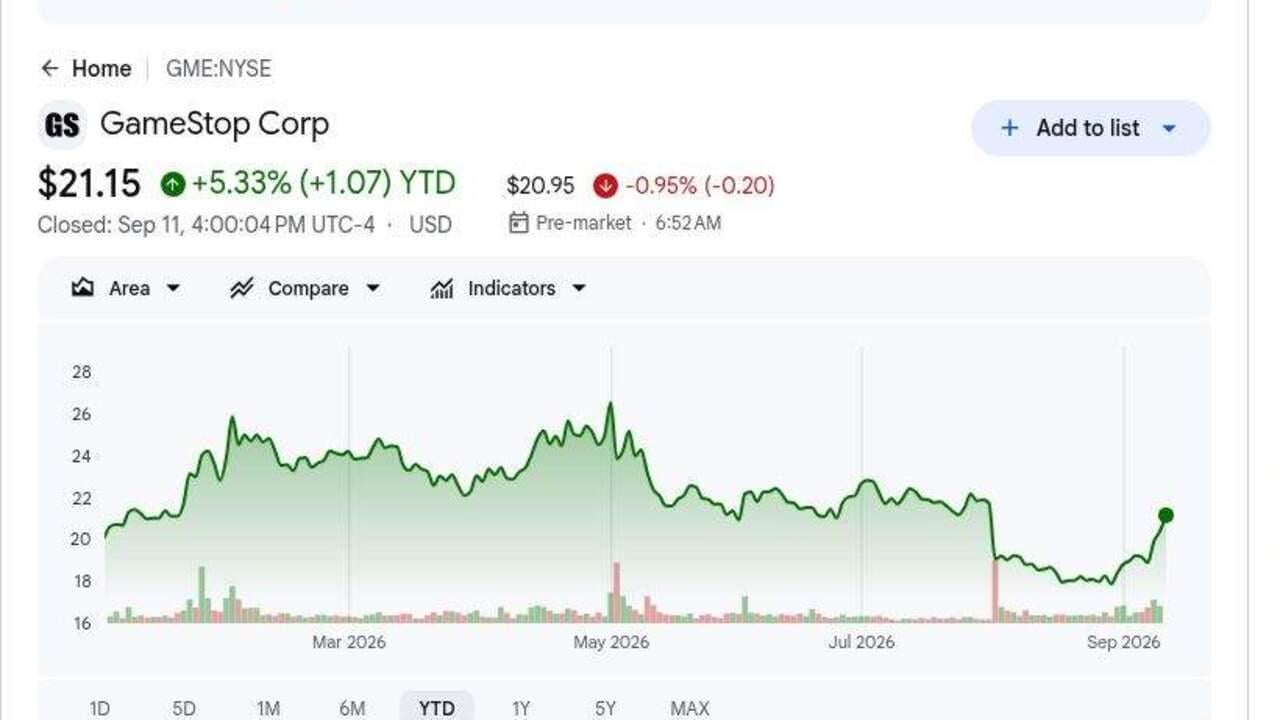
- GME closed at USD 21.15 after gaining 5.33% YTD: The modest gain hides wide swings around earnings, insider buying and capital-allocation news. Shares remain 57% above the only current Wall Street target of USD 13.50, showing that asset value and retail sentiment still matter heavily.
- Q2 sales fell 18.7% to USD 790.2 million: Revenue still beat the roughly USD 764.4 million consensus by about USD 25.8 million. Store closures, the France exit and a tough prior-year comparison kept the legacy retail business under pressure.
- Collectibles sales rose 57% to USD 356.3 million: The category reached 45.1% of total sales, ahead of video games at 33.3%. Trading cards and related products are becoming GameStop's clearest operating growth engine.
- Operating income reached USD 160.2 million, up 141%: Gross margin expanded to 43.7% from 29.1% as mix improved and costs fell. The stronger operating result provides better evidence of recurring business improvement than one-time investment gains.
- Full-year adjusted EBITDA guidance increased above USD 650 million: The prior floor was above USD 600 million, while first-half adjusted EBITDA reached USD 339.7 million. Reaching the new outlook requires collectibles growth and cost discipline to offset weaker game revenue.
What Is GameStop (GME)?
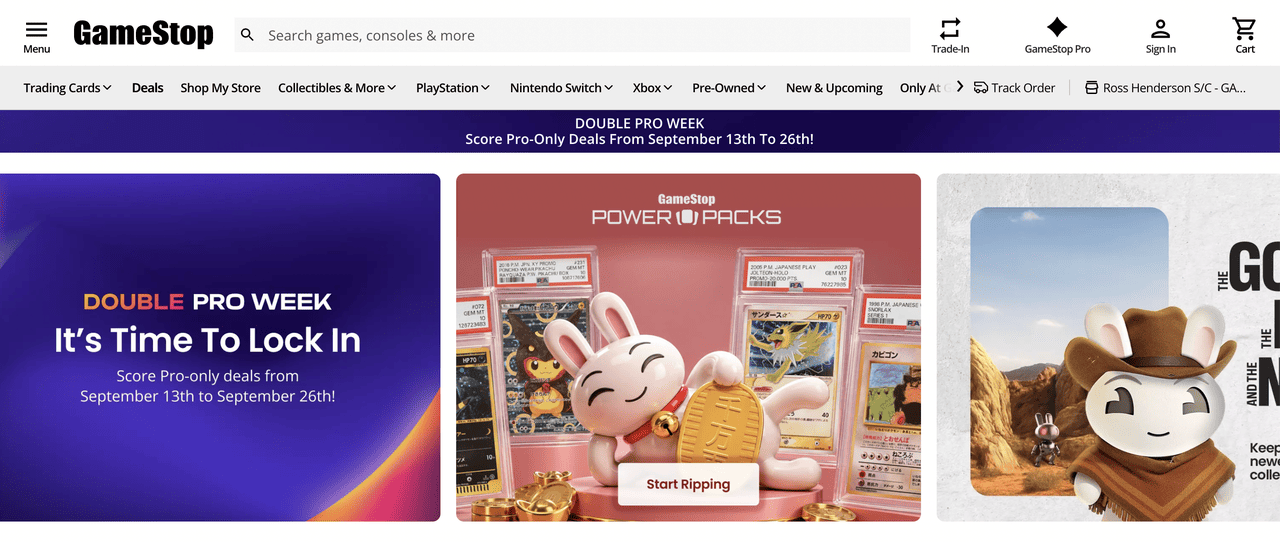
GameStop is a specialty retailer serving gamers and collectors through stores and e-commerce operations in the United States, Australia and Europe. The company had 2,206 stores at the beginning of 2026, including the GameStop, EB Games, Micromania-Zing and Zing Pop Culture banners. Revenue comes from new video games and hardware, pre-owned products, accessories and collectibles. Trade-ins supply used inventory, while GameStop Pro memberships, online fulfillment and in-store services support customer retention and transaction economics.
Its long-term direction is shifting toward higher-margin collectibles and a broader holding-company model. GameStop has expanded sealed trading cards, card buying and PSA grading services as the collectibles market grows, while store closures and the France divestiture reduce exposure to weaker locations. The company also built a large eBay position and proposed acquiring the marketplace, though eBay rejected the offer. Cash, marketable securities, digital assets and strategic investments now represent a material part of per-share value alongside the retail operation.
GameStop (GME) Q2 FY2026 Earnings Overview: Sales Mix, Operating Income and Collectibles Growth
GameStop reported Q2 net sales of $790.2 million versus roughly $764.4 million expected, adjusted EPS of $0.27 in line with consensus, and GAAP diluted EPS of $0.51 versus $0.31 a year earlier. Collectibles sales grew 57% to $356.3 million and operating income rose to $160.2 million, though total sales declined 18.7%. Management raised full-year adjusted EBITDA guidance above $650 million, leaving the central question whether operating improvement can outlast investment gains and shrinking legacy game revenue.
|
Financial Metric |
Guidance / Consensus |
Reported / Actual |
Surprise |
|
Q2 FY2026 net sales |
$764.4M consensus; $972.2M prior year |
$790.2M |
Beat. About $25.8M above consensus, though down 18.7% YoY. |
|
Q2 adjusted EPS |
$0.27 consensus |
$0.27 |
In line. Profitability met expectations despite lower sales. |
|
Q2 GAAP diluted EPS |
$0.31 a year earlier |
$0.51 |
Improved. Net income and investment gains raised earnings. |
|
Q2 net income |
$168.6M a year earlier |
$298.7M |
Improved. Profit rose 77% YoY, aided by investment gains. |
|
Q2 operating income |
$66.4M a year earlier |
$160.2M |
Expanded. Operating profit rose 141% YoY. |
|
Q2 collectibles sales |
$227.6M a year earlier |
$356.3M |
Accelerated. Sales rose 57% to 45.1% of revenue. |
|
Q2 video-game sales |
$494.6M a year earlier |
$263.2M |
Declined. Sales fell 47% after the prior-year launch comparison. |
|
Q2 free cash flow |
N/A |
$60.7M |
Positive. Core cash generation improved despite lower revenue. |
|
FY2026 adjusted EBITDA outlook |
Prior above $600M |
Above $650M |
Raised. The minimum outlook increased by more than $50M. |
- Sales of USD 790.2 million beat consensus by about USD 25.8 million: Revenue exceeded expectations, though the 18.7% year-over-year decline shows that store exits and weaker game sales are still shrinking the top line. Future earnings depend more on mix and cost control than broad sales growth.
- Adjusted EPS of USD 0.27 matched consensus: GAAP diluted EPS rose to USD 0.51 from USD 0.31 as net income reached USD 298.7 million. Investment gains contributed materially, so operating performance remains the better test of sustainable profitability.
- Collectibles sales rose USD 128.7 million to USD 356.3 million: The category reached 45.1% of sales versus 23.4% a year earlier. The mix supports margin improvement, though collectibles demand can still be cyclical and inventory-sensitive.
- Operating income increased USD 93.8 million to USD 160.2 million: Gross margin rose 14.6 percentage points to 43.7%, while SG&A declined with store rationalization. The result shows that a smaller revenue base can still produce stronger profit when mix and costs improve.
- Adjusted EBITDA guidance rose above USD 650 million from above USD 600 million: First-half adjusted EBITDA of USD 339.7 million provides more than half the new floor. The second half still needs strong collectibles demand and cost discipline to offset weaker game sales.
GameStop (GME) 2026 Investment Outlook: $30 Bull Case vs. $13.50 Bear Case
GameStop's 2026 outlook depends on two sources of value. The retail business is smaller but more profitable as collectibles offset part of the decline in video games, while the balance sheet and investment portfolio can add asset value but make earnings less predictable.
The Bull Case: Strong Collectibles Growth Pushes GME Toward USD 30
The Bull Case assumes collectibles remain near 45% of sales, PSA grading and card buying deepen customer engagement, and store rationalization preserves stronger margins. Operating profit keeps improving even if total sales remain below the prior year, while management avoids value-destroying capital allocation.
A move toward USD 30 would require adjusted EBITDA above the USD 650 million floor, positive free cash flow and clear evidence that profitability comes from retail operations rather than one-time gains. More insider buying or a strategic transaction that raises per-share asset value would strengthen the case.
The Base Case: Better Margins Keep GME Between USD 18 and USD 24
The Base Case assumes collectibles growth and lower costs offset part of the decline in video games. GameStop remains profitable, though revenue contraction and uncertainty around investments, digital assets and convertible securities limit the valuation multiple.
Under this scenario, GME could trade mainly between USD 18 and USD 24. Stable operating income, positive free cash flow and a steady asset base would support the range. Collectibles growth below 20%, renewed cash burn or a large acquisition with uncertain returns would weaken the upper end.
The Bear Case: Weaker Retail Sales Pull GME Toward USD 13.50
The Bear Case assumes video-game sales decline faster than collectibles grow, reversing recent operating leverage. Investment gains do not repeat, asset values weaken and financing or acquisition activity increases the diluted share count.
A move toward USD 13.50 would become more likely if full-year adjusted EBITDA falls below USD 650 million, operating cash flow turns negative or GameStop commits substantial capital without clear returns. That level also matches the sole current Wall Street target.
GME Stock Price Forecasts for 2026 By Wall Street Analysts
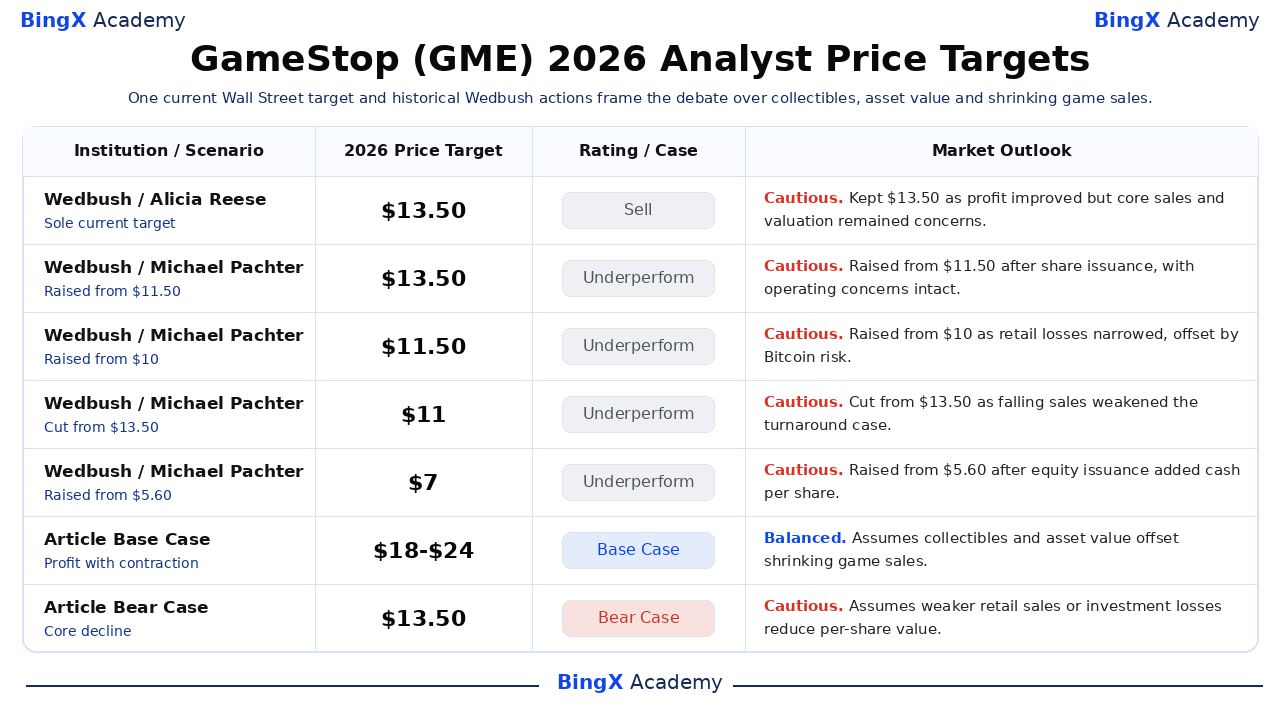
Current institutional coverage is exceptionally thin. MarketWatch lists one active target, Wedbush's $13.50 view, so the table also shows four dated historical Wedbush actions to explain how the firm's valuation changed with cash, operating performance and equity issuance. Those older targets are context, not current consensus. The final two rows are BingX Academy editorial scenarios.
|
Institution / Scenario |
2026 Price Target |
Rating / Case |
Market Outlook |
|
Wedbush / Alicia Reese |
$13.50 |
Sell |
Cautious. September 10: maintained the sole current target as stronger profit did not resolve core sales decline or valuation risk. |
|
Wedbush / Michael Pachter |
$13.50 |
Underperform |
Cautious. March 31: raised from $11.50 after equity issuance increased cash value, while the operating outlook stayed weak. |
|
Wedbush / Michael Pachter |
$11.50 |
Underperform |
Cautious. March 26: raised from $10 as retail losses narrowed, offset by Bitcoin allocation risk. |
|
Wedbush / Michael Pachter |
$11 |
Underperform |
Cautious. June 12: cut from $13.50 as falling sales weakened the turnaround case. |
|
Wedbush / Michael Pachter |
$7 |
Underperform |
Cautious. May 17: raised from $5.60 after equity issuance added cash per share. |
|
Article Base Case |
$18-$24 |
Base Case |
Balanced. Assumes collectibles and asset value offset shrinking game sales. |
|
Article Bear Case |
$13.50 |
Bear Case |
Cautious. Assumes weaker retail sales or investment losses reduce per-share value. |
How to Trade GameStop (GME) Stock on BingX
Trade GameStop's collectibles-growth, operating-margin and capital-allocation outlook using BingX TradFi and BingX AI tools. Because GME can react sharply to earnings, insider activity and retail-trading momentum, traders should define both the catalyst and risk limits before entering a position.
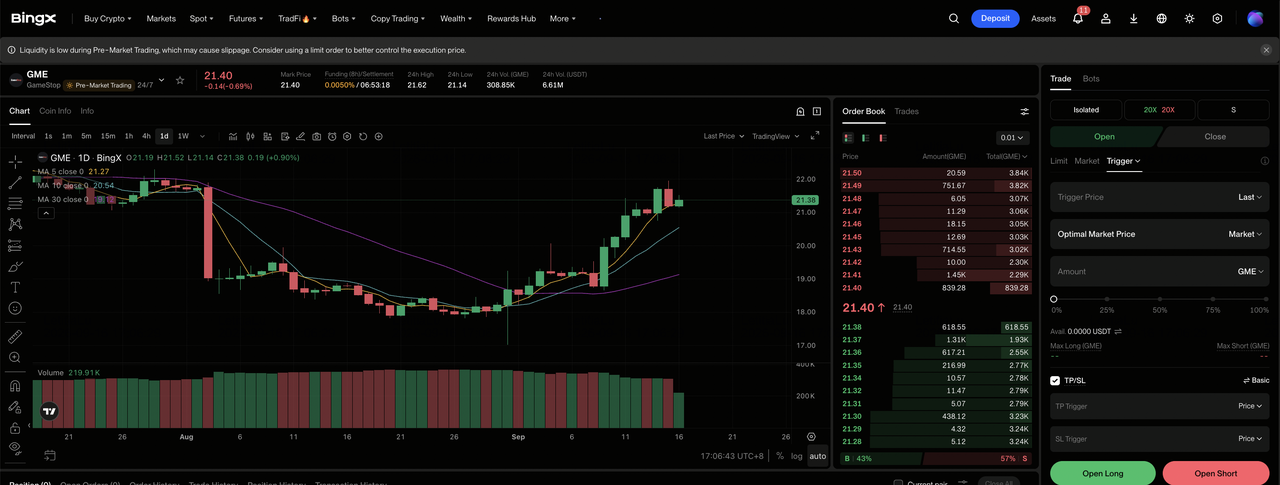
Step 1: Access BingX TradFi. Sign up and navigate to the specialized TradFi section on the BingX exchange dashboard.
Step 2: Select GameStop (GME). Search for and select the GME-USDT perpetual futures contract.
Step 3: Choose your direction. Select Open Long if collectibles growth and operating profit remain firm. Select Open Short if retail contraction, investment losses or dilution weaken per-share value.
Step 4: Select leverage and margin mode. Choose Isolated or Cross-Margin based on your risk tolerance. GME's history of meme-driven volatility shows why conservative leverage and clear position sizing are important.
Step 5: Execute strict risk protocols. Set Take-Profit and Stop-Loss (TP/SL) levels before or immediately after entering the trade. GME can react quickly to collectibles demand, earnings, insider purchases, capital allocation and retail sentiment.
Top 5 Risks to Watch for GameStop Investors in 2026
GameStop's per-share value depends on retail performance, investments, financing and market sentiment. These risks can affect earnings quality and the asset value supporting the stock.
- Video-game sales continue to shrink: Revenue from video games fell 47% to USD 263.2 million. If collectibles growth slows, the smaller legacy business may contribute less gross profit toward fixed store and corporate costs.
- Investment gains make earnings less predictable: Q2 net income reached USD 298.7 million, helped by USD 238 million of investment gains. A weaker asset value or failed transaction could reverse part of that contribution.
- A large acquisition could increase execution risk: The proposed USD 55.5 billion eBay deal would be far larger than GameStop itself. Debt, new shares or outside financing could increase leverage and dilution before any benefits reach earnings.
- Convertible securities could dilute per-share value: GameStop exchanged USD 1.4 billion of notes and used cash for part of the consideration. More conversions or equity financing would spread future earnings across a larger share base.
- The stock still trades well above the analyst target: GME traded at USD 21.15 versus the sole current Wall Street target of USD 13.50. A sentiment reversal could compress that premium quickly even if operating results continue improving.
Final Thoughts: Should You Invest in GameStop in 2026?
GameStop's Q2 results provide real operating evidence behind the transformation. Collectibles sales rose 57% to $356.3 million, operating income reached $160.2 million and full-year adjusted EBITDA guidance moved above $650 million. The remaining concern is that total sales fell 18.7% and investment gains contributed materially to net income.
The Bull Case requires collectibles, operating cash flow and disciplined capital allocation to support $30. The Bear Case reflects continuing retail decline, investment losses and dilution that could pull GME toward $13.50. Conservative traders may monitor collectibles growth, operating income, free cash flow and changes in shares outstanding rather than relying on meme momentum alone.
Risk Reminder: Trading and investing in equities like GME involves a high risk of capital loss. Retail contraction, investment volatility, acquisition risk, convertible dilution, short squeezes and leveraged trading can produce rapid losses. Conduct independent research before allocating capital.
Related Reading
- AMC Stock Price Prediction 2026: Fundamental Turnaround or Massive Dilution Trap?
- Netflix (NFLX) Price Prediction 2026: Can NFLX Stock Rebound to $125 on Ads and Live Sports?
- Meta (META) Price Prediction 2026: Can AI Monetization Push META Toward $1,000?
- Reddit (RDDT) Price Prediction 2026: Can AI Data Opportunities Push RDDT Toward $300?
- Snap Inc. (SNAP) Price Prediction 2026: Can Advertising and Subscription Growth Push SNAP Toward $10?
