


CoreWeave (CRWV) provides AI cloud infrastructure built around GPU clusters, high-speed networking, storage and software. Its customers include AI labs and enterprises that need computing capacity for model training and inference. Growth depends on bringing new infrastructure online efficiently and generating sufficient returns on each expansion project.
CoreWeave Q2 2026 showed both sides of the investment case. Revenue increased 112% to $2.575 billion, and adjusted EBITDA reached $1.510 billion. However, CoreWeave recorded a $626 million net loss as interest expense climbed to $640 million, keeping debt and financing costs central to the outlook.
The CRWV stock forecast for 2026 centers on two competing views:
- The demand-and-scale case: CoreWeave had $104.2 billion in backlog and secured more than $25 billion in additional customer commitments after the quarter. Better contract terms and newly activated capacity could strengthen operating leverage.
- The funding-and-execution case: Planned 2026 capital expenditures of $35 billion to $39 billion create substantial funding and construction risks. Customer concentration could also leave cash returns below the level needed to support a lasting valuation increase.
This guide breaks down the CRWV stock forecast, 2026 price scenarios, key risks and analyst outlooks using CoreWeave’s August 11 Q2 2026 earnings release, quarterly filing and market data through September 9. It also explains how to trade CRWV stock futures on BingX TradFi with USDT collateral when an eligible market is available.
Top 5 Things for CoreWeave Investors to Know in September 2026
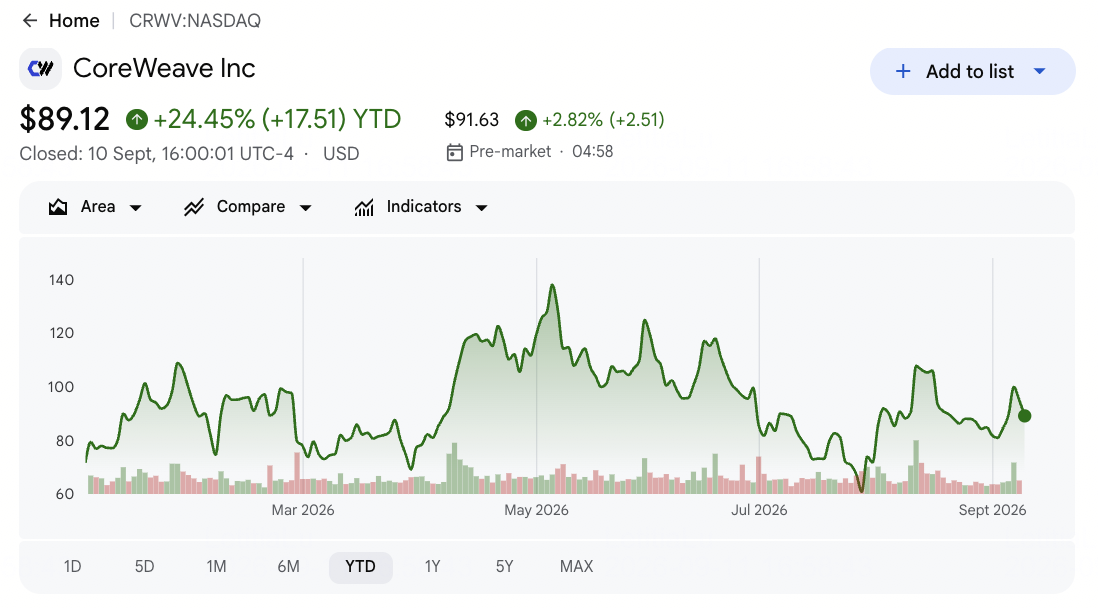
- CRWV was up 32.58% YTD at its $94.94 September 9 close: The stock remained 137% above CoreWeave's $40 IPO price yet had pulled back 38% from its $153.20 52-week high, illustrating how quickly expectations move around AI spending and funding conditions. The close is a historical reference point, not a live quote.
- Q2 revenue of $2.575 billion increased 112% year over year: Sales exceeded the $2.555 billion Wall Street estimate by about $20 million. The beat was modest relative to the growth rate, making forward capacity deployment and contract pricing more important than a single-quarter upside surprise.
- Revenue backlog of $104.2 billion expanded 246%: The reported balance excluded more than $25 billion of net new customer commitments added early in Q3. Those commitments strengthen demand visibility, though revenue can only be recognized as CoreWeave delivers available service capacity.
- FY2026 revenue guidance increased to $12.4 billion to $13.2 billion: The prior range was $12.0 billion to $13.0 billion, and management also introduced an $18.5 billion to $19.5 billion exiting annualized revenue run rate. Converting that outlook requires data centers and power to arrive on schedule.
- Planned 2026 capital expenditures rose to $35 billion to $39 billion: Q2 interest expense already reached $640 million, up from $267 million a year earlier. CoreWeave therefore must show that better pricing and utilization can offset the higher cost of adding GPUs, power and facilities.
What Is CoreWeave (CRWV)?
CoreWeave is a specialized cloud provider built for artificial intelligence workloads. Its platform combines GPU computing, AI-optimized storage, high-performance networking, bare-metal infrastructure, monitoring tools and managed software. Customers use these services to train AI models, run inference and manage compute-intensive enterprise workloads. CoreWeave generates revenue from contracted cloud capacity and platform services, making power availability, deployed GPUs, utilization and contract pricing central to the business.
CoreWeave’s long-term strategy is to build a complete AI cloud platform that extends beyond GPU leasing. Its partnership with NVIDIA supports the deployment of new computing architectures, and the company plans to develop more than five gigawatts of AI data-center capacity by 2030. OpenAI, Microsoft and Meta are major long-term customers, with IBM, Mistral AI, Jane Street and Databricks expanding the workload mix. Mission Control, Weights & Biases and cross-cloud tools add software and infrastructure-management capabilities to the platform.
Read More: Top AI Networking Stocks 2026: AI Fabric, Switches, Copper, Fiber, and Optics Connectivity
CoreWeave (CRWV) Q2 2026 Earnings Overview: Revenue, Backlog and AI Capacity Growth
CoreWeave delivered $2.575 billion of Q2 revenue versus $2.555 billion expected, and its $1.14 diluted loss per share was $0.06 narrower than consensus. Adjusted EBITDA reached $1.510 billion at a 59% margin and backlog expanded 246% to $104.2 billion. Management raised FY2026 revenue guidance to $12.4 billion to $13.2 billion, though $9.352 billion of capex kept funding in focus.
|
Financial Metric |
Guidance / Consensus |
Reported / Actual |
Surprise |
|
Q2 2026 revenue |
$2.555B |
$2.575B |
Beat. About $20M above consensus; up 112% YoY. |
|
Q2 diluted net loss per share |
$1.20 loss |
$1.14 loss |
Beat. The loss was $0.06 narrower than consensus. |
|
Q2 GAAP net loss |
— |
$626M loss |
Widened. Increased from $290M a year earlier. |
|
Adjusted EBITDA |
— |
$1.510B; 59% margin |
Expanded. EBITDA rose 101% YoY. |
|
Adjusted operating income |
About $65M |
$128M; 5% margin |
Beat. Nearly double consensus. |
|
Revenue backlog |
$30.1B year earlier |
$104.2B |
Expanded. Up 246%, excluding $25B of later commitments. |
|
Q2 capital expenditures |
$2.938B year earlier |
$9.352B |
Accelerated. More than tripled YoY. |
|
Q2 interest expense |
$267M year earlier |
$640M |
Increased. Financing cost rose 140%. |
|
Q3 revenue outlook |
$3.45B |
$3.45B–$3.60B |
Above at midpoint. $3.525B is $75M over consensus. |
|
FY2026 revenue outlook |
Prior $12.0B–$13.0B |
$12.4B–$13.2B |
Raised. Capacity and pricing supported both ends. |
|
FY2026 capital expenditures |
Prior $31B–$35B |
$35B–$39B |
Raised. Expansion increases growth and funding needs. |
|
Exiting 2026 ARR outlook |
— |
$18.5B–$19.5B |
Introduced. Signals a higher year-end revenue pace. |
- Revenue of $2.575 billion beat consensus by about $20 million: The 112% annual increase extended CoreWeave's record-revenue sequence. The smaller scale of the beat versus the growth rate means investors are likely to focus on forward delivery rather than treat one quarter as proof of durable returns.
- The $1.14 diluted loss per share was $0.06 better than expected: GAAP net loss still widened to $626 million from $290 million as interest expense rose to $640 million. Operating progress is therefore being partly absorbed by the financing structure.
- Adjusted EBITDA of $1.510 billion rose 101%: The 59% margin improved from 56% sequentially, and adjusted operating income increased to $128 million from $21 million. Higher utilization and newer contract economics are beginning to create leverage, though GAAP profitability remains distant.
- Backlog of $104.2 billion rose 246%: More than $25 billion of additional commitments arrived after quarter-end, and contracted power reached about 4.2 gigawatts by August 11. The demand is visible, yet backlog conversion depends on construction, grid connections and installed GPUs.
- Q3 revenue guidance reached $3.45 billion to $3.60 billion: Its $3.525 billion midpoint was $75 million above consensus, and FY2026 guidance increased by $300 million at the midpoint. The concurrent capex increase to $35 billion to $39 billion shows the cost required to support that acceleration.
CoreWeave Stock Price Outlook for 2026: $175 Bull Case vs. $70 Bear Case
CRWV's outlook depends on whether contracted demand converts into active capacity fast enough to outrun capital and interest costs. The $94.94 reference close sits below most current analyst targets, though the $74 to $176 range shows that Wall Street assigns sharply different values to the same backlog and funding model.
The Bull Case: New Capacity and Customer Contracts Push CRWV Toward $175
The Bull Case assumes CoreWeave converts its $104.2 billion backlog and more than $25 billion in newer commitments into revenue as active power exceeds 1.5 gigawatts. Better pricing and utilization would help adjusted operating income outgrow revenue and offset part of the $640 million quarterly interest burden.
A move toward $175 would require Q3 revenue near the upper end of the $3.45 billion to $3.60 billion range, improving operating margin and no major construction delays. Stronger returns from the planned $35 billion to $39 billion capex program would provide the clearest confirmation.
The Base Case: Strong AI Demand Keeps CRWV Between $115 and $150
The Base Case assumes AI computing demand continues to exceed supply and CoreWeave delivers full-year revenue of $12.4 billion to $13.2 billion. Backlog growth supports expansion, but interest expense, debt and facility investment keep the valuation from rising as quickly as revenue.
Under this scenario, CRWV could trade between $115 and $150. On-time capacity additions, a year-end annualized revenue run rate of $18.5 billion to $19.5 billion and steady margin improvement would support the range. Higher guidance without better cash returns would limit upside.
The Bear Case: Construction Delays and Funding Pressure Pull CRWV Toward $70
The Bear Case assumes power or construction delays push contracted revenue into later periods. Tighter funding conditions would increase pressure because CoreWeave finances GPUs and facilities before they begin generating revenue.
A move toward $70 would become more likely if backlog growth stalled, Q3 revenue fell below $3.45 billion or adjusted operating margin declined. Higher borrowing costs, dilution or customers shifting demand to larger cloud providers would further weaken the outlook.
CoreWeave (CRWV) Stock Price Forecast for 2026 by Wall Street Analysts
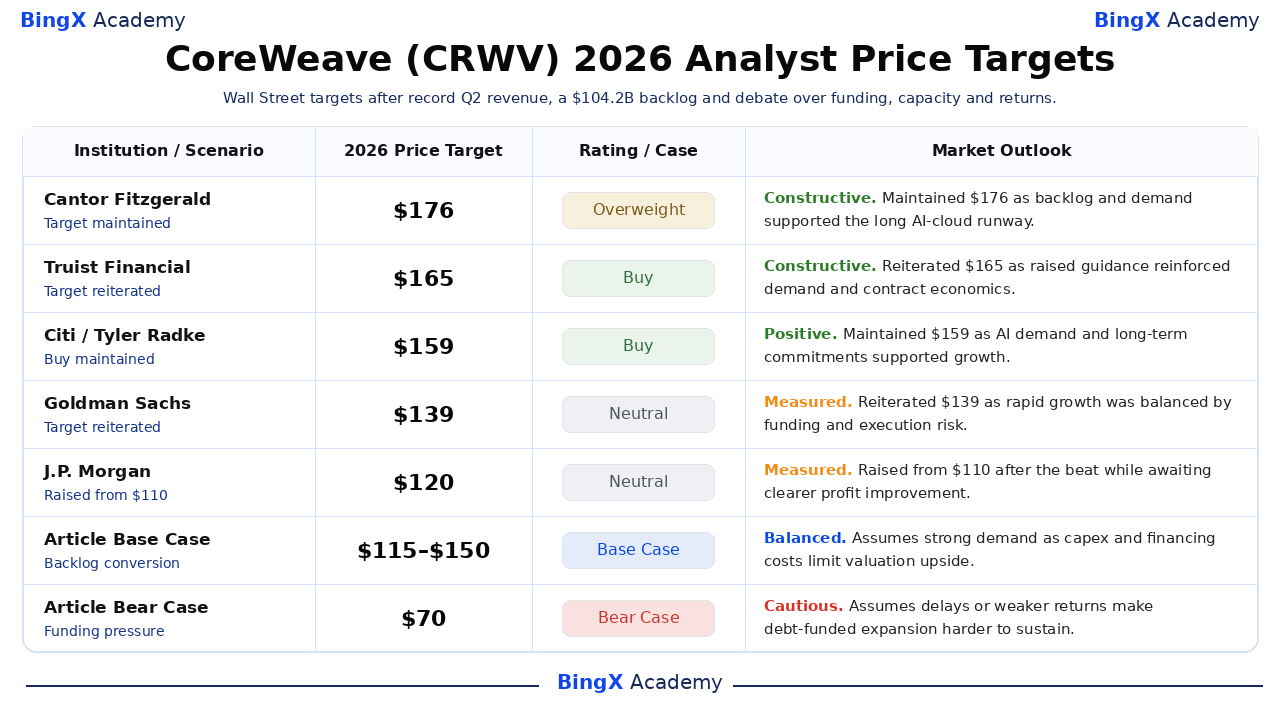
Wall Street remains divided because CoreWeave combines triple-digit growth with high financing requirements. Targets span $74 to $176, while the $138.81 average exceeds the September 9 close. These forecasts are outside opinions, and their dispersion maps competing assumptions rather than a promised outcome.
|
Institution |
2026 Price Target |
Rating / Case |
Market Outlook |
|
Cantor Fitzgerald |
$176 |
Overweight |
Constructive. August 11: maintained as record demand and backlog supported the long AI-cloud runway. |
|
Truist Financial |
$165 |
Buy |
Constructive. August 24: reiterated after raised guidance reinforced demand and contract economics. |
|
Citi |
$159 |
Buy |
Positive. August 14: maintained as AI demand and multi-year commitments supported growth. |
|
Goldman Sachs |
$139 |
Neutral |
Measured. August 21: reiterated as rapid growth was balanced by funding and execution risk. |
|
J.P. Morgan |
$120 |
Neutral |
Measured. August 12: raised from $110 after the beat while awaiting clearer profit improvement. |
|
Bernstein |
$74 |
Underperform |
Cautious. August 11: maintained as debt-funded expansion and hyperscaler competition constrained returns. |
|
Article Base Case |
$115–$150 |
Base Case |
Balanced. Assumes strong demand as capex and financing costs limit valuation upside. |
|
Article Bear Case |
$70 |
Bear Case |
Cautious. Assumes delays or weaker returns make debt-funded expansion harder to sustain. |
How to Trade CoreWeave (CRWV) Stock on BingX
Trade CoreWeave's backlog-conversion, AI-capacity and funding outlook using BingX TradFi and BingX AI tools. Because CRWV can react sharply to contract wins, capacity updates, guidance and credit conditions, traders should define both the catalyst and risk limits before entering a position.
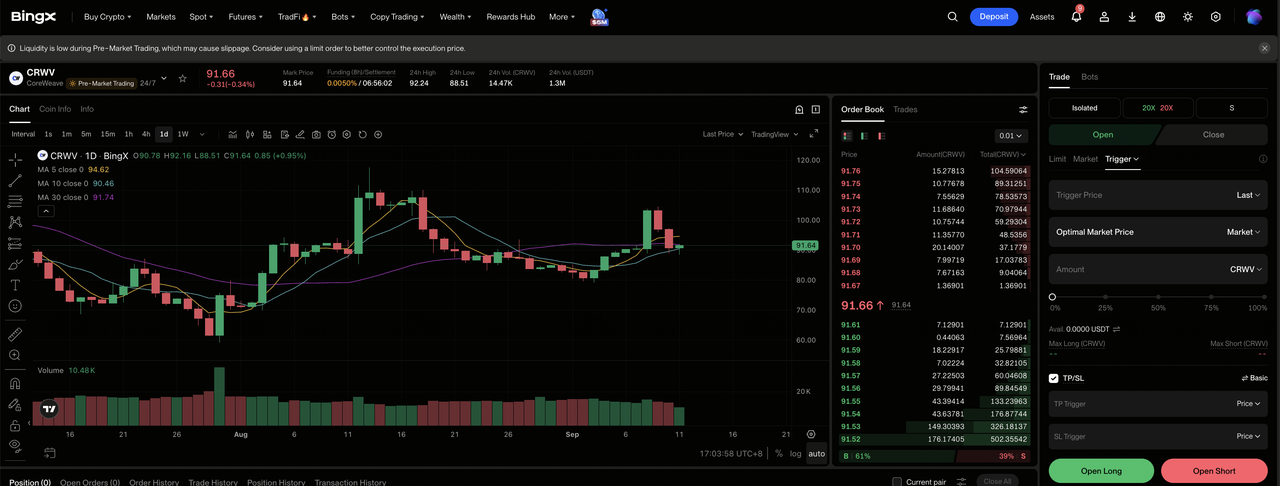
Step 1: Access BingX TradFi. Sign up and navigate to the specialized TradFi section on the BingX exchange dashboard.
Step 2: Search for CoreWeave (CRWV). Search for and select the CRWV-USDT perpetual futures contract.
Step 3: Choose your direction. Select Open Long if backlog conversion and operating leverage strengthen. Select Open Short if construction delays or higher funding costs weaken expected returns.
Step 4: Select leverage and margin mode. Choose Isolated or Cross-Margin based on your risk tolerance. The stock's wide 52-week range shows why conservative leverage and clear position sizing are important.
Step 5: Execute strict risk protocols. Set Take-Profit and Stop-Loss (TP/SL) levels before or immediately after entering the trade. CRWV can move quickly on customer commitments, financing, power availability and quarterly guidance.
Top 5 Risks to Watch for CoreWeave Investors in 2026
CoreWeave’s main risks are closely connected. A delayed facility postpones revenue, extends the debt-funded construction period and may require additional financing before contracted demand produces cash.
- Planned capex of $35 billion to $39 billion could weaken per-share returns: CoreWeave must pay for GPUs, facilities and power before much of the related customer revenue is recognized. More debt would increase interest expense, and equity issuance could dilute future earnings per share.
- Quarterly interest expense of $640 million raises the execution threshold: Interest expense increased from $267 million a year earlier. If new capacity falls behind schedule, financing costs could rise before the infrastructure begins contributing revenue and adjusted operating profit.
- Large customer contracts create concentration risk: Microsoft, OpenAI and Meta provide long-term revenue visibility, but a delayed deployment from any major customer could materially reduce utilization. These companies are also building internal infrastructure that may lower their future reliance on outside AI cloud providers.
- Contracted power of 4.2 gigawatts still requires physical delivery: Grid connections, construction, cooling systems and GPU installation can all delay revenue from the backlog. Each delay extends the time between capital spending and customer billing, reducing infrastructure returns.
- The $74 to $176 analyst target range reflects valuation uncertainty: Analysts use widely different assumptions for contract returns, financing costs and competition. Even modest changes in these inputs could reduce CoreWeave’s revenue multiple and produce large swings in equity value.
Final Thoughts: Should You Invest in CoreWeave in 2026?
CoreWeave enters the rest of 2026 with 112% revenue growth, $2.575 billion in quarterly revenue and more than $104 billion in backlog. These figures demonstrate strong demand for its AI cloud infrastructure, but the investment case depends on whether new facilities can begin generating revenue fast enough to offset $640 million in quarterly interest expense and a planned $35 billion to $39 billion capital expenditure program.
The Bull Case requires on-time capacity additions, improving adjusted operating margin and stronger returns from contracted demand, which could support a move toward $175. The Bear Case centers on construction delays, higher financing costs and weaker per-share cash returns, potentially pulling CRWV toward $70. Investors seeking stronger confirmation may prefer to see active power continue rising, Q3 revenue reach the upper end of the $3.45 billion to $3.60 billion outlook and progress toward the $18.5 billion to $19.5 billion year-end annualized revenue run rate.
Risk Reminder: Trading and investing in equities like CRWV involves a high risk of capital loss. Construction delays, customer concentration, debt, interest expense, dilution and changes in AI infrastructure demand can materially affect results. Conduct independent research before allocating capital.
Related Reading
- Top AI Data Center Stocks to Buy in 2026: Cloud, Servers, and AI Compute Infrastructure
- Top High-Performance Computing (HPC) Stocks to Watch in 2026: Accelerated Computing Market Leaders
- Top AI Semiconductor Stocks to Buy in 2026: AI Chips and Supply Chain Complete Guide
- Top AI Compute and GPU Stocks to Buy in 2026: The Shift to Inference and Custom Silicon
- Top AI Networking Stocks 2026: AI Fabric, Switches, Copper, Fiber, and Optics Connectivity
- Top AI Server Stocks to Buy in 2026: Rack-Scale Systems, GPU Servers, and AI Servers Infrastructure
