

Ambarella (AMBA) is a fabless chip designer whose low-power vision processors serve automotive cameras, security systems, drones, robotics and edge devices. Its video-processing base remains important, while higher-value CVflow AI chips are central to growth. The transition broadens its physical-AI market but leaves results exposed to manufacturing costs, design timing and customer demand.
The latest quarter showed edge-AI sales reaching a record without a margin recovery. Ambarella Q2 FY2027 revenue reached $108.1 million, up 13.2%, while its GAAP net loss narrowed to $6.7 million from $20.0 million. Cash and marketable debt securities totaled $272.3 million, giving Ambarella runway to scale CV7 and X7 programs even though converting new designs into higher-volume shipments remains necessary to absorb advanced-process costs.
The AMBA stock forecast for 2026 now centers on two competing views:
- The edge-AI expansion case: X7, CV7 and a 50-million-plus installed base widen Ambarella's addressable market, while seven-year channel agreements help more enterprise customers move from evaluation to production.
- The margin-conversion case: advanced-process costs, customer concentration and long automotive qualification cycles keep earnings growth below the level needed for a durable re-rating.
This guide breaks down the AMBA stock forecast, 2026 price scenarios, key risks and analyst outlooks, drawing on Ambarella's September 3 fiscal Q2 2027 earnings release, 10-Q and market data through October 5, plus how to trade AMBA stock futures on BingX TradFi with USDT collateral.
Top 5 Things for Ambarella Investors to Know in October 2026
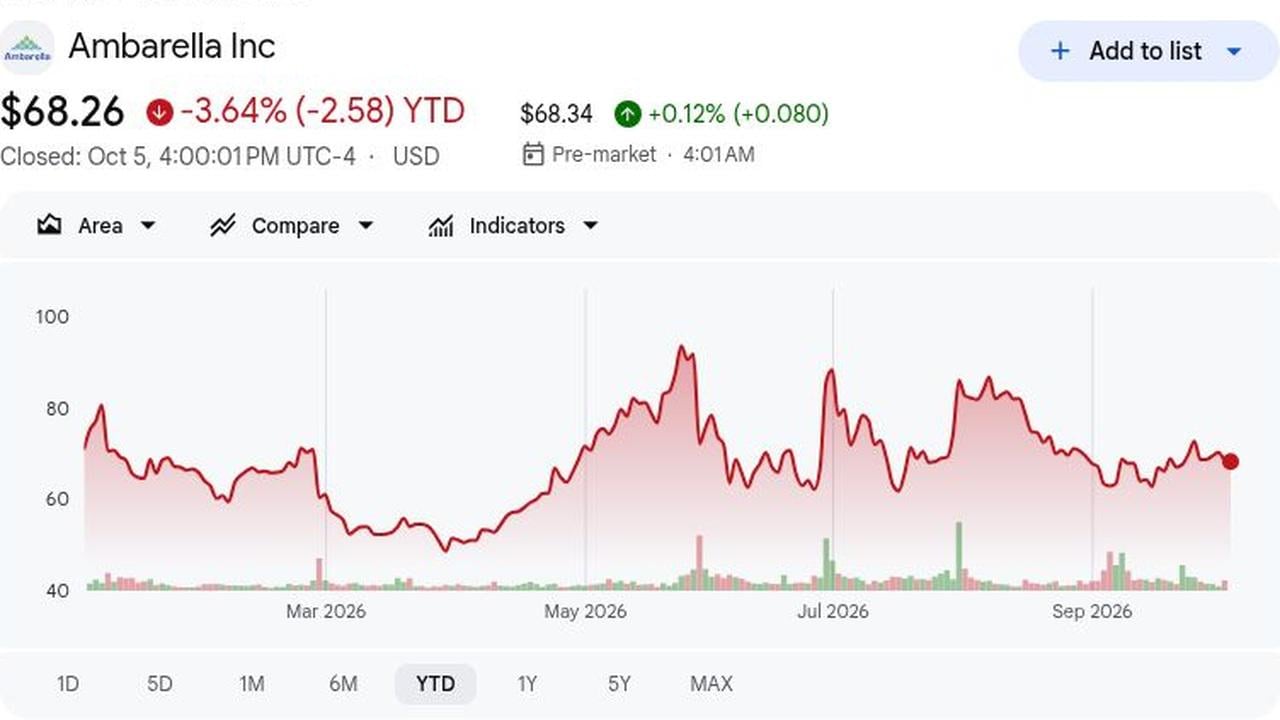
- AMBA closed at $68.26 on October 5 and was down 3.64% YTD: AMBA closed at $68.26 on October 5, down 3.64% YTD, between a $48.30 52-week low and $96.69 high. Shares also jumped about 19% after July 31 NXP acquisition speculation, showing how rumors can overshadow operating results.
- Q2 FY2027 revenue rose 13.2% to $108.1 million: Q2 revenue of $108.1 million grew 13.2% and beat consensus by $0.36 million. The narrow beat shows steady demand for higher-priced AI inference chips, but leaves the margin debate unresolved.
- More than 50 million Ambarella AI SoCs have shipped: More than 50 million AI SoCs have shipped, and record edge-AI sales came with strong CV75/CV72 demand in automotive and IoT. CV7 offers over 2.5 times prior-generation AI performance on 4nm, supporting future product-mix gains.
- Q3 revenue guidance reached $115 million to $124 million: Q3 revenue guidance of $115 million to $124 million puts the midpoint at $119.5 million, $0.2 million above consensus and about 10% over $108.5 million a year ago. The 59% to 60% adjusted-margin outlook signals continued advanced-node cost pressure.
- Wall Street targets ranged from $65 to $120: Targets span $65 to $120. Rosenblatt's $120 Buy view contrasts with Roth MKM's $65 target and Craig-Hallum's September 4 downgrade to Hold at $70, showing disagreement over whether physical-AI growth can offset execution and margin risks.
What Is Ambarella (AMBA)?

Ambarella designs systems-on-chip that combine video compression, image processing, computer vision, and AI acceleration. Its chips are used in automotive cameras and driver-assistance systems, security cameras, drones, robotics, and other connected devices where low power use and on-device processing matter. As a fabless semiconductor company, Ambarella designs its chips and software but relies on external foundries and assembly partners for manufacturing. That model keeps the company focused on chip design, though product ramps still depend on qualification, yields, and customer production schedules.
Ambarella is expanding from camera-focused processors into broader edge and physical-AI applications. Its 4nm CV7 vision SoCs handle perception workloads on-device, while X7 adds standalone AI acceleration for Arm- and x86-based systems. Partners such as Macnica, Capgemini, Google Cloud, Ultralytics, and ZEDEDA support distribution, development, model deployment, and fleet management, helping customers move from evaluation toward production across vehicles, robotics, industrial equipment, and security systems.
Ambarella (AMBA) Q2 FY2027 Earnings Overview: Edge-AI Growth Meets Margin Pressure
Q2 FY2027 revenue was $108.12 million versus $107.76 million consensus; non-GAAP EPS was $0.18 versus $0.17. Revenue grew 13.2% and GAAP net loss narrowed to $6.7 million from $20 million, but non-GAAP gross margin fell 120 basis points to 59.3%. Q3's $119.5 million midpoint exceeded consensus by $0.2 million, keeping growth intact while profitability remained the central question.
|
Financial Metric |
Guidance / Consensus |
Reported / Actual |
Surprise |
|
Q2 FY2027 revenue |
$107.76M consensus |
$108.12M |
Beat. $0.36M above consensus; up 13.2% YoY. |
|
Q2 non-GAAP diluted EPS |
$0.17 consensus |
$0.18 |
Beat. One cent above consensus; up from $0.15. |
|
Q2 GAAP net loss |
$20.0M loss a year earlier |
$6.7M loss |
Improved. Loss narrowed by $13.3M. |
|
Q2 GAAP gross margin |
58.9% a year earlier |
57.70% |
Lower. Contracted 120 basis points. |
|
Q2 non-GAAP gross margin |
60.5% a year earlier |
59.30% |
Lower. Contracted 120 basis points. |
|
Cash and marketable debt securities |
$261.2M a year earlier |
$272.3M |
Higher. Up $11.1M year over year. |
|
Q3 FY2027 revenue outlook |
$119.3M consensus |
$115M to $124M |
In line. $119.5M midpoint was $0.2M above consensus. |
|
Q3 non-GAAP gross-margin outlook |
60.9% a year earlier |
59% to 60% |
Lower. Midpoint implies 140 basis points of pressure. |
- Revenue of $108.1 million grew 13.2% year over year: Revenue increased $12.6 million to $108.1 million, up 13.2% YoY, mainly on higher shipments of pricier AI inference processors. The $0.36 million consensus beat was narrow, so mix improvement is evident but not yet a major earnings surprise.
- Non-GAAP diluted EPS rose 20% to $0.18: Non-GAAP EPS rose 20% to $0.18, with adjusted net income increasing to $8.2 million from $6.4 million. The one-cent consensus beat is constructive, though a $9.0 million one-time GAAP R&D credit limits conclusions about recurring efficiency.
- GAAP net loss narrowed by $13.3 million to $6.7 million: GAAP net loss narrowed $13.3 million to $6.7 million as operating loss improved to $8.1 million from $22.0 million. Six-month operating cash flow remained negative $25.9 million as inventory absorbed working capital.
- Non-GAAP gross margin fell 120 basis points to 59.3%: Non-GAAP gross margin fell 120 basis points to 59.3%; the filing cited advanced-process costs, partly offset by favorable mix. Q3 guidance of 59% to 60% suggests CV7 and X7 need greater scale before sales growth lifts margins.
- The $119.5 million Q3 midpoint implies about 10% growth: The $119.5 million Q3 midpoint implies about 10% YoY growth from $108.5 million and nearly matches $119.3 million consensus. The $9 million range and $49.0 million purchase obligations make demand conversion and inventory discipline key.
Ambarella (AMBA) 2026 Investment Outlook: $130 Bull Case vs. $55 Bear Case
Ambarella's 2026 outlook depends on whether stronger edge-AI demand can turn new products such as CV7 and X7 into sustained revenue growth and better cash generation. The upside comes from wider adoption across automotive, robotics, security, and industrial markets, while slower qualification, margin pressure, and higher operating costs remain the main risks.
The Bull Case: Strong Edge-AI Demand Pushes AMBA Toward $130
The Bull Case assumes Ambarella's newer CV-series chips, including CV75, CV72, and CV7, keep growing across applications that need real-time vision and AI processing, such as driver-assistance cameras, security systems, drones, and robots. Its X7 accelerator, which adds AI processing to Arm- or x86-based systems, also expands the opportunity into broader industrial and physical-AI workloads beyond camera-focused devices.
A move toward $130 would require Q3 revenue near the $124 million high end, further guidance upgrades, non-GAAP gross margin above 60%, and stronger evidence that X7 is moving from customer evaluation into production. Positive operating cash flow would provide additional confirmation.
The Base Case: Steady Edge-AI Growth Keeps AMBA Between $80 and $105
The Base Case assumes demand for Ambarella's vision and AI chips remains healthy, while automotive and enterprise programs take time to reach volume. CV-series products continue supporting camera and perception workloads, while X7 gradually expands adoption in robotics, industrial systems, and other devices that need local AI processing.
AMBA could trade mainly between $80 and $105 if revenue growth stays above 10%, cash remains above $250 million, and non-GAAP gross margin holds near 59% to 60%. Slower customer ramps would likely limit the upper end.
The Bear Case: Slower Product Ramps Pull AMBA Toward $55
The Bear Case assumes new AI-chip deployments slip, automotive qualification takes longer, and higher development and channel costs weigh on profitability. Slower adoption of newer vision chips and X7 would reduce the expected benefit from Ambarella's shift toward broader edge-AI applications.
A move toward $55 would become more likely if revenue misses guidance, inventory rises above July's $76.9 million, or operating cash outflow continues. Weak X7 production conversion would add further pressure.
AMBA Stock Price Forecasts for 2026 By Wall Street Analysts
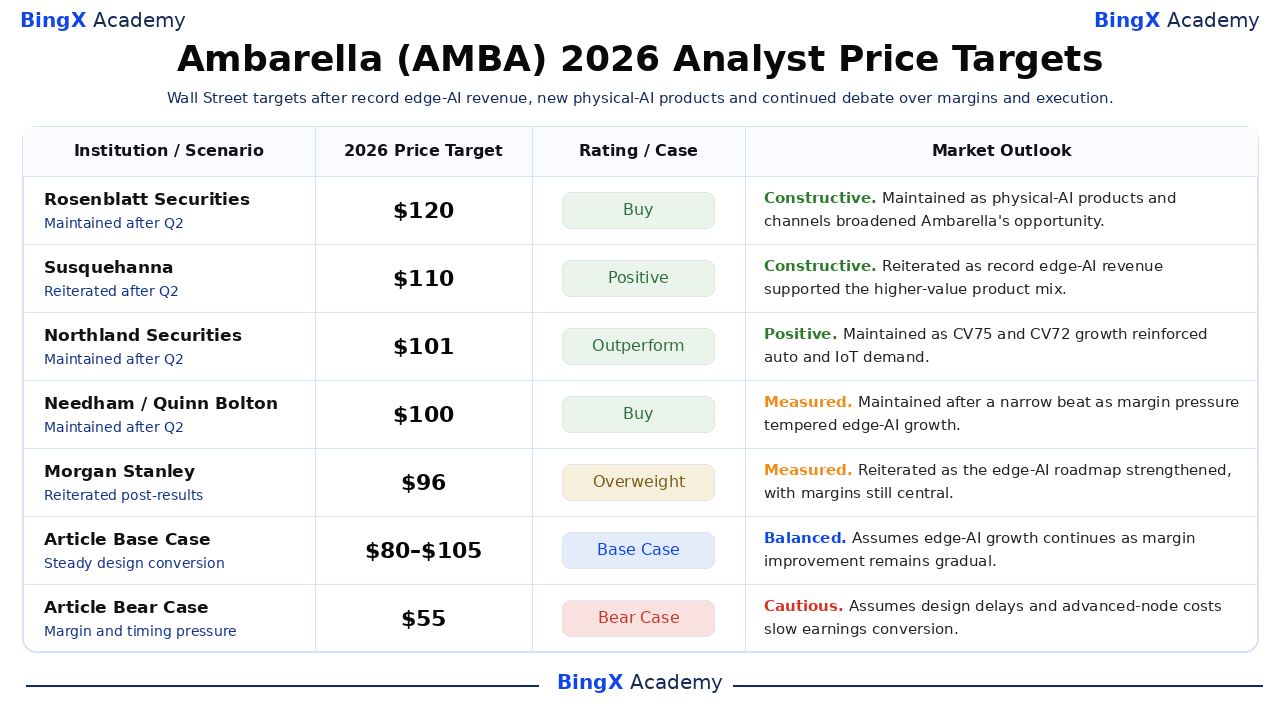
The table summarizes dated third-party actions available through October 5. The $65 to $120 spread reflects uncertainty over growth, margins and execution rather than a single price promise. Article Base and Bear Case rows are editorial scenarios and are kept separate from the real analyst actions.
|
Institution / Scenario |
2026 Price Target |
Rating / Case |
Market Outlook |
|
Rosenblatt Securities / Kevin Cassidy |
$120 |
Buy |
Constructive. September 15: maintained as physical-AI products and channels broadened Ambarella's opportunity. |
|
Susquehanna / Christopher Rolland |
$110 |
Positive |
Constructive. September 4: reiterated as record edge-AI revenue supported the higher-value product mix. |
|
Northland Securities / Gus Richard |
$101 |
Outperform |
Positive. September 4: maintained as CV75 and CV72 growth reinforced automotive and IoT demand. |
|
Needham / Quinn Bolton |
$100 |
Buy |
Measured. September 4: maintained after a narrow beat as margin pressure tempered edge-AI growth. |
|
Morgan Stanley / Joseph Moore |
$96 |
Overweight |
Measured. September 18: reiterated as the edge-AI roadmap strengthened, with margins still central. |
|
Stifel Nicolaus / Tore Svanberg |
$90 |
Buy |
Balanced. September 4: maintained as the $119.5 million Q3 midpoint kept growth intact despite lower margin expectations. |
|
Article Base Case |
$80 to $105 |
Base Case |
Balanced. Assumes edge-AI growth continues as margin improvement remains gradual. |
|
Article Bear Case |
$55 |
Bear Case |
Cautious. Assumes design delays and advanced-node costs slow earnings conversion. |
How to Trade Ambarella (AMBA) Stock on BingX
Trade Ambarella's edge-AI product cycle, physical-AI partnerships and margin outlook using BingX TradFi and BingX AI tools. Because AMBA can react sharply to earnings, design wins, product launches and acquisition reports, traders should define both the catalyst and risk limits before entering a position.
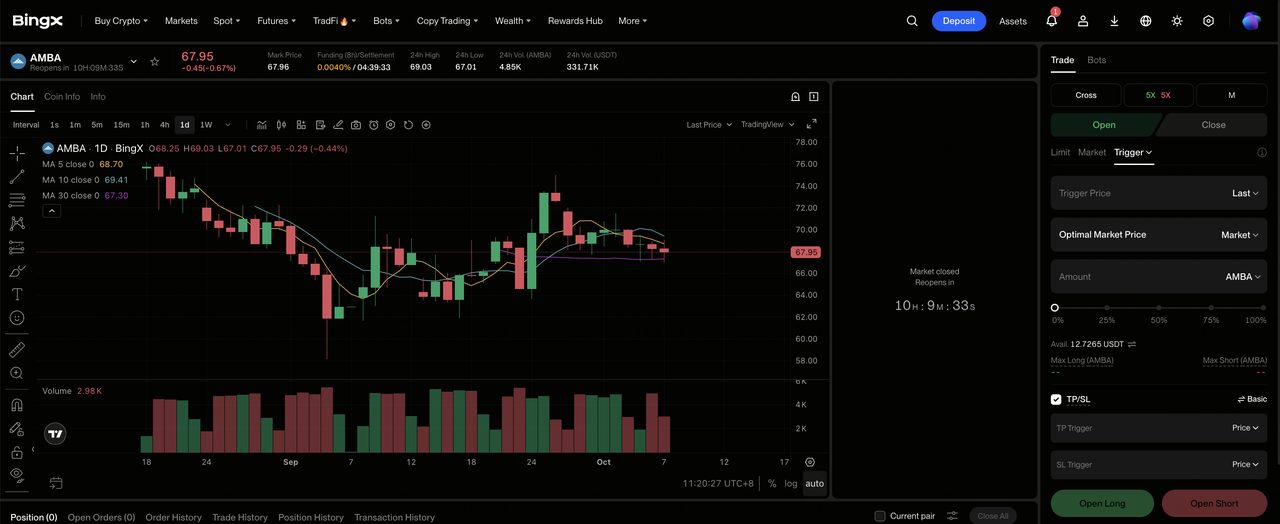
Step 1: Access BingX TradFi. Sign up and navigate to the specialized TradFi section on the BingX exchange dashboard.
Step 2: Select Ambarella (AMBA). Search for and select the AMBA-USDT perpetual futures contract.
Step 3: Choose your direction. Select Open Long if you expect edge-AI revenue and X7 adoption to strengthen while gross margin stabilizes. Select Open Short if you expect design delays or advanced-node costs to weaken earnings conversion.
Step 4: Select leverage and margin mode. Choose Isolated or Cross-Margin based on your risk tolerance. The roughly 19% July 31 acquisition-rumor jump shows why conservative leverage and clear position sizing are important.
Step 5: Execute strict risk protocols. Set Take-Profit and Stop-Loss (TP/SL) levels before or immediately after entering the trade. AMBA can react quickly to quarterly guidance, design-win timing, gross-margin changes, product launches and strategic reports.
Top 5 Risks to Watch for Ambarella Investors in 2026
Ambarella's edge-AI market is growing, but profitable production depends on converting designs into volume while protecting margins and generating cash to fund further development.
- Gross-margin compression can limit earnings conversion: GAAP and non-GAAP gross margins both fell 120 basis points in Q2, and the Q3 adjusted range remains below the 60.9% year-earlier level. Persistent advanced-node and memory costs could keep profit growth below revenue growth.
- Long design cycles can delay physical-AI revenue: automotive and industrial programs often require validation before volume production. If CV7 or X7 wins shift into later periods, Ambarella would continue funding engineering and channel development before receiving the expected sales contribution.
- Distributor and customer concentration can amplify volatility: WT Microelectronics and Hakuto handle a meaningful portion of indirect sales. Changes in purchasing, inventory or end-customer timing can therefore produce sharp quarterly swings even when the long-term pipeline remains intact.
- Inventory growth can consume cash: inventory rose to $76.9 million from $52.2 million at January 31, and six-month operating cash flow was negative $25.9 million. If demand converts more slowly than planned, write-down risk and working-capital needs could reduce per-share value.
- Strategic speculation can disconnect price from execution: AMBA jumped about 19% after the July NXP report, though no completed transaction was announced. If takeover expectations fade, the stock may reprice toward standalone earnings before new products generate sufficient profit.
Final Thoughts: Should You Invest in Ambarella in 2026?
Ambarella has edge-AI momentum: Q2 revenue rose 13.2%, edge-AI sales hit a record, more than 50 million AI SoCs have shipped, and partners including Macnica, Capgemini, ZEDEDA and Ultralytics support deployments. X7 also extends the market beyond systems built around Ambarella SoCs, giving Ambarella another route to accelerator revenue beyond traditional camera chips.
The debate is conversion. The $130 bull case needs design wins, partners and advanced-node products to lift revenue and margins together; the $55 bear case gains weight if margin stays below 60%, inventory rises or programs slip. Conservative traders can watch whether Q3 reaches the $119.5 million midpoint and operating cash flow improves.
Risk Reminder: Trading and investing in equities like AMBA involves a high risk of capital loss. Semiconductor cycles, design delays, manufacturing costs, customer concentration and acquisition speculation can create sharp price moves. Conduct independent research before allocating capital.
Related Reading
- IBM (IBM) Price Prediction 2026: Can Software and Quantum Growth Push IBM Toward $350?
- Marvell Technology (MRVL) Price Prediction 2026: Can Custom AI Silicon Push MRVL Toward $350?
- NVIDIA (NVDA) Price Prediction 2026: Can AI Infrastructure Growth Drive NVDA Toward $420?
- Applied Materials (AMAT) Price Prediction 2026: Can AI Equipment Demand Push AMAT Toward $850?
- Texas Instruments (TXN) Price Prediction 2026: Can Analog Recovery Push TXN Toward $380?
