


Amazon (AMZN) is a global e-commerce and cloud company that is increasingly defined by its pivot into AI infrastructure. It operates a worldwide retail and logistics network alongside Amazon Web Services (AWS), with results driven largely by cloud adoption, advertising monetization, retail volume, and the pace of its data-center investment. At the same time, Amazon is using its scale to build out AI compute capacity and custom chips, giving investors exposure to both a mature retail-and-cloud franchise and the wider AI infrastructure buildout.
The investment case now centers on whether Amazon can convert an enormous AI capex cycle into durable, high-margin growth across cloud and advertising. In Q2 2026, revenue rose 20% to $200.6 billion from $167.7 billion a year earlier, while operating income jumped 43% to $27.5 billion and AWS grew 37%, its fastest pace in 18 quarters. At the same time, management raised full-year capex to roughly $220 billion, pushing trailing free cash flow to an outflow. For investors, the key question is whether AWS and advertising can scale margins fast enough to justify that spend over time.
The AMZN stock forecast for 2026 now centers on two competing views:
- The AI-and-ecosystem case: Bulls expect AWS's re-acceleration toward a $169 billion-plus annualized run rate, a $25 billion AI run rate growing triple digits, 26% advertising growth, and retail efficiency gains to expand margins, with analyst targets running as high as $405.
- The capex-and-cash-flow case: Bears see a $220 billion capex bill, negative free cash flow, decelerating retail growth, and rising antitrust scrutiny that pressures near-term returns despite the strong top line.
This guide breaks down the AMZN stock forecast, 2026 price scenarios, key risks, and analyst views, drawing on the July 30 earnings release, plus how to trade AMZN stock futures on BingX TradFi with USDT collateral.
Top 5 Things for Amazon Investors to Know in 2026
Amazon traded near $265 in August 2026 after briefly hitting a $3 trillion market cap, with the stock remaining highly sensitive to AWS growth, AI capex, and advertising momentum.
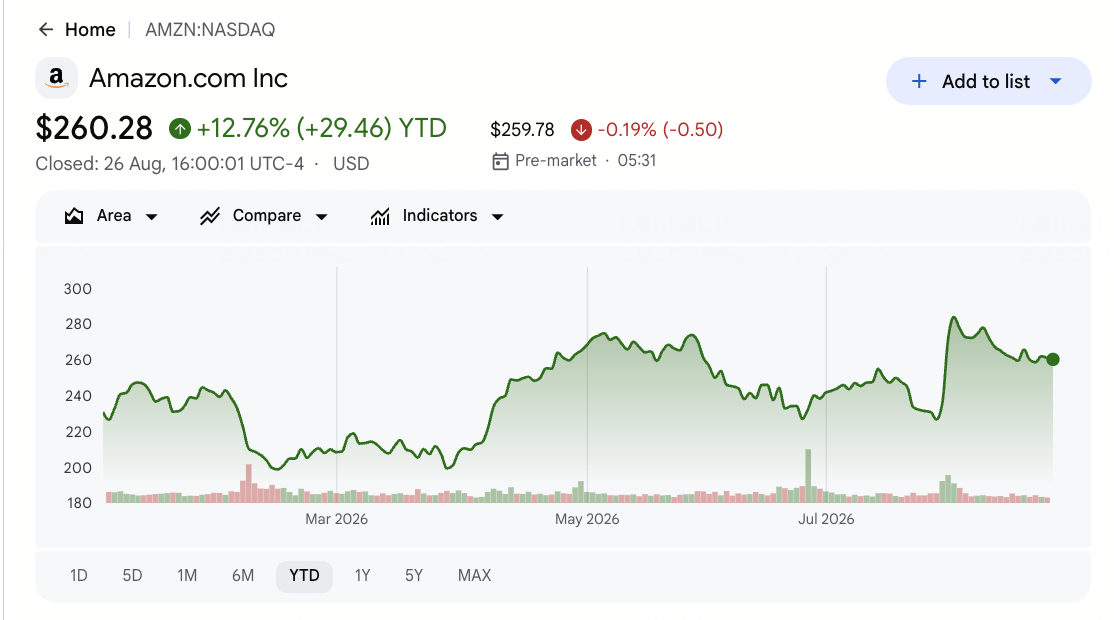
- Q2 revenue rose 20% to $200.6 billion and beat expectations. Net sales increased from $167.7 billion a year earlier and came in above the roughly $196 billion consensus, while adjusted EPS of $1.97 also topped estimates.
- AWS growth accelerated to 37%, its fastest pace in 18 quarters. AWS reached a $169 billion annualized run rate, while Amazon’s AI business surpassed a $25 billion run rate and continued growing at triple-digit rates.
- Advertising remained a high-margin growth engine. Ad revenue climbed 26% year over year to $19.8 billion, supported by sponsored products and continued expansion of Amazon’s higher-margin non-retail businesses.
- AI spending pushed capex guidance to about $220 billion. Amazon raised planned 2026 investment to support AI infrastructure demand, contributing to roughly $7.6 billion of negative trailing free cash flow and increasing the importance of future AWS returns.
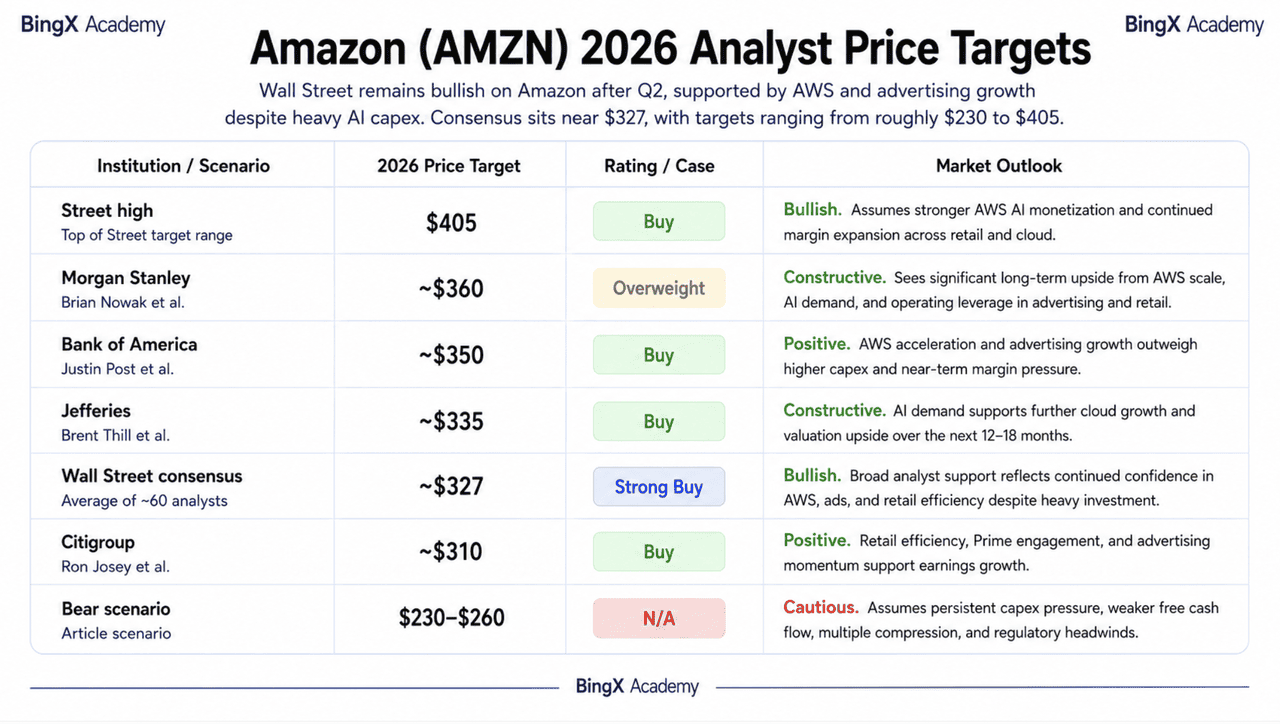
- Analysts remain bullish despite regulatory and spending risks. Consensus sits near $327 across roughly 60 analysts, with a Strong Buy tilt, a Street high near $405, and a low near $230, while antitrust scrutiny remains an additional overhang.
Read More: Amazon (AMZN) Q2 2026 Earnings Overview: 37% AWS Growth Drives a 15.32% Rally
What Is Amazon (AMZN)?
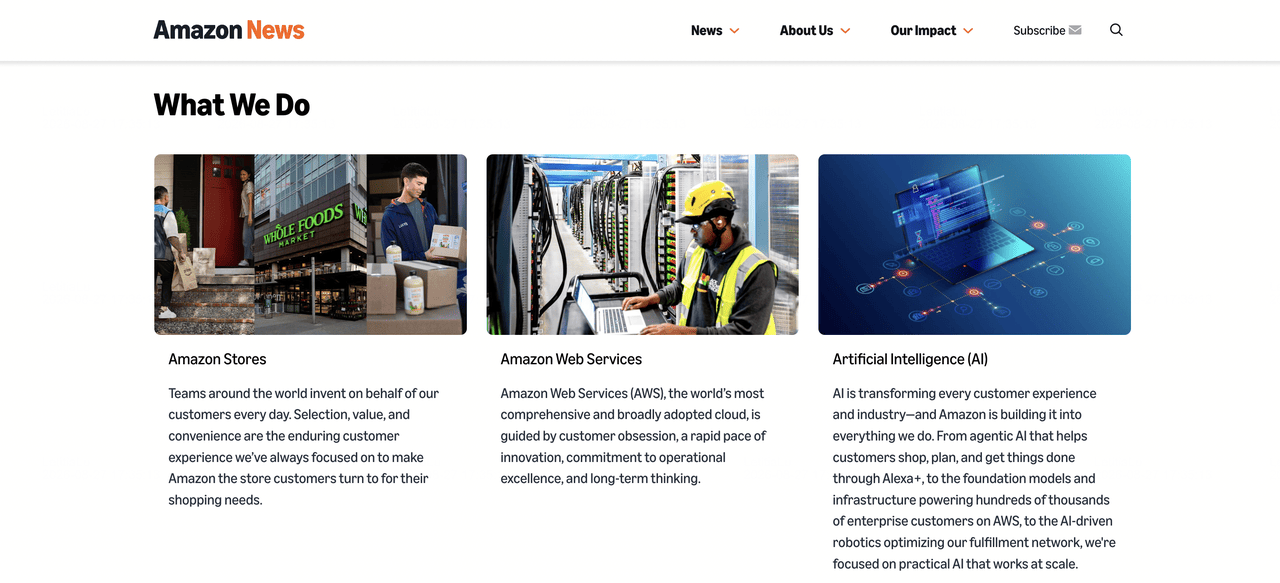
Amazon is a global technology and retail company founded by Jeff Bezos, built around three major businesses: a worldwide e-commerce and logistics network, Amazon Web Services (AWS), and a fast-growing advertising platform. Prime membership, a large fulfillment footprint, and a broad cloud ecosystem reinforce those businesses, while results are driven by retail demand, delivery efficiency, AWS cloud and AI adoption, and advertising monetization across Amazon’s properties.
Amazon is now using that scale to build a stronger position in AI infrastructure. AWS sits at the center of that transition, supported by a massive data-center expansion, custom AI chips such as Trainium, and its investment in Anthropic. The company therefore sits between a mature retail-and-cloud operator and an emerging AI infrastructure platform, with future performance depending on how efficiently record capital spending can translate into higher AWS growth, stronger advertising revenue, and improved returns on invested capital.
Read More: Top AI Cloud Infrastructure Stocks to Buy in 2026 Amid Hyperscaler Capex and the Neocloud Boom
Amazon (AMZN) Q2 2026 Earnings: What Drove the Record and the Capex Debate
- Revenue growth was broad-based across all three segments. Net sales rose 20% to $200.6 billion, with North America up 16% to $116.2 billion and AWS and advertising both accelerating, the primary reason revenue cleared consensus.
- A large Anthropic-related gain lifted GAAP earnings. Diluted EPS of $5.75 was boosted by a non-operating pre-tax gain of roughly $53.4 billion tied to Amazon's Anthropic stake; adjusted EPS of about $1.97 still beat the roughly $1.82 estimate on a comparable basis.
- AWS re-acceleration became the key growth catalyst. AWS grew 37% to a $169 billion annualized run rate, its fastest in 18 quarters, with an AI business past a $25 billion run rate, prompting talk of AWS eventually becoming a $1 trillion revenue business.
- Capex guidance stepped up sharply to about $220 billion. Management raised full-year capital spending to fund AI data-center capacity, a decision that turned trailing free cash flow negative and framed the bull-bear debate.
- Operating income expanded even as spending rose. Operating income increased 43% to $27.5 billion and operating margin widened to roughly 13.7%, showing profitability discipline despite heavy investment.
Read More: Microsoft, Meta, Amazon, and Apple Q2 2026 Earnings: Can AI Spending Still Be Covered by Cash Flow?
Amazon Fiscal Q2 2026 Financial and Consensus Profile: Revenue, AWS and Capex
Amazon's Q2 print showed a company beating on revenue and earnings while committing to a record capex cycle that pressures near-term cash flow. The table separates the one-time Anthropic gain from the underlying operating and strategic developments.
|
Financial Metric |
Guidance / Consensus |
Reported / Actual |
Surprise |
|
Q2 2026 Revenue |
~$196.5 billion consensus |
$200.6 billion |
Beat. Topped consensus by ~$4.4 billion and rose 20% year over year, Amazon's first-ever $200 billion quarter. |
|
Q2 2026 Adjusted EPS |
~$1.82 consensus |
$1.97 |
Beat. Ahead by ~6%, and the first EPS beat after two straight misses. |
|
Q2 2026 GAAP EPS |
n/a |
$5.75 |
Distorted. More than triple the year-ago $1.68, but inflated by a $53.4 billion non-cash Anthropic gain and not recurring. |
|
Q2 2026 AWS Revenue |
~$40.5 billion expected |
$42.2 billion |
Beat. Up 37% year over year, its fastest growth in 18 quarters, reaching a $169 billion run rate. |
|
Q2 2026 AWS Operating Income |
n/a |
$16.6 billion |
Strong. Up 64% year over year at a 39.4% margin, showing AWS is growing profitably. |
|
Q2 2026 Advertising |
n/a |
$19.8 billion |
Strong. Up 26% year over year, led by Sponsored Products, a high-margin non-retail stream. |
|
Q2 2026 Operating Income |
n/a |
$27.5 billion |
Beat. Up 43% year over year as margin widened from 11.4% to 13.7%, so profit outgrew sales. |
|
Q3 2026 Revenue Guidance |
~$204.1 billion consensus |
$197 to $202 billion |
Soft. Below Street, though the release flagged roughly 400 bps of Prime Day timing drag. |
|
2026 Capex Guidance |
~$200 billion prior |
~$220 billion |
Elevated. Raised for AI and AWS, pushing trailing free cash flow to a ~$7.6 billion outflow. |
For context, Amazon reached a $3 trillion market cap for the first time in early August 2026, while founder Jeff Bezos filed to sell about 15 million shares under a pre-scheduled 10b5-1 plan and New Jersey filed an antitrust suit. Together these events shaped sentiment around the quarter.
Amazon (AMZN) 2026 Investment Outlook: $405 Bull Case vs. $260 Bear Case
Amazon's outlook for the rest of 2026 depends on one central question: whether the $220 billion AI infrastructure buildout is a high-return investment that compounds AWS and advertising margins, or a cash-flow drag that weighs on the stock until returns become visible.
The Bull Case: AWS AI and Advertising Push AMZN Toward $405
The bull case centers on Amazon's AWS re-acceleration and its broader move into AI infrastructure. The 37% AWS growth and a $25 billion-plus AI run rate give the company a durable, high-margin revenue engine very different from low-margin retail, while advertising's 26% growth reduces reliance on the core store business. If Amazon can use its data-center buildout as a foundation for continued AI hosting demand, the business could begin to look more like a dominant AI infrastructure platform with retail attached.
A move toward $405 would require Amazon to keep AWS growth elevated, convert capex into rising cloud operating income, and sustain advertising momentum. The strongest confirmation would be evidence that AWS margins hold or expand even as AI mix increases, showing the capex cycle is earning its keep.
The Base Case: Steady Cloud and Retail Progress Keep AMZN Between $300 and $340
The base case assumes AWS and advertising remain the main growth drivers while Amazon absorbs the capex cycle without a major cash-flow scare. AWS advances toward a $1 trillion run-rate narrative over time, retail efficiency improves, and margins hold, but free cash flow stays pressured near term. Under this setup, investors continue to value AMZN as a cloud-and-ads growth compounder with a heavy investment phase.
Under this scenario, AMZN could trade mainly between $300 and $340 as investors wait for clearer evidence that capex is translating into cash flow. Key confirmation points would include AWS margin trends, advertising growth, retail operating income, and the trajectory of free cash flow as spending peaks. A consensus near $327 defines the middle of the range.
The Bear Case: Capex and Cash-Flow Pressure Pull AMZN Toward $260
The bear case assumes the AI buildout consumes cash faster than AWS returns materialize while retail growth normalizes. Negative free cash flow, a $220 billion capex bill, and slower store growth could pressure the stock before AI revenue scales enough to offset the spend. The long-term AI thesis could still remain intact, but the market may be unwilling to pay a premium until free cash flow recovers and antitrust risk clears.
A move toward $260 would become more likely if AWS growth stalls, capex rises further, retail margins compress, or regulatory pressure escalates. In that scenario, the long-term AI opportunity could remain intact, but near-term cash-flow and valuation concerns would dominate the stock. The low analyst target sits near $230.
Amazon (AMZN) Stock Price Forecasts for 2026 by Wall Street Analysts
Wall Street remains broadly bullish on Amazon after Q2, with AWS re-acceleration and advertising growth supporting the upside case despite heavy AI capex and weaker free cash flow. Analyst targets span roughly $230 to $405, with consensus near $327 across about 60 analysts. The lower-end scenario reflects capex, valuation, and regulatory risks rather than a collapse in the core growth thesis.
|
Institution / Scenario |
2026 Price Target |
Rating |
Market Outlook |
|
Street high |
$405 |
Buy |
Bullish. Assumes stronger AWS AI monetization and continued margin expansion. |
|
Morgan Stanley |
~$360 |
Overweight |
Constructive. Sees significant long-term upside from AWS scale and AI demand. |
|
Bank of America |
~$350 |
Buy |
Positive. AWS acceleration and advertising growth outweigh higher capex. |
|
Jefferies |
~$335 |
Buy |
Constructive. AI demand supports further cloud growth and valuation upside. |
|
Wall Street consensus |
~$327 |
Strong Buy |
Bullish. Broad analyst support reflects continued confidence in AWS, ads, and retail efficiency. |
|
Citigroup |
~$310 |
Buy |
Positive. Retail efficiency and advertising momentum support earnings growth. |
|
Bear scenario |
$230–$260 |
- |
Cautious. Assumes persistent capex pressure, weaker free cash flow, and regulatory ri |
How to Trade Amazon (AMZN) Stock on BingX
Navigate the volatility of Amazon's earnings and AI-capex cycle using BingX TradFi and BingX AI tools. By leveraging AI-driven predictive analytics, you can better anticipate market sentiment shifts and price action around AWS growth, capex updates, and advertising results.
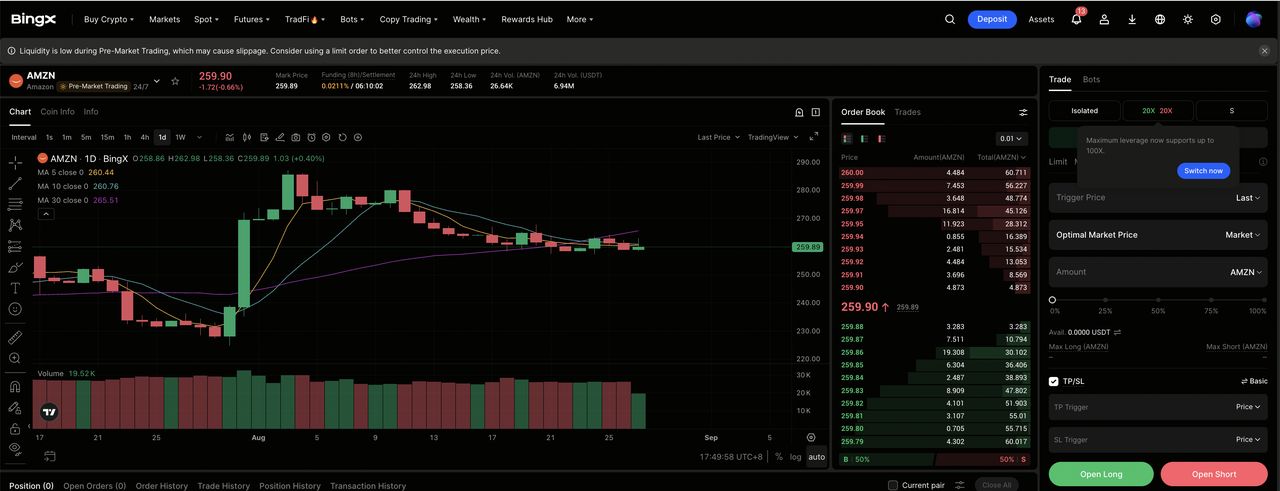
Step 1: Access BingX TradFi. Sign up and navigate to the specialized TradFi section. Complete KYC if required in your region and enable two-factor authentication before funding an account.
Step 2: Select Amazon (AMZN). Deposit USDT, then search for and select the AMZN-USDT perpetual futures contract.
Step 3: Choose your direction. Select Open Long if you expect AWS growth to stay elevated, AI capex to convert into cloud margin, and advertising to keep accelerating. Select Open Short if you expect capex to pressure free cash flow, retail growth to slow, or regulatory risk to escalate.
Step 4: Select leverage and margin mode. Choose Isolated or Cross-Margin based on your risk tolerance. Because AMZN can move sharply on AWS growth and capex headlines, conservative leverage and clear position sizing are important.
Step 5: Execute strict risk protocols. Set Take-Profit and Stop-Loss (TP/SL) levels before or immediately after entering. AMZN can react quickly to quarterly earnings, AWS growth rates, capex revisions, and antitrust developments.
Top 5 Risks to Watch for AMZN Investors in 2026
Amazon’s AWS and advertising growth support the upside case, but record AI spending raises the bar for execution and future returns.
- AI capex has climbed to roughly $220 billion. Amazon is investing aggressively in data centers, chips, and AI infrastructure, increasing pressure on AWS to generate enough growth and returns to justify the spending.
- Free cash flow has turned negative. Trailing free cash flow of roughly negative $7.6 billion marks a sharp reversal and puts more focus on how quickly heavy infrastructure investment can translate into cash generation.
- AWS needs to sustain strong growth. Growth near 37% is a major part of the current investment case, but maintaining that pace will depend on continued enterprise AI demand and successful capacity expansion.
- Investment gains can distort headline earnings. Large gains tied to investments such as Anthropic can lift GAAP EPS, making underlying operating performance harder to compare from one quarter to the next.
- Regulatory pressure remains an overhang. Antitrust actions in the U.S. and other markets could increase legal costs, limit business practices, or weigh on valuation even if operating growth remains strong.
Final Thoughts: Should You Invest in Amazon in 2026?
Amazon enters the rest of 2026 as a retail-and-cloud giant reinventing itself as an AI infrastructure leader. A $200.6 billion quarter, 37% AWS growth, 26% advertising growth, and a first-ever $3 trillion market cap are not in dispute. What is in dispute is the $220 billion capex bill and negative free cash flow, which give the company a clearer path only if AWS returns show up. With a "Strong Buy" analyst tilt, the key question is whether Amazon can execute the AI buildout without a prolonged cash-flow drag.
The bull case is that AWS AI monetization and advertising expand margins fast enough to justify record spending. The bear case is that capex outruns returns while retail normalizes and regulatory risk builds. The main confirmation points to watch are AWS growth and margins, advertising trends, the capex trajectory, and evidence that free cash flow is recovering.
Risk Reminder: Investing in AMZN carries a high risk of capital loss. Amazon remains exposed to AI capex intensity, free-cash-flow swings, AWS competition, antitrust scrutiny, and a valuation that amplifies any disappointment. Investors should conduct independent research and assess their own risk tolerance before trading.
Related Reading
- What Is Anthropic Pre-IPO and How to Trade It on BingX?
- Top AI Data Center Stocks to Buy in 2026: Cloud, Servers, and AI Compute Infrastructure
- Top AI Cloud Infrastructure Stocks to Buy in 2026 Amid Hyperscaler Capex and the Neocloud Boom
- Top AI Compute and GPU Stocks to Buy in 2026: The Shift to Inference and Custom Silicon
- Top 10 AI Infrastructure Stocks to Buy in 2026: Chip Manufacturing and Design Leaders
- Top 10 AI Hardware Stocks to Watch in 2026: The Architecture Driving Next-Gen Intelligence
