
Google has been one of the world’s most influential technology companies since its IPO in 2004, and by 2025 it has become the fourth-largest company in the world by market capitalization. Bloomberg’s latest market cap rankings place Alphabet (GOOGL) just behind Nvidia (NVDA), Microsoft (MSFT), and Apple (AAPL). Its scale is built on long-standing dominance across search, YouTube, Android, and cloud computing, and its momentum has accelerated with the rollout of Gemini 3.0. The new model powers upgraded AI experiences across Search, Workspace, and Android, reinforcing Google’s shift toward an AI-first product ecosystem.
As Alphabet expands its investment in infrastructure, TPUs, and AI-driven services, Google continues to play a central role in the global technology landscape. Interest in Alphabet’s stock remains strong in 2025, both in its traditional form (GOOGL) and through newer tokenized formats such as GOOGLon and GOOGLx, which offer additional flexibility for investors seeking exposure to Google’s growth.
What Is Google and What Does Google Do?
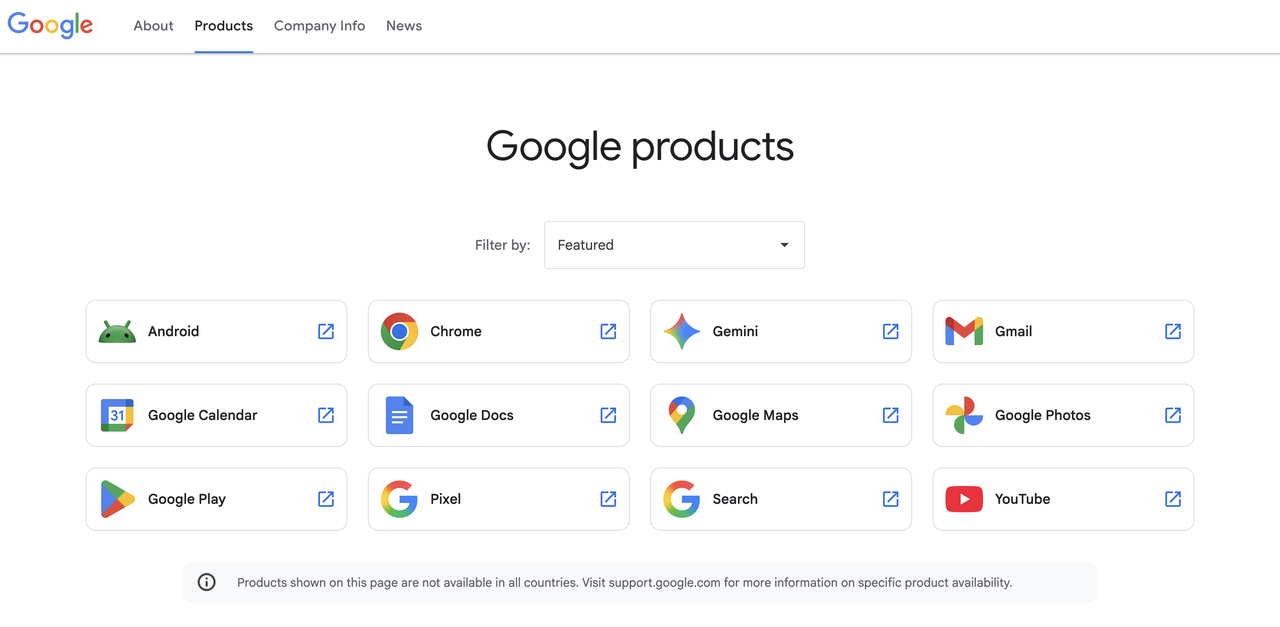
Google is the core subsidiary of Alphabet Inc. and has expanded far beyond search to become one of the world’s largest technology ecosystems. Its work spans software, advertising, mobile platforms, cloud computing, hardware, and advanced artificial intelligence. The company’s mission to organize information has evolved into building products and infrastructure that shape how billions of users interact with technology every day.
1. Google’s consumer and advertising product line remains its largest business segment. This includes Google Search, the world’s most widely used search engine; YouTube, a global leader in video content and digital advertising; and Android, the most widely adopted mobile operating system worldwide. Together, these platforms anchor Google’s advertising revenue and define its global reach.
2. Google’s enterprise and infrastructure product line supports businesses, developers, and organizations worldwide. This segment includes Google Cloud, which provides cloud computing, data analytics, and AI infrastructure; Google Workspace, the productivity suite that includes Gmail, Docs, Sheets, and Drive; and the company’s Pixel and Nest hardware lines, which integrate AI features across smartphones and smart home devices. It also includes Google Research and DeepMind, which advance foundational technologies used across the company’s broader product ecosystem.
3. Google’s AI product line is becoming increasingly central to its long-term strategy.
• Gemini 3.0, Google’s latest multimodal AI model used across Search, Workspace, and Android
• Gemini Advanced and Gemini for Enterprise, subscription AI services for individuals and organizations
• AI agents and developer tools that integrate with Google Cloud, Workspace, and mobile platforms
• DeepMind’s applied AI systems, which power optimization, safety research, and emerging agent capabilities
Although Google does not report AI as a standalone revenue category, AI drives a growing share of Cloud and product usage, and many new features across Google’s ecosystem are built directly on Gemini-based models.
Google vs. Nvidia vs. OpenAI: Who Is Winning the AI Race in 2025?
The AI race in 2025 is not defined by a single frontrunner but by three companies pushing the field forward from different angles. Google shapes how AI reaches billions of users, Nvidia supplies the compute that trains most modern models, and OpenAI drives rapid progress in model development. Their roles intersect, yet each leads in a different part of the landscape.
Overall: Google’s Integrated Ecosystem Gives It a Strategic Advantage
Google’s strength in 2025 comes from a tightly connected AI stack. Google DeepMind builds the models, Alphabet operates TPU-powered data centers, and the company deploys AI across Search, YouTube, Android, Workspace, and Cloud. This alignment allows Google to update its entire ecosystem through a single model platform.
Nvidia leads AI compute with its GPUs but does not operate consumer-scale AI products. OpenAI moves quickly in model development but depends on external cloud and hardware. Microsoft drives enterprise AI through Azure yet lacks full control of the model stack and mobile distribution. Google remains the only company combining in-house model research, proprietary hardware, and immediate access to billions of users.
Model Comparison: Google Prioritizes Ecosystem Integration While AI Labs Compete Freely
Gemini 3.0 powers Google’s major products, from Search and Workspace to Android and Pixel. Instead of racing for benchmark wins, Google focuses on embedding Gemini into daily workflows, which gives the model broad, stable usage even if it is not the top performer in every test.
Other leading models in the AI competition
• Gemini 3.0 (Google) optimized for multimodal reasoning and integrated product experiences.
• Claude (Anthropic) strong in structured reasoning and safety-aligned enterprise tasks.
• Perplexity Model (Perplexity AI) designed for retrieval accuracy and search-style answers.
• DeepSeek V3.1 (DeepSeek Labs) effective in technical reasoning and certain trading simulations.
• GPT-5 Series (OpenAI) widely used through ChatGPT, APIs, and agent workflows.
• Grok-4 (xAI) built for real-time data access and fast iteration.
One interesting episode came from the Alpha Arena experiment on Perp Dex Hyperliquid, where each model received ten thousand dollars to trade crypto perpetuals. After seventy-two hours, DeepSeek V3.1 and Grok-4 posted gains above fourteen percent, while GPT-5 and Gemini 2.5 Pro recorded losses. The results reflect performance within that specific setup and should not be viewed as a general ranking of model capability.
Despite intensive competition among model labs, Google’s strength remains its ability to deploy Gemini across products used daily by billions.
Hardware Comparison: Nvidia Leads Compute While Google Optimizes Internal Scale
Google trains and serves Gemini using Tensor Processing Units (TPUs), designed for efficient large-scale workloads across its own infrastructure. TPUs give Google control over cost and performance, though they are not widely used outside the company.
How hardware strategies differ
• Nvidia remains the industry leader in AI hardware, powering most global model training and inference.
• Google uses TPUs primarily within its own cloud and model pipeline, giving internal efficiency but limited market presence.
• OpenAI depends on Nvidia hardware through Microsoft Azure and does not operate its own chips.
Nvidia dominates the global compute layer, while Google focuses on running its internal AI stack efficiently.
Emerging Battlegrounds: Cloud Storage and Energy
As AI models scale, storage throughput and data movement have become major constraints. Google links TPU training systems directly with its storage layer, while AWS and Azure rely on global data networks to handle increasingly large datasets. Decentralized storage platforms such as Filecoin and Arweave also provide distributed capacity for non-real-time data, adding another option to the storage stack.
Energy and cooling now determine how fast AI clusters can grow. Google is investing in renewable power, liquid-cooled TPU facilities, and exploring nuclear-backed baseload sources to support long-term expansion. Nvidia continues improving GPU efficiency, while OpenAI relies on Microsoft’s growing data-center footprint, which also includes interest in nuclear-powered infrastructure. These factors increasingly shape the pace at which each company can scale next-generation AI systems.
Read More: xU3O8 Explained: How to Buy Tokenized Uranium as Nuclear Stocks Strengthen (2025)
How to Invest in Google Stocks: A Step-by-Step Guide in 3 Different Ways
Investors can gain exposure to Google through regulated stock markets or crypto-native products on BingX. Below are three clear paths depending on your preference for access, flexibility, or trading tools.
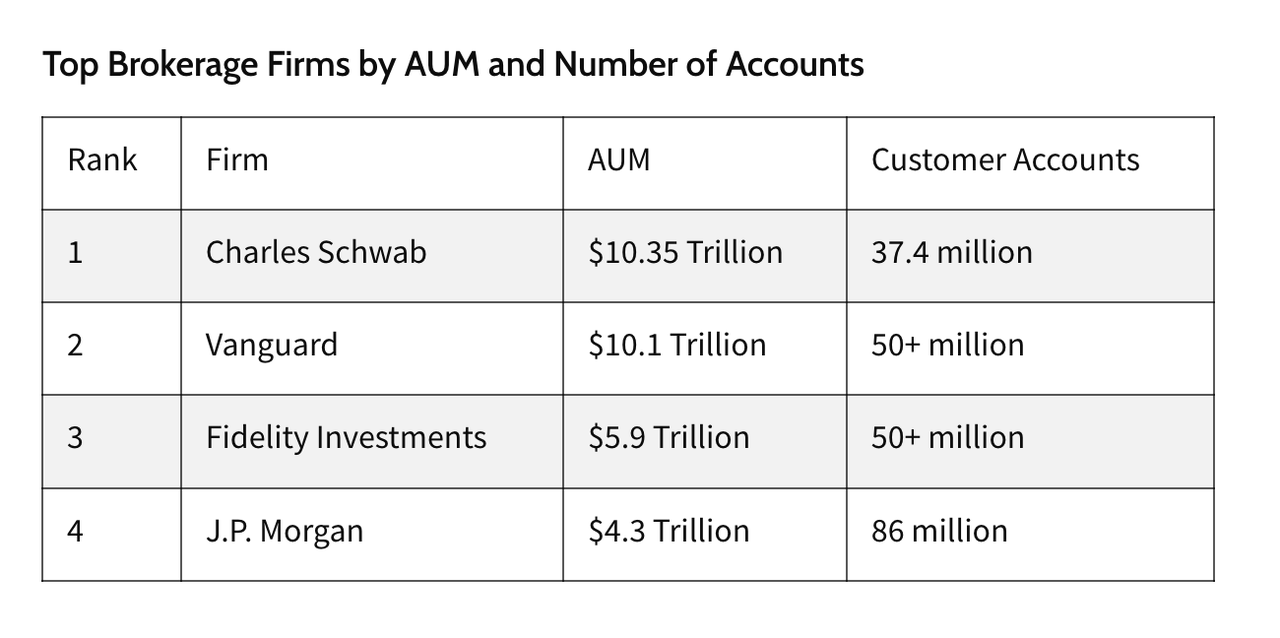
1. Buy Alphabet Shares (GOOGL / GOOG) on a Brokerage Platform
Source: Investopedia
If you want direct exposure through traditional equity markets and full shareholder rights, you can buy Alphabet stock on any brokerage that supports U.S. listings.
Step 1: Choose a brokerage: Select a regulated platform that supports Nasdaq trading, offers transparent fees, USD funding options, and provides tools such as charts, research, and mobile access.
Step 2: Verify your account: Complete registration by providing personal information, uploading identification, passing KYC checks, and submitting required tax forms such as W-8BEN for non-U.S. investors.
Step 3: Fund your account: Deposit USD through bank transfer or supported payment methods. If depositing in local currency, convert funds within the platform and review any fees, processing times, or minimum deposit amounts.
Step 4: Buy GOOGL or GOOG: Search for Alphabet’s Class A (GOOGL) or Class C (GOOG) shares, review charts and pricing, choose a market or limit order, enter the amount, and confirm your purchase.
2. Buy Tokenized Google Stock (GOOGLon) on BingX
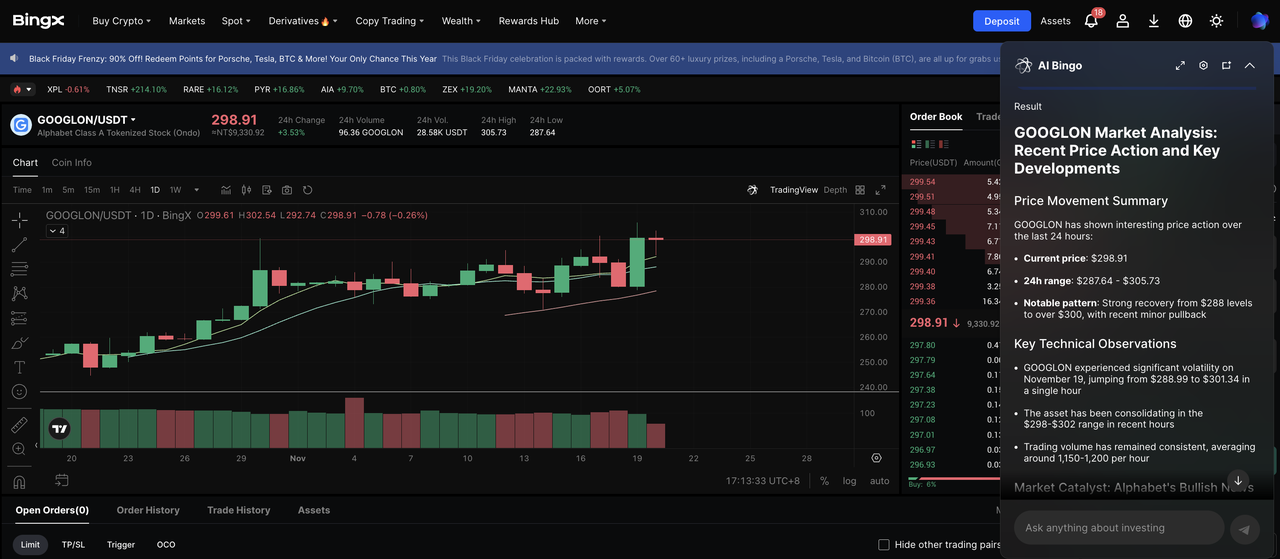
Source: BingX Tokenized Google Stock GOOGLon Price
If you prefer 24/7 access, fractional shares and a crypto-native experience, you can buy GOOGLon directly on BingX Spot.
Step 1: Create and secure your BingX account: Register, complete KYC and enable security features such as two-factor authentication to protect your account.
Step 2: Deposit USDT or supported assets: Transfer stablecoins to your BingX wallet, confirm the correct network and check any deposit fees or minimums.
Step 3: Search for GOOGLon in Spot Trading: Open the GOOGLON/USDT or GOOGLX/USDT pair to review real-time price, order depth and recent trading activity.
Step 4: Use BingX AI to interpret market conditions: Ask BingX AI about price trends, key support levels or recent market movements before placing your order.
Step 5: Place your buy order: Choose between a market or limit order, enter your purchase amount and confirm the transaction.
3. Trade Google Tokenized Stock Futures on BingX
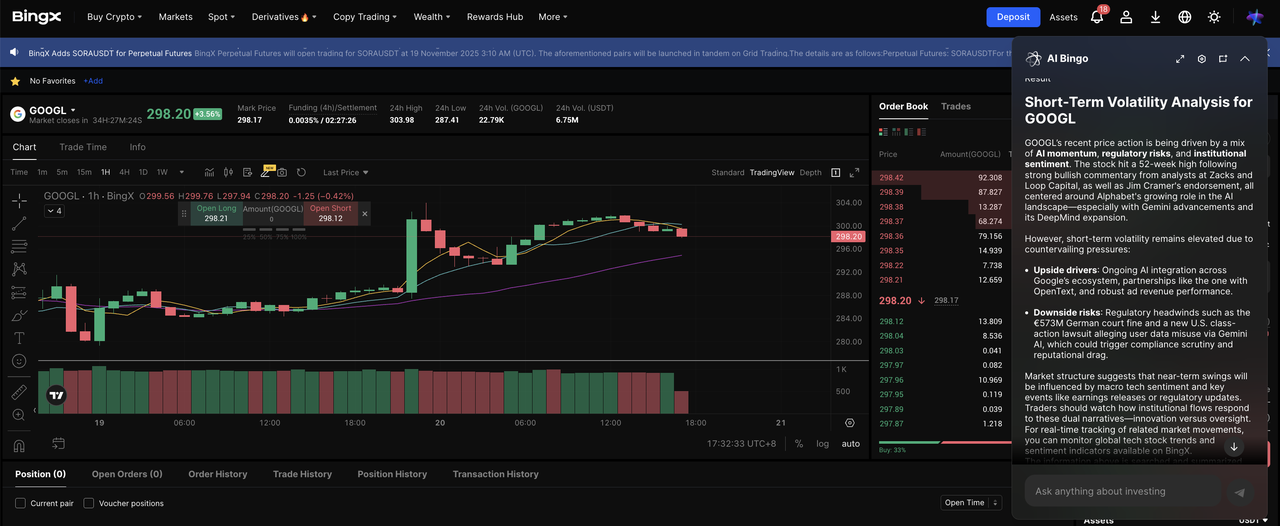
Source: BingX Tokenized Google Stock GOOGLon Futures
If you want leverage, directional exposure or hedging strategies, Google Tokenized Stock Futures on BingX Futures offer a flexible way to trade Google’s price movements without holding the underlying token.
Step 1: Enable futures trading: Open your BingX account, complete KYC and transfer USDT or supported collateral to your Futures wallet.
Step 2: Open the Google Tokenized Stock Futures market: Search for the GOOGL perpetual contract and review leverage options, funding rates and margin requirements.
Step 3: Use BingX AI to check market conditions: Ask BingX AI about volatility, key levels or recent sentiment shifts to better understand potential entry points.
Step 4: Choose long or short with your preferred leverage: Go long if you expect Google’s price to rise or short if you expect it to fall, adjusting leverage based on your risk tolerance.
Step 5: Execute and manage your trade: Place your order, set take-profit and stop-loss levels and monitor funding rates, margin levels and overall market volatility.
What Is Google Tokenized Stock and How Does It Work?
Google tokenized stock is a blockchain-based representation of Alphabet Class A (GOOGL) shares, issued by different providers such as xStocks, Ondo, and Zipmex. These tokens give users economic exposure to Google’s stock price without using a traditional brokerage account. They offer fractional access, global availability, and weekday 24-hour trading on supported platforms, making Google exposure more accessible to non-U.S. investors and crypto-native users.
Read More: Ondo Global Markets Unlocks 100+ Tokenized U.S. Stocks on Ethereum - All You Need to Know
How Google Tokenized Stock Works
1. Price Tracking: Google tokenized stocks are designed to follow the live price of Alphabet Class A shares on Nasdaq, updating in real time with Google’s official market movements.
2. Backing Method (Varies by Supplier): Different issuers use different mechanisms to keep their Google token aligned with the real GOOGL price, which is why tickers differ across platforms such as GOOGLon, GOOGLx, or GOOGL2-USD.
• xStocks: Uses custodial backing by holding underlying shares or equivalent financial instruments.
• Ondo: Provides economic exposure through custodial or synthetic structures depending on platform and jurisdiction.
• Zipmex: Tracks Google’s price using derivatives such as GOOGL2-USD, a synthetic futures-style product rather than a token backed by real shares.
3. Trading Structure: Google tokenized stocks trade like crypto assets, can be purchased with stablecoins, transferred between compatible wallets, and accessed outside standard U.S. market hours. Liquidity is provided by the exchange, not Nasdaq.
4. No Shareholder Rights: Token holders receive economic exposure only. They do not gain voting rights, legal ownership, or direct dividends, which may instead be reflected through synthetic price adjustments.
Why Investors Use Google Tokenized Stock
• Allows fractional access with smaller minimum purchases
• Provides global access for users without a U.S. brokerage account
• Fits naturally into crypto-native portfolios alongside stablecoins
• Supports weekday 24-hour trading rather than fixed U.S. market hours
• Can be paired with Google tokenized stock futures for leverage or hedging
Risk and Considerations Before Investing in Google Tokenized Stock
GOOGLon offers flexible exposure to Google’s price movement, but tokenized stocks carry risks that differ from traditional equities.
1. Regulatory Uncertainty: Tokenized stocks operate in a developing legal landscape, and changes in regional rules may affect access, investor protections, or long-term availability.
2. Backing and Custody Risk: Investors should verify whether GOOGLon is backed by custodial shares or synthetic exposure and understand how assets are safeguarded and how corporate actions are handled.
3. Platform and Liquidity Risk: Liquidity depends on the crypto exchange rather than Nasdaq, which can lead to wider spreads, execution risk, or issues during outages or delistings.
4. No Shareholder Rights: GOOGLon provides economic exposure only, without voting rights, and dividends may not be distributed directly.
5. Tracking Variation: Premiums or discounts may occur due to liquidity differences or synthetic modeling, creating short-term deviations from Alphabet’s stock price.
6. Smart Contract and Wallet Exposure: On-chain assets carry risks related to contract security, network congestion, and personal wallet management.
Final Thoughts
Google’s leadership in AI, cloud infrastructure, and global consumer products continues to drive long-term investor interest. Whether accessed through traditional Alphabet shares or through tokenized formats like GOOGLon, the underlying investment thesis remains centered on Google’s scale, innovation, and steadily expanding ecosystem.
Tokenized stocks offer new flexibility by enabling global users to gain exposure to Google’s price performance with smaller minimums and extended trading hours. At the same time, they come with considerations around custody, regulation, and liquidity that differ from traditional stock ownership. Investors should understand these structural differences before choosing the format that suits their needs.
For those who prefer regulated markets, buying Alphabet shares through a brokerage provides full shareholder rights and direct equity ownership. For others seeking easier access or a crypto-native approach, tokenized exposure can offer a more flexible alternative. Ultimately, the right choice depends on an investor’s goals, jurisdiction, and risk tolerance.