

In April 2026, the Invesco QQQ Trust (QQQ) remains the undisputed titan of growth investing, commanding over $370 billion in assets despite a historic shift in the ETF landscape. While the fund has returned an average of 18.3% annually over the last 15 years, it currently faces a dual-threat environment: a massive AI infrastructure build-out meeting a risk-off wall triggered by Operation Epic Fury in the Middle East.
As the Nasdaq-100 index attempts to recover from an 8% pullback in March, a pivotal debate has emerged: Is the current 21x forward P/E for tech a prime buy-the-dip opportunity, or is the market ignoring the risk of CapEx Fatigue among the Magnificent Seven?
This guide breaks down the QQQ price prediction for 2026 using data from FactSet, TipRanks, and Invesco, and how to trade QQQ ETF futures with Tether (USDT) on BingX TradFi.
Top 5 Things for QQQ Investors to Know in 2026
As the Agentic Web and global energy shocks redefine the tech sector, QQQ investors must monitor these five factors:
- The End of the Monopoly: In April 2026, BlackRock and State Street officially filed for their own Nasdaq-100 ETFs, ending Invesco’s decades-long exclusivity and potentially triggering a fee war.
- AI Earnings vs. Spend: Big Tech capex is projected to exceed $650 billion this year. The market is now demanding a clear Return on Investment (ROI) rather than just AI potential.
- The Epic Fury Macro Tail: The conflict between the U.S.-Israel alliance and Iran has pushed Brent Crude to $118, reigniting stagflation fears that historically weigh on high-multiple tech stocks.
- Concentration at the Top: The Big Three, Nvidia (8.8%), Apple (7.3%), and Microsoft (5.5%), now control nearly 22% of the fund, making QQQ a direct bet on the semiconductor and cloud software cycle.
- Fed Pivot Potential: With the Fed Funds rate at 3.75% as of April 2026, markets are pricing in two additional cuts by year-end, which could act as a mechanical tailwind for growth valuations.
What Is the Invesco QQQ Trust (QQQ) ETF?
The Invesco QQQ Trust (QQQ) is one of the world's most liquid ETFs, tracking the Nasdaq-100 Index. It holds the 100 largest non-financial companies listed on the Nasdaq, creating a structural tilt toward Information Technology (60%), Consumer Discretionary (21%), and Healthcare (5%).
In 2026, the fund's composition has evolved to mirror the AI Value Chain, from silicon stocks like Nvidia and Marvell to infrastructure companies like Microsoft and Amazon and consumer applications' stocks like Meta and Apple. With a lean 0.18% expense ratio, it remains the primary vehicle for institutional and retail long-tech exposure.
Read more: How to Buy Invesco QQQ Tokenized ETF in 2026: A Guide for Beginners
A Review of QQQ's Performance in 2025: The Year of the AI Multiplier
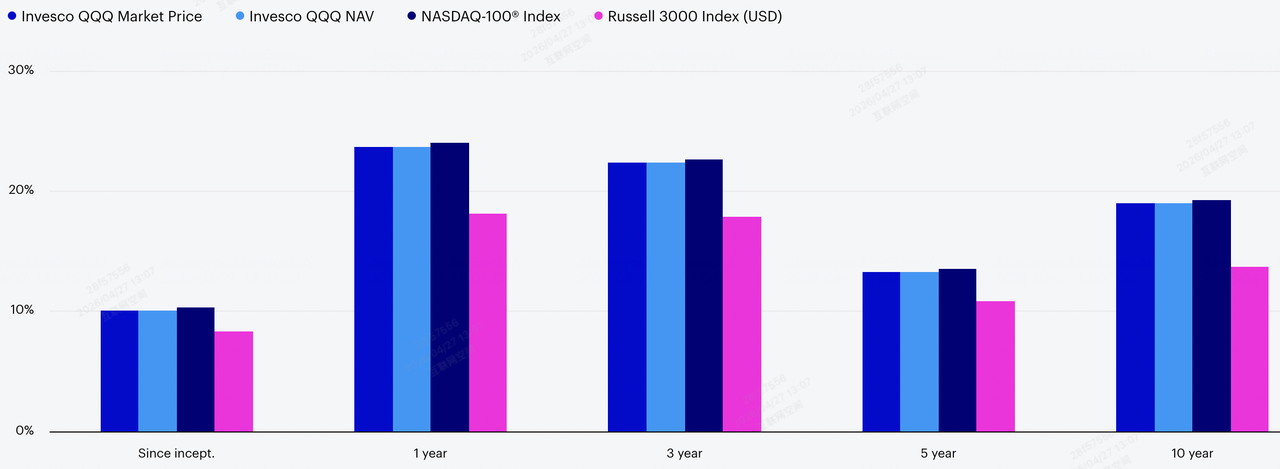
Annualized returns of QQQ vs. Nasdaq 100 and Russell 3000 | Source: Invesco
In 2025, QQQ solidified its status as the premier vehicle for the AI Multiplier Effect, delivering a robust annual total return exceeding 25%. This performance was anchored by the aggressive revenue growth of mega-cap holdings like Nvidia and Microsoft, which benefited from the massive transition from model training to inference at scale. While the broader S&P 500 posted healthy gains, QQQ’s concentrated exposure to the Information Technology sector allowed it to outperform broad-market benchmarks for the third consecutive year, despite early-year volatility and a high-interest-rate environment.
Beyond the headline returns, 2025 was defined by a strategic shift in the fund’s internal architecture. A significant portfolio reconstitution in late 2025 saw the inclusion of high-growth enablers like Monolithic Power Systems, while stagnating legacy firms like Biogen were removed. This survival of the fastest rebalancing ensured that QQQ entered 2026 with a lean, high-velocity mix of stocks optimized for the $5 trillion cumulative AI spend projected through the end of the decade. For BingX traders, 2025 proved that QQQ’s high valuation was not a bubble but a reflection of the unmatched cash-flow generation within the Nasdaq-100.
A Review of the Overall Tech Sector's Performance in 2025
In 2025, the Nasdaq-100 surged as Nvidia crossed the $3 trillion market cap threshold and corporate earnings for the tech sector grew by 36%. However, the rally cooled in early 2026 as geopolitical instability and the Liberation Day tariff corrections introduced new volatility. By March 2026, QQQ broke a four-month losing streak, finding a technical floor despite massive net outflows of $5.05 billion during the month.
QQQ 2026 Investment Outlook: $870 Bull Run vs. $530 Bear Case
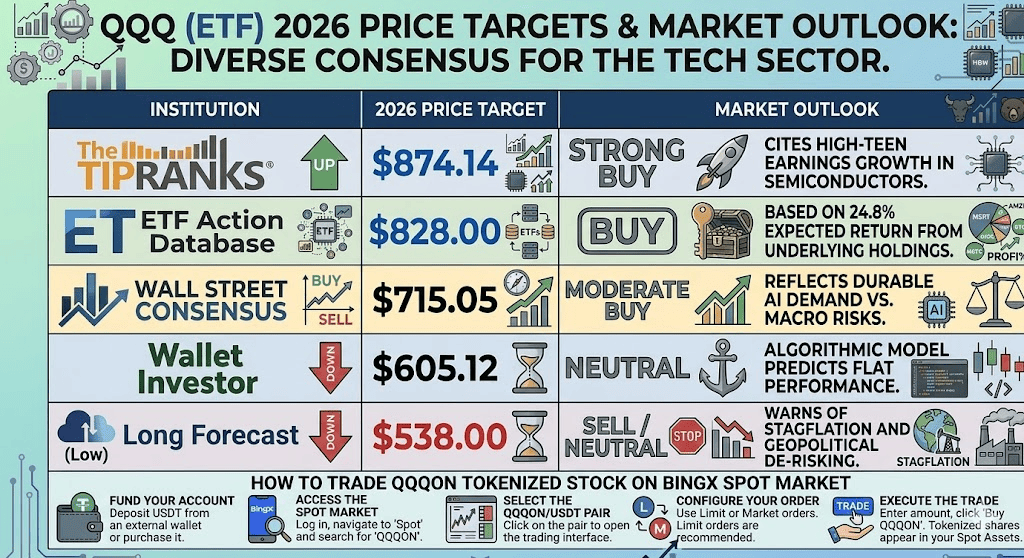
QQQ ETF price prediction 2026 by various Wall Street analysts
Navigate the high-stakes volatility of the 2026 tech cycle by weighing these three probability-weighted scenarios for the QQQ ETF through the remainder of the year.
The Bull Case: The $874 AI Integration Breakout
The bullish narrative for QQQ hinges on the transition from AI experimentation to Realized AI Productivity. In this scenario, mega-cap holdings transcend hardware sales to deliver high-margin software revenue. Key catalysts include Palantir’s expansion as a U.S. DoD program of record and Marvell Technology’s accelerated custom-ASIC growth, backed by Nvidia’s $2 billion strategic investment. If tech sector earnings growth hits the projected 36% for 2026, the ETF is positioned to decisively clear the $700 psychological barrier toward the high-end analyst target of $874.
From a macro perspective, this 'Goldilocks' outcome assumes a successful soft landing where cooling labor data allows the Federal Reserve to implement at least two 25-basis-point rate cuts. Lower discount rates would mechanically support the fund's high forward P/E multiples, currently averaging around 21x. Traders should watch for a sustained breakout above the R1 pivot of $627 as a signal that institutional risk-on flows are returning to the Nasdaq-100, potentially fueling a massive year-end rally driven by compounding AI gains.
The Base Case: The $680 – $720 Range-Bound Grind
The base case envisions QQQ entering a healthy distribution phase as the market digests its massive 2025 gains. While fundamental earnings remain robust, they are balanced by Higher for Longer interest rate pressures and geopolitical friction in the Middle East. In this environment, Wall Street’s weighted average price target of $715.05 acts as a magnetic north. Investors should expect a stock-picker's market within the ETF, where gains in semiconductor leaders like Nvidia are partially offset by rotations into value-tech or consumer discretionary names as traders manage sector-specific concentration.
Practically, this scenario assumes Brent Crude stays volatile near $100, keeping the VIX elevated around the 20–22 level. QQQ will likely oscillate between the 50-day SMA at $606 and the recent all-time highs of $664. For BingX users, this provides a prime environment for range-bound strategies, such as grid trading or selling premium, as the index awaits a clear macroeconomic signal. Stability is supported by the 44.5% institutional ownership floor, which prevents deep drawdowns despite the lack of a fresh vertical breakout.
The Bear Case: The $538 CapEx Fatigue Correction
The bear case is triggered by CapEx Fatigue among hyperscalers like Microsoft, Meta, and Google. If Q3 2026 earnings reports signal that the $650 billion in AI infrastructure spending is failing to yield adequate margin expansion, the market may initiate a severe valuation reset. This risk is amplified if the U.S.-Iran conflict and Operation Epic Fury escalates, driving domestic gas prices above $4.00/gallon and crippling the Consumer Discretionary sector, which makes up 21% of the fund's weight.
Technically, a decisive break below the 200-day SMA ($612) would act as a catastrophic trigger for systematic trend-following programs. Such a breach would likely accelerate selling toward the S1 support zone near $590, with a ultimate floor at the low-end analyst projection of $538. In this hard landing environment, the 0% exposure to defensive financial stocks, historically a strength, becomes a liability, as QQQ lacks the structural hedges to weather a broad-based flight to quality and value sectors.
QQQ Analyst Forecasts and Price Targets for 2026
|
Institution |
2026 Price Target (QQQ) |
Market Outlook |
|
TipRanks (High) |
$874.14 |
Strong Buy: Cites high-teen earnings growth in semiconductors. |
|
ETF Action Database |
$828.00 |
Buy: Based on 24.8% expected return from underlying holdings. |
|
Wall Street Consensus |
$715.05 |
Moderate Buy: Reflects durable AI demand vs. macro risks. |
|
Wallet Investor |
$605.12 |
Neutral: Algorithmic model predicts flat performance. |
|
Long Forecast (Low) |
$538.00 |
Sell/Neutral: Warns of stagflation and geopolitical de-risking. |
How to Trade Invesco QQQ Trust (QQQ) ETF on BingX
Maximize your precision in the technology market by leveraging BingX TradFi and insights from BingX AI to trade the Nasdaq-100 ETF without needing a traditional brokerage account.
Long or Short QQQ Futures on BingX TradFi
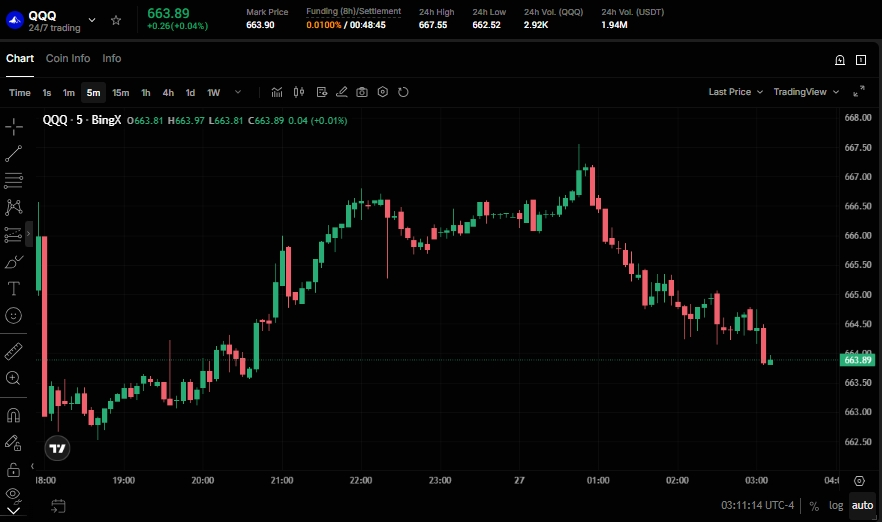
QQQ/USDT perpetual contract on BingX futures market
- Access TradFi: Log in to your BingX account and navigate to the TradFi section.
- Locate QQQ: Search for the QQQ/USDT perpetual contract or trade direct AI stocks like NVDA, MSFT, and PLTR.
- Configure Leverage: QQQ is a high-beta asset; use appropriate leverage, e.g., 2x–5x, to manage volatility.
- Analyze Technicals: Watch the 200-day SMA as major support and the R1 Pivot as immediate resistance.
- Execute and Protect: Use Stop-Loss (SL) orders to protect against sudden geopolitical headlines.
Buy, Sell, or HODL Ondo's QQQ Tokenized ETF (QQQON) on BingX Spot Market
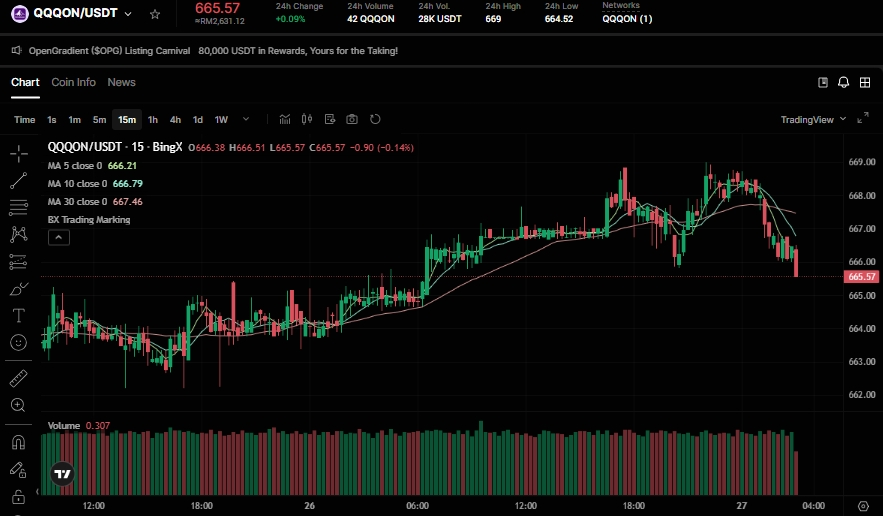
QQQON/USDT trading pair on BingX spot market
- Fund Your Account: Ensure you have USDT in your BingX Fund Account. You can deposit USDT from an external wallet or purchase it via the Buy Crypto gateway using a credit card or P2P trading.
- Access the Spot Market: Log in to the BingX website or app, navigate to the Spot tab, and search for the ticker QQQON in the market search bar.
- Select the QQQON/USDT Pair: Click on the QQQON/USDT trading pair to open the live price chart and order book interface.
- Configure Your Order:
- Limit Order: Set a specific price at which you want to buy (recommended during high volatility).
- Market Order: Execute the trade immediately at the current best available market price.
- Limit Order: Set a specific price at which you want to buy (recommended during high volatility).
- Execute the Trade: Enter the amount of USDT you wish to spend or the number of QQQON units you want to buy. Click Buy QQQON to complete the transaction. Your tokenized shares will now be visible in your Spot Assets.
Top 5 Risks to Watch for QQQ ETF Investors in 2026
As the tech sector transitions from a high-growth AI honeymoon to a high-stakes macroeconomic reality, investors must remain vigilant regarding these five structural and geopolitical threats to the QQQ ETF’s 2026 trajectory.
- Energy-Driven Inflation: If crude oil prices remain above $110, the Fed may be forced to hold rates higher for longer, hurting tech valuations.
- Regulatory Scrutiny: Increased focus on AI ethics and monopolistic behavior among the top 10 QQQ holdings.
- The ETF Omen: The launch of new competing Nasdaq-100 ETFs from BlackRock and State Street could lead to short-term outflows from QQQ.
- Software Compression: Potential breakthroughs in AI efficiency that reduce the need for expensive hardware from Nvidia and Micron could dampen the hardware boom.
- Geopolitical Black Swan: Any further escalation of the war in the Middle East beyond Iran and Israel.
Final Thoughts: Should You Invest in Invesco's QQQ ETF in 2026?
At current levels around $663 in April 2026, the Invesco QQQ Trust remains the premier vehicle for capturing the AI-led innovation cycle, yet its proximity to all-time highs requires a disciplined entry strategy. For long-term investors, the fund’s fundamental growth, evidenced by a projected 36% earnings increase in 2026, supports a bullish outlook. However, with the VIX elevated at 25 and geopolitical tensions persisting, the path to the $874 bull target is likely to be defined by sharp, news-driven pullbacks. Practically, this means moving away from FOMO buying at peaks and instead utilizing limit orders near established technical floors.
Conservative traders should prioritize capital preservation by monitoring the 200-day SMA and the $590 support zone as more favorable entry points during market de-risking events. The arrival of competing Nasdaq-100 ETFs from BlackRock and State Street also suggests that liquidity and fee structures are evolving; keeping a portion of capital liquid to take advantage of potential fee wars or sector rotations is a prudent tactical move. Whether you are hedging with shorts or building a long-term core position, the key for 2026 is balancing tech-optimism with the reality of a volatile, high-oil macro environment.
Risk Reminder: Trading thematic and tech-heavy ETFs involves significant sector concentration risk. The Nasdaq-100 is historically volatile and highly sensitive to shifting interest rates and geopolitical escalations. Always utilize stop-losses and ensure that concentrated tech exposure remains within your personalized risk tolerance.
Related Reading
- How to Buy Invesco QQQ Tokenized ETF in 2026: A Guide for Beginners
- Nasdaq 100 (NAS100) Forecast 2026: 27,000 AI Breakthrough or 22,000 Stagflation Trap?
- Roundhill Memory ETF (DRAM) Forecast 2026: $1.5B AI Supercycle or 'RAMmageddon' Trap?
- XOP S&P Oil & Gas ETF Prediction 2026: $210 Geopolitical Moonshot or $130 Hedge Trap?
- Energy Select Sector XLE ETF Prediction 2026: $65 Energy Supercycle or $40 Hormuz Hedge Exit?