
For cryptocurrency investors operating with smaller volumes, converting Ethereum (ETH) to US Dollar (USD) often brings an unpleasant surprise: fees. Between fixed fees, percentages, and hidden spreads, a significant portion of capital can be lost in the process. In a market with dozens of exchanges competing for attention, identifying the most economical platform is not a trivial task.
This guide provides an in-depth comparative analysis of the fee structures of leading exchanges in 2026, determining which one offers the best value for small ETH/USD transactions, with the clarity needed to maximize your returns in the Brazilian market.
Key Takeaways: What You Need to Know Before Converting ETH
- The hidden cost of small transactions: platforms with fixed fees, such as Coinbase, can charge the equivalent of over 6% on low-value transactions (e.g., ~$50), making them economically unviable for small traders.
- Zero-fee direct conversion tools: exchanges offering a 'Convert' function, such as BingX, eliminate direct trading fees, making them the most economical solution available.
- Market standard for spot fees: among the most competitive platforms (BingX, Binance, Bybit, and KuCoin), the standard has settled at 0.10% for entry-level maker and taker orders.
- Security is non-negotiable: beyond fees, platforms that publish Proof of Reserves audits, such as BingX and Kraken, offer an additional layer of trust, a decisive factor in the post-FTX landscape.
Understanding Crypto Conversion Fees: What Do You Really Pay?
Before comparing platforms, it's essential to dissect the different types of fees that apply to an ETH to USD transaction. The total cost rarely boils down to a single advertised percentage; it's a composition of factors that disproportionately penalize small investors.
1. Spot Trading Fees (Maker/Taker)
The most common fee in spot markets. A maker order adds liquidity to the order book and is not executed immediately. It generally has a cost equal to or lower than a taker order. A taker order removes liquidity from the market and is executed instantly, like a market sell. Platforms incentivize the maker/taker model to maintain deep and liquid order books.
2. Direct Conversion Fees and the Hidden Spread
Many platforms offer a 'Convert' tool, which exchanges one asset for another at market price. Even when they advertise 'zero fees,' the real cost is embedded in the spread, the difference between the buy (ask) and sell (bid) price. A wider spread means a higher implicit cost. For small transactions, simplicity can come at the price of a less favorable quote.
3. Fixed Fees: The Biggest Villain for Small Volumes
Fixed fees are charged regardless of the transaction value. A $2.99 fee on a $50 sale represents a loss of almost 6%, while the same fee on $5,000 would be only 0.06%. Platforms aimed at beginner users often adopt this model, making them unsuitable for those operating with reduced capital.
4. Withdrawal Fees
After converting ETH to USD (or to a stablecoin like USDT), there is an additional cost to withdraw funds to a bank account or another wallet. These fees can be fixed amounts or percentages and vary drastically between platforms and blockchain networks, a point often overlooked when comparing exchanges.
Comparison of Fees for Major Exchanges to Convert ETH in 2026
We analyzed the fee structure of the most widely used exchanges globally to determine the real cost of converting small amounts of ETH to USD. The data below reflects the values practiced for entry-level users (low trading volume), which is the reality for most individual investors in Brazil.
| Exchange | Maker Fee | Taker Fee | Direct Converter | Proof of Reserves |
| BingX | 0.10% | 0.10% | Zero fee ✓ | Bi-weekly ✓ |
| Binance | 0.10% | 0.10% | ~0.20% | Monthly ✓ |
| Bybit | 0.10% | 0.10% | Variable spread | Monthly ✓ |
| KuCoin | 0.10% | 0.10% | Variable spread | Monthly ✓ |
| Kraken | 0.16% | 0.26% | Variable spread | Quarterly ✓ |
| Coinbase | Spread + fixed fee | Spread + fixed fee | Not available | Quarterly ✓ |
| Gemini | Up to 1.49% + fee | Up to 1.49% + fee | High spread | Quarterly ✓ |
| OKX | 0.08% | 0.10% | Variable spread | Monthly ✓ |
| Crypto.com | Spread ~0.5-2% | Spread ~0.5-2% | High spread | Monthly ✓ |
Source: Data compiled from official exchange fee pages in March 2026. Fees may vary according to market conditions and user VIP level.
The Disparity of Costs in Practice
The data shows a clear division in the market. Platforms focused on simplicity for the retail market, such as Coinbase and Gemini, charge prohibitive fees for small transactions. In a scenario of selling 0.05 ETH (~$113), costs on these platforms can easily exceed $3.50, representing over 3% of the value. Convenience comes at a high price.
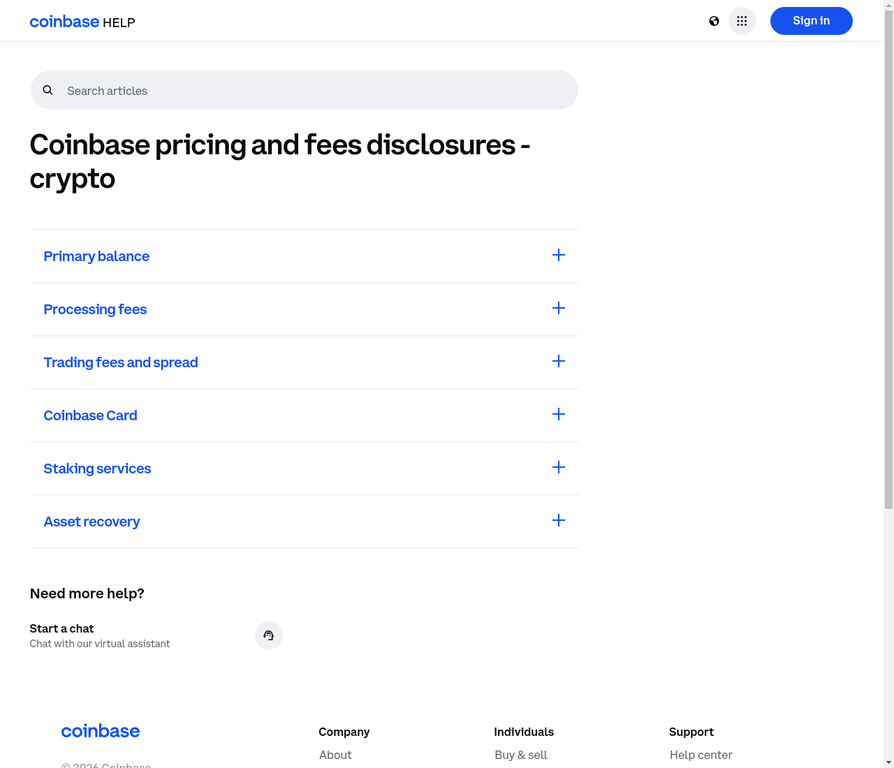
Source: Coinbase
Coinbase's fee structure, although not detailed in a simple table, involves a combination of spread and fixed fees that make it expensive for small amounts.
On the other hand, exchanges focused on active traders, such as Binance, Bybit, and KuCoin, have converged to a 0.10% standard for spot fees. This is a low and competitive value. Kraken, known for its robust security, positions itself with slightly higher fees, at 0.26% for low-volume takers, a premium paid for its established reputation.
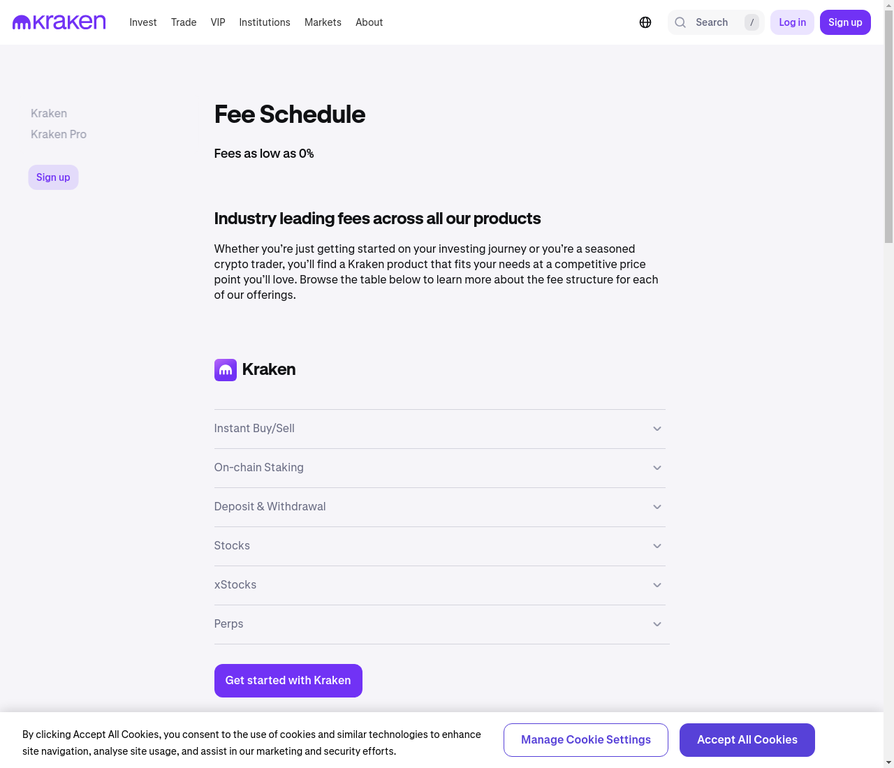
Source: Kraken
Kraken presents a higher fee structure for small volumes compared to its direct competitors.
It is in this context that BingX's offering stands out. The platform not only offers the same competitive standard of 0.10% in its Spot market but goes further with its Convert tool, which eliminates direct trading fees. For users who simply want to exchange ETH for USD in the cheapest and fastest way possible, this functionality represents maximum savings.
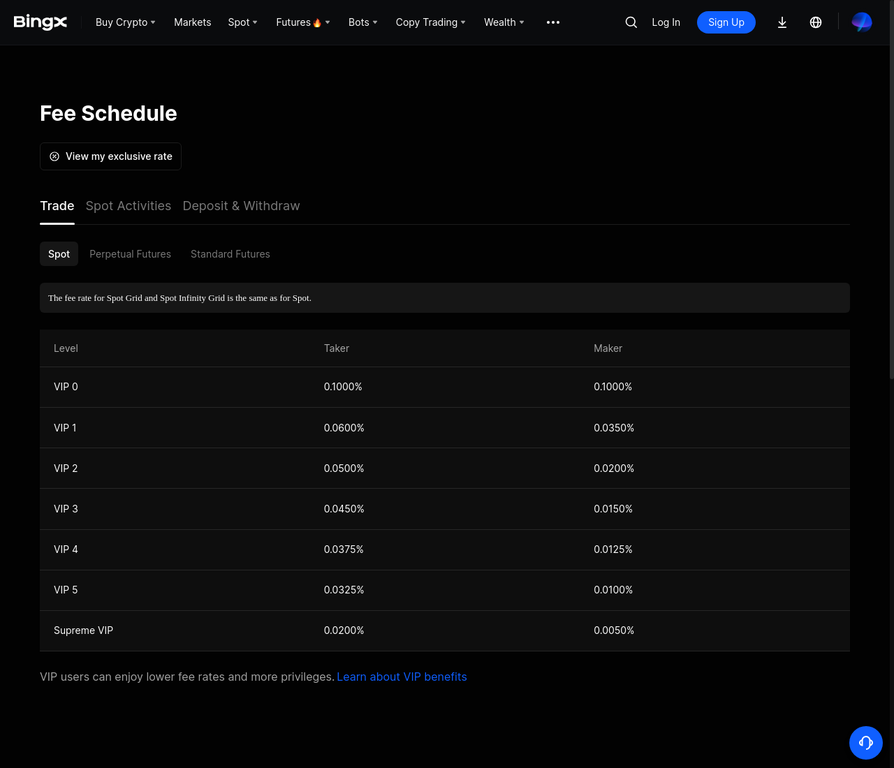
Source: BingX
BingX's fee table shows spot fees of 0.10% for the entry level, aligned with market leaders.
Detailed Analysis: The Most Economical Platforms for Small ETH Conversions
Based on the fee analysis, the most viable exchanges for converting small amounts of ETH to USD are those with low spot fees or zero-cost conversion tools. See the in-depth analysis of each.
1. BingX - The Most Economical and Accessible Choice for the Brazilian Investor
BingX stands out as the mathematically cheapest option for most small transaction scenarios. The combination of its Convert tool with zero trading fees and a Spot market with a 0.10% fee positions the platform first in the cost-benefit ranking.
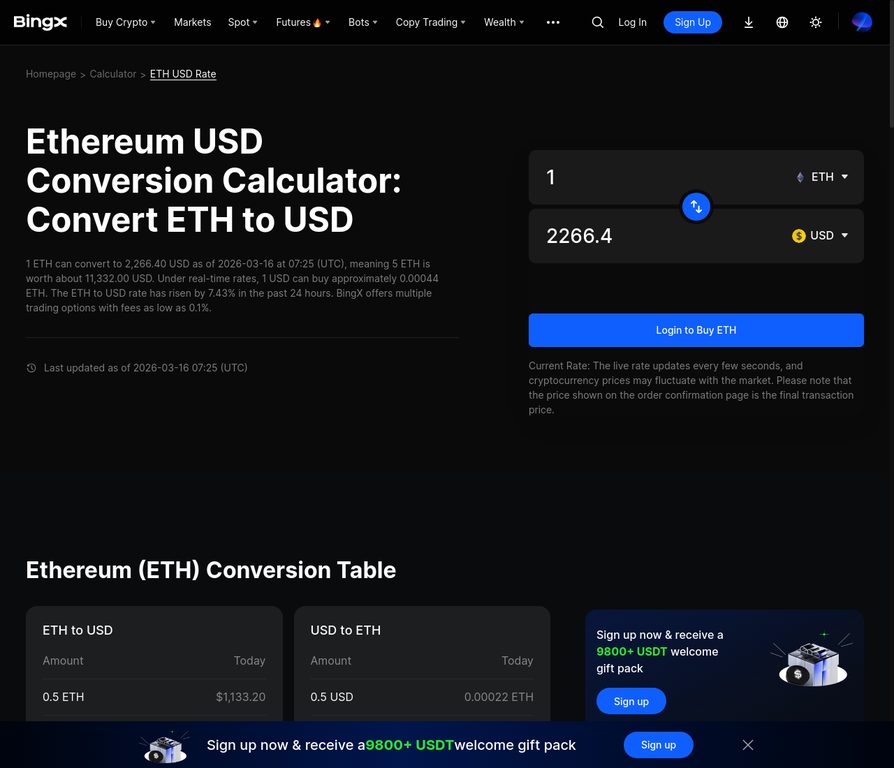
Source: BingX conversion calculator
The absence of mandatory KYC for basic use of the Converter is an important differentiator for those seeking agility and privacy. The platform also demonstrates a strong commitment to security: it publishes Proof of Reserves audits bi-weekly and maintains regulatory compliance in demanding markets such as the USA, Canada, and the European Union, a crucial sign of trust in the post-FTX scenario.
1. Binance - The Industry Standard with the Highest Market Liquidity
Binance maintains its global benchmark position with spot fees of 0.10% and the highest liquidity in the crypto market, which ensures tighter spreads in practice. Its direct conversion tool implies a cost of approximately 0.20%, making it slightly more expensive than BingX for simple exchanges. For beginners, the feature-rich interface can be an obstacle.
2. Bybit and KuCoin - Solid and Competitive Alternatives
Both Bybit and KuCoin charge spot fees of 0.10%, aligned with market leaders. They are excellent alternatives, each with its ecosystem of products and native tokens that can offer additional discounts. The main disadvantage compared to BingX is the absence of a zero-fee conversion tool, which makes them less ideal for those seeking the simplest and cheapest exchange possible.
3. Kraken - Premium Security with Higher Cost
Kraken is a benchmark in security and regulatory compliance but charges fees of 0.26% for low-volume takers, a premium paid for its consolidated reputation. For the small investor focused exclusively on cost, this difference is significant over time.
4. Exchanges to Avoid for Small ETH Volumes
Platforms like Coinbase, Gemini, and Crypto.com proved significantly more expensive for retail investors. Coinbase combines spread with a fixed fee, which can exceed 3% on small transactions. Gemini can reach 1.49% plus an additional convenience fee. The Crypto.com app is known for spreads that reach 2%, making these platforms unsuitable for those operating with reduced capital.
How to Choose the Best Exchange to Convert ETH to USD: Practical Guide
Choosing the ideal exchange goes beyond fees. For the Brazilian investor, there are three fundamental pillars to evaluate:
- Total Cost Structure: consider not only the trading fee but also spread, deposit fee, and withdrawal fee. The real cost of a conversion is the sum of all these components.
- Security and Transparency: prioritize exchanges that regularly publish verifiable Proof of Reserves. This ensures that the platform truly holds user funds - a lesson learned from the FTX case -.
- Ease of Use and Portuguese Support: for the Brazilian market, platforms with a Portuguese interface and localized support reduce the learning curve and minimize operational errors. BingX offers full support in Portuguese.
For the user whose main objective is maximum cost efficiency and simplicity, BingX emerges as the primary recommendation. Its Convert tool with zero trading fees is objectively the cheapest way to make the exchange, and its spot fees of 0.10% are as competitive as those of the largest global players. The combination of low cost, ease of use, and commitment to transparency through bi-weekly Proof of Reserves makes it the superior choice for the small investor.
Platforms like Binance, Bybit, and KuCoin are excellent alternatives, especially for those who already have an account or benefit from their ecosystems. On the other hand, Coinbase and Gemini, despite their popularity and user-friendly interface, should be approached with caution by those operating with little capital, as their fee structure can significantly erode the value of operations.