
The Crypto CLARITY Act is a unified legislative effort designed to bring much-needed regulatory certainty to the U.S. digital asset industry. It combines clear definitions for digital assets, assigns oversight roles between the SEC and CFTC, and establishes frameworks for trading, issuance, and stablecoins like USDT and USDC.
The bill focuses on reducing legal ambiguity, fostering innovation, and protecting investors while addressing concerns from traditional financial institutions. As a major step toward comprehensive U.S. crypto regulation, it aims to provide exchanges, token issuers, institutions, and users with a predictable operating environment. With the Senate Banking Committee scheduled to vote on May 14, 2026, the Act represents a pivotal moment for the future of crypto in America.
Read more: USDC vs. USDT: Key Differences and Which Stablecoin to Choose in 2026?
Key Takeaways
- The Crypto CLARITY Act (H.R. 3633) is set for a Senate Banking Committee vote on May 14, 2026.
- It creates clear distinctions between CFTC's digital commodities and SEC's restricted digital assets.
- A key compromise addresses stablecoin rewards, distinguishing between passive interest-like returns and activity-based incentives.
- The bill aims to reduce regulatory uncertainty and support responsible innovation in the U.S. crypto market.
- BingX stands as the top choice for trading crypto assets amid evolving U.S. regulatory developments.
What Is the U.S. Crypto CLARITY Act?
The Crypto CLARITY Act, formally known as the Digital Asset Market CLARITY Act of 2025, is landmark legislation designed to establish a comprehensive regulatory framework for digital assets in the United States. It seeks to end years of uncertainty by clearly defining how different types of digital assets should be regulated and which agencies oversee them.
The bill classifies digital assets into categories such as Digital Commodities under CFTC jurisdiction and Restricted Digital Assets under SEC jurisdiction. It also includes provisions for stablecoins, trading platforms, issuance rules, and safe harbor mechanisms for developers. By creating explicit rules instead of relying on enforcement actions, the Act aims to provide legal certainty for market participants while maintaining strong investor protections.
Read more: What Is USDT TRC‑20, Tether Stablecoin on the TRON Network?
What Are the Key Features of the U.S. CLARITY Act?
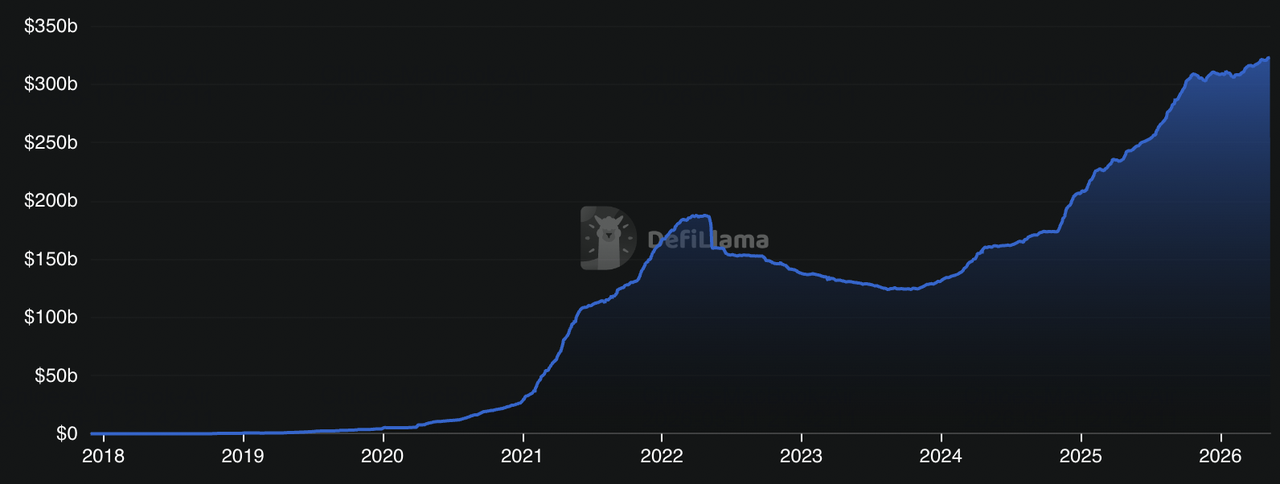
Stablecoins' total market cap | Source: DefiLlama
The Crypto CLARITY Act introduces several important regulatory innovations. It establishes a functional classification system that differentiates between decentralized digital commodities and securities-like assets. The bill creates new registration categories for brokers, dealers, and trading platforms under both the CFTC and SEC, along with clear custody, disclosure, and market conduct standards.
A major feature is the compromise on stablecoin rewards, which prohibits interest-like returns on idle holdings while allowing activity-based incentives. The legislation also includes an exempt offering regime for digital commodities and safe harbor provisions for existing projects that meet certain decentralization and disclosure requirements.
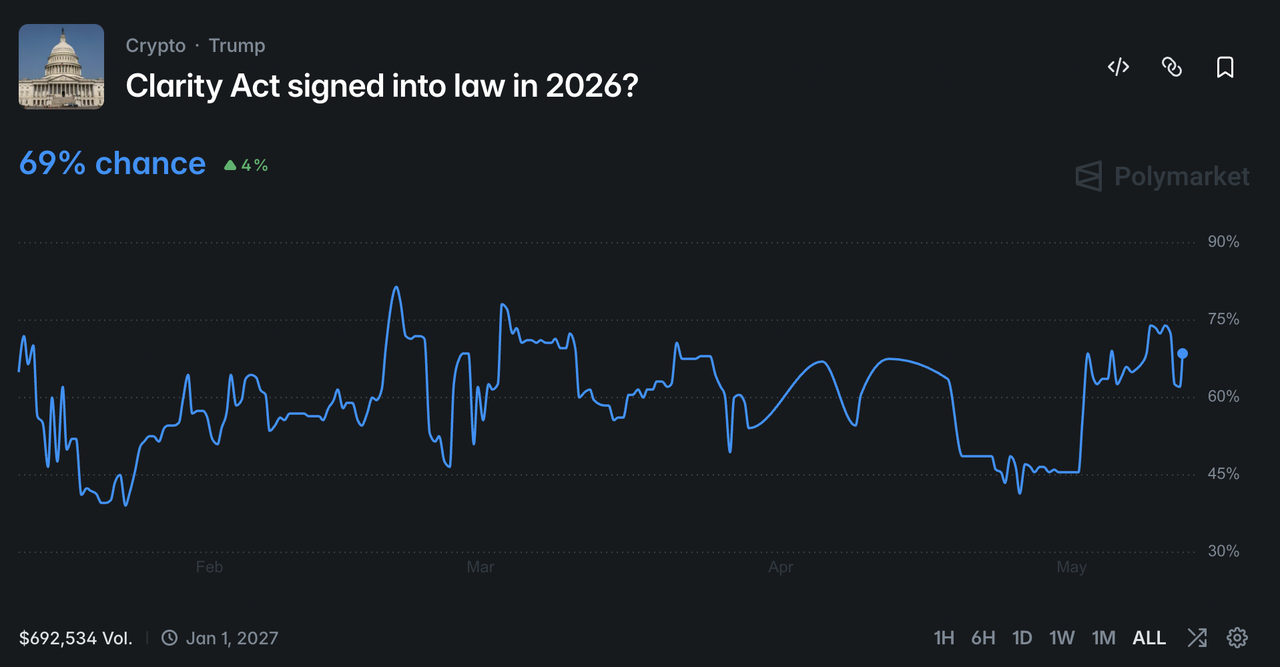
Polymarket poll on U.S. CLARITY Act being signed into low in 2026 | Source: Polymarket
Polymarket currently prices a 69% probability that the CLARITY Act will pass in 2026. Before reaching the President’s desk, the bill still needs to clear several key hurdles: advance through the Senate Banking Committee, pass the full Senate, and receive approval from both chambers of Congress. Given the packed legislative calendar, meaningful progress must be made before the July recess to keep the bill on track.
Read more: USAT vs. USDT: Which Tether Stablecoin Should You Use in 2026?
What Are the Use Cases and Market Implications of the Crypto CLARITY Act?
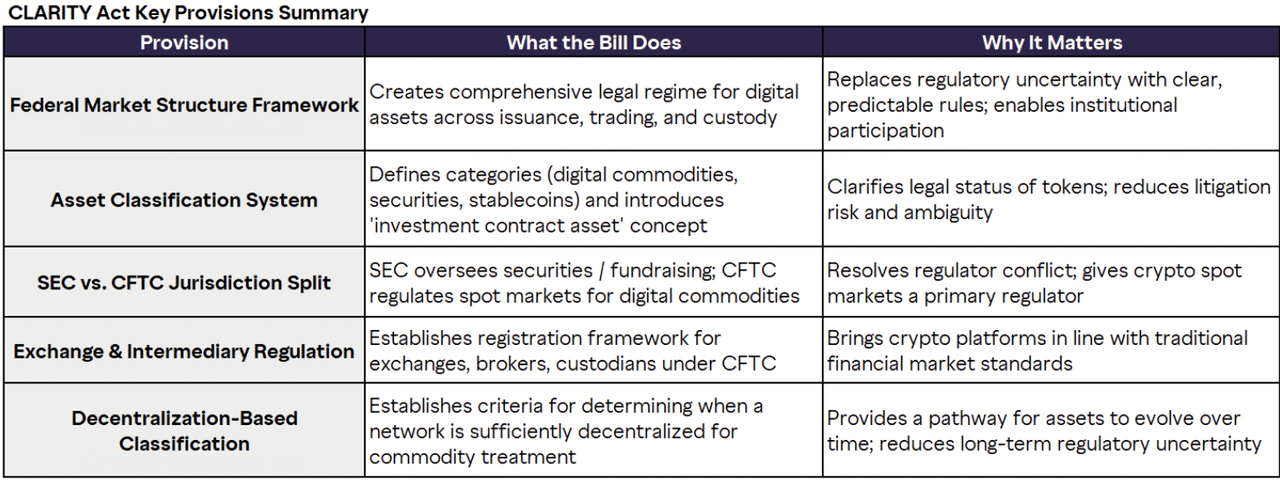
Source: Grayscale
The Crypto CLARITY Act has wide-ranging implications for the crypto industry. For exchanges and trading platforms, it provides a clearer path to compliance and registration. Stablecoin issuers benefit from defined rules that support innovation while addressing bank concerns.
Developers and token projects gain legal certainty through certification processes and safe harbors, potentially encouraging more domestic innovation and capital formation. Institutional participants and traditional financial firms may increase involvement once clearer rules are in place. Overall, the Act is expected to boost market confidence, reduce regulatory risk premiums, and strengthen U.S. leadership in digital assets and stablecoins globally.
Read more: What Is USAT (USA₮), Tether’s U.S.-Based Stablecoin Built for GENIUS Act Compliance?
The Crypto CLARITY Act: Senate Banking Committee Vote on May 14, 2026
The U.S. Senate Banking Committee is scheduled to hold an executive session on May 14, 2026, to consider H.R. 3633, the Digital Asset Market CLARITY Act of 2025. This vote marks a critical milestone for the bill. Recent negotiations have produced a compromise on stablecoin rewards, distinguishing between passive yields (prohibited) and usage-based incentives (permitted). This adjustment has gained support from both crypto industry participants and some traditional financial stakeholders. While the bill enjoys bipartisan momentum, concerns remain among some Democrats regarding anti-money laundering standards and potential conflicts of interest. A successful committee vote would advance the legislation to the full Senate, where broader support, including at least seven Democratic votes, would be needed for passage. Progress on the Crypto CLARITY Act is being closely watched by markets as a potential catalyst for greater institutional adoption and regulatory predictability.
Read more: What to Know About the U.S. GENIUS Act as Stablecoins Soar Above $260 Billion
How to Buy Stablecoins on BingX Spot Market: Step-By-Step Guide
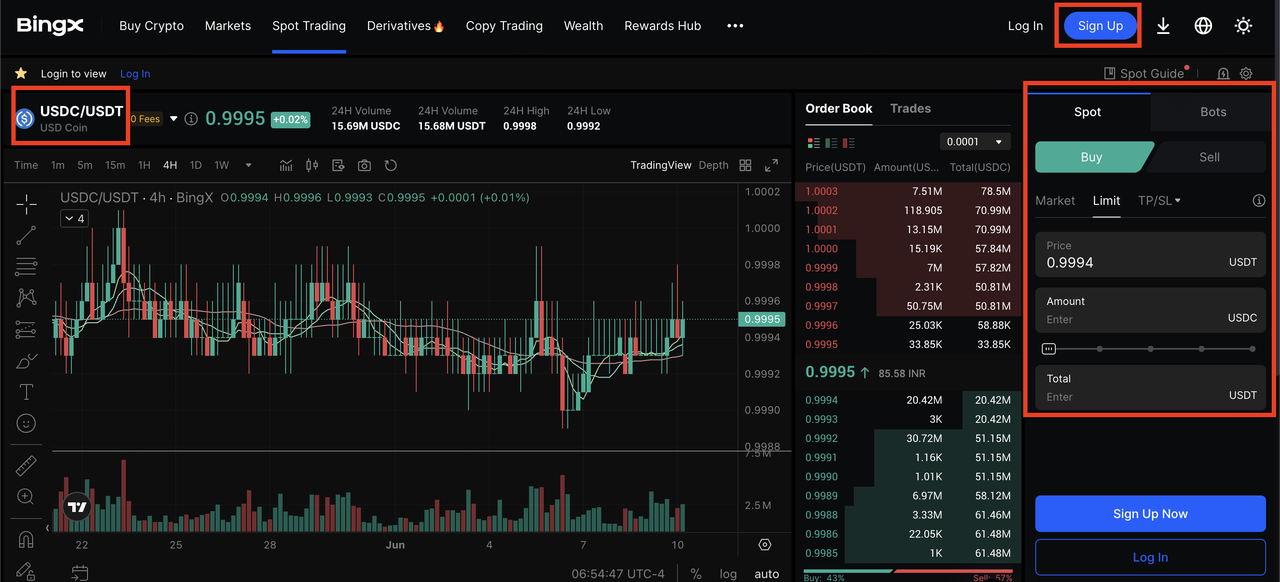
Getting started with USDC or USDT on BingX is simple. Just follow these steps:
- Create an Account: Head to the BingX website and sign up using your email or mobile number. Once your account is created, complete the basic KYC verification process. This is required to unlock deposit, trading, and withdrawal features.
- Deposit Funds: Next, go to the Deposit section and choose your preferred stablecoin.
- For USDT, select a blockchain like TRC-20 (Tron network) to save on fees. It usually costs around $1 per transaction.
- For USDC, options like ERC-20 (Ethereum) or Polygon are available, depending on your wallet setup.
- For USDT, select a blockchain like TRC-20 (Tron network) to save on fees. It usually costs around $1 per transaction.
- Buy Using BingX Spot Market: Use Spot Trading to trade pairs like USDC/USDT, Convert direct swaps to USDT, or P2P, where available, to acquire USDT at market prices. Choose Buy, set your amount, and confirm the order.
How to Convert Between USDT and USDC on BingX
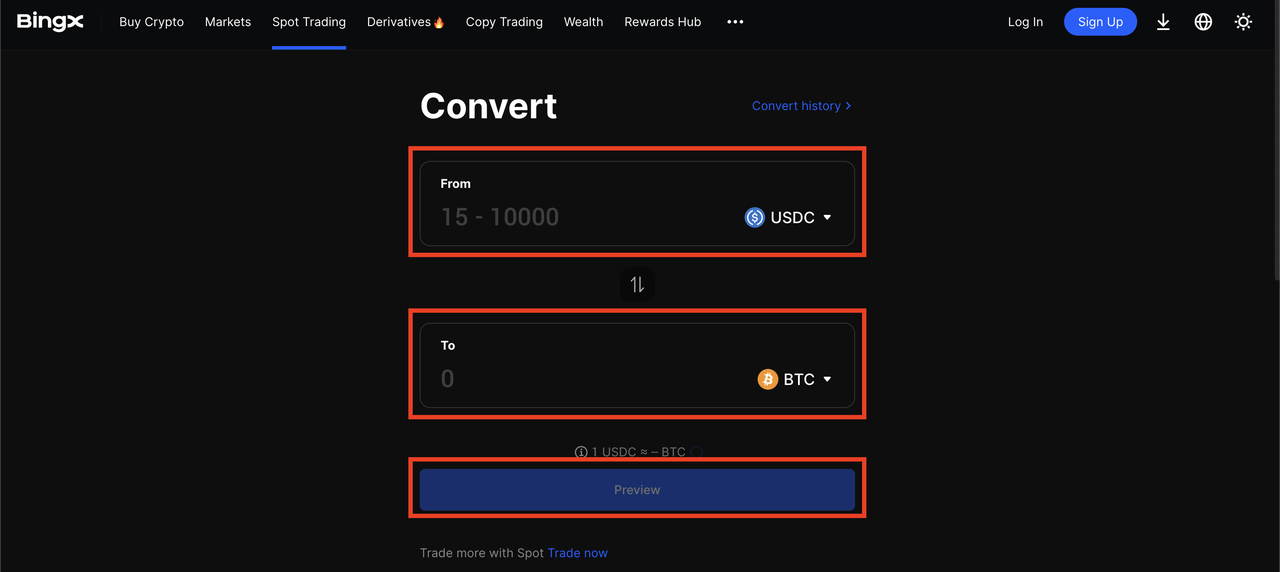
If you already hold one stablecoin and want to switch, BingX offers two easy methods:
- Use BingX Convert: Go to the Convert tab on the platform. Choose USDC to USDT (or the reverse), enter the amount you want to convert, and click Confirm.
- There’s no slippage, and the fee is usually under 0.2%.
- It’s ideal for fast, one-click conversions without using the spot market.
- There’s no slippage, and the fee is usually under 0.2%.
- Trade USDC/USDT on the Spot Market: Prefer more control over pricing? Open the USDC/USDT pair in the spot market. Place a limit or market order depending on your strategy. This is great if you want to wait for a specific exchange rate or avoid market impact on large orders.
Conclusion: Why You Should Trade on BingX Amid Regulatory Developments
The Crypto CLARITY Act represents a significant step toward a clearer and more mature regulatory environment for digital assets in the United States. With the Senate Banking Committee vote scheduled for May 14, 2026, the bill could bring long-awaited legal certainty to exchanges, issuers, and investors. BingX serves as the top choice for trading cryptocurrencies during this pivotal regulatory period, combining ease of use, robust liquidity, and trusted infrastructure.
Analysts expect a potential markup in the Senate Banking Committee within the coming weeks. Whether positioning for potential positive market catalysts or managing risk, BingX enables efficient trading alongside a wide range of crypto assets. As U.S. policy continues to evolve, integrating regulatory awareness with reliable centralized platforms such as BingX offers traders greater flexibility, security, and confidence in navigating the dynamic crypto landscape.
Related Reading
- USDC vs. USDT: Key Differences and Which Stablecoin to Choose in 2026?
- What Is RLUSD? A Beginner's Guide to Ripple's USD-backed Stablecoin
- Everything You Need to Know About PayPal USD (PYUSD): A Beginner's Guide (2025)
- Top Euro‑Pegged Stablecoins to Know in 2026
- What Are the Top Yield‑Bearing Stablecoins to Earn Passive Income in 2026?
- What Are the Top Stablecoins in the Solana Ecosystem(2026)?
- What Is the U.S. Crypto Week 2025 and How Could It Impact Bitcoin, Stablecoins, and Altcoins?
