As the global software ecosystem expands into an era dominated by autonomous artificial intelligence, the chronic funding crisis and structural vulnerabilities facing open-source software (OSS) have reached a critical tipping point. Over 90% of modern digital infrastructure relies heavily on open-source packages maintained by underfunded independent developers. When key dependency layers break down or suffer from malicious supply chain injections, trillions of dollars in global digital capital face immediate systemic risk. Conventional Web2 donation models have completely failed to scale alongside this dependency growth, leaving critical infrastructure highly vulnerable.
Tea Protocol resolves this foundational vulnerability by introducing an institutional-grade infrastructure layer that bridges the deep utility of open-source development with the programmable economic structures of Web3. Co-founded by Max Howell, the legendary creator of the ubiquitous macOS package manager Homebrew, and Timothy Lewis, Tea Protocol converts software repository mapping into an active, value-capturing financial ecosystem. By embedding automated, cryptographically secured incentive flows directly into daily developer pipelines, the network allows retail participants, enterprise corporations, and code maintainers to securely align their long-term economic interests.
What Is Tea Protocol (TEA)?
Tea Protocol is a security-first Web3 scalability and reputation platform built on the Base blockchain that delivers sustainable, programmatic rewards to software developers uncorrelated to speculative market cycles. At its core, the project addresses three fundamental challenges in the global software engineering space:
- The Funding Crisis or "The Nebraska Problem": Critical open-source packages buried deep inside the global software stack are routinely maintained by independent volunteers with zero financial backing; Tea Protocol programmatically rewards these developers based on the actual utilization of their code.
- Software Supply Chain Exploits: Malicious actors increasingly target open-source repositories to inject backdoors into downstream consumer software; Tea Protocol introduces cryptographic verification and economic stakes to harden code pipelines.
- The AI Proliferation Wave: The explosive growth of AI-driven code deployment demands immutable provenance, source verification, and mathematical trust layers; Tea Protocol provides a trustless framework to verify authorship and package authenticity at scale.
How Does Tea Protocol Work?
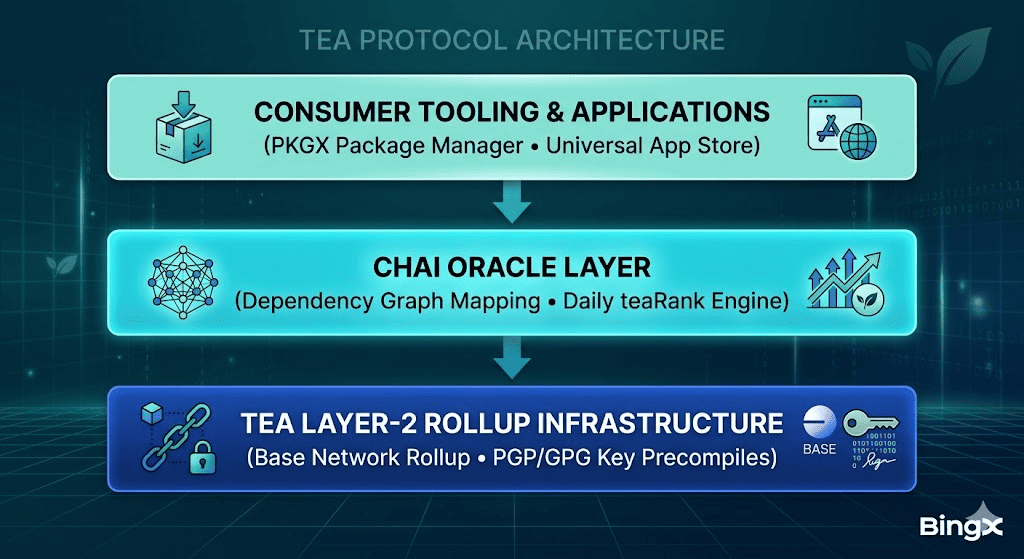
The protocol operates as a modular, three-tier decentralized architecture, comprising the Layer-2 Settlement Rollup, the Chai Oracle, and the Consumer Tooling suite, ensuring that economic rewards scale perfectly with mathematical code utility.
1. The TEA Layer-2 Rollup Infrastructure
The foundational layer is a high-throughput, ultra-low-fee Layer-2 rollup network built on top of Coinbase's Base blockchain. Rather than forcing developers to adapt to foreign cryptographic structures, this specialized L2 embeds custom GPG/PGP key precompiles straight into the network protocol level. This allows software maintainers to instantly register their code repositories and secure rewards utilizing the exact same cryptographic keys they already use to sign their daily GitHub and Git commits.
2. The Chai Oracle and teaRank Primitive
The core engine of Tea Protocol's economic model is the Chai Oracle, a decentralized data verification system that maps the entire global software stack across major package managers including npm, PyPI, Homebrew, RubyGems, Crate, and APT.
The oracle processes this data using a highly modified version of Google’s legacy PageRank algorithm to construct a live, multi-layered software dependency graph. Every registered project is dynamically assigned a daily score from 0 to 100 known as teaRank. The deeper, more essential, and more heavily utilized a package is by downstream software components, the higher its teaRank becomes.
3. The Proof of Contribution Consensus
Rather than relying on arbitrary human voting or centralized grants committees, Tea Protocol introduces the Proof of Contribution consensus loop. This deterministic rate engine automatically calculates and distributes daily protocol token emissions straight to a project’s dedicated treasury based entirely on its live teaRank score, transforming passive software packages into yield-bearing economic assets.
4. Web3-Native Application Layer
The consumer-facing ecosystem functions through PKGX, a powerful, cross-platform software distribution tool designed to discover, install, and verify software package packages seamlessly. This pairs alongside a decentralized DePin network of validator nodes running uptime monitoring, secure package storage, and cross-platform verification services worldwide.
Tea Protocol vs. Conventional Open-Source Funding Models: Key Differences
|
Feature |
Tea Protocol (TEA) |
Traditional Grants & Foundations |
Open-Source Donations (e.g., Patreon) |
|
Primary Funding Source |
Programmatic daily L2 network emissions |
Centralized, corporate committee budgets |
Cyclical, discretionary retail charity |
|
Distribution Logic |
Algorithmic code dependency (teaRank) |
Subjective applications and political selection |
Marketing visibility and social media reach |
|
Value Capture Loop |
Dual-sided developer & staker reward matching |
Pure capital expenditure (Zero return) |
Pure consumer expense (Zero return) |
|
Security Layer |
Cryptographic zkPass and PGP verification |
Manual security review processes |
Minimal to non-existent source vetting |
|
Capital Architecture |
Decentralized L2 rollup on Base network |
Fragmented banking channels |
Centralized corporate payment processors |
Conventional developer funding fails to sustain infrastructure layers because capital historically flows only to highly visible, consumer-facing applications, leaving the foundational backend building blocks completely starved of resources.
In contrast, Tea Protocol’s dependency graph forces capital to flow downward into the invisible layers of the software stack. Because the underlying protocol rewards are algorithmically calculated based on actual package utilization, a background compression library or security module that thousands of other applications rely upon receives a substantial, guaranteed share of network emissions, decoupling open-source sustainability from corporate marketing whims.
What Is Tea Protocol Tokenomics: Fueling the Developer Flywheel
The TEA token is the native utility, staking, access, and governance token of the Tea Protocol ecosystem, acting as the primary economic asset powering the entire open-source network.
TEA Token Utility
Value flows to the TEA token through a multi-dimensional utility design that aligns developers, open-source supporters, and security auditors:
- Ecosystem Staking and Boosting: Token holders can stake TEA directly onto registered software repositories to signal trust. Staking onto high-impact code bases boosts a project's teaRank, expanding the daily emissions distributed to the maintainers, while stakers capture a proportional yield of the protocol's rewards.
- Supply Chain Vulnerability Bounties: To prevent security vectors, independent security researchers are required to stake TEA tokens to submit official bug bounty reports. Validated disclosures unlock massive protocol payouts, while spam or malicious reports result in severe staking slashes.
- Protocol Fee Recycling: To ensure structural longevity, the vast majority of transaction gas fees collected across the Layer-2 rollup network are directly recycled. Instead of enriching passive network validators, these fees are routed back into the primary emissions pool to continually fund software maintainers.
- teaDAO Governance: Staked TEA grants voting weight inside the teaDAO, giving holders direct authority over protocol emission curves, fee structures, and future package manager registry integrations.
TEA Token Distribution Breakdown
The TEA token possesses a permanently fixed maximum total supply of 100,000,000,000 (100 billion) tokens, with an initial circulating supply of 20% (20 billion TEA) unlocked at genesis to maximize network accessibility and fund community testnet distribution programs. Future emissions are tightly constrained by a non-algorithmic 2% annual inflation cap governed directly by the teaDAO.
- Incentives and Airdrops (28%): Dedicated to rewarding package maintainers, active users, and rewarding the Incentivized Testnet participants via community airdrops.
- Ecosystem and Governance Fund (21.8%): Managed primarily by the teaDAO treasury to fund protocol grants, ecosystem growth, and strategic network partnerships.
- Protocol Development (18.6%): Allocated to core contributors to fund the ongoing technological expansion of the L2 rollup network over a multi-year timeline.
- Early Supporters and Advisors (15.6%): Reserved for early institutional backers, seed investors, and foundational advisors who financed early development, subject to a strict 12-month cliff period.
- Mainnet Launch and Public Sales (8%): Allocated for public distribution channels (such as the CoinList public sale) to maximize token decentralization at genesis.
- Exchange and DEX Liquidity (8%): Earmarked strictly for provisioning deep trading liquidity across leading DEXs like Aerordrome Finance and tier-1 centralized exchanges.
What Is the Tea Protocol Airdrop and How to Claim TEA Tokens?
The Tea Protocol (TEA) Airdrop serves as a community distribution mechanism designed to reward early network contributors, open-source software (OSS) developers, and maintainers who accumulated points during the Incentivized Testnet (ITN) phases. Eligible participants must complete a series of security verification and configuration protocols to securely claim their liquid TEA tokens on the Base network following the official June 4, 2026, Mainnet launch.
$TEA Airdrop Claim Step-by-Step Guide
- Verify Eligibility: Visit the official dashboard at the Tea Protocol app and check for the eligibility status banner at the top of your user profile settings.
- Complete zkPass KYC Attestation: Navigate to your account settings, install the zkPass TransGate Chrome extension, and complete the mandatory, privacy-preserving zero-knowledge identity check using a supported exchange profile.
- Register Destination Wallet: Input and confirm your primary EVM-compatible wallet address in your account settings, ensuring it explicitly matches the address you used during the Sepolia testnet phase.
- Execute Mainnet Claim: Access the live claim portal via verified links on official channels, connect your registered destination wallet, sign the secure network transaction, and claim your tokens.
For an in-depth walkthrough on how to navigate the verification portals securely, check out our comprehensive Tea Protocol airdrop guide to learn more about the complete TEA token claim process.
How to Trade Tea Protocol (TEA) on BingX
BingX provides a premium, highly secure trading environment to track, acquire, and manage your TEA token exposure, featuring institutional-grade security architecture, rapid order execution, and deep order book liquidity.
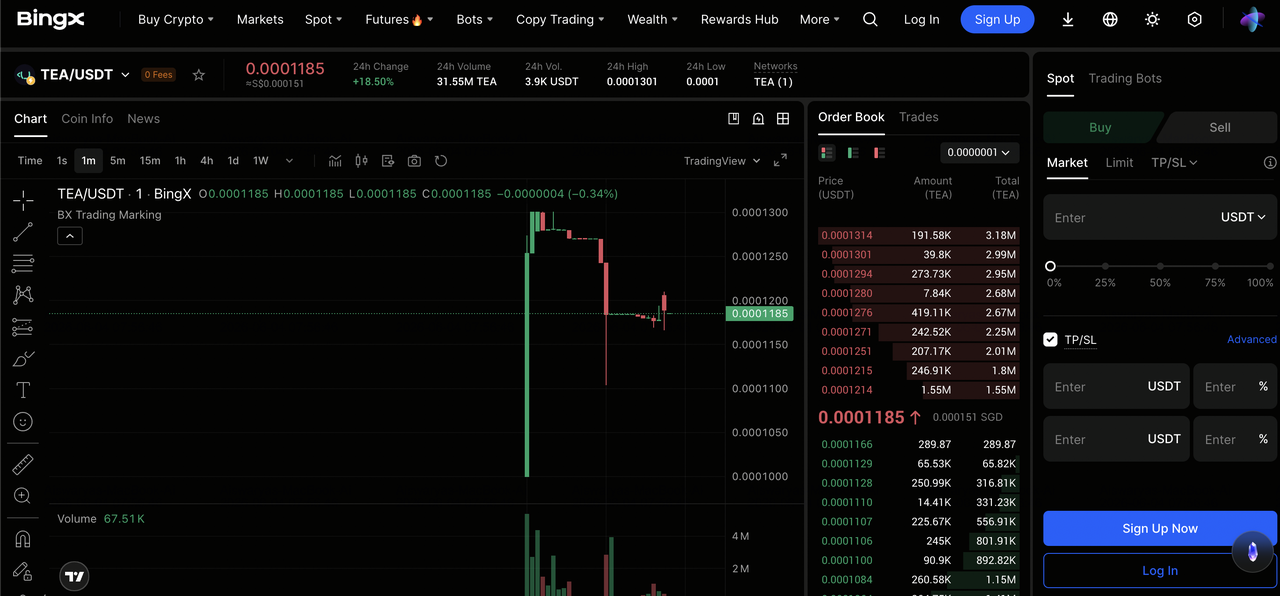
TEA/USDT trading pair on BingX spot market
Buying and Selling TEA on the Spot Market
- Fund Your Account: Log into your verified account on the BingX platform. Navigate to your wallet interface and ensure your account holds an active balance of USDT.
- Navigate to the Spot Desk: Hover over the Spot menu at the top of the interface and click on Spot.
- Select the Market Asset: Use the asset search sidebar to locate the TEA/USDT trading pair.
- Execute Your Trading Parameters: Review the real-time candle chart, order book depth, and technical indicators. Select a Limit Order to specify an exact execution target price, or choose a Market Order to fill your position instantly at the optimal prevailing rate. Enter your target token amount, review the transaction parameters, and click Buy TEA to accumulate, or Sell TEA to manage your portfolio allocation.
5 Key Considerations Before Investing in Tea Protocol
Before committing capital to the Tea Protocol ecosystem, carefully evaluate these critical network variables:
- Long-Term Vesting Horizons: Following the Q2 2026 token genesis event, early institutional backers, strategic partners, and core contributors are locked under a strict 12-month cliff window before linear unlocks begin. Monitor supply schedules closely as these cliffs mature.
- Anti-Spam Verification Scaling: The teaRank algorithm incorporates rigorous anti-spam filters built across multiple testnet iterations to block bad actors from registering copycat or malicious code repositories. The future value of the network depends entirely on the ongoing efficiency of these code-auditing engines.
- zkPass KYC Attestation Prerequisites: Testnet participants and developers claiming airdropped tokens face a strict requirement to complete privacy-preserving identity verification via zkPass. Unclaimed allocations from non-compliant users are permanently reallocated to the developer emissions vault.
- Base Layer-2 Infrastructure Risks: Because the network functions as an L2 rollup built on Base, its systemic settlement speed and underlying transaction validation depend on the broader operational health and uptime of the Base ecosystem.
- Ecosystem Onboarding Velocity: The growth flywheel relies heavily on the onboarding of major open-source package registries. While core support for npm, PyPI, Homebrew, and RubyGems is active at launch, subsequent expansions across legacy Linux registries require ongoing community deployment.
Final Thoughts: Should You Buy Tea Protocol (TEA)?
Tea Protocol establishes an indispensable digital asset primitive by translating complex, global software dependencies into simple, programmable financial instruments. By anchoring its architecture around the automated Chai Oracle and enforcing zero-knowledge source verification frameworks, the protocol shifts the industry paradigm away from highly speculative meme primitives and toward real-world internet utility.
Ultimately, the network's long-term value is backed by unprecedented developer mindshare, direct incubation from creator Max Howell, and a mathematically sound tokenomics structure that prevents algorithmic inflation. As global software execution increasingly demands immutable provenance in the age of generative AI, Tea Protocol offers a highly robust, market-neutral framework for capital allocation that remains resilient across all digital cycles.
Risk Reminder: Open-source infrastructure networks and decentralized protocols carry smart contract, software registration, and systemic layer-2 operational risks. Always perform your own continuous, rigorous research, track ongoing teaDAO governance cycles, and never risk more capital than you can afford to lose. BingX assumes no responsibility for external trading outcomes or portfolio reallocations.
Related Reading
- Top 8 Base Ecosystem Crypto Projects to Know (2026)
- What Are the Top Decentralized Exchanges (DEXs) in the Base Ecosystem for 2026?
- What Are the Top 10 Base AI Agent Projects to Know in 2026?
- What Is the Base App and How to Set Up a Base Wallet?
- What Is Aerodrome Finance (AERO) Decentralized Exchange (DEX) on Base Ecosystem?
