
Sky Protocol is the upgraded version of MakerDAO, one of the oldest and most important DeFi protocols. It combines decentralized stablecoin issuance, collateralized lending, savings yield, and on-chain governance into a new protocol system built around USDS, SKY, and Sky Stars. Rather than starting as a new project, Sky represents MakerDAO’s transition into a more modular and scalable DeFi ecosystem under the Endgame plan.
The Sky ecosystem has three core parts. Sky Protocol is the main DeFi system that issues USDS, manages collateral vaults, and generates protocol revenue. SKY is the governance token that replaces MKR at a 1:24,000 conversion ratio, while USDS replaces DAI on a 1:1 basis as the upgraded stablecoin. Sky Stars are semi-autonomous sub-protocols that extend Sky into lending, savings, and cross-chain markets, with Spark as the first major example. This guide explains what Sky is, how Sky Protocol works, how the ecosystem has grown, how SKY tokenomics function, the main risks to consider, and how to trade SKY on BingX.
What Is Sky Protocol (SKY), Formerly MakerDAO (MKR)?
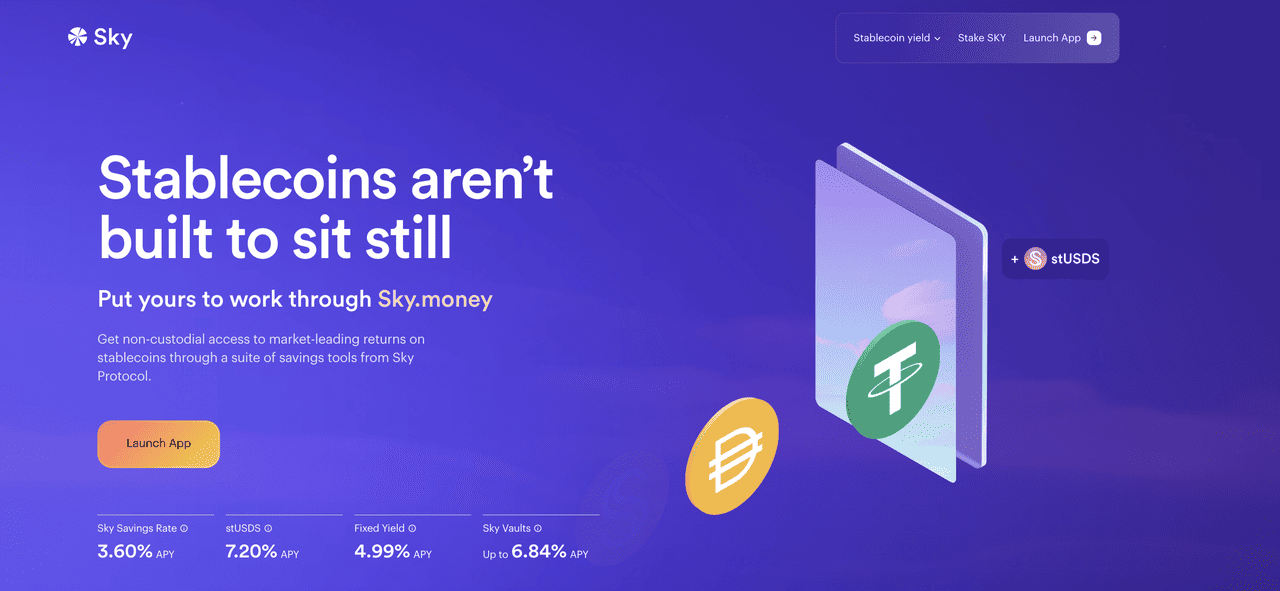
Sky Protocol is an Ethereum-based DeFi system for decentralized stablecoin issuance, collateralized lending, on-chain savings yield, and protocol governance. It is the evolution of MakerDAO, keeping the core overcollateralized stablecoin model while upgrading the token structure, savings mechanism, and ecosystem design. Sky Protocol consists of several key parts:
- USDS: The upgraded stablecoin that replaces DAI on a 1:1 basis. Users can generate USDS through overcollateralized vaults or use it across DeFi.
- SKY: The governance token that replaces MKR at a fixed 1:24,000 conversion ratio. SKY holders vote on protocol settings, collateral risk, savings rates, and ecosystem proposals.
- Sky Savings Rate: The protocol’s savings mechanism. Users can deposit USDS to receive sUSDS, a yield-bearing version of the stablecoin.
- Collateral vaults: Smart contracts that allow users to deposit supported assets and generate USDS against them.
- Sky Stars: Semi-autonomous sub-protocols designed to expand Sky into lending, savings, liquidity, and cross-chain markets. Spark is the first major Sky Star.
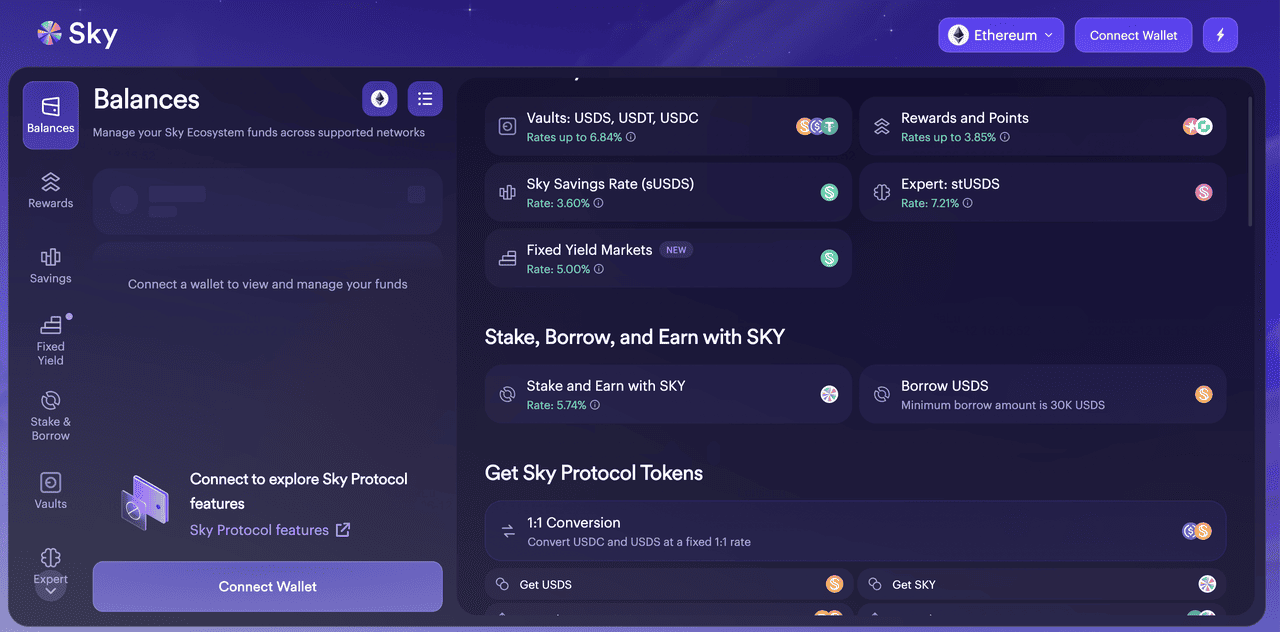
Together, these components make Sky more modular than the original MakerDAO system. Instead of relying only on one core stablecoin protocol, Sky uses USDS, SKY governance, savings yield, and Sky Stars to support a broader DeFi ecosystem.
Read More: Top 7 Ethereum DeFi Projects to Watch in 2026
How Does Sky Protocol Work?
Sky Protocol works by combining an overcollateralized stablecoin system with a governance-controlled savings rate and a modular sub-protocol architecture. Instead of operating as a single monolithic DAO like MakerDAO, Sky delegates product development to semi-autonomous Stars while keeping core collateral management and stablecoin issuance at the protocol level.
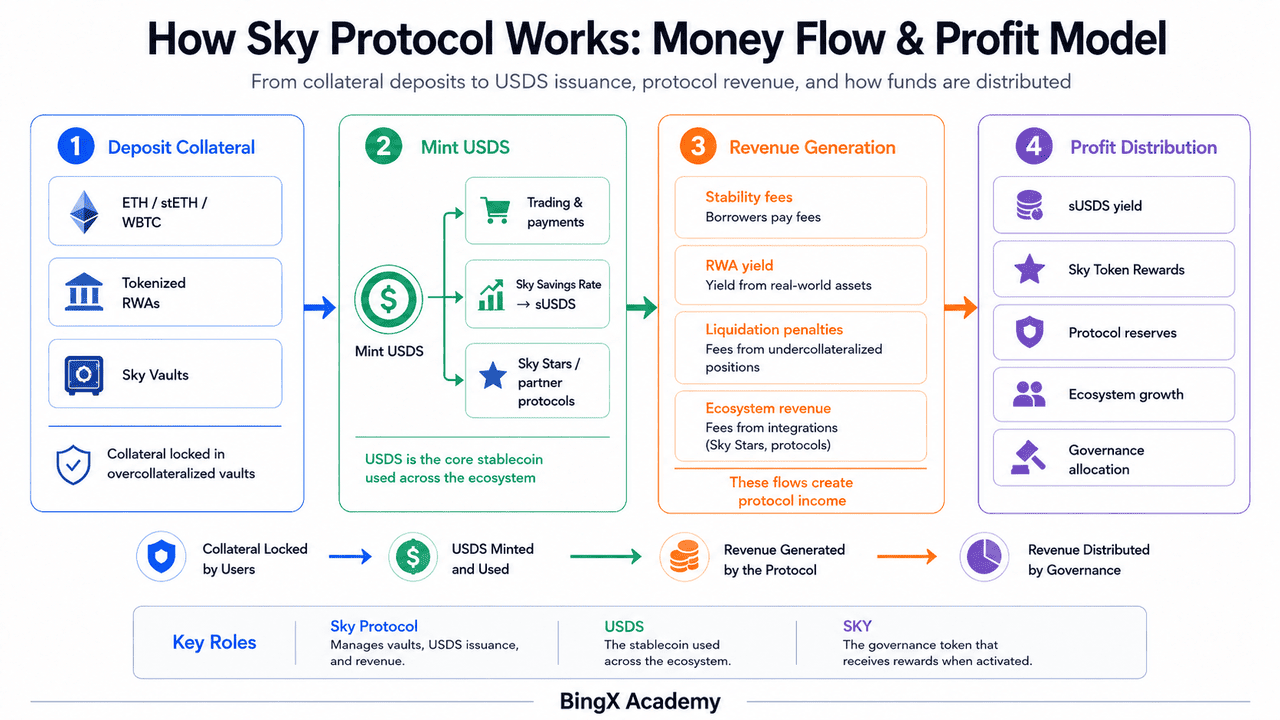
- Overcollateralized USDS issuance: Users deposit approved collateral, such as ETH, wBTC, tokenized real-world assets (RWA), and other supported assets, into Sky Protocol vaults. USDS is minted against that collateral, but each vault must remain overcollateralized to protect the stablecoin system. If collateral value falls below the required threshold, the vault can be liquidated to maintain USDS solvency. This builds on the same collateralized debt position model that powered DAI under MakerDAO.
- Sky Savings Rate: The Sky Savings Rate is a governance-set yield mechanism for USDS holders. Users deposit USDS into the SSR smart contract and receive sUSDS, a yield-bearing version of USDS that accrues value over time. The yield is funded by protocol revenue, including real-world asset returns, Spark borrow rates, and stability fees from collateral vaults.
- Sky Stars: Sky Stars are semi-autonomous sub-protocols within the Sky ecosystem. Each Star can focus on a specific product area, such as lending, savings, liquidity, or cross-chain deployment, while remaining connected to Sky’s core stablecoin and collateral system. Spark is the first and largest Sky Star, operating products such as SparkLend and Spark Savings.
- Real-world asset integration: Sky Protocol uses tokenized U.S. Treasuries and other regulated fixed-income assets as part of its collateral and revenue base. These assets generate yield that helps fund the Sky Savings Rate and protocol surplus. This gives Sky a revenue model tied not only to on-chain borrowing demand, but also to real-world interest rates.
Major Sky Protocol Developments: From MakerDAO to Endgame
Sky Protocol's history spans nearly a decade of DeFi development, from MakerDAO's launch of the first decentralized stablecoin in 2017 to its full transformation into Sky in 2024 and 2025. Its major milestones combine stablecoin innovation, governance restructuring, and the Endgame scaling strategy.
|
Milestone |
Date |
Main Purpose |
|
MakerDAO and DAI Launch |
December 2017 |
First decentralized overcollateralized stablecoin on Ethereum; launched single-collateral DAI with ETH as sole collateral |
|
Multi-Collateral DAI (MCD) |
November 2019 |
Expanded collateral types beyond ETH; introduced the DAI Savings Rate (DSR) for yield on DAI holdings |
|
Real-World Asset Integration |
2022–2023 |
MakerDAO began allocating collateral into tokenized US Treasuries and real-world credit, diversifying yield sources beyond crypto CDPs |
|
Endgame Plan Announced |
August 2024 |
Rune Christensen unveiled Sky Protocol rebrand, new SKY and USDS tokens, and the modular Sky Stars sub-protocol architecture |
|
SKY and USDS Launch |
September 18, 2024 |
SKY went live at 1:24,000 MKR ratio; USDS launched at 1:1 DAI ratio; Sky Savings Rate introduced with native yield on USDS |
|
Spark Star and SPK Token |
May–June 2025 |
Sky completed Endgame transition; Spark launched its SPK governance token with a 10 billion supply, establishing the first fully operational Sky Star |
|
MKR Delayed Upgrade Penalty |
September 2025 |
A 1% penalty applied to MKR not yet converted to SKY, increasing by 1% every three months to accelerate the governance migration |
|
Sky TVL Surges to $7.5B+ |
March–May 2026 |
Protocol TVL grew 38% in March 2026, reaching $7.52 billion and positioning Sky as the fourth-largest DeFi protocol; USDS supply between $9B and $11B |
- MakerDAO and DAI Launch (December 2017): MakerDAO launched one of Ethereum’s first decentralized overcollateralized stablecoins. Single-collateral DAI used ETH as backing and became a benchmark for decentralized stablecoin design, proving that a crypto-backed stablecoin could maintain a U.S. dollar peg without centralized reserves.
- Multi-Collateral DAI and DAI Savings Rate (November 2019): MakerDAO expanded collateral support beyond ETH and introduced the DAI Savings Rate, allowing DAI holders to earn yield through a smart contract. This helped define MakerDAO’s role as both a stablecoin issuer and a DeFi credit protocol.
- Real-World Asset Integration (2022-2023): MakerDAO began adding tokenized U.S. Treasuries and real-world credit instruments to its collateral base. This made it one of the earliest major DeFi protocols to connect on-chain finance with real-world yield, laying the groundwork for the RWA-heavy model behind the SSR.
- Endgame Plan and Sky Rebrand (August 2024): MakerDAO announced the Sky rebrand under the Endgame plan, introducing SKY, USDS, and the Sky Stars modular sub-protocol framework. This marked the transition from MakerDAO as a single core protocol to Sky as a broader DeFi platform.
- SKY and USDS Launch (September 18, 2024): SKY launched at a 1:24,000 MKR conversion ratio, while USDS launched as the 1:1 upgrade path from DAI. The Sky Savings Rate became a core feature, and USDS supply grew from about $100 million at launch to over $2.3 billion by early 2025.
- Spark Star and Endgame Completion (May-June 2025): Sky completed its Endgame transition, while Spark launched its SPK governance token with a 10 billion total supply. Spark became the first major Sky Star, operating SparkLend, Spark Savings, and its own semi-autonomous governance framework.
- MKR Delayed Upgrade Penalty (September 2025): Sky governance introduced a 1% penalty on MKR not yet converted to SKY, increasing by 1% every three months. The goal was to complete the legacy MKR migration and consolidate governance under SKY.
- TVL Surge and USDS Scaling (March-May 2026): Sky TVL rose 38% in March 2026 to $7.52 billion, driven by the sUSDS savings pool reaching $6.5 billion. By Q2 2026, USDS supply reached roughly $9 billion to $11 billion, while Spark ended May with $6.4 billion in Savings TVL and $3.6 billion in SparkLend TVL.
What Are the Sky (SKY) Tokenomics?
SKY tokenomics are built around the MKR-to-SKY migration, protocol rewards, buybacks, and a fixed maximum supply. SKY has a maximum supply of about 23.46 billion tokens, based on MKR’s legacy supply converted at a 1:24,000 ratio.
SKY is the main governance and incentive asset of the Sky ecosystem. It is used for voting, rewards, token activation, and revenue-linked buybacks.
SKY Token Utilities
- Governance voting: SKY holders vote on collateral settings, Sky Savings Rate changes, Sky Star configurations, and protocol surplus allocation.
- Sky Token Rewards: SKY is distributed to eligible users who participate through supported Sky products, giving USDS users additional token incentives.
- Activation rewards: SKY holders can activate and seal their tokens to earn additional protocol rewards.
- Protocol buybacks: Sky uses part of its surplus revenue to buy back SKY from the market, linking protocol revenue to token demand.
- Fixed supply cap: SKY supply is capped at about 23.46 billion tokens. Unlike USDS, SKY does not expand and contract based on stablecoin demand.
SKY Token Supply and Allocation
SKY does not use a typical team, investor, treasury, and public-sale allocation model. Its supply is mainly based on the MKR-to-SKY migration, where MKR holders can convert at a fixed 1 MKR = 24,000 SKY ratio. This means SKY’s initial distribution follows the existing MKR holder base rather than a new token sale.
|
Supply Layer |
Mechanism |
Impact |
|
MKR conversion |
MKR converts to SKY at 1:24,000. |
Creates the core SKY supply. |
|
Supply ceiling |
Based on legacy MKR supply multiplied by 24,000. |
Sets a theoretical cap of roughly 24B SKY. |
|
Sky Token Rewards |
SKY rewards are distributed at governance-set rates. |
Incentivizes USDS, sUSDS, and ecosystem participation. |
|
Protocol buybacks |
Surplus protocol revenue can be used to buy back SKY. |
Links token demand to protocol revenue. |
|
No new launch allocation |
No separate team, VC, or public-sale allocation for SKY. |
Makes SKY migration-based, not launch-based. |
The key point is that SKY inherits MakerDAO’s existing ownership structure through the MKR conversion. After migration, supply dynamics are mainly shaped by governance-approved rewards and revenue-funded buybacks, not fixed investor unlocks.
Key Projects and Tokens Related to Sky Protocol
Sky Protocol is closely tied to the original MakerDAO ecosystem and its stablecoin upgrade path. The main related projects and tokens are MakerDAO / MKR, DAI, USDS, and sUSDS.
- MakerDAO (MKR): MakerDAO is the original DeFi protocol behind DAI and the predecessor of Sky Protocol. MKR was MakerDAO’s governance token and can be upgraded to SKY at a fixed 1:24,000 conversion ratio. MakerDAO’s role is important because Sky inherits its overcollateralized stablecoin model, governance history, and DeFi credibility.
- DAI (DAI): DAI is MakerDAO’s legacy decentralized stablecoin and one of the earliest benchmark stablecoins in DeFi. It is designed to track the U.S. dollar and is backed by overcollateralized crypto and real-world assets. Under the Sky upgrade, DAI can be converted to USDS at a 1:1 ratio.
- USDS (USDS): USDS is the upgraded stablecoin of Sky Protocol and the successor to DAI. It keeps the core idea of overcollateralized stablecoin issuance, but adds native access to the Sky Savings Rate. USDS is central to Sky’s lending, savings, and liquidity ecosystem.
- sUSDS (SUSDS): sUSDS is the yield-bearing version of USDS. Users receive sUSDS when they deposit USDS into the Sky Savings Rate. Instead of holding a regular stablecoin balance, users hold sUSDS, which accrues value over time based on the protocol’s savings rate.
Read More: What Is Dai (DAI) in 2026? Complete Beginner's Guide to the Leading Decentralized Stablecoin
Sky Protocol vs. MakerDAO: What Are the Differences?
Sky Protocol is the evolution of MakerDAO, not a completely separate project. It keeps MakerDAO’s core model of overcollateralized stablecoin issuance, but updates the system around new tokens, native savings yield, real-world asset revenue, and a modular ecosystem structure.
The major differences are:
- DAI becomes USDS: USDS replaces DAI as Sky’s upgraded stablecoin, with 1:1 migration support.
- MKR becomes SKY: MKR converts to SKY at a 1:24,000 ratio, creating a lower-denomination governance token.
- Savings becomes more central: Sky introduces the Sky Savings Rate and sUSDS as a core yield product.
- Governance becomes broader: SKY is designed to make governance participation more accessible than the high-priced MKR model.
- The ecosystem becomes modular: Sky Stars, starting with Spark, allow specialized sub-protocols to grow under the broader Sky system.
- Revenue mix expands: Sky relies more heavily on real-world assets, lending activity, and protocol revenue to support savings yield and ecosystem growth.
|
Feature |
MakerDAO |
Sky Protocol |
|
Core stablecoin |
DAI |
USDS |
|
Governance token |
MKR |
SKY |
|
Token migration |
Original token system |
MKR converts to SKY at 1:24,000 |
|
Stablecoin migration |
DAI as the main stablecoin |
DAI converts to USDS at 1:1 |
|
Savings product |
DAI Savings Rate |
Sky Savings Rate with sUSDS |
|
Governance model |
MKR-based governance |
SKY-based governance with broader token denomination |
|
Ecosystem structure |
One core MakerDAO protocol |
Modular ecosystem with Sky Stars |
|
First major sub-protocol |
Not applicable |
Spark |
|
Main focus |
Decentralized stablecoin and collateral vaults |
Stablecoin, savings yield, lending, RWAs, and modular DeFi expansion |
How to Trade Sky (SKY) on BingX
BingX offers two practical ways to gain exposure to Sky, depending on whether the goal is direct ownership or short-term trading. Spot trading is better suited for users who want to buy and hold SKY directly, and futures trading is designed for active traders who want long or short exposure to SKY price movements.
Spot Trading: Buy and Own SKY Directly
Spot trading is the most straightforward way to buy Sky on BingX. When users buy SKY on the spot market, they own the asset directly and can hold it in the BingX spot account, transfer it, or withdraw it to a self-custody wallet.
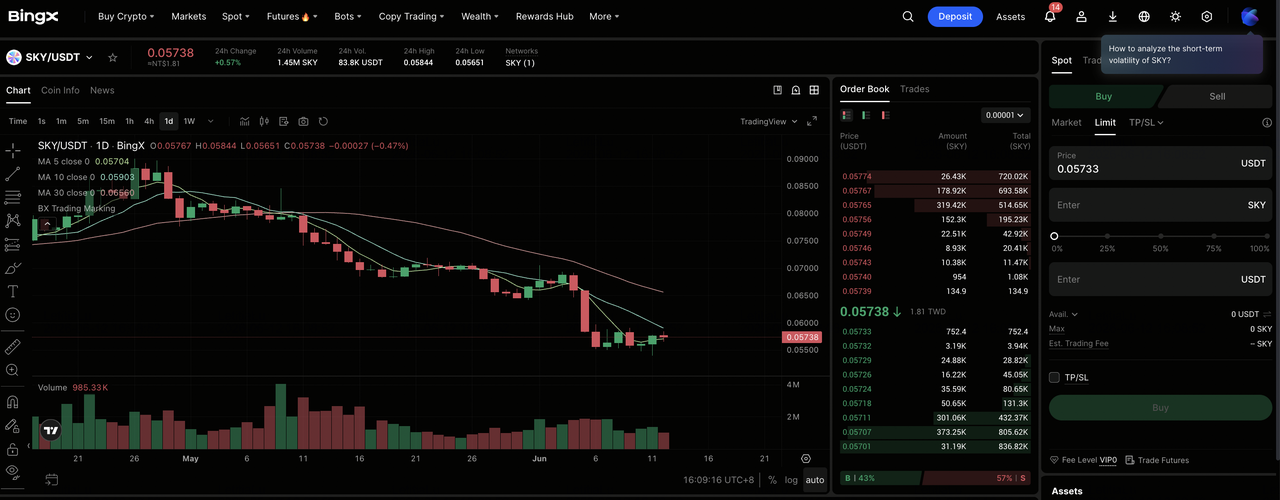
Step 1: Account setup and security. Sign up and log into your BingX account, complete the identity verification (KYC) required in your region, and enable two-factor authentication.
Step 2: Fund your spot account. Deposit USDT or another supported asset into your BingX spot account. Where available, users can also use supported fiat on-ramp options.
Step 3: Navigate to the spot market. Search for the SKY/USDT trading pair.
Step 4: Place your order. Choose a market order to buy SKY immediately at the current price, or use a limit order to set the price you want to pay.
Step 5: Manage your SKY. Once filled, your SKY appears in your spot account. You can keep it on BingX for convenience or withdraw it to a personal wallet for self-custody.
Futures Trading: Trade SKY Price Movements
For active traders, BingX offers USDT-margined SKY perpetual futures. Futures allow users to trade SKY price movements without holding the underlying asset, with the flexibility to open long positions if they expect SKY to rise or short positions if they expect SKY to fall.
Because futures involve leverage, they can amplify both gains and losses. This approach is more suitable for traders who already have a clear risk plan and understand liquidation risk, particularly for an asset like SKY that is sensitive to both DeFi sentiment and broader shifts in stablecoin regulatory developments.
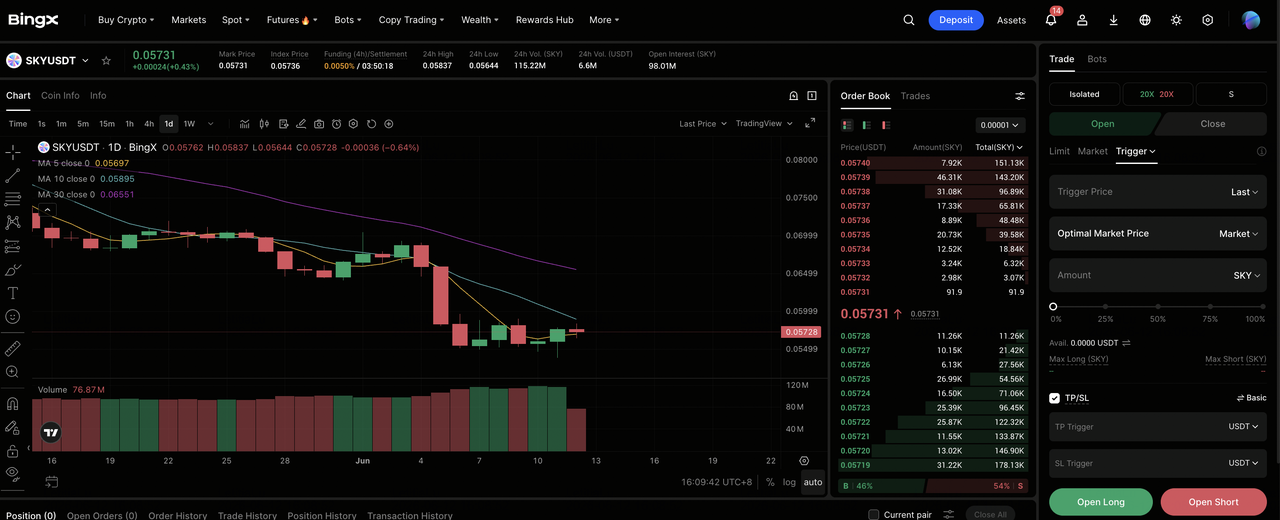
Step 1: Transfer collateral. Move USDT from your spot account into your futures account, where it will serve as margin.
Step 2: Select the contract. Search for the SKY-USDT perpetual contract.
Step 3: Set direction and leverage. Open long if you expect SKY to rise, or open short if you expect SKY to decline. Choose leverage based on your risk tolerance and position size.
Step 4: Execute the trade. Enter the order amount and choose a market or limit order depending on your trading plan.
Step 5: Manage risk. Set stop-loss and take-profit orders before or immediately after entering the position. Profit and loss settle dynamically in USDT.
Risks and Considerations Before Investing in Sky (SKY)
Sky has strong DeFi roots and a growing USDS ecosystem, but SKY still carries risks around governance, yield, regulation, competition, and buyback demand.
- Governance migration risk: SKY voting is still transitioning from the legacy MKR governance system. Until migration is complete, SKY’s direct governance role remains limited.
- Interest rate sensitivity: The Sky Savings Rate depends heavily on RWA and Treasury-linked yield. If interest rates fall, USDS and sUSDS yields may become less attractive.
- Smart contract and collateral risk: Sky manages large pools of crypto and RWA collateral. Oracle failures, liquidations, exploits, or collateral shocks could affect USDS stability and protocol TVL.
- Stablecoin regulatory risk: USDS could face regulatory pressure in major markets, especially as governments tighten rules around decentralized and yield-bearing stablecoins.
- Stablecoin competition: USDS competes with USDT, USDC, FRAX, and Ethena’s USDe. Higher liquidity or stronger yields elsewhere could pull capital away from Sky.
- Buyback dependency: SKY demand is partly supported by protocol buybacks. If revenue falls or governance redirects surplus to reserves, buyback support could weaken.
Final Thoughts: Should You Invest in Sky Protocol in 2026?
Sky Protocol is one of DeFi’s most important infrastructure projects, carrying MakerDAO’s long track record into a new modular system built around USDS, SKY, Spark, RWAs, and the Sky Savings Rate. With USDS supply in the $9 billion to $11 billion range, Sky TVL reaching $7.52 billion, Spark Savings TVL at $6.4 billion, and more than one billion SKY bought back through revenue-funded repurchases, Sky has shown that the rebrand is more than a cosmetic change.
For anyone evaluating SKY in 2026, the key question is whether the Endgame transition can fully complete and whether USDS adoption can keep growing as interest rates shift. Sky’s strengths are clear: deep DeFi history, RWA-backed yield, Spark’s lending scale, and a transparent buyback mechanism. The risks are also clear: incomplete SKY governance migration, SSR sensitivity to rate cycles, stablecoin regulation, and competition from other yield-bearing stablecoins. Whether users buy SKY through spot, hold USDS through the Sky Savings Rate, or trade SKY futures, understanding the link between protocol revenue, buybacks, and token value is essential before investing.
Related Reading
- Top 7 Ethereum DeFi Projects to Watch in 2026
- What Are the Top Yield‑Bearing Stablecoins to Earn Passive Income in 2026?
- What Is DeFi (Decentralized Finance)? 8 Types of DeFi Protocols to Know
- What Is Dai (DAI) in 2026? Complete Beginner's Guide to the Leading Decentralized Stablecoin
- Understanding 6 Different Types of Stablecoins: A 2026 Breakdown
FAQs on Sky Protocol (SKY) and the MakerDAO (MKR) Migration
1. Which blockchain are SKY and USDS on?
SKY and USDS are Ethereum-based tokens. Sky Protocol runs on Ethereum, and the official docs also describe SkyLink bridging for USDS and sUSDS between Ethereum and Base.
2. Can I still use MKR?
Yes. MKR can still be upgraded to SKY through the official Sky upgrade flow. The conversion rate is 1 MKR = 24,000 SKY, but a delayed upgrade penalty now applies to late conversions.
3. When is the last date to convert MKR to SKY?
There is no single hard deadline stated in the official timeline. Instead, Sky introduced a delayed upgrade penalty starting on September 18, 2025, beginning at 1% and increasing by another 1% every three months. The official penalty page says this continues until it reaches 100% in 25 years.
4. Is DAI still usable?
Yes. DAI still exists as the legacy stablecoin from MakerDAO, and Sky supports upgrading DAI to USDS. The Sky app also explicitly supports upgrading DAI to USDS and MKR to SKY.
5. Should I convert my DAI to USDS?
It depends on your use case. Users may prefer USDS if they want access to Sky features such as the Sky Savings Rate and Sky Token Rewards. Users may keep DAI if they rely on existing DAI integrations, liquidity, or DeFi apps that have not fully migrated to USDS. Sky’s own site highlights USDS access to Sky Token Rewards and the Sky Savings Rate, so the main benefit of converting is access to the new Sky ecosystem features.
