

Pixels (PIXEL) is a generational Web3 gaming platform that reimagines the classic farming simulator as a decentralized, community-driven metaverse. Built on the Ronin Network, Pixels has scaled to over 1 million daily active users (DAU) as of March 2026 by prioritizing fun-first gameplay and true asset ownership. Unlike traditional games where in-game progress is locked, Pixels allows players to own their land, pets, and resources as NFTs, creating a tangible bridge between virtual labor and real-world value.
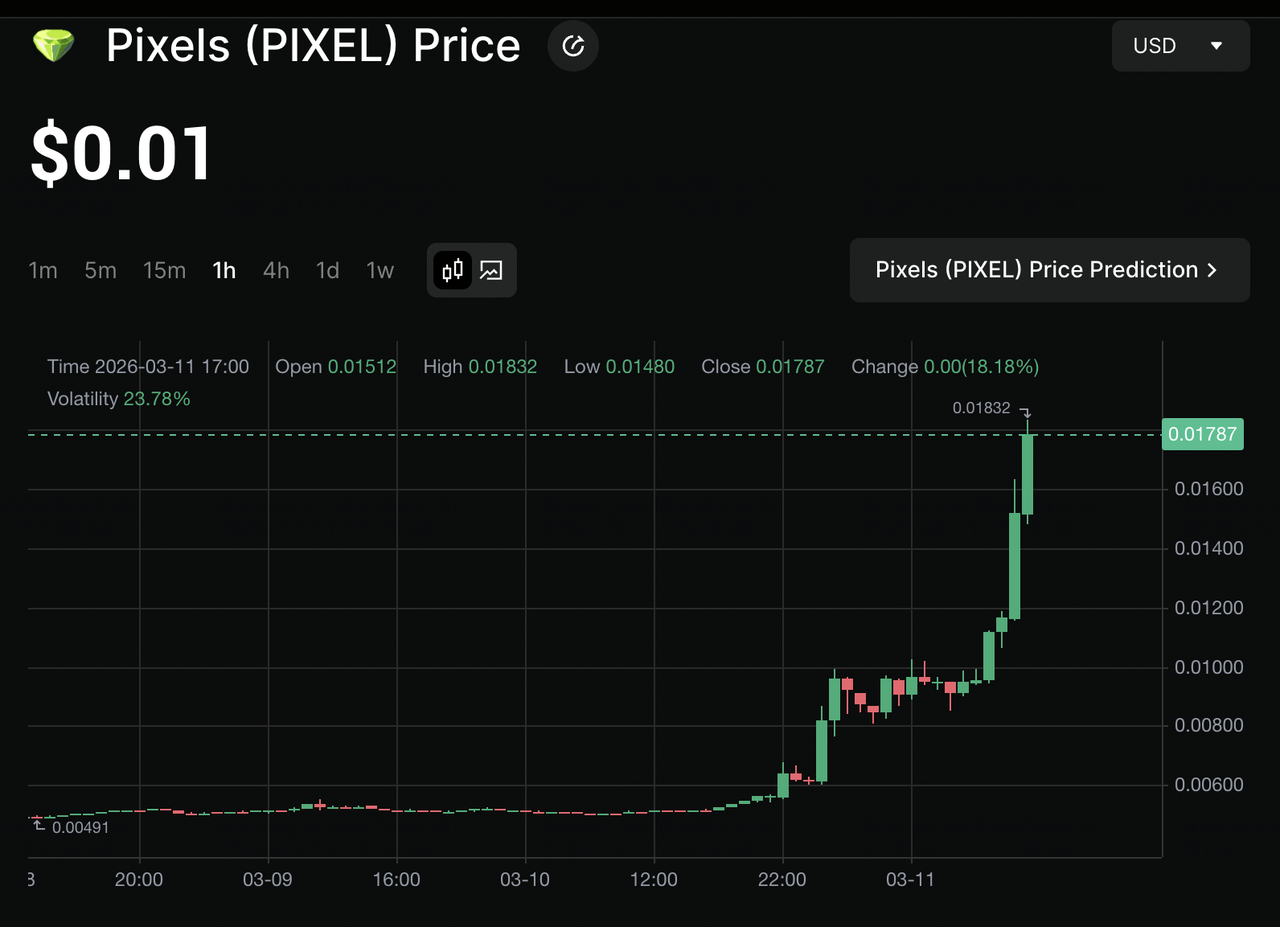
$PIXEL price surge | Source: BingX
As of March 11, 2026, $PIXEL has emerged as a top performer in the GameFi sector, staging a parabolic 193% rally in 24 hours. Driven by a 6,000%+ explosion in trading volume, the token is currently leading a rotation into high-beta gaming narratives. This surge is backed by the project’s strategic Chapter 2 pivot, which replaced speculative extraction models with a data-driven ecosystem where $PIXEL acts as the primary utility and governance engine for a multi-game publishing hub.
This article breaks down the mechanics of the Pixels universe, how to play and earn rewards in the Chapter 2 era, the utility of the $PIXEL and $vPIXEL tokens, and a guide on how to trade Pixels (PIXEL) on BingX spot and futures markets.
What Is Pixels (PIXEL) and How Does It Work?
Pixels functions as a decentralized virtual world where social interaction and resource management drive the economy. By evolving from a single farming game into a multi-game publishing platform, Pixels solves the sustainability crisis of early Web3 games. It operates through three core pillars:
• The RORS Meta-Engine: Pixels uses a unique Return on Reward Spend (RORS) metric. The goal is to ensure every $PIXEL token distributed as a reward generates at least $1.00 in protocol revenue via fees and sinks, creating a self-sustaining loop rather than an inflationary spiral.
• Multi-Game Staking: In a departure from traditional staking, $PIXEL holders can stake their tokens into specific Game Validators. This allows the community to vote on which games receive ecosystem resources, effectively decentralizing the publishing process.
• Asset Interoperability: Through the Pixels Events API, player data and assets are portable. A player's reputation and progress in the core farming game can unlock perks in partner titles like Pixels Pals or Forgotten Runiverse.
The platform’s growth is anchored in verifiable activity. In 2026, the ecosystem has expanded into Chapter 3 development, introducing combat mechanics and procedurally generated Exploration Realms to keep long-term players engaged beyond the initial farming loop.
How to Play Pixels Game and Earn Rewards
Pixels offers a tiered earning structure that rewards skill, time, and strategic asset management.
1. The Farming Loop: Active Play
Players start in the central hub of Terra Villa. By planting crops like Popberries, gathering resources (wood/stone), and crafting items, players build their skills.
• Task Board: The primary way to earn $PIXEL. Players fulfill orders at Buck’s Galore by delivering specific resources. Higher-tier orders require advanced skill levels, e.g., Level 35 Farming.
• VIP Access: While the game is free-to-play, core earning opportunities and the ability to withdraw tokens are gated behind a VIP Membership, which can be purchased with $PIXEL or WRON.
2. Multi-Game Staking: Passive and Strategic Earnings
Users can stake $PIXEL into different game pools to earn a share of the monthly ecosystem rewards, currently capped at 28 million $PIXEL/month as of March 2026.
• Land Boost: Owning a Farm Land NFT provides a 10% staking power boost of up to 100k $PIXEL per land.
• Dynamic Distribution: Rewards are split based on the total $PIXEL staked to each game, encouraging studios to build high-quality experiences to attract stakers.
3. $vPIXEL and Apptokens
To reduce sell pressure, Pixels introduced $vPIXEL, a fee-free spend-only token.
• Fee-Free Utility: Players can withdraw rewards as $vPIXEL with a 0% fee to spend on in-game upgrades, pets, or staking.
• The Farmer Fee: Direct withdrawals of $PIXEL are subject to a heavy Farmer Fee of 20%–50%, which is redistributed to $PIXEL stakers.
What Is the $PIXEL Token Utility?
The $PIXEL token is a capped-supply asset (5 billion) that serves as the lifeblood of the Ronin-based metaverse.
• Premium Currency: Used to mint high-value NFTs like Pets, purchase VIP memberships, and unlock exclusive crafting recipes.
• Ecosystem Governance: Stakers influence the distribution of ecosystem rewards and the onboarding of new partner games.
• In-Game Sinks: Spent $PIXEL is split: 80% goes to the Community Treasury (DAO) and 20% is recycled back into the Ecosystem Rewards pool.
• Staking Validator Power: $PIXEL is used to support individual games, acting as a signal of game quality and community trust.
Pixels (PIXEL) vs. Traditional Web2 Games: Key Differences
| Feature | Traditional Games (e.g., Stardew Valley) | Pixels (PIXEL) |
| Asset Ownership | Centralized; progress is deleted if the server shuts down. | Decentralized; Land and Pets are NFTs owned by the player. |
| Economy | One-way spending; no way to extract value. | Circular; players can earn $PIXEL and trade it on global markets. |
| Governance | Top-down developer decisions. | Community-driven; stakers vote on reward allocations. |
| Platform Scope | Single-game experience. | Multi-game hub; one token used across an entire ecosystem. |
Traditional Web2 games operate as walled gardens where player effort is a sunk cost; items and currency are licensed to the user but remain the property of the publisher. In contrast, Pixels (PIXEL) transitions to an ownership model where Farm Land NFTs and resources are verifiable on-chain assets. Beyond simple ownership, Pixels utilizes a Return on Reward Spend (RORS) metric, currently targeting a ratio $> 1.0$, to ensure that for every token rewarded, the ecosystem generates more than $1.00 in fee revenue. This creates a circular, data-driven economy where players act as stakeholders rather than mere consumers, with their in-game labor directly influencing the protocol’s treasury and growth.
While Web2 giants like Stardew Valley or FarmVille rely on top-down development and centralized servers, Pixels functions as a decentralized publishing hub on the Ronin Network. Practically, this shifts the power from a single studio to the community through $PIXEL staking. Players don't just play the game; they stake tokens into specific game validators to determine which titles receive ecosystem incentives. By integrating the Pixels Events API, player data becomes portable across multiple games, allowing for a publishing flywheel where user acquisition costs are slashed by leveraging shared, on-chain behavioral data, a feat impossible for isolated Web2 databases.
What Is Pixels (PIXEL) Tokenomics?
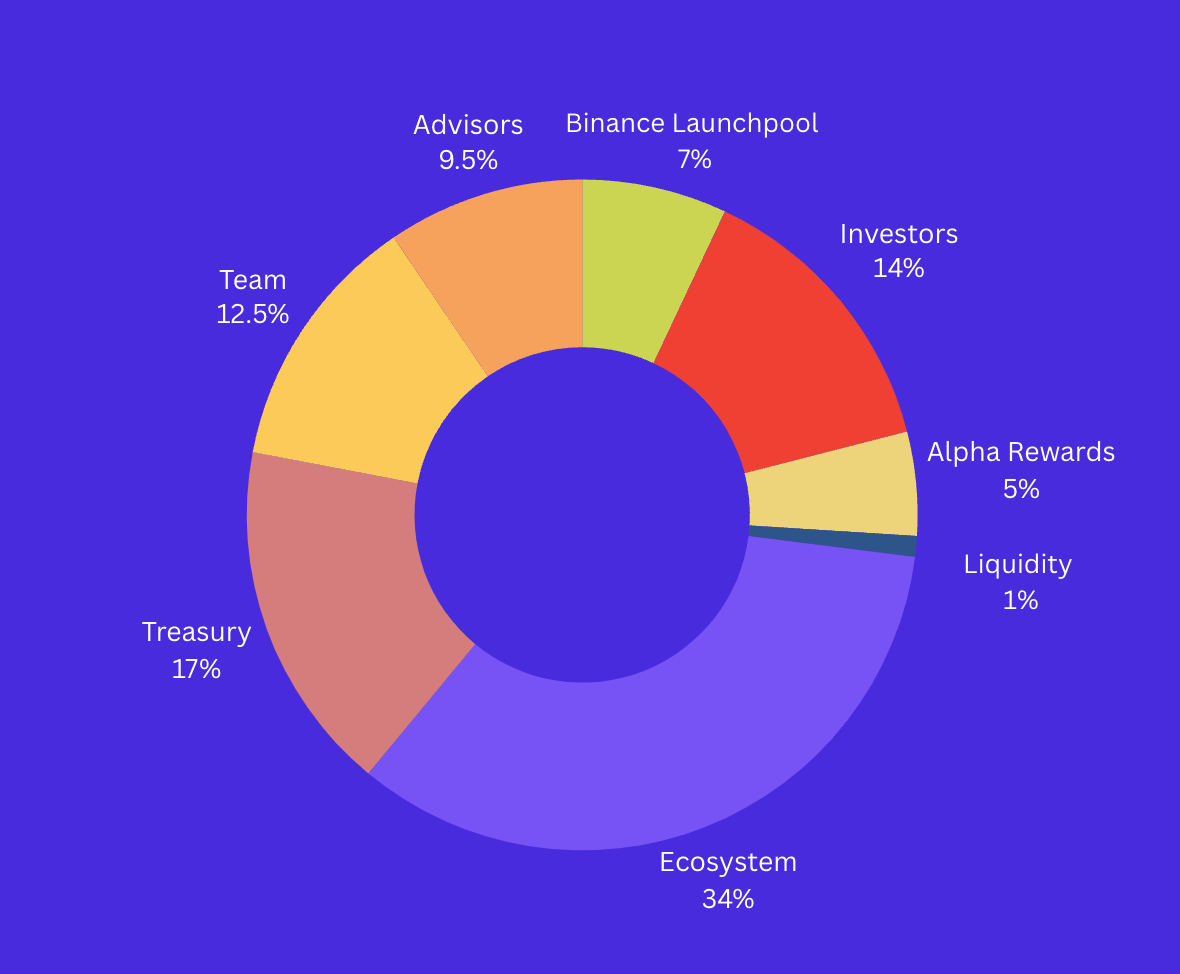
PIXEL token distribution | Source: Pixels docs
The $PIXEL token is a capped-supply utility asset with a maximum total supply of 5,000,000,000 tokens, all of which are vested on-chain using a predetermined 60-month unlock schedule.
• Ecosystem Rewards (34%): The largest allocation, dedicated to incentivizing gameplay, staking, and decentralized publishing.
• Treasury (17%): Community-owned funds managed by a DAO for long-term ecosystem development.
• Investors (14%): Allocated to private backers who supported the project’s initial growth.
• Team (12.5%): Reserved for the core developers, subject to long-term vesting to ensure alignment.
• Advisors (9.5%): Designated for strategic partners and industry experts.
• Binance Launchpool (7%): Distributed to the community during the initial token generation event (TGE).
• Alpha Rewards (5%): Rewards for early adopters and testers of the Pixels universe.
• Liquidity (1%): Reserved to ensure stable trading pairs on centralized and decentralized exchanges.
How to Trade Pixels (PIXEL) on BingX
Take advantage of $PIXEL's high-beta volatility and the Ronin ecosystem's growth by trading on BingX, where you can leverage BingX AI insights to identify optimal entry points and navigate the evolving Web3 gaming narrative.
Buy or Sell PIXEL/USDT on Spot Trading
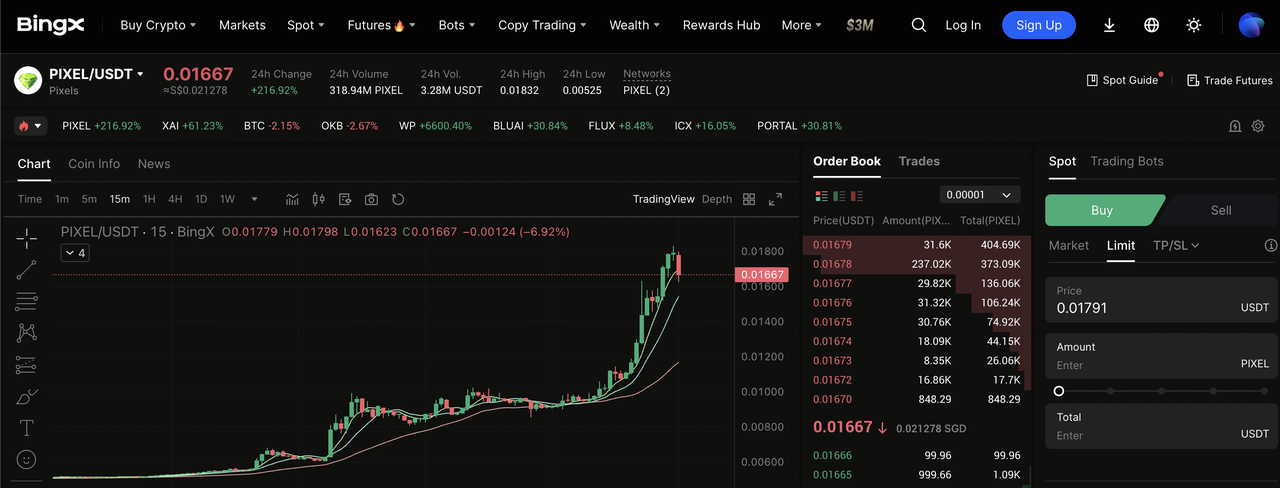
PIXEL/USDT trading pair on the spot market
1. Deposit: Move USDT into your BingX account.
2. Search: Look for the PIXEL/USDT pair in the Spot market.
3. Execute: Buy $PIXEL to participate in the staking ecosystem or hold for potential price appreciation.
Long or Short PIXEL Perpetuals on the Futures Market
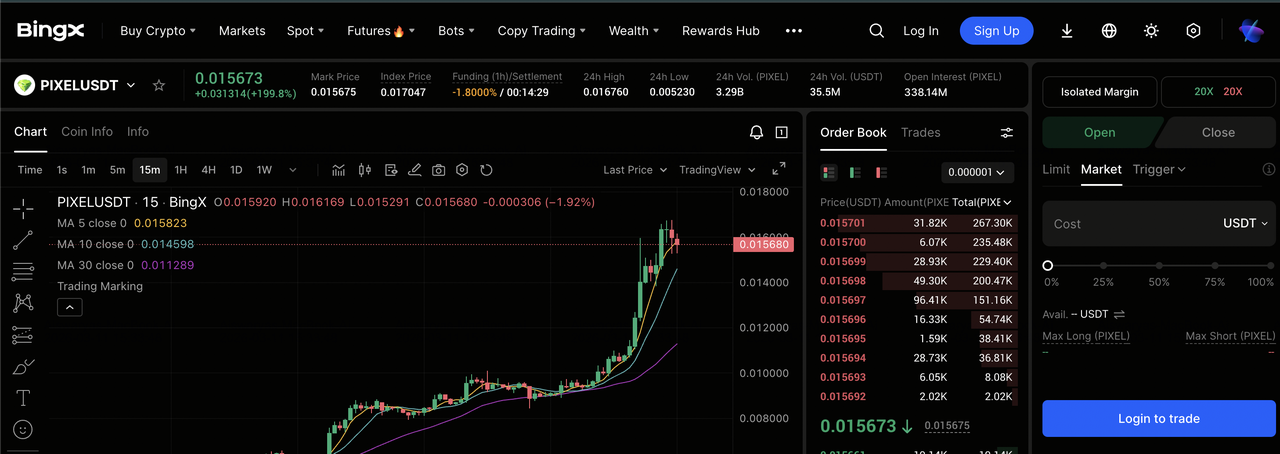
PIXEL/USDT perpetual contract on the futures market
For traders looking to capitalize on $PIXEL's vertical moves:
1. Transfer: Move USDT to your Futures account and select PIXEL/USDT perpetual contract.
2. Select Leverage: Choose your leverage, e.g., 2x to 10x.
3. Manage Risk: Use Stop-Loss orders to protect against sharp retracements toward key support zones.
3 Key Considerations Before Trading $PIXEL
Beyond short-term price volatility, long-term success in the Pixels ecosystem depends on fundamental economic sustainability and the careful management of token emissions.
1. RORS as a Valuation Floor: Unlike traditional GameFi, $PIXEL’s long-term value is tethered to Return on Reward Spend (RORS). If the project maintains a RORS > 1.0, it proves the game is generating more revenue than it is emitting in rewards, effectively transitioning the token from a speculative asset to a sustainable ecosystem utility.
2. Emission and Unlock Pressure: With only a portion of the 5 billion token supply currently circulating, traders must account for the 60-month vesting schedule. Large cliff unlocks, particularly from the 14% Investor and 12.5% Team allocations, can create significant overhead resistance, requiring a proportional increase in platform revenue to offset new supply entering the market.
3. Staking-to-Revenue Ratio: The health of the Publishing Flywheel relies on the ratio of staked $PIXEL to active in-game spending. Monitor the effectiveness of the Farmer Fee and the adoption of $vPIXEL; if players choose $vPIXEL for reinvestment over $PIXEL for extraction, it signals a maturing economy that can withstand broader market downturns.
Conclusion: The Future of the Pixels Ecosystem
The transition of Pixels from a standalone farming title into a data-centric publishing hub represents a significant shift in the Web3 gaming landscape. By implementing the RORS (Return on Reward Spend) framework and the $vPIXEL spend-only token, the ecosystem has moved away from the hyper-inflationary pitfalls of early GameFi toward a model focused on sustainable revenue and player retention. As the platform integrates Chapter 3 end-game content and scales its first-party titles like Pixels Pals, its success will largely depend on whether these economic sinks can continue to outpace token emissions and maintain a net-positive value loop for stakers.
Despite the project’s robust technical roadmap and current market momentum, the intersection of blockchain gaming and speculative trading remains a high-volatility environment. Future performance is contingent on consistent user growth, the successful decentralization of its staking pools, and the broader health of the Ronin Network ecosystem.
Risk Reminder: Cryptocurrency investments, particularly in the altcoin and GameFi sectors, carry substantial risk. Market sentiment can shift rapidly, and rapid price surges, such as the spike seen in March 2026, are often followed by significant volatility. Always employ strict risk management and only trade with capital you can afford to lose.
Related Reading
1. Top Web3 Games in the GameFi Sector to Watch in 2026
2. What Is Audiera (BEAT) and How to Play the AI-Powered Dance Metaverse?
3. Axie Infinity (AXS) Explained: What It Is, How to Play Origins, and How Rewards Work in 2026
4. Top Gaming Blockchain Networks in 2026: List and Stats to Know
5. What Is Dropee Telegram Game, and How to Earn $DROPEE Airdrop Rewards?
