

Perle (PRL) is a high-integrity data coordination protocol designed to replace opaque, black-box AI training pipelines with human-verified, blockchain-auditable datasets. In an era where AI models are increasingly poisoned by synthetic content and unverified data, Perle Labs provides a transparent alternative for governments, healthcare providers, and frontier AI labs that require absolute data provenance.
On March 25, 2026, Perle reached its most significant milestone: the Token Generation Event (TGE) for the $PRL token. Following a massive Season 1 Perle airdrop campaign that saw over 1.7 million tasks completed and 330 million points distributed, the protocol has officially transitioned into a decentralized expert economy on the Solana blockchain. Backed by $17.5 million in funding from Framework Ventures and CoinFund, Perle is now the leading infrastructure play for verifiable AI.
This article examines how Perle’s 'Human-in-the-Loop' philosophy prevents model degradation, the mechanics of its on-chain reputation system, what the $PRL token launch means for the future of the AI supply chain, and how to trade Perle (PRL) on BingX.
What Is Perle (PRL) Sovereign AI Layer?
Perle Labs (PRL) functions as a high-performance sovereign data layer on Solana, engineered to solve the model collapse crisis by delivering a 30% improvement in model accuracy through expert-verified datasets. Unlike traditional crowdsourcing, Perle utilizes a vetted network of over 1 million annotators, including 2,500+ physicians and 530+ specialists, to produce a billion traceable data points. This 'Expert-in-the-Loop' approach has been benchmarked to outperform automated tagging systems by over 70%, ensuring high-fidelity results for critical sectors like healthcare, law, and robotics.
By integrating blockchain-native accountability, the protocol achieves a 20% reduction in annotation errors and 10x faster data indexing compared to legacy pipelines. This infrastructure allows enterprises to scale training datasets with a 99.9% accuracy rate, while immutable on-chain reputation scores ensure that high-stakes tasks are routed to the most qualified contributors. For institutional clients, this translates into an average of $600,000 in annual cost savings, replacing opaque black-box data sources with a fully auditable and verifiable supply chain.
The project was founded by veterans of Scale AI, the $30 billion industry giant. By bringing the Scale AI playbook on-chain, Perle solves three critical risks in modern AI:
- Model Collapse: Preventing AI from training on its own synthetic output, which leads to hallucinations.
- Data Poisoning: Eliminating adversarial or biased data through multi-layered human verification.
- Auditability: Providing a tamper-resistant ledger on Solana so regulators can trace every high-stakes AI decision back to accountable human judgment.
As of March 2026, $PRL has seen explosive growth, listing on major exchanges like BingX, with a circulating supply of 175 million tokens or 17.5% of total supply at launch.
How Does the Perle Data Ecosystem Work?
At its core, Perle is a modular stack designed to transform human expertise into a programmable asset:
- Data and Task Layer: This layer ingests petabytes of raw data, including text, medical images, video, and sensor streams, and organizes them into task workflows. It is designed to be 10x faster than traditional indexing methods.
- Coordination and Reputation Layer: This is the brain of Perle. It uses a multi-dimensional reputation system to route tasks. For example, a legal annotation task isn't sent to the cheapest worker; it’s routed to a contributor with a high 'Legal Specialist on-chain score.
- Settlement and Record Layer: Every annotation and verification is recorded on the Solana blockchain. This creates an immutable Proof of Work for each data point, allowing enterprise clients to verify the quality of their training sets in real-time.
- Application Layer: Provides user-friendly dashboards and SDKs for AI labs and developers to plug Perle's verified data directly into their model training pipelines (RLHF).
What Is the PRL Token Used For?
The $PRL token is the incentive engine of the sovereign intelligence layer. Its utility includes:
- Contributor Rewards: Experts earn $PRL for completing high-accuracy tasks. Unlike gig work, these rewards are escrowed in smart contracts and guaranteed upon verification.
- Platform Access & Priority: Holding $PRL grants enterprises and AI labs priority access to Premium Expert Guilds and early access to new data schemas or safety benchmarks.
- On-Chain Reputation: In the Perle ecosystem, $PRL acts as a coordination asset where high-reputation contributors can gain token exposure that aligns their long-term interests with the network’s growth.
- Governance: Token holders through the Perle Foundation, a non-profit steward, influence the protocol's strategic direction, including new vertical expansions into sectors like defense or healthcare.
What Is Perle (PRL) Tokenomics?
The $PRL token features a hard-capped supply of 1,000,000,000 (1 billion). The distribution is designed for long-term alignment, with strict vesting schedules for insiders.
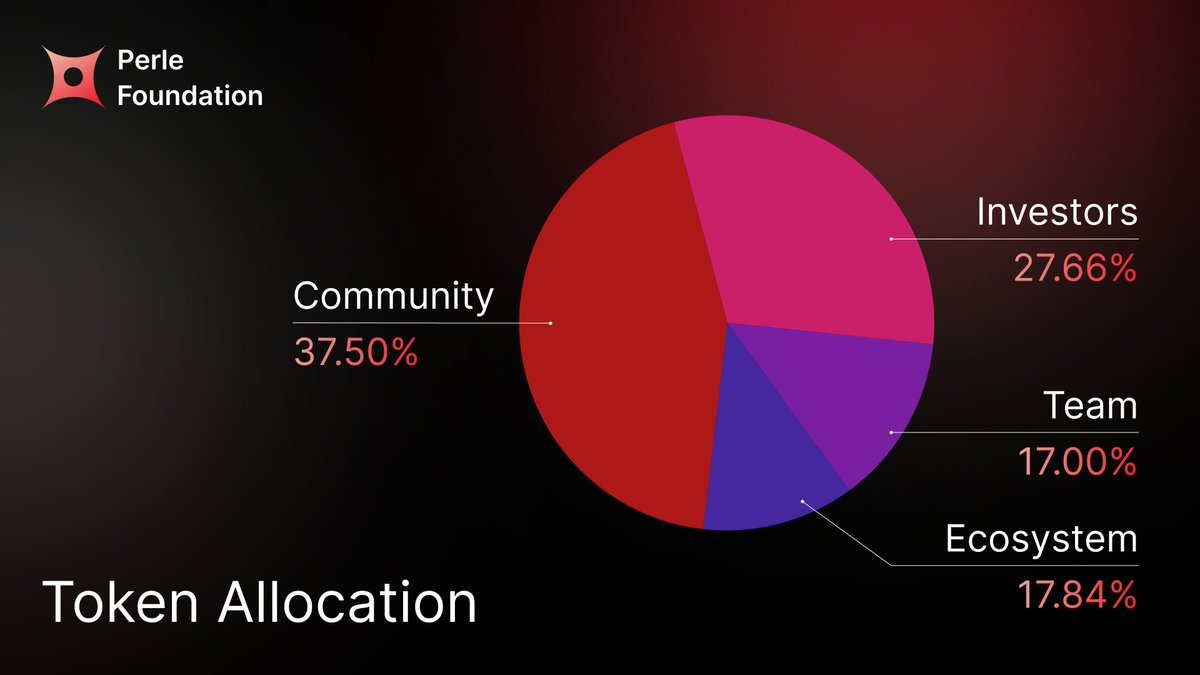
PRL token allocation | Source: Perle litepaper
PRL Token Distribution and Vesting Schedule
- Community (37.50%): The largest allocation, dedicated to contributor rewards and early user incentives. 7.5% (75 million PRL) is released immediately at TGE to provide initial liquidity and reward early adopters, with the remainder vesting linearly over 36 months.
- Investors (27.66%): Allocated to the strategic partners who funded the protocol's $17.5 million seed and private rounds. These tokens are subject to a 12-month cliff, followed by 36 months of linear monthly vesting to ensure long-term capital alignment.
- Ecosystem (17.84%): Reserved for strategic partnerships, liquidity provision, and protocol growth. 10% (100 million PRL) is unlocked at TGE to facilitate exchange depth, with the remaining balance vesting over 48 months.
- Team (17.00%): Allocated to the founding Scale AI veterans and core developers. Mirroring the investor schedule, these tokens face a strict 12-month cliff and a 36-month linear unlock, totaling a 4-year commitment to the Sovereign Intelligence mission.
The circulating supply on Day 1 is exactly 17.5%. Because the team and investor tokens are locked behind a 12-month cliff, there is zero scheduled insider sell pressure throughout 2026. This structure prioritizes early community contributors and active data annotators.
What Is the Perle Airdrop and How to Claim PRL Tokens?

The Perle ($PRL) Airdrop is a community distribution designed to reward early contributors who helped build the protocol’s sovereign intelligence data layer. Eligibility is primarily based on participation in Season 1, which ran from January to March 2026. This includes users who completed specialized data verification tasks, such as medical imaging interpretation or legal document analysis, accumulated Perle Points, and maintained a high on-chain reputation score. Additionally, participation in official Galxe quests and community voice campaigns like #PerleAI served as key qualification criteria to filter for genuine human experts and prevent automated Sybil registrations.
The key window for the airdrop began on March 18, 2026, when the registration portal officially opened. Eligibility verification and an appeal process for not eligible tags ran until March 24, 2024, at 10:00 UTC, at which point registrations were finalized. The Token Generation Event (TGE) and the official claim portal went live on March 25, 2026. Eligible users can currently claim 20% of their allocation immediately, while the remaining 80% is subject to a linear vesting schedule over 36 months; though users can opt for a 6-month Visionary lock to align with the protocol’s long-term growth.
How to Claim Perle ($PRL) Airdrop Rewards
The $PRL claim portal went live on March 25, 2026, for Season 1 participants.
- Access the Portal: Visit the Perle airdrop claim and connect a Solana-compatible wallet, e.g., Phantom, Solflare, or Backpack.
- Verify Socials: Link the Discord or X accounts used during the contributor campaigns.
- Check Allocation: The portal will display your Total Allocation, Claimable (20%), and Locked (80%) amounts.
- Choose Your Path:
- Option A: Claim 20% immediately.
- Option B: Commit to the 6-month Visonary lock to align with long-term protocol growth.
- Confirm on Solana: You will need approximately 0.002 SOL for gas fees. You can buy Solana on BingX and transfer you tokens to fund your wallet before claiming the PRL token airdrop.
How to Trade Perle (PRL) on BingX
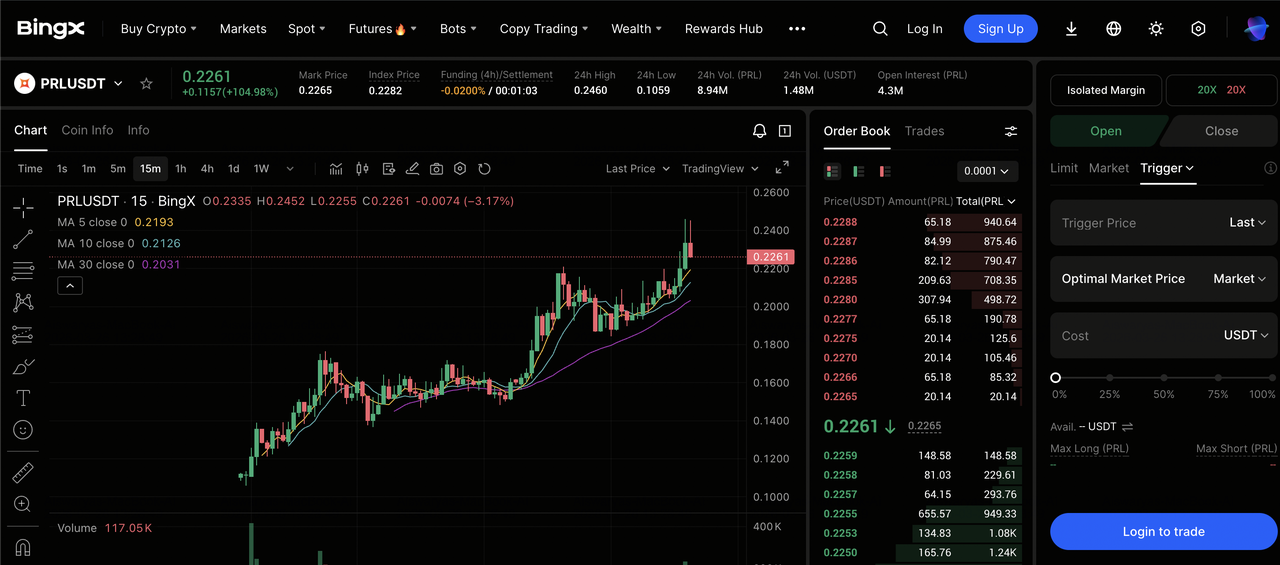
PRL/USDT perpetuals on the futures market
By integrating BingX AI-powered trend analysis, traders can now navigate the $PRL token's high-fidelity data cycles with institutional-grade risk management and real-time momentum insights.
Long or Short Perle Perpetuals on BingX
- Access the Trading Terminal: Log in to your BingX account, navigate to the Futures tab, and select Perpetual Futures. Search for the PRL/USDT perpetual contract.
- Configure Your Margin: Choose between Isolated Margin to cap risk on a specific trade or Cross Margin to utilize your entire available balance.
- Set Your Leverage: Select your desired leverage, e.g., up to 20x, to amplify your market exposure, keeping in mind that higher leverage increases liquidation risk.
- Execute the Trade: Analyze the market using BingX’s technical tools; click Open Long if you anticipate the Expert Economy will drive prices up, or Open Short to hedge against broader AI sector volatility.
- Monitor with AI: Utilize BingX AI to set precise Stop-Loss and Take-Profit levels, ensuring your capital is protected during 24/7 market fluctuations.
Perle vs. Traditional Data Labeling Platforms: Key Differences
| Feature | Perle (PRL) | Traditional Platforms |
| Verification | On-chain Auditable | Centralized/Opaque |
| Incentive | Reputation + Tokens | Hourly/Task-based Wage |
| Contributor | Verified Experts | Anonymous Crowds |
| Tech Stack | Decentralized (Solana) | Proprietary Web2 Cloud |
| Trust Model | Trustless (Blockchain) | Trust-based (Company) |
While traditional platforms like Scale AI and Appen rely on a volume-centric, black-box model, Perle (PRL) introduces a precision-centric, decentralized architecture. Legacy providers typically capture 70% of the value created by annotators, resulting in low worker retention and a speed-over-accuracy bias that frequently triggers model regressions. In contrast, Perle’s Solana-based infrastructure removes intermediaries, allowing contributors to keep 80–90% of their earnings.() This shift has enabled Perle to achieve a 99.9% accuracy rate, outperforming general crowdsourced pipelines by over 70% in high-stakes domains such as medical imaging and autonomous robotics.
The practical differentiator lies in cryptographic accountability. While traditional clients face data ghosting where the identity and qualifications of the annotator are unknown, Perle utilizes on-chain reputation scores and domain-specific Expert Guilds. This ensures that a legal contract is reviewed by a verified professional rather than an anonymous gig worker. For enterprise labs, this transition translates into $600,000 in average annual cost savings by eliminating the need for expensive secondary clean-up cycles and reducing payment settlement times from 30–90 days to a sub-second 400ms on-chain transaction.
5 Key Considerations Before Investing in Perle (PRL)
Before engaging with the $PRL token, investors should evaluate the unique technical, regulatory, and market-driven factors that define Perle’s role as the foundational data layer for the intelligence age.
- The AI Data Moat: As foundation models reach a plateau in raw compute power, the quality of data becomes the only sustainable competitive advantage; Perle owns the infrastructure for that quality.
- Solana Scalability: Perle relies on Solana’s high-performance execution to record data provenance; while efficient, the protocol's uptime is inherently tied to the health of the Solana network.
- Institutional Adoption: Perle is targeting high-stakes government and defense contracts, similar to Scale AI, where success in these regulated sectors could lead to massive, recurring institutional demand for $PRL.
- Vesting Cliffs: While 2026 features low sell pressure due to a community-centric launch, investors should monitor the March 2027 cliff when team and institutional investor tokens begin their linear monthly unlock.
- Model Collapse Hedge: As AI increasingly trains on synthetic, lower-quality content, Perle serves as a critical hedge by providing the human-verified data necessary to prevent model degradation and hallucinations.
Final Thoughts: What Is the Role of Perle in the AI Era?
As of late March 2026, Perle (PRL) has transitioned from a high-growth data protocol into a foundational execution layer for the broader AI economy. By merging an institutional-grade matching engine with a decentralized expert economy, the $PRL token represents a move toward protocol-native utility backed by tangible revenue and high-velocity data volume. Its practical value is structurally tied to the success of its four-layer stack on Solana, which aims to capture market share from legacy providers like Scale AI by offering a unified, auditable environment for high-stakes sectors like healthcare and robotics.
For the strategic participant, the $PRL launch serves as a primary case study for the Sovereign Intelligence thesis, where infrastructure is purpose-built to defend against model collapse and synthetic data loops. The platform's ability to maintain its 99.9% accuracy rate and $600,000 in average annual cost savings for enterprise clients will be the ultimate metric of its sustainability. Success in this ecosystem requires a balanced approach: leveraging Perle’s capital-efficient tools for data verification while remaining vigilant regarding the upcoming March 2027 investor cliffs and the technical stability of its on-chain reputation engine.
Risk Reminder: Digital asset investments, particularly in emerging AI data protocols like $PRL, carry high market risk and price volatility. The value of $PRL may fluctuate significantly following the March 25 TGE and subsequent airdrop claims. Always perform your own research, utilize BingX AI for real-time risk assessment, and only trade capital you can afford to lose. BingX is not responsible for any trading losses incurred.
Related Reading
- Perle Airdrop Goes Live on March 25, 2026: How to Claim PRL Tokens
- What Is Freysa (FAI) Sovereign AI Agent Stack on Base and How to Trade FAI?
- What Is UnifAI Network (UAI) Agentic Finance Layer for Autonomous DeFi and How to Buy?
- Top 7 AI Agent Tokens on Solana to Watch in 2026 Amid the Rise of the Machine Economy
- What Is Fabric's ROBO Token for Empowering the Global Robot Economy and How to Trade ROBO?
