

Internet Computer (ICP) is a Layer-1 blockchain that aims to bring cloud computing onto a decentralized network. Instead of using blockchain only for tokens, DeFi, or smart contracts, Internet Computer is designed to run full applications on-chain, including websites, backend systems, and data storage. Its goal is to offer a decentralized alternative to traditional cloud platforms such as AWS, Google Cloud, and Azure.
This makes ICP one of the more ambitious infrastructure projects in crypto. Backed by the DFINITY Foundation, the network combines on-chain governance, WebAssembly-based smart contracts called canisters, and cross-chain technology such as Chain Fusion. This guide explains what Internet Computer is, how ICP works, why its ecosystem matters, the role of the ICP token, key risks to watch, and how to trade ICP on BingX.
What Is Internet Computer (ICP)?
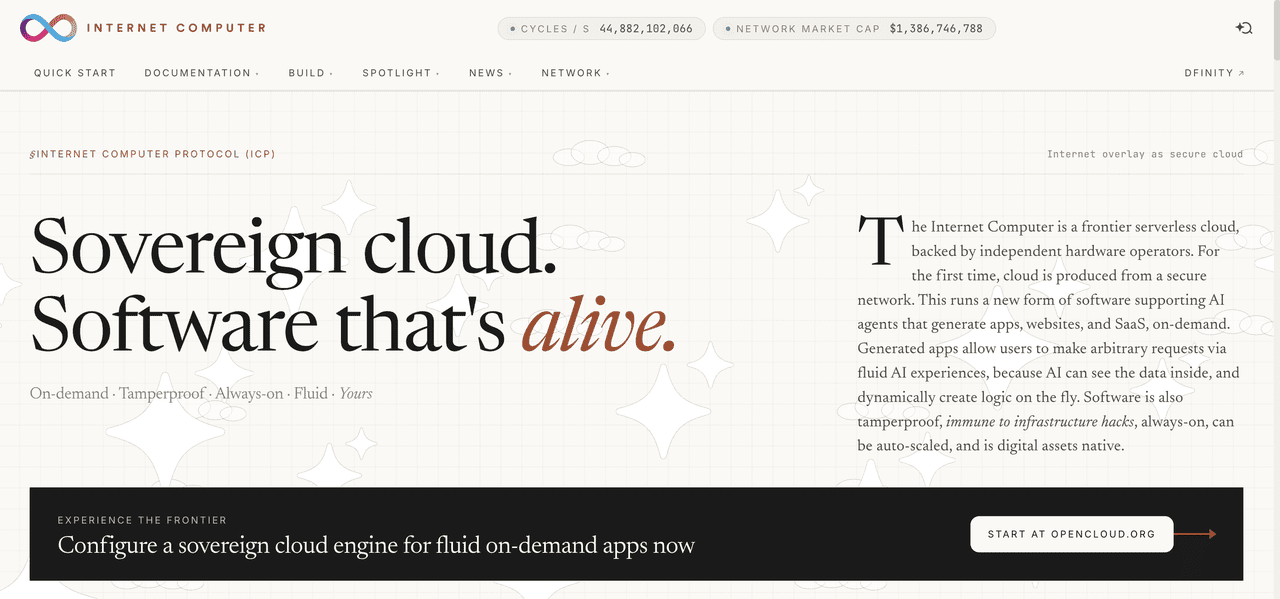
Internet Computer (ICP) is a Layer-1 blockchain protocol developed by the DFINITY Foundation, a Swiss non-profit founded by Dominic Williams in 2016. Its mainnet launched on May 10, 2021, a milestone DFINITY calls “Genesis.” ICP was built as a public alternative to centralized cloud infrastructure, allowing developers to host full decentralized applications on-chain, including front-end interfaces, backend logic, and data storage. Unlike many blockchains that still rely on AWS, Cloudflare, or Google Cloud for parts of the user experience, ICP canisters can serve web content directly to browsers.
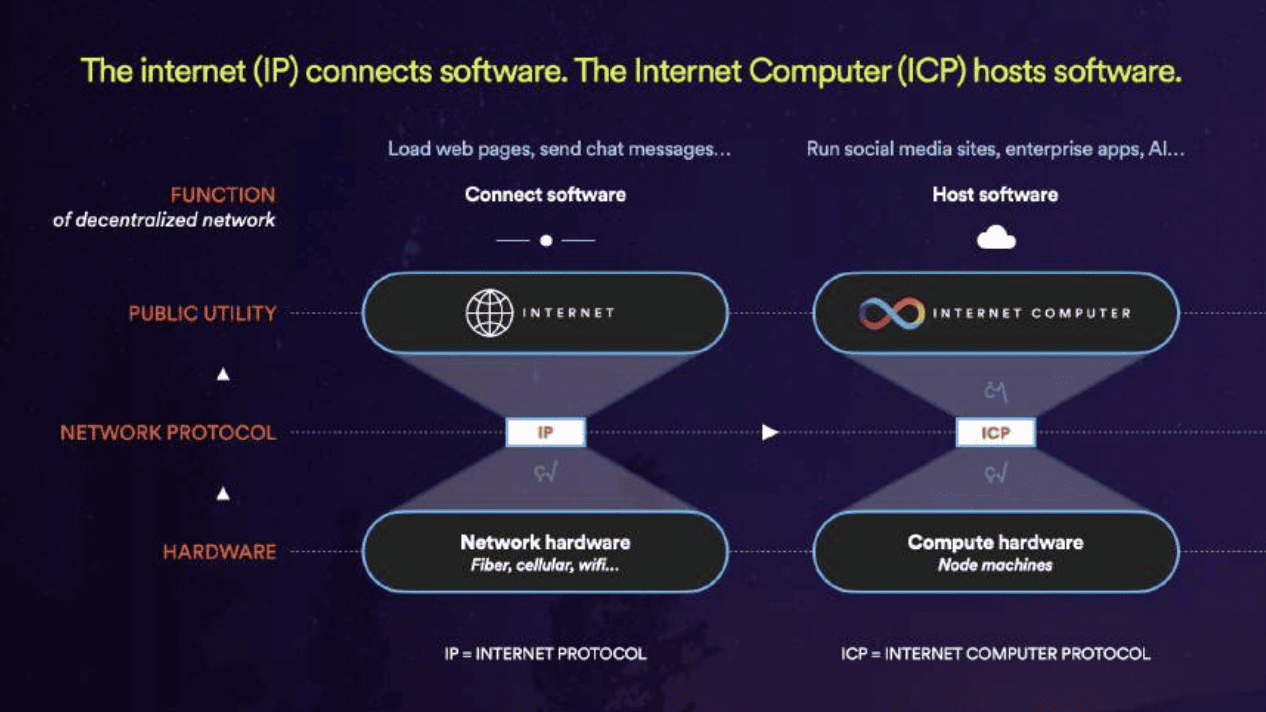
The network runs through independent data centers, where node machines form subnets governed by the Network Nervous System (NNS). By 2026, ICP had processed over one billion transactions in Q1, hosted around 980,000 canister contracts, and introduced Mission 70, a tokenomics upgrade targeting a reduction in annual inflation from about 9.72% to 2.92%–5.42% by the end of 2026. Its recent AI push has also become a key part of the narrative. Through Caffeine AI and the broader “self-writing internet” concept, DFINITY is positioning ICP as a network where AI agents can help generate, deploy, and maintain applications directly on-chain.
Key components of the Internet Computer ecosystem include:
- ICP token: Used for computation, governance, staking, and rewarding node operators.
- Canisters: ICP’s smart contracts, capable of running application logic, storing data, and serving web content.
- NNS: The on-chain governance system that manages protocol upgrades, subnets, and tokenomics.
- Subnets: Groups of node machines that host canisters in a replicated and fault-tolerant environment.
- Chain Fusion: ICP’s cross-chain architecture for interacting with Bitcoin, Ethereum, and Solana without traditional bridges or wrapped tokens.
- Caffeine AI: An AI-powered app creation platform built on ICP, designed to let users create and deploy applications through natural-language prompts.
Read More: Top AI Cloud Infrastructure Stocks to Buy in 2026 Amid Hyperscaler Capex and the Neocloud Boom
How Does Internet Computer Work?
Internet Computer works through a combination of subnet architecture, canister smart contracts, Chain Key cryptography, and a reverse gas model. Together, these features allow ICP applications to run on-chain while offering a user experience closer to traditional web apps than most blockchain networks.
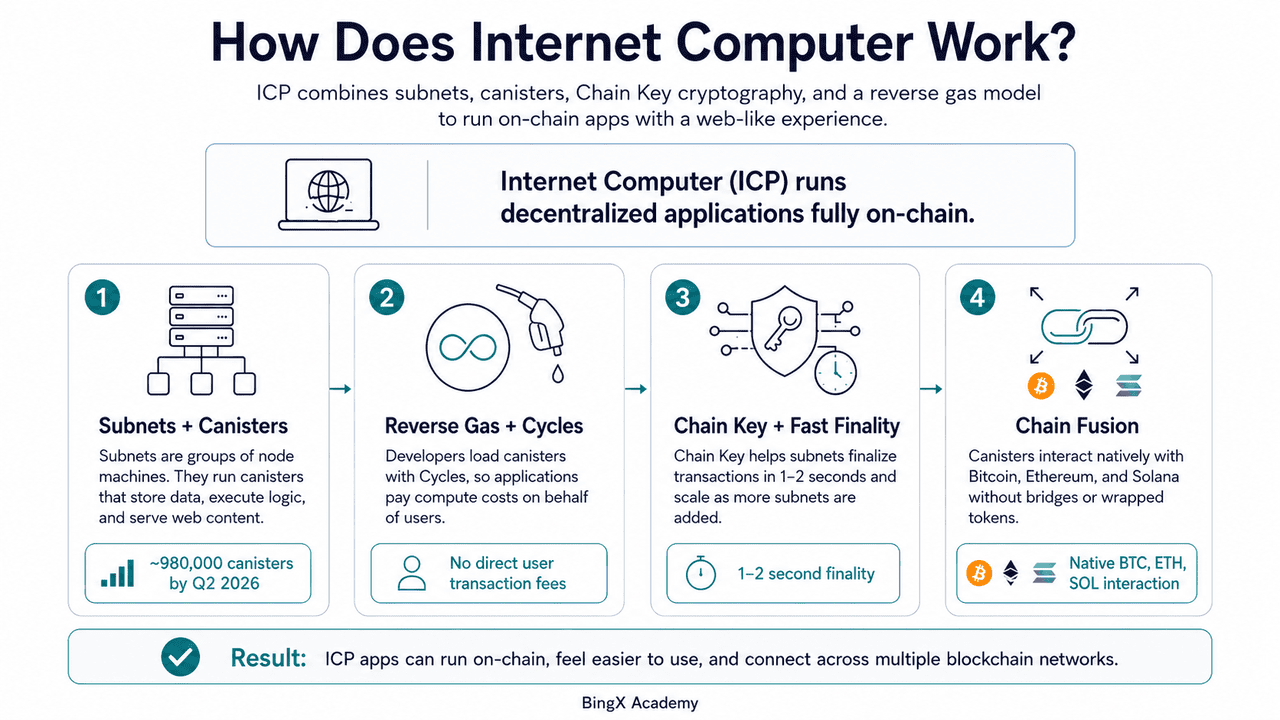
- Subnets and canister smart contracts: Internet Computer is organized into subnets, which are groups of independently operated node machines. These subnets run canisters, ICP’s version of smart contracts. A canister can store data, execute logic, communicate with other canisters, and serve web content directly to users. By Q2 2026, around 980,000 canisters had been deployed across use cases such as decentralized social apps, DeFi, AI agents, and enterprise data systems.
- Reverse gas model and Cycles: Unlike Ethereum, where users pay gas fees for each transaction, ICP uses a reverse gas model. Developers load canisters with Cycles, the computational fuel created by burning ICP, and the application pays the cost for users. This means users can interact with ICP dapps without paying transaction fees directly, making the experience feel more like a normal web application. The trade-off is that developers must manage application costs themselves.
- Chain Key cryptography and fast finality: ICP uses Chain Key cryptography to help subnets finalize transactions quickly without requiring every node to verify the full chain history. This supports one-to-two-second finality and allows throughput to scale as more subnets are added. Chain Key also supports ICP’s cross-chain functions by allowing canisters to interact with assets and networks such as Bitcoin, Ethereum, and Solana.
- Chain Fusion and native cross-chain interoperability: Chain Fusion is one of ICP’s most important recent upgrades. It allows canisters to interact with native Bitcoin, Ethereum, Solana, and other networks without relying on traditional bridges or wrapped tokens. This can reduce bridge-related security risks and positions ICP as a cross-chain infrastructure layer rather than a standalone execution environment.
Major Internet Computer Developments: From Genesis to Chain Fusion and Mission 70
Internet Computer's history spans a decade of research and five years of post-launch development, progressing from a controversial Genesis launch to a maturing infrastructure network with cross-chain capabilities, enterprise cloud integrations, and a governance-driven tokenomics restructuring.
|
- DFINITY Founded (2016–2020): Dominic Williams founded the DFINITY Foundation in Switzerland in 2016 to build a decentralized public cloud alternative. The early years focused on cryptography, distributed systems, and protocol research.
- Genesis Launch (2021): ICP’s mainnet launched on May 10, 2021, in an event DFINITY called “Genesis.” The token attracted major attention at launch but fell sharply afterward, creating a reputational challenge the project has worked to rebuild through technical development.
- Bitcoin Integration and Chain Fusion (2022–2024): ICP introduced native Bitcoin integration through Chain Key cryptography, then expanded cross-chain support to Ethereum, Solana, and other networks through Chain Fusion. This positioned ICP as a multi-chain compute and orchestration layer.
- Caffeine AI and On-Chain AI (2024–2025): DFINITY introduced Caffeine AI, a natural-language app creation tool for building canister-based applications. ICP also advanced on-chain AI inference, supporting AI models and agents that can run inside decentralized smart contracts.
- Storage and Cloud Expansion (2025–2026): The NNS approved a storage upgrade that doubled replicated state storage per subnet. DFINITY also announced Cloud Engines, a framework for sovereign cloud instances designed for autonomous AI agents and enterprise workloads.
- Mission 70 Tokenomics Upgrade (2026): The NNS approved Mission 70 to reduce annual ICP inflation from about 9.72% to 2.92%–5.42% by the end of 2026. The upgrade aims to reduce supply pressure by adjusting staking rewards and increasing the role of Cycles burn.
Internet Computer Ecosystem and Adoption: On-Chain AI, Chain Fusion DeFi, and Enterprise Cloud
Internet Computer’s adoption is driven by three main areas: Chain Fusion DeFi, on-chain AI, and enterprise cloud use cases. Together, they support ICP’s broader goal of becoming a full-stack decentralized computing network, not just another Layer 1 blockchain.
- Chain Fusion DeFi: Chain Fusion brings Bitcoin and Ethereum liquidity into ICP through assets such as ckBTC and ckETH, without relying on traditional bridges. This supports DeFi activity on ICPSwap and Bitfinity EVM, with ICP DeFi TVL growing from around $100 million in 2024 to more than $250 million in 2026.
- On-Chain AI: AI is now one of ICP’s strongest narratives. Caffeine AI lets users build canister-based applications through natural-language prompts, while ICP’s canister model supports AI inference inside smart contracts. Cloud Engines extends this direction toward autonomous AI agents and sovereign cloud workloads.
- Enterprise Cloud: DFINITY is also pushing ICP toward hybrid enterprise infrastructure through Cloud Engines and integrations involving Azure and Google Cloud. Potential use cases include credential verification, data pipelines, and AI workloads that need sovereign or decentralized cloud environments.
- Adoption Challenge: ICP has strong infrastructure metrics, including around 980,000 canisters and over one billion transactions in Q1 2026. The main challenge is turning backend activity into sticky consumer-facing dapps that users return to regularly.
What Are the Internet Computer (ICP) Tokenomics?
ICP tokenomics are governed by the Network Nervous System (NNS). The token has no fixed maximum supply, so its supply is shaped by staking rewards, node operator rewards, Cycles burn, and governance upgrades such as Mission 70.
ICP Token Utility
- Cycles for computation: Developers burn ICP to create Cycles, which power canisters. Higher network usage can increase ICP burn.
- NNS staking: ICP holders can stake tokens in NNS neurons to vote on proposals and earn rewards. Around 63% of circulating ICP supply is staked.
- Node rewards: Data center operators earn ICP for running node machines and providing compute capacity to the network.
- Mission 70: This 2026 upgrade aims to reduce annual inflation from about 9.72% to 2.92%–5.42% by adjusting rewards and increasing the role of Cycles burn.
- Dynamic supply: ICP has no hard cap. Future supply depends on governance decisions, staking rewards, node rewards, and actual network usage.
ICP Token Allocation
|
Holder Category |
Share at Genesis |
Description |
|
DFINITY Foundation |
~23.9% |
Foundation endowment for R&D, operations, ecosystem programs, partnerships, and grants |
|
Internet Computer Association (ICA) |
~4.3% |
Swiss non-profit association supporting the Internet Computer ecosystem |
|
Seed Investors |
~24.7% |
2017 seed participants; received ICP in neurons at Genesis |
|
Team Members |
~18.0% |
DFINITY team members |
|
Early Contributors |
~9.5% |
Early contributors before the Foundation was established |
|
Other investors, partners, advisors, grants, airdrop, and node operators |
~19.7% |
Strategic investors, presale investors, strategic partnerships, advisors/third parties, community airdrop, developer grants, and node operator allocation |
ICP’s Genesis allocation drew attention because a large share of supply was allocated to early investors, the foundation, and team-related categories, while the initial community allocation was relatively small. The early distribution and unlock structure became an important part of ICP’s post-launch market narrative. Since then, ICP tokenomics have continued to evolve through NNS governance, including proposals such as Mission 70, which aim to adjust inflation, rewards, and Cycles burn over time.
How to Trade Internet Computer (ICP) on BingX
BingX offers two practical ways to gain exposure to Internet Computer, depending on whether the goal is direct ownership or short-term trading. Spot trading is better suited for users who want to buy and hold ICP directly, and futures trading is designed for active traders who want long or short exposure to ICP price movements.
Spot Trading: Buy and Own ICP Directly
Spot trading is the most straightforward way to buy Internet Computer on BingX. When users buy ICP on the spot market, they own the asset directly and can hold it in the BingX spot account, transfer it, or withdraw it to a self-custody wallet.
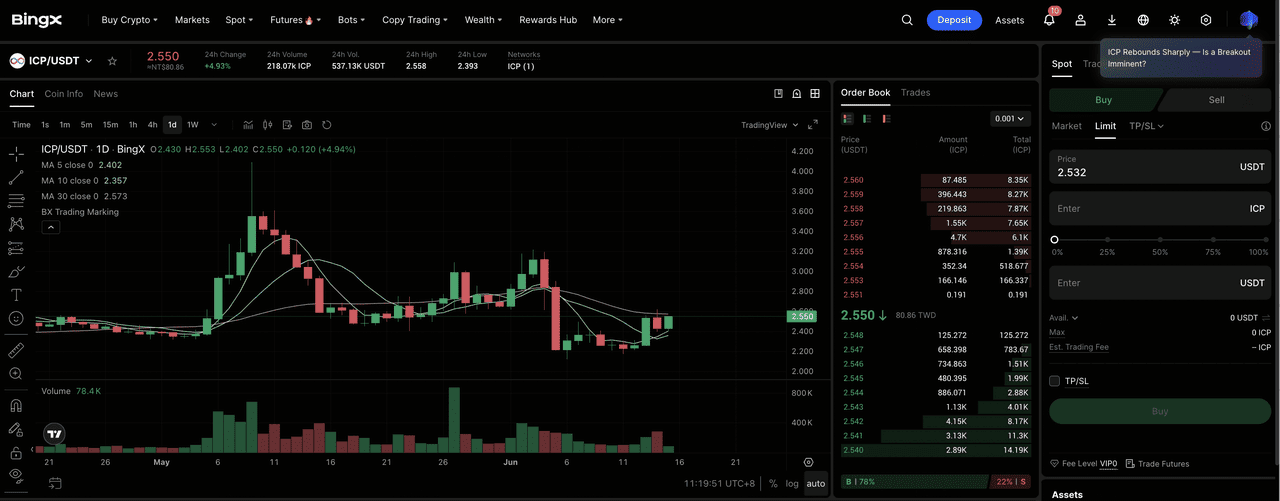
Step 1: Account setup and security. Sign up and log into your BingX account, complete the identity verification (KYC) required in your region, and enable two-factor authentication.
Step 2: Fund your spot account. Deposit USDT or another supported asset into your BingX spot account. Where available, users can also use supported fiat on-ramp options.
Step 3: Navigate to the spot market. Search for the ICP/USDT trading pair.
Step 4: Place your order. Choose a market order to buy ICP immediately at the current price, or use a limit order to set the price you want to pay.
Step 5: Manage your ICP. Once filled, your ICP appears in your spot account. You can keep it on BingX for convenience or withdraw it to a self-custody wallet such as Plug or Internet Identity for use in NNS governance staking.
Futures Trading: Trade ICP Price Movements
For active traders, BingX offers USDT-margined ICP perpetual futures. Futures allow users to trade ICP price movements without holding the underlying asset, with the flexibility to open long positions if they expect ICP to rise or short positions if they expect ICP to fall.
Because futures involve leverage, they can amplify both gains and losses. This approach is more suitable for traders who already have a clear risk plan and understand liquidation risk, particularly for an asset like ICP that is sensitive to both developer adoption metrics and broader AI infrastructure sentiment cycles.
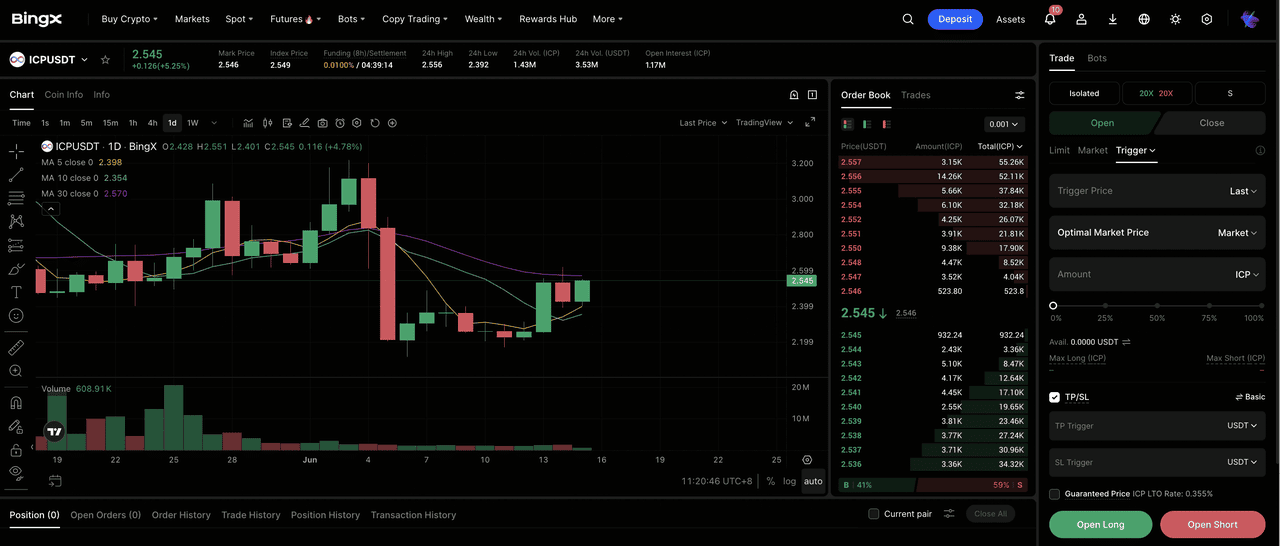
Step 1: Transfer collateral. Move USDT from your spot account into your futures account, where it will serve as margin.
Step 2: Select the contract. Search for the ICP-USDT perpetual contract.
Step 3: Set direction and leverage. Open long if you expect ICP to rise, or open short if you expect ICP to decline. Choose leverage based on your risk tolerance and position size.
Step 4: Execute the trade. Enter the order amount and choose a market or limit order depending on your trading plan.
Step 5: Manage risk. Set stop-loss and take-profit orders before or immediately after entering the position. Profit and loss settle dynamically in USDT.
Risks and Considerations Before Investing in Internet Computer (ICP)
Internet Computer has a differentiated architecture, but ICP still carries risks around adoption, tokenomics, competition, and governance.
- Developer learning curve: ICP’s canister model uses Rust, Motoko, and WebAssembly-based tooling, which may be less familiar to developers from Ethereum or Solana. Caffeine AI and SDK updates help, but onboarding remains a barrier.
- DApp adoption gap: ICP has strong infrastructure metrics, including around 980,000 canisters and over one billion Q1 2026 transactions. The challenge is turning this backend activity into consumer dapps with consistent user retention.
- Tokenomics perception: ICP’s Genesis allocation and early unlock structure remain part of its market narrative. Mission 70 may improve supply dynamics, but investors still watch inflation, staking rewards, and Cycles burn closely.
- Competitive pressure: ICP competes with Layer 1 chains, decentralized compute networks, and centralized cloud providers expanding into Web3 and AI infrastructure.
- Governance concentration: The NNS enables on-chain governance, but voting power is not evenly distributed. Large neuron holders, including DFINITY-linked participants, can still have meaningful influence over outcomes.
Final Thoughts: Should You Invest in Internet Computer in 2026?
Internet Computer remains one of the more technically ambitious blockchain infrastructure projects. By 2026, the network had reached around 980,000 canisters, processed more than one billion transactions in Q1, expanded Chain Fusion for native cross-chain interoperability, and introduced Mission 70 to improve long-term tokenomics. Its AI direction, including Caffeine AI and Cloud Engines, also gives ICP a clearer narrative around on-chain AI agents and decentralized cloud infrastructure.
The key question is whether ICP can turn strong infrastructure development into sustained user adoption. Mission 70 may improve supply dynamics, and Chain Fusion strengthens the multi-chain DeFi case, but user-facing dapp engagement still needs to catch up with backend growth. For investors and traders, ICP’s 2026 outlook depends on whether canister usage, AI applications, and Cycles burn can grow enough to support the broader “World Computer” thesis.
Related Reading
- Top AI Cloud Infrastructure Stocks to Buy in 2026 Amid Hyperscaler Capex and the Neocloud Boom
- Top AI Data Center Stocks to Buy in 2026: Cloud, Servers, and AI Compute Infrastructure
- Top AI Compute and GPU Stocks to Buy in 2026: The Shift to Inference and Custom Silicon
- What Are the Top 10 AI Agent Crypto Projects of 2026?
- What Are the Top Layer-1 (L1) Blockchains to Know in 2026?
- What Is Bittensor (TAO)? A Beginner's Guide to How Bittensor Works (2026)
