

Impossible Cloud Network (ICNT) is a decentralized cloud service provider (DePIN) engineered to provide enterprise-grade storage and compute resources at a fraction of the cost of centralized giants like Amazon AWS or Google Cloud. By leveraging a global network of independent hardware providers, ICNT creates a high-performance cloud of clouds that eliminates single points of failure and vendor lock-in.
As of March 26, 2026, ICNT is entering its most ambitious phase following a successful listing on major global exchanges, including BingX. With the launch of the HyperNode validation layer and the expansion of its Hardware Constellation, the protocol is scaling to meet the massive demand for AI-driven compute and decentralized data sovereignty.
This article examines the technical stack powering ICNT’s 2026 growth, the role of the $ICNT token in securing the network, and strategic considerations for traders looking to enter the decentralized cloud sector.
What Is Impossible Cloud Network (ICNT)?
Impossible Cloud Network (ICNT) is a decentralized, performant cloud infrastructure protocol that aggregates underutilized institutional-grade hardware into a unified global pool. Unlike early-generation decentralized storage projects that often struggled with latency, ICNT focuses on enterprise readiness, offering S3-compatible object storage and high-speed compute tailored for AI, big data, and Web3 developers.
Backed by a robust roadmap that saw the Full ICN Protocol Launch in late 2025, the network has successfully transitioned from a bootstrap phase to a revenue-generating ecosystem. The project's core value proposition lies in its ability to offer up to 75% lower costs than traditional hyperscalers while maintaining 99.9% durability. For investors, the $ICNT token serves as the lifeblood of this economy, acting as both a medium of exchange for cloud services and a governance tool for the network's future expansion.
How Does the ICN Decentralized Cloud Ecosystem Work?
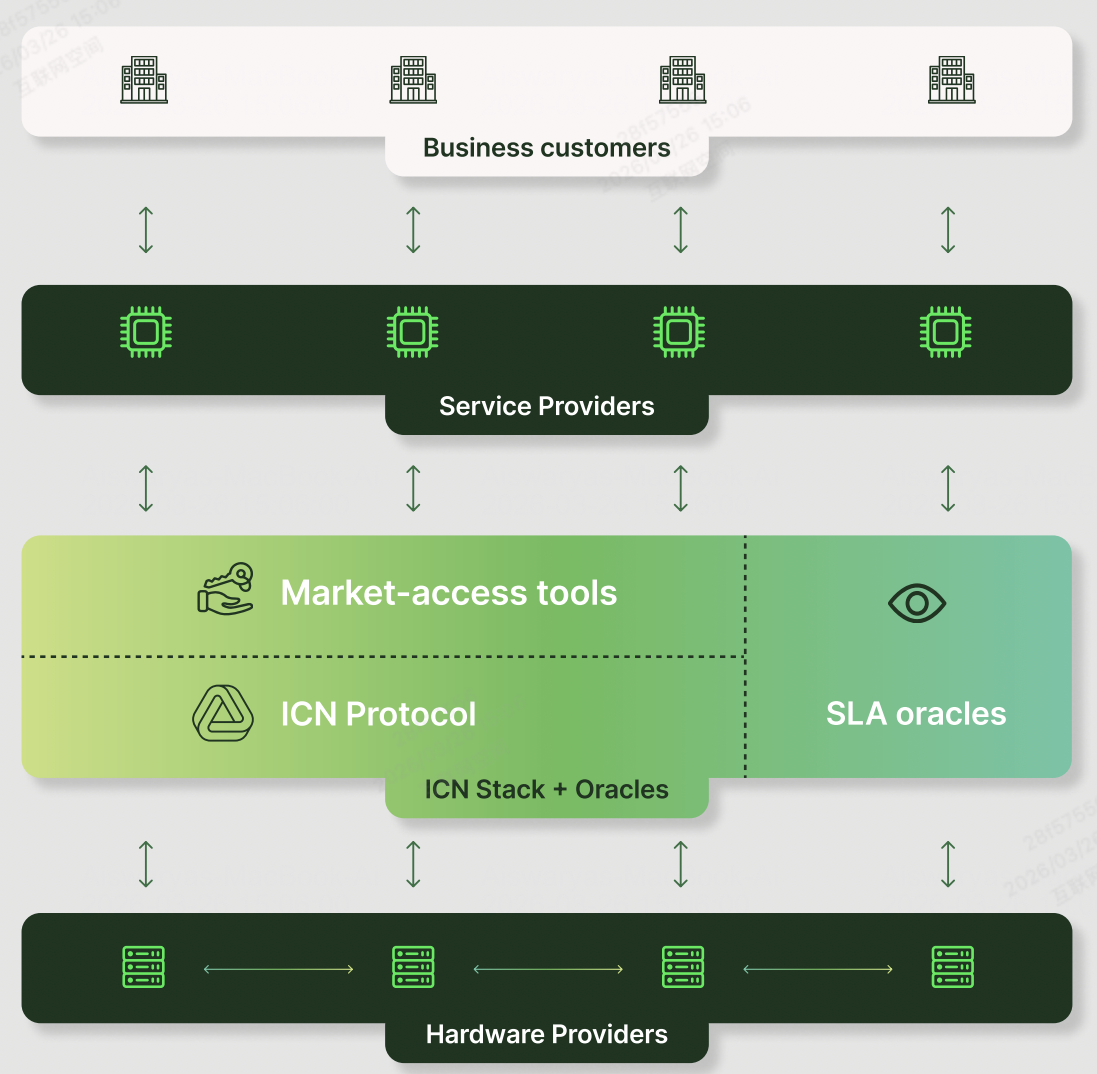
How Impossible Cloud Network works | Source: ICN litepaper
The Impossible Cloud Network (ICN) ecosystem operates through a sophisticated, multi-layered architecture designed to ensure security, speed, and scalability:
- ScalerNodes Hardware Providers: These are the backbone of the network. ScalerNodes consist of professional data centers and institutional hardware providers that contribute storage and compute power. They are rewarded in $ICNT for providing high-uptime resources.
- HyperNodes or Validators: Launched in early 2026, HyperNodes act as the protocol’s security and performance layer. They monitor ScalerNodes, verify data integrity, and ensure that service-level agreements (SLAs) are met. HyperNode operators must stake $ICNT to participate.
- The Hardware Constellation: This refers to the expansion of resources beyond simple storage. By March 2026, ICNT has integrated high-performance GPU clusters into its constellation, specifically optimized for AI model training and inference.
- S3-Compatible Gateway: To ensure ease of adoption, ICNT provides a seamless gateway that allows developers to switch from AWS to ICNT with minimal code changes, making the transition impossible to resist for cost-conscious startups.
What Is the Impossible Cloud Network Token (ICNT) Token Used For?
The $ICNT token is a utility-first asset designed to capture the value generated by the network's cloud service adoption. Its primary functions include:
- Service Payments: Users pay for storage and compute power using ICNT, creating a direct link between network usage and token demand.
- Staking and Security: HyperNode operators stake $ICNT to secure the network. In exchange, they earn a portion of protocol fees and block rewards.
- Governance: Token holders can vote on Hardware Constellation expansions, fee structures, and the onboarding of new geographical regions.
- Incentives (Real Yield): A portion of the protocol's revenue is distributed to active participants, ensuring long-term alignment between providers and the DAO.
What Is ICNT Tokenomics?
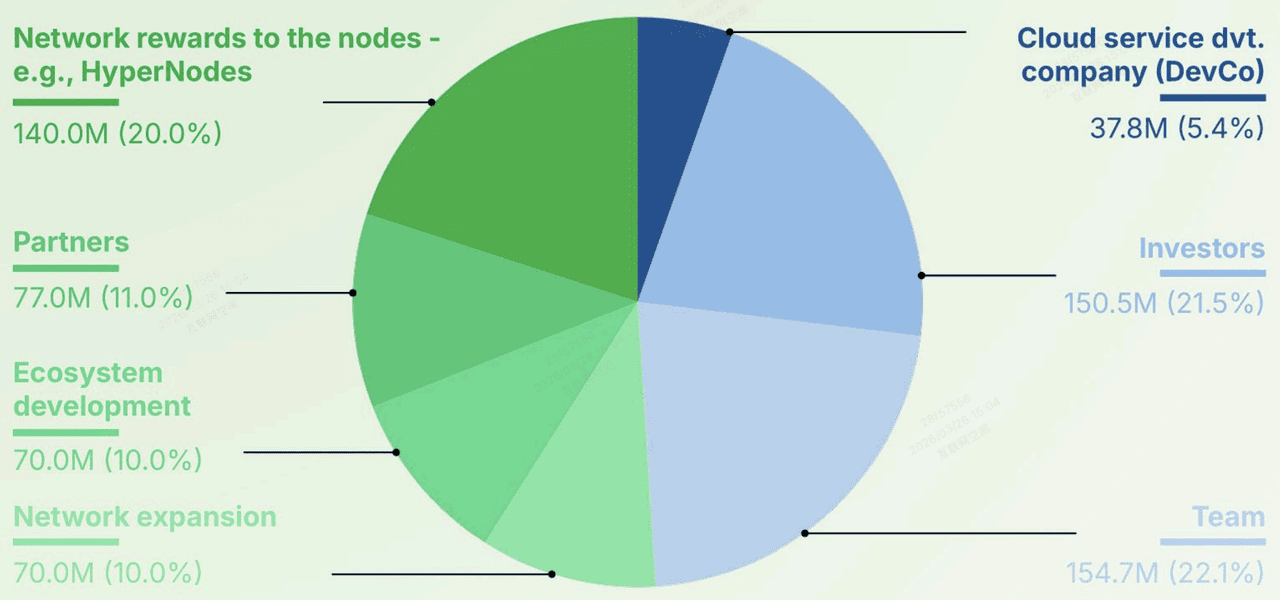
ICNT token distribution | Source: Impossible Cloud Network docs
The $ICNT token features a fixed maximum supply of 700,000,000 tokens minted at launch to power the network’s decentralized cloud economy.
- Founders and Core Team (22.1%): Allocated to the founding team and future employees, subject to a 12-month cliff followed by 24 months of linear vesting.
- External Investors (21.5%): Allocated to early-stage backers, following a 12-month lock-up and a 24-month linear release schedule.
- Node Sale Participants (20.0%): Distributed to ICN Link holders via a front-loaded, degressive 48-month vesting schedule.
- Early Contributors and Partners (11.0%): Incentives for pre-TGE supporters, with 50% unlocked at launch and the remainder vesting over 36 months.
- Rewards Reserve (10.0%): Fully unlocked at TGE to provide immediate capacity and utilization incentives for Hardware Providers.
- EcoDev Fund (10.0%): Supports ecosystem growth through grants and partnerships, with a 50% TGE unlock and 24-month linear vesting.
- Impossible Cloud GmbH (5.4%): Allocated to the operating company, with 50% unlocked at TGE and the rest vesting over 24 months.
ICN vs. Akash vs. Render vs. Filecoin: Key Differences
In 2026, the decentralized cloud sector has bifurcated into two distinct tracks: specialized compute and mass-scale storage. Impossible Cloud Network (ICN) differentiates itself as an Enterprise DePIN bridge, prioritizing S3-compatibility and institutional hardware to lure Web2 corporations away from AWS. In contrast, Filecoin remains the undisputed heavyweight of archival storage with over 25 Exbibytes of capacity, recently pivoting toward Warm Storage and programmable data via its 2026 Onchain Cloud upgrade to improve retrieval speeds.
For high-performance workloads, Akash Network and Render lead the Supercloud movement. Akash functions as a permissionless marketplace for general-purpose compute, recently implementing a Burn-Mint Equilibrium to tie $AKT value directly to hardware demand. Meanwhile, Render has solidified its dominance in the AI and creative verticals, evolving from a simple GPU rendering tool into a distributed backbone for AI model training, leveraging its massive OctaneBench capacity to handle complex generative media tasks.
Read more: What Is Filecoin Onchain Cloud, the Next-Generation Decentralized Cloud Launching in January 2026?
Comparison of Decentralized Cloud Leaders (March 2026)
| Feature | Impossible Cloud (ICNT) | Akash Network (AKT) | Render (RENDER) | Filecoin (FIL) |
| Primary Use Case | Enterprise Storage & S3 Cloud | General Purpose Compute/AI | GPU Rendering & AI Training | Mass Archival & Data Sovereignty |
| Core Strength | S3-Compatibility & 99.9% SLAs | Reverse-Auction (Low Cost) | Specialized GPU Clusters | Massive 25+ EiB Capacity |
| Provider Type | Institutional Data Centers | Independent & Consumer | Distributed Global GPUs | Global Storage Miners |
| Economic Model | Service-based Utility | Burn-Mint Equilibrium (BME) | Work-based Burn (BME) | Collateral-based Staking |
| Latency/Speed | High-Performance (Low) | Moderate (Standard Cloud) | Task-Dependent | Improving (F3 Fast Finality) |
| Target User | Web2/Web3 Enterprises | Developers & Startups | Artists & AI Engineers | Data Archives & Web3 Apps |
How to Trade Impossible Cloud Network Token (ICNT) on BingX
With the ICNT/USDT pair active on both Spot and Futures markets, BingX offers multiple ways to gain exposure to the decentralized cloud sector.
Buy, Sell, or HODL ICNT on the Spot Market
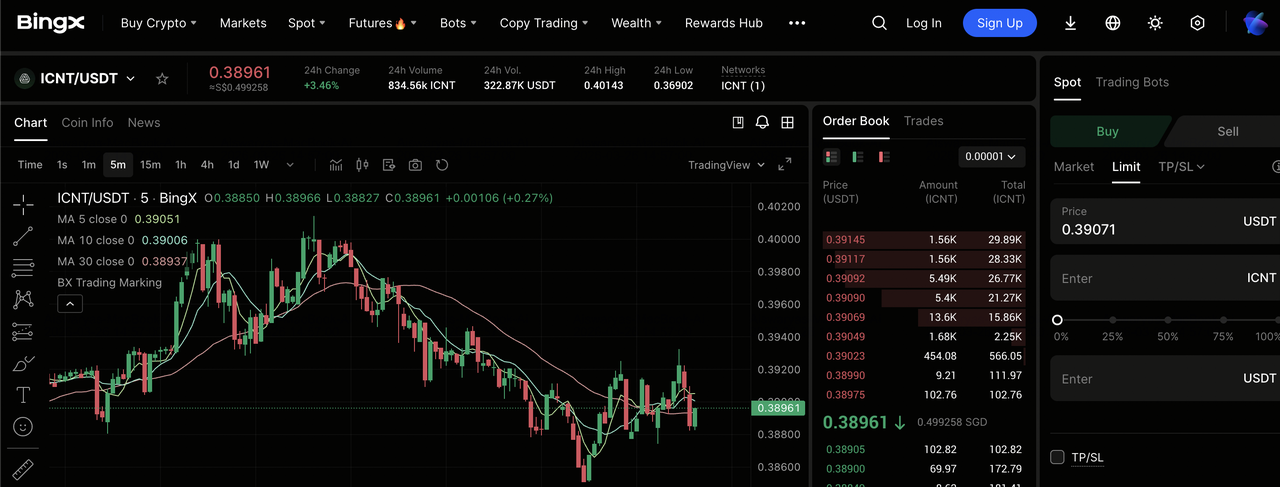
ICNT/USDT trading pair on the BingX spot market
- Log In: Access your BingX account.
- Search: Navigate to the Spot market and search for ICNT/USDT trading pair.
- Execute: Select Market order for an instant fill or Limit order to set your desired entry price.
Long or Short ICNT Perpetuals on the Futures Market
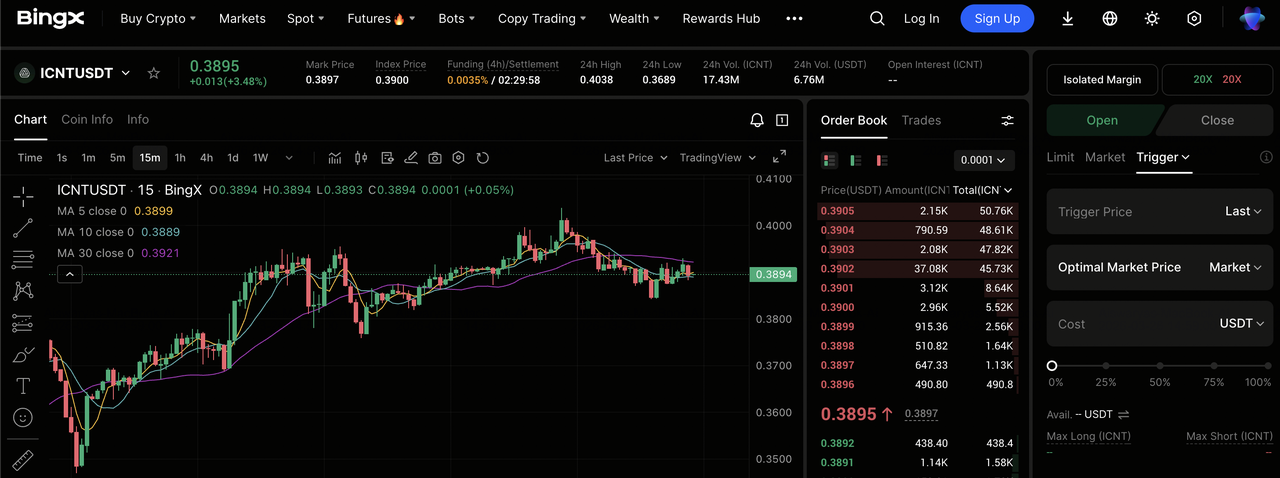
BingX offers ICNTUSDT Perpetual Contracts with up to 20x leverage for those looking to capitalize on short-term volatility.
- Go Long: If you anticipate further adoption of the HyperNode network.
- Go Short: To hedge your position during periods of market-wide cooling or after major exchange listing pumps.
5 Key Considerations Before Investing in ICNT
Evaluating $ICNT requires a balanced look at its unique Enterprise DePIN model against the inherent volatility of decentralized infrastructure protocols.
- Mainnet Stability: As the network scales its Hardware Constellation, any technical downtime could impact its enterprise-grade reputation.
- Competitive Landscape: ICNT faces stiff competition from both DePIN peers and centralized incumbents.
- Token Inflation: Monitor the emission rate of staking rewards, as 40% of the supply is earmarked for network incentives.
- Adoption Metrics: Look for Total Data Stored and Active Compute Hours rather than just price, as these are the true drivers of ICNT's value.
- Regulatory Environment: DePIN projects involving global hardware may face evolving compliance standards in different jurisdictions.
Final Thoughts: Is Impossible Cloud Network the Future of Decentralized Cloud?
As of 2026, Impossible Cloud Network has successfully transitioned from an ambitious concept into a foundational "neocloud" for the decentralized infrastructure (DePIN) movement. By bridging the gap between high-performance institutional hardware and blockchain-based coordination, ICNT offers a practical alternative for enterprises seeking to diversify away from centralized providers like AWS. The protocol's long-term sustainability now rests on its ability to maintain its Enterprise-Grade 99.9% uptime while scaling its GPU and storage clusters to meet the global surge in AI-driven compute demand.
For the strategic investor, the $ICNT token represents a direct stake in this shifting cloud economy, acting as the essential access key for network services and the primary incentive for hardware providers. However, success in this sector requires navigating a highly competitive landscape and monitoring the multi-year vesting schedules of early stakeholders. As the network matures through its post-TGE phase, its real-world utility, measured by petabytes stored and GPU hours utilized, will be the ultimate metric of its role in the 2026 decentralized cloud evolution.
Risk Reminder: Digital asset investments, particularly in emerging infrastructure tokens like $ICNT, carry significant market risk and price volatility. The value of $ICNT may fluctuate based on network utilization, hardware provider participation, and broader market shifts in the DePIN sector. Always perform your own research, utilize BingX risk management tools, and only trade capital you can afford to lose.
Related Reading
- What Is Filecoin Onchain Cloud, the Next-Generation Decentralized Cloud Launching in January 2026?
- What Are the Top 10 DePIN Crypto Projects to Know in 2026?
- Top 5 DePIN Projects to Watch in the Solana Ecosystem 2026
- Akash Network (AKT) Faces Volatility as Landmark Burn-Mint Equilibrium Upgrade Goes Live on March 23
