
In an era where data privacy is paramount, Horizen (ZEN) emerges as a leading privacy-focused blockchain platform. Originally launched as a privacy coin, it has evolved into a comprehensive ecosystem that prioritizes confidentiality, scalability, and regulatory compliance. By integrating advanced cryptographic technologies like zero-knowledge proofs (ZKPs), Horizen enables users and enterprises to conduct secure transactions and build decentralized applications (dApps) without compromising sensitive information. Now operating as a Layer 3 appchain on Base, Horizen bridges the gap between privacy and interoperability, making it a versatile solution for the modern digital economy.
What is Horizen (ZEN)?
Horizen (ZEN) is a privacy-centric blockchain platform designed to empower developers in creating customizable public or private blockchains and dApps. At its core, it utilizes the Zendoo sidechain protocol, which allows for the construction of interconnected, specialized chains tailored to specific use cases. This modular approach incorporates zero-knowledge succinct non-interactive arguments of knowledge (zk-SNARKs) for confidential transactions and communications, ensuring users maintain control over their digital footprint. As a Layer 3 solution on Base, an Ethereum Layer 2 network, Horizen benefits from enhanced scalability, low-cost transactions, and Ethereum Virtual Machine (EVM) compatibility. This positioning enables seamless integration with the broader Ethereum ecosystem while focusing on privacy-enhancing technologies (PETs). Horizen addresses key challenges in Web3, such as the tension between data transparency and confidentiality, making it ideal for applications in decentralized finance (DeFi), healthcare, supply chain management, and enterprise workflows. Its infrastructure supports compliance-friendly apps that can be audited when required, without exposing underlying data.
What are the Key Features of Horizen (ZEN)?
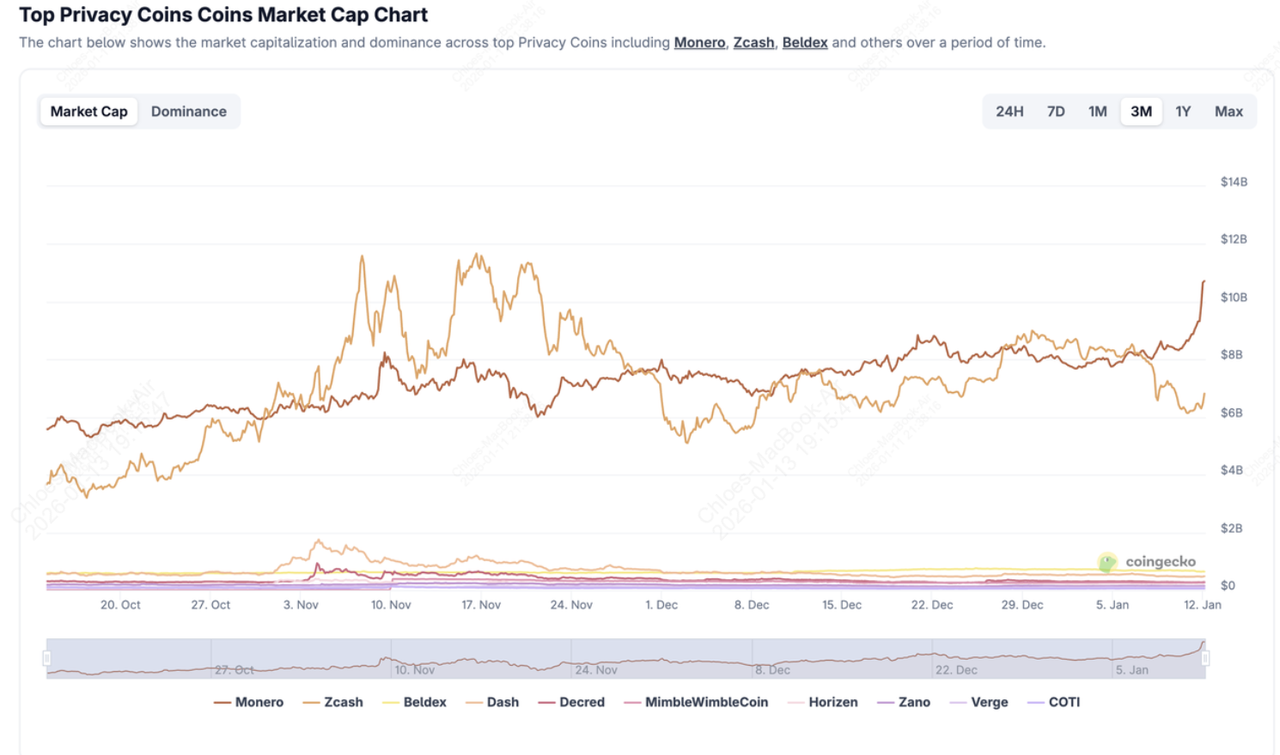
Source: CoinGecko
Horizen stands out in the blockchain space due to its robust set of features that emphasize privacy, scalability, and flexibility. Its modular sidechain architecture, known as Zendoo, enables developers to build custom blockchains with unique consensus mechanisms, privacy settings, and economic models, all secured by the Horizen mainchain. This allows for independent sidechains that communicate value and data without compromising the overall network. Advanced privacy technology employs zk-SNARKs and Trusted Execution Environments (TEEs) to enable confidential transactions and dApps. Users can choose their level of transparency, from fully private to selectively auditable, fostering trust in regulated environments. The platform delivers strong scalability through its sidechain system that offloads transactions from the mainchain, achieving higher throughput and lower fees. As a Layer 3 on Base, it leverages Ethereum's security while handling complex computations efficiently. The native ZEN token serves as the ecosystem's utility and governance asset, now formatted as an ERC-20 token on Base, powering privacy services, staking, and interactions within zkApps. Full EVM compatibility facilitates easy development using familiar tools such as Solidity, allowing developers to embed privacy features directly into smart contracts. Finally, a large and decentralized node network, including secure and super nodes, enhances overall security, resilience, and participation through incentive rewards, making Horizen a versatile platform for building privacy-first applications that meet real-world demands.
Who created Horizen?
Horizen was co-founded by Rob Viglione and Rolf Versluis in May 2017, initially under the name ZenCash. Viglione, a former physicist and military officer with an MBA in Finance and Marketing, brought expertise in cryptocurrency research and blockchain applications. Versluis, an Electrical Engineering graduate from the United States Naval Academy and a former US Navy nuclear submarine officer, contributed his background in IT management and cryptocurrency mining. The project began as a fork of Zcash, aiming to advance zero-knowledge-proof technologies and create a sustainable ecosystem. In August 2018, it rebranded to Horizen to reflect its broader ambitions beyond a simple digital currency, focusing on scalability and privacy platforms. The team has since expanded, partnering with organizations like IOHK to enhance research and development. Governance is now community-driven through a Decentralized Autonomous Organization (DAO), where ZEN holders vote on proposals.
How does Horizen (ZEN) Work?
Horizen operates through a hybrid architecture combining a Proof-of-Work (PoW) mainchain with a Proof-of-Stake (PoS) sidechain platform. The core framework, Zendoo, enables the creation of custom sidechains that link to the mainchain via the Cross-Chain Transfer Protocol (CCTP). This decoupled design allows sidechains to function independently in terms of consensus, programming language, and other parameters, while remaining secured by the mainchain's decentralized node network, one of the largest in the industry. Transactions and dApps on Horizen leverage zk-SNARKs for privacy, ensuring data remains confidential yet verifiable. For instance, in a confidential DeFi application, users can execute trades without revealing strategies, while regulators can access audits if needed. The platform's EVM compatibility on its EON sidechain simplifies development, and integrations like zkVerify accelerate ZKP processing for faster, cheaper operations. Horizen's security was bolstered after a 2018 51% attack attempt, leading to the implementation of a delayed block penalty algorithm, which increases the cost of malicious actions. Now as a Layer 3 on Base, it inherits Ethereum's robustness, supporting use cases like private data sharing, compliant trading, and custom blockchains for businesses.
What is the ZEN Token?
The ZEN token is the native cryptocurrency of the Horizen ecosystem, functioning as both a utility and governance asset. Originally a privacy coin with optional shielding features, ZEN has transitioned to an ERC-20 token on Base, enhancing its interoperability within the Ethereum network. ZEN is used for governance, where holders vote on Zen Improvement Proposals (ZENIPs) via the DAO, influencing ecosystem upgrades and fund allocations. It also supports staking and rewards, participating in staking programs to secure the network and earn incentives. For privacy services, ZEN pays for generating ZKPs, confidential transactions, and other privacy-focused operations in dApps. Additionally, it facilitates ecosystem interactions by acting as gas for zkApps and enabling cross-chain transfers. With roots in 2017 as one of the first fair-launched ZK coins, ZEN empowers users to shape Horizen's future while enabling private, on-chain activities.
Source: ZEN
What are the Tokenomics of ZEN?
Horizen maintains a fixed total supply of 21 million ZEN tokens, mirroring Bitcoin's scarcity model. There was no pre-mine or ICO, ensuring a fair launch. Block rewards are distributed as follows: 60% to miners, 20% to the treasury for development and marketing, 10% to supernode operators, and 10% to secure node operators. Following the migration to Base as a Layer 3 appchain, the tokenomics were updated via ZenIP 42409 (an addendum to ZenIP 42407), reallocating the remaining 5 million unminted ZEN. Key allocations include Incentives/Participation (750,000 ZEN, 15%) for rewards on developer contributions, dApp deployments, and staking milestones; Community Grants (250,000 ZEN, 5%) to fund grassroots initiatives and projects; Growth Marketing (250,000 ZEN, 5%) to support targeted campaigns for adoption and awareness; ZEN Sustainability Initiative (2,000,000 ZEN, 40%) as a long-term reserve for ecosystem growth, including revenue-generating investments; Ecosystem Development (750,000 ZEN, 15%) to enhance technical infrastructure and tools; ZEN Growth & Stability (500,000 ZEN, 10%) to stabilize token value through liquidity and market buffers; and Infrastructure (500,000 ZEN, 10%) to maintain security for nodes, oracles, and bridging. Vesting occurs linearly over 48 months after an initial 25% mint at migration, promoting stability and prudent use. This structure emphasizes sustainability, with ZEN integral to governance and privacy utilities.
How to Trade Futures on Horizen (ZEN) on BingX
Futures trading allows you to speculate on the price movements of assets like Horizen (ZEN), offering the potential to profit from both rising and falling markets. Here's the step-by-step overview of how to trade Horizen futures on BingX, helping you understand the process, key concepts, and risks involved in futures trading.
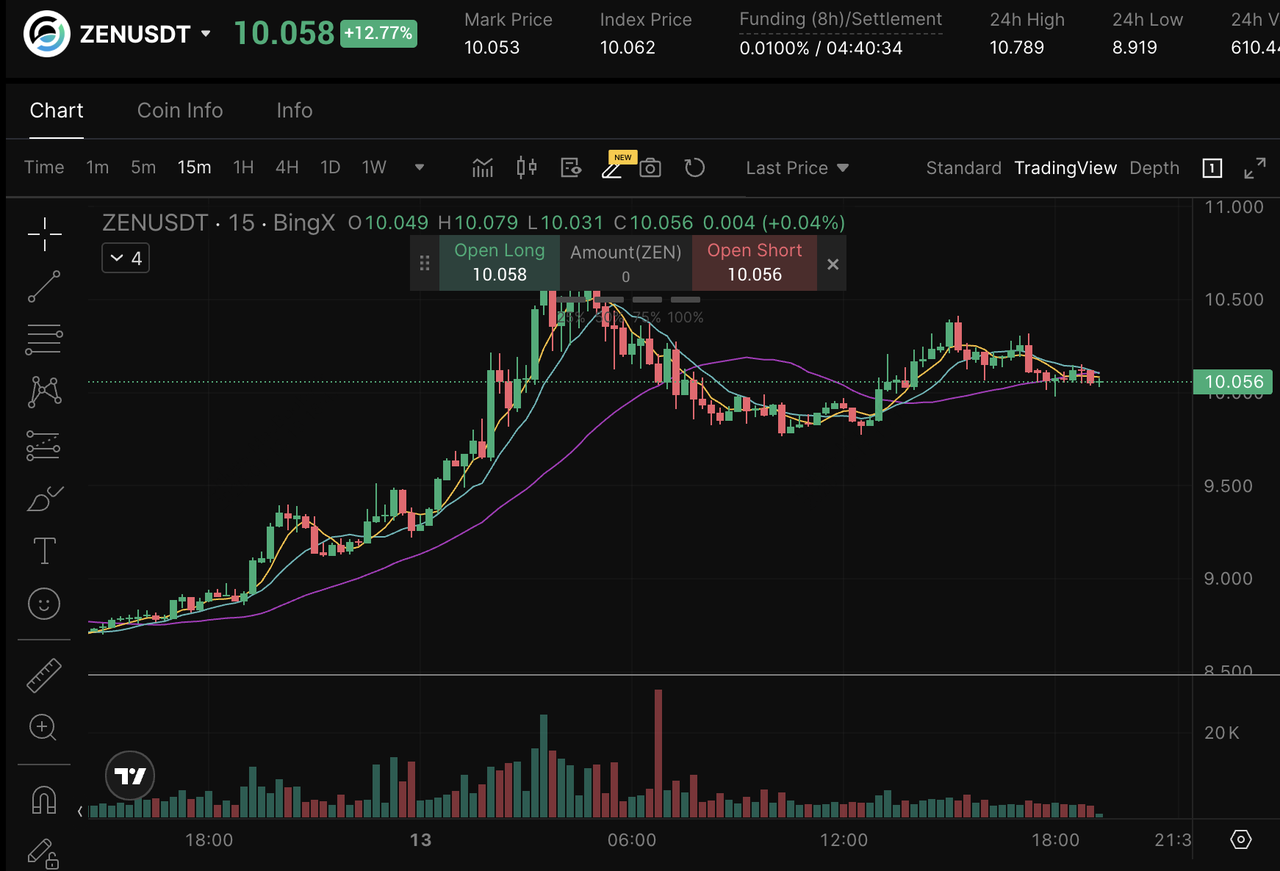
ZEN/USDT trading pair on the futures market
1. Open BingX Futures and search for the token ZEN/USDT trading pair on the perpetual market. Before that, ensure your account is funded with USDT or other supported assets.
2. Set leverage, then place a Long (price up) or Short (price down) trade.
3. Always add Stop-Loss and Take-Profit, and size positions conservatively; ZK tokens can be volatile after news, listings, or ecosystem announcements.
On-chain tip: Many ZK tokens use EVM chains. Verify the official contract address, use trusted bridges, and never interact with unknown dApps; ZK ecosystems each have specific wallets, explorers, and bridge tools.
Conclusion
Horizen (ZEN) represents a forward-thinking evolution in blockchain technology, blending privacy, scalability, and compliance to meet the demands of a data-driven world. From its origins as ZenCash to its current role as a Layer 3 on Base, it offers developers and users tools to build and interact with confidential, efficient applications. With a community-governed DAO, innovative features like Zendoo, and a capped supply tokenomics model, Horizen is poised to drive adoption in regulated industries. As privacy becomes a cornerstone of Web3, Horizen stands ready to empower a more secure and equitable digital future.
