

As digital assets mature toward institutional global capital markets, the structural paradox of Bitcoin has reached a critical juncture. Despite representing over $1.5 trillion in economic value, Bitcoin remains largely economically idle due to the base network's lack of native smart contract programmability and restricted transaction throughput.
Conventional attempts to scale Bitcoin have historically relied on sidechains or custodial federations, forcing users to abandon Bitcoin’s core security guarantees and accept honest-majority trust assumptions. Citrea (CTR) solves this systemic limitation by deploying an institutional-grade infrastructure layer that anchors fully programmable smart contracts directly into Bitcoin blockspace.
Backed by high-conviction institutional crypto allocators including Peter Thiel’s Founders Fund and Galaxy Ventures, Citrea bridges the unmatched security of the Bitcoin blockchain with the highly expressive developer ecosystem of the Ethereum Virtual Machine (EVM). By compiling transactions off-chain and embedding cryptographic proof material directly into Bitcoin inscriptions, Citrea allows retail users and institutional asset managers to access sophisticated financial primitives, such as lending markets, decentralized trading, and structured yield products, while maintaining a direct, mathematical settlement link to the Bitcoin network.
What Is Citrea (CTR)?
Citrea is a security-first, general-purpose BTC Layer 2 scaling platform built to transform Bitcoin into the foundational liquidity layer for global decentralized finance. At its core, the network addresses three fundamental challenges in the legacy Bitcoin expansion landscape:
- The Programmability Gap: Bitcoin’s native scripting language is deliberately restrictive; Citrea introduces full EVM compatibility, allowing developers to deploy standard Solidity smart contracts natively secured by Bitcoin.
- The Sovereign Security Problem: Traditional Bitcoin L2 solutions rely on external validator sets or centralized multisigs; Citrea utilizes zero-knowledge technology to ensure its state transitions are verified cryptographically by Bitcoin itself.
- Liquidity Fragmentation: Existing wrapped Bitcoin variants split liquidity across multiple non-native chains; Citrea establishes a unified, programmable destination for native Bitcoin capital, supplemented by native fiat-backed stablecoins.
How Does Citrea Work?
The protocol operates through a modular, high-performance architecture that leverages Bitcoin as its definitive data availability (DA) and settlement layer. By splitting execution, proving, and bridging into distinct functional domains, Citrea hardcodes cryptographic scaling directly into the transaction lifecycle.
1. The zkEVM Execution Environment
Citrea functions as a Type 2 zkEVM (Zero-Knowledge Ethereum Virtual Machine). It maintains strict EVM compatibility, allowing developers to port audited Ethereum tooling, dApps, and contracts into a Bitcoin-anchored architecture with zero source-code friction. Transactions are submitted by users to a private mempool, where a specialized Sequencer node batches and orders them every 2 seconds, providing instantaneous soft finality confirmations to applications.
2. Zero-Knowledge Proving and Bitcoin Data Availability (DA)
Rather than posting heavy, uncompressed transaction histories onto Bitcoin's scarce blockspace, Citrea utilizes a Batch Prover running a Groth16 circuit within a RISCZero zkVM environment, powered by Boundless.
- Mempool Submission: Users broadcast EVM-compatible transactions via a full node RPC interface directly to the Citrea network.
- Sequencing & Soft Finality: The Sequencer packages transactions into a rollup block every 2 seconds, executing code and updating state roots.
- Sequencer Commitments: The Sequencer periodically inscribes a Merkle root of block hashes natively into a Bitcoin transaction to finalize ordering.
- Validity Proof Generation: The Batch Prover replays the block batch inside a zkVM, generating a succinct ZK-STARK validity proof that encapsulates thousands of transactions into a single file under 400 kilobytes.
- Bitcoin Settlement: The validity proof and explicit state differences (state diffs) are permanently posted to the Bitcoin blockchain, allowing any full node to trustlessly reconstruct Citrea's state.
3. The Clementine Bridge Primitive
The core vulnerability of traditional scaling solutions is the bridge. Citrea solves this via Clementine, a native, BitVM-based, trust-minimized two-way peg for moving BTC to cBTC (Citrea Bitcoin, the native network currency used to cover gas fees).
Clementine relies on an optimistic, 1-of-N honest assumption. Deposits are directed into a Taproot address encoding explicit spending paths. If an operator attempts a fraudulent reimbursement claim during a peg-out (withdrawal), permissionless Challengers utilize a specialized Light Client Prover (LCP) to initiate a challenge-response game directly on the Bitcoin blockchain. If the operator fails to provide a valid cryptographic proof of payout, their entire collateral bond (~2 BTC) is automatically slashed, making an attack on Citrea's bridge as economically unfeasible as attacking Bitcoin itself.
4. The ctUSD Stablecoin Liquidity Layer
To insulate financial protocols from underlying asset volatility, Citrea introduces ctUSD, a native, 1:1 fiat-backed stablecoin issued via MoonPay and routed through the M0 protocol. Designed to fully align with forthcoming regulatory frameworks, ctUSD is 100% collateralized by short-term U.S. Treasury bills and cash. It serves as the foundational liquidity denominator across Citrea's active lending markets, decentralized exchanges (DEXs), and institutional vaults operated by partners like Morpho, Keyrock, and Noon.
Citrea vs. Other Bitcoin Layer-2 Networks: Key Differences
|
Feature |
Citrea (CTR) |
Lightning Network |
Traditional Sidechains |
|
Execution Layer |
Type 2 zkEVM (Full Smart Contracts) |
P2P Payment Channels |
Independent VM (EVM/Wasm) |
|
Data Availability (DA) |
On-Chain Bitcoin via State Diffs |
Off-Chain Local States |
External Validator Committee |
|
Settlement Layer |
Cryptographic ZK Proof on Bitcoin |
Bitcoin Base Layer (On Close) |
Independent Consensus |
|
Bridge Security Model |
1-of-N Trust-Minimized (BitVM) |
Native Cryptographic Hashed Timelock |
Honest-Majority Custodial Multisig |
|
Primary Utility Focus |
Institutional DeFi & Application Scale |
Micro-payments & High-Speed Retail |
General Custom Applications |
Traditional Bitcoin sidechains fail to capture true layer-1 security because their state transitions are isolated from Bitcoin's miners; they function essentially as independent blockchains glued together by vulnerable multisig federations. In contrast, Citrea enforces data availability directly through native Bitcoin blockspace. Because the underlying validity proofs require explicit settlement inside Bitcoin blocks, a transaction on Citrea cannot be reversed or altered without executing a deep, systemic re-organization of the entire Bitcoin blockchain.
What Is Citrea Tokenomics: Powering the Coordination Flywheel
The CTR token is the native utility, coordination, and governance asset of the Citrea network, engineered to eliminate the ownership gap prevalent in early layer-2 architectures.
CTR Token Utility and the xCTR Vault
Value accrues to the Citrea ecosystem through a non-transferable staking lockup model designed to hand operational control exclusively to active network participants:
- Staking for Governance: CTR tokens carry no inherent voting weight. Users must lock CTR into an upgradeable ERC-4626 vault contract to receive xCTR. Your voting power is precisely equivalent to your xCTR balance, which can be self-delegated or assigned to trusted network ecosystem representatives.
- The Upcoming Gauge System: Once activated by governance, xCTR holders gain direct authority over the Governance Treasury's liquidity emissions. Protocols, liquidity providers, and developers must actively accumulate xCTR weight to steer programmatic network incentives toward their specific application pools. Active voters who provide liquidity to the pools they vote for receive multiplied emissions multipliers, creating a powerful feedback loop.
- Early Exit Penalties: Staking into xCTR introduces a structural 90-day unstaking window. While standard completion after 90 days incurs 0% friction, immediate capital exit triggers a flat 50% penalty. These penalized assets are programmatically redistributed pro-rata directly into the xCTR vault, compounding the capital value and underlying asset backing for remaining long-term stakers.
The Dual Treasury Architecture: To ensure decentralized checks and balances, Citrea splits capital reserves into two distinct structures: the Governance Treasury, entirely controlled via public xCTR voting for incentives and infrastructure provider payouts, and the Foundation Treasury, managed by the core team exclusively for multi-year protocol R&D, compliance, and core ecosystem grants.
CTR Token Distribution
The CTR token features a strictly fixed maximum supply of 10,000,000,000 (10 billion) tokens with zero built-in inflation. At its formal launch in late May 2026, the circulating supply was strictly bounded to 12%, isolating market dynamics from non-circulating institutional tranches.
- Incentives and Treasury (25.16%): 2,516,000,000 tokens locked within governance contracts, deployable exclusively via active xCTR milestone direction.
- Ecosystem Growth and R&D (22.83%): 2,283,000,000 tokens held by the Foundation for strategic network bootstrapping, developer tool onboarding, and launch delegation.
- Early Contributors (20.66%): 2,066,000,000 tokens reserved for the core engineering team, bound to a strict 12-month cliff followed by a 36-month linear vesting schedule.
- Investors (19.35%): 1,935,000,000 tokens allocated to institutional backing rounds (including Founders Fund and Galaxy Ventures), subject to a matching 1-year cliff and 4-year linear unlock.
- Initial Claims / Genesis Airdrop (12.00%): 1,200,000,000 tokens unlocked entirely at the Token Generation Event (TGE) for eligible community allocators and historical testnet participants.
How to Access the Citrea Mainnet and Genesis Ecosystem
Following the successful mainnet launch and TGE in late May 2026, users can actively interact with Citrea's live financial applications using official cross-chain rails.
Step 1: Network Configuration
To connect an EVM-compatible wallet, such as MetaMask, Rabby, or Phantom, to the Citrea Mainnet, enter the following parameters into your network interface:
- Network Name: Citrea Mainnet
- Chain ID: 4114
- Currency Symbol: cBTC
- HTTP RPC URL: https://rpc.mainnet.citrea.xyz/
- Block Explorer: https://explorer.mainnet.citrea.xyz/
Step 2: Bridging Capital
- For Capital Allocations Over 10 BTC: Utilize Clementine, Citrea’s canonical bridge via clementine.citira.xyz. Due to the BitVM cryptographic script setup, Clementine handles funds strictly in precise units or multiples of exactly 10 BTC per transaction.
- For Smaller BTC Retail Amounts: Use partner bridges like Symbiosis or Atomiq Exchange, which supports instant deposits natively via the Bitcoin Lightning Network, to swap base-layer BTC directly for cBTC on Citrea.
- From Ethereum and Alternative EVM Networks: Navigate to the centralized Citrea Bridge Hub to port standard assets like USDC, USDT, WBTC onto Citrea via LayerZero or Hyperlane infrastructure, utilizing built-in Gas Refuel parameters to automatically receive an upfront drop of cBTC gas upon arrival.
Step 3: Staking and Staking Rewards
Verified participants of the Genesis Airdrop (snapshot taken May 5, 2026, at Bitcoin block 6919313) can claim their tokens at the official Citrea airdrop claim portal. To maximize capital velocity, Citrea has committed an initial allocation of 10 million CTR tokens exclusively to early stakers during the first 3 months post-launch. Users can acquire CTR directly across supported platforms or secondary DEX pools, routing assets to the Citrea staking portal to convert CTR to xCTR and capture their share of weekly streaming emissions.
How to Claim the Citrea (CTR) Airdrop
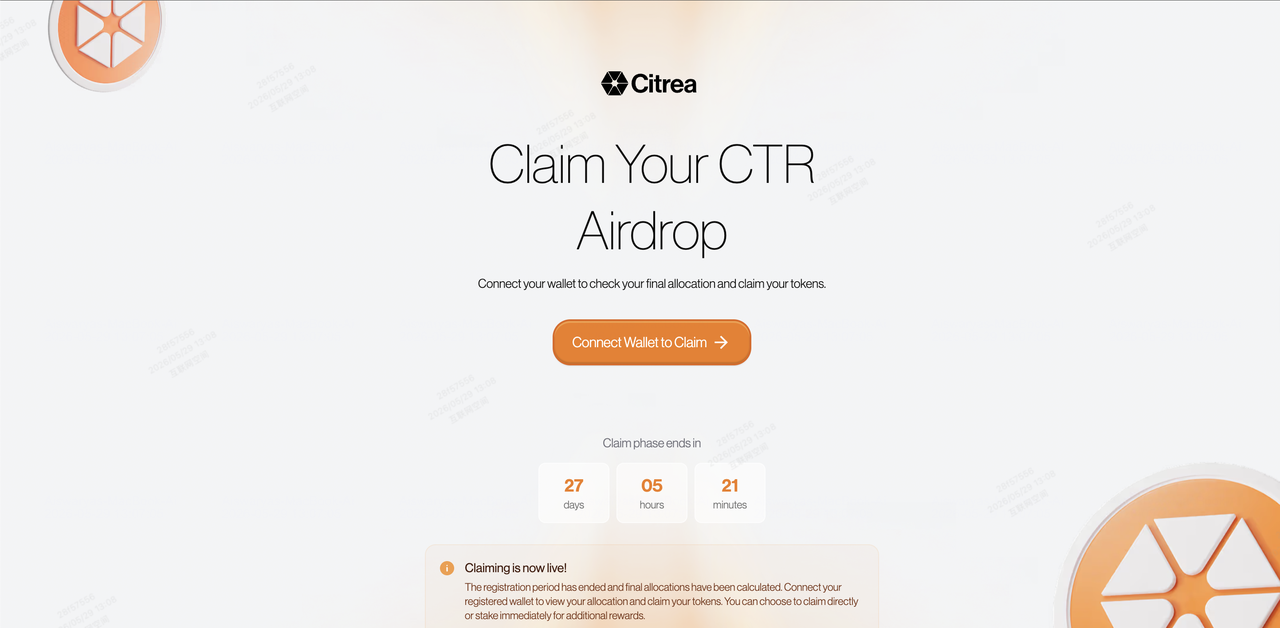
Source: Citrea (CTR) airdrop portal
Following the official Token Generation Event (TGE) in late May 2026, Citrea opened its decentralized community airdrop claims portal. The distribution serves to transition the network toward its user-led governance blueprint, rewarding early network contributors while embedding long-term supply guardrails.
What Is the Citrea (CTR) Airdrop?
The Genesis Airdrop is the initial community distribution phase of the CTR token. Rather than deploying a generic token handout, Citrea designed a maximum alignment drop to empower the community members who have been the heartbeat of the network across every stage of development. Up to 12% of the fixed 10 billion CTR supply was unlocked at launch for initial claims and TGE-related activities to preserve and distribute voting weight directly to active network users.
Read more: How to Claim Citrea (CTR) Genesis Airdrop Rewards Following the May 26 TGE
Who Is Eligible for the $CTR Airdrop?
Eligibility was finalized based on a May 5, 2026, snapshot (at midnight UTC, Bitcoin block 6,919,313). To eliminate farming behavior and automated bots, strict anti-sybil efforts were applied with the help of Human Tech and ZeruAI.
The allocation is divided across five core participant categories:
- Citrea Mainnet Campaign Users: The primary eligible group. Wallets required a comprehensive ecosystem engagement score over 920 points. Tokens were distributed in tiers proportional to mainnet activity.
- Campaign Multiplier Boosts: Eligible mainnet campaign users received a token allocation boost if they held specific historical credentials:
- Testnet Campaign ₿apper NFT Holders: Received a 20% boost to their mainnet allocation.
- Devnet Expert NFT Holders: Received a 10% boost to their mainnet allocation.
- OG and Citrus Champion Discord Roles: Received a 10% boost to their mainnet allocation.
- Citrea Supporters on X: Content creators and vocal community members chosen based on genuine, long-standing alignment with the project.
- Bitcoin and Crypto Community on X: Active Bitcoin developers, researchers, and prominent voices advocating for Bitcoin scalability.
- Developers & Researchers on GitHub: Contributors to key infrastructure projects in the ZK, Bitcoin, and stablecoin ecosystems, e.g., BitVM, Sovereign SDK, RISC Zero, Boundless, Reth/Revm, Bitcoin Layers, Bitcoin Core, and M0, as well as participants in the Citrea-Risc0-to-BitVM Trusted Setup Ceremony.
- Local Communities: Active local group members who helped bootstrap Citrea's growth in key global regions, including Korea, Brazil, India, and Nigeria.
When Is the Citrea Airdrop Snapshot: Key Dates
The snapshot, registration, and claim schedule followed a highly synchronized path leading up to mainnet token listings:
|
Time / Block |
Calendar Date |
Event / Milestone |
|
Block 6,919,313 |
May 5, 2026 (00:00 UTC) |
Genesis Airdrop Snapshot (Strict on-chain cutoff) |
|
14:00 UTC |
May 11, 2026 |
Airdrop Registration Portal opens |
|
14:00 UTC |
May 17, 2026 |
Airdrop Registration Portal closes (Mandatory for eligibility) |
|
TGE |
May 26, 2026 |
Claims & Staking Go Live (Trading launches on major venues) |
How to Claim Your CTR Token Airdrop: Step-by-Step Guide
To claim your tokens securely and choose whether to route them directly into the network’s ecosystem flywheel, follow this operational walkthrough:
- Navigate to the Official Portal: Go exclusively to the official Citrea airdrop claim domain. Double-check the URL carefully to avoid phishing links.
- Connect Your Active Wallet: Connect the identical EVM-compatible wallet that you utilized during the Citrea Mainnet campaign prior to the May 5 snapshot.
- Verify Your Eligibility Status: The interface will parse your data, display your eligibility tier, and calculate your total finalized CTR token allocation, including any NFT or Discord role boosts.
- Process the Claim Transaction: Confirm the claim execution through your wallet extension. The upfront unlocked CTR tokens will be routed directly to your on-chain address.
- Optionally Stake for xCTR: Upon claiming, you can immediately choose to stake your CTR tokens directly into the staking vault to receive xCTR. Staking converts your tokens into active voting power over the Citrea Governance Treasury. Furthermore, staking early qualifies you for a portion of the 10 million CTR token distribution allocated exclusively to early stakers and distributed weekly during the first 3 months of the token launch.
Critical Security Reminder: The official X handle for all updates is @citrea_xyz. If you encounter X account login issues on the portal due to utilizing a physical security key, such as a Yubikey, consider disabling the key temporarily to complete the authorization loop. Always ensure you have a small baseline of native cBTC in your wallet to cover subsequent Layer 2 network transaction gas fees.
How to Trade Citrea (CTR) on BingX
BingX provides a highly liquid, institutional-grade trading ecosystem to monitor and execute CTR transactions, complete with advanced real-time charts, market depth visualization, and robust cold-storage security.
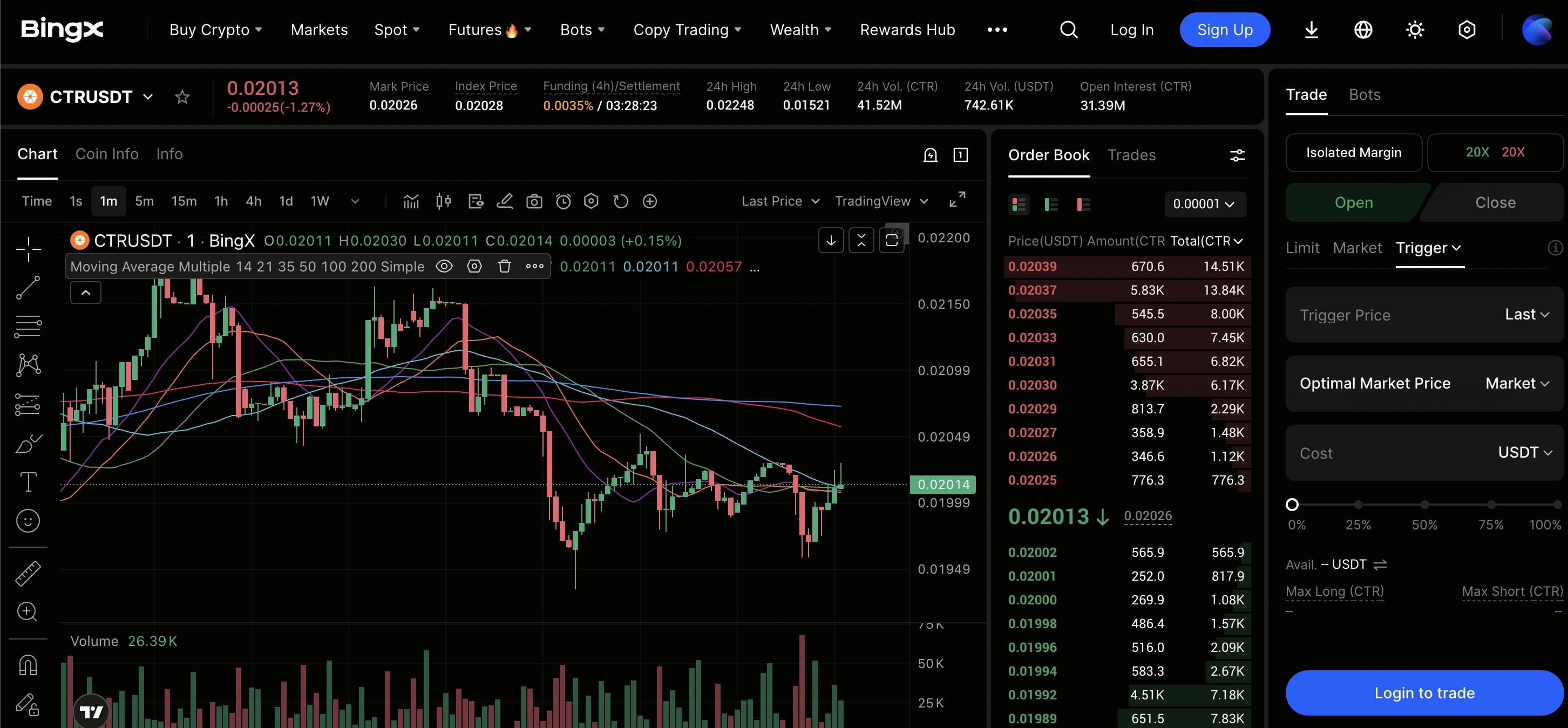
Long or Short CTR Perpetuals in the Futures Market
- Access the Derivatives Portal: Navigate to the primary Futures drop-down menu on the BingX platform, select Perpetual Futures, and locate the CTR/USDT perpetual contract.
- Select Your Margin Parameter: Opt for Isolated Margin to restrict liquidation risks strictly to an individual position balance, or Cross Margin to pool your available account collateral.
- Calibrate Leverage: Carefully position the leverage slider to fit your personal risk profile.
Note: While high leverage amplifies prospective yield velocities, it inherently compounds liquidation sensitivity. - Execute Your Market Thesis: Place an Open Long market or limit entry order if your data points to underlying ecosystem expansion, or an Open Short position to hedge structural spot token exposures or capture downstream market retracements.
5 Key Considerations Before Investing in Citrea (CTR)
Before exposing capital to the Citrea network, thoroughly analyze these essential ecosystem risk variables:
- Bridge Operational Boundaries: Clementine’s institutional layer operates strictly in fixed units of 10 BTC. Retail users must interface with third-party cross-chain swapping providers, introducing localized liquidity pool dependencies.
- BitVM Conflict Window Dynamics: The 1-of-N trust-minimization mechanism requires an active dispute period of around 2 weeks on the Bitcoin blockchain to settle contested operator claims. Ensure you account for these timelines during institutional peg-out planning.
- Unstaking Penalty Constraints: Converting xCTR back to liquid CTR instantly incurs an immediate 50% loss of the principal assets staked. Do not lock assets into the xCTR governance architecture unless your capital is fully aligned with a long-term duration horizon.
- Circulating Supply Inflows: While team and investor tokens are locked behind a firm 12-month post-TGE cliff, programmatic releases from the 22.83% Ecosystem Growth allocation and rolling weekly distributions of the 10M early staker program will consistently alter circulating market supply.
- Bitcoin Blockspace Economics: Citrea's throughput relies on inscribing ZK data directly onto Bitcoin L1. Extended periods of extreme congestion on the Bitcoin base layer can compress the frequency of rollup batch proof finalizations or escalate the base transaction operational costs for provers.
Final Thoughts: Should You Buy Citrea (CTR)?
Citrea represents a profound paradigm shift in the digital asset landscape, moving Bitcoin away from its legacy classification as a passive store of value and transforming it into a highly active, sovereign computing layer. By anchoring a Type 2 zkEVM directly into Bitcoin blockspace and resolving the core bridge vulnerability through a BitVM-powered 1-of-N security architecture, the network effectively decouples scalability from systemic trust degradation.
Ultimately, Citrea's long-term enterprise valuation will track its capacity to attract permanent capital via its native ctUSD stablecoin rails and maintain active developer adoption through its upcoming gauge coordination primitives. As global institutions seek secure, predictable on-chain yield environments without incurring layer-1 network abstraction risks, Citrea offers a mathematically sound framework for scalable asset deployment backed entirely by the world's most resilient blockchain network.
Risk Reminder: Layer 2 rollups and smart contract execution layers carry inherent code vulnerability, cryptographic assembly, and localized infrastructure counterparty risks. Always perform your own continuous, objective technical research, monitor live on-chain governance proposals, and never commit more capital than your financial parameters allow you to lose. BingX assumes no liability for external portfolio allocations.
Related Reading
- What Are the Top Bitcoin Layer-2 Networks of 2026?
- What Are the Top BTCFi (Bitcoin DeFi) Projects in 2026?
- What Is Zest Protocol (ZEST) BTCFi Platform and How Does It Transform Bitcoin Into Collateral?
- What Is Lombard (BARD) the Bitcoin DeFi Protocol and How Does it Work?
- What Is Bitlayer (BTR), the First BitVM-Based Bitcoin Layer 2 Scaling Solution?
