
Copy trading has evolved into a cornerstone of the 2026 digital asset economy, allowing over 11.4 million BingX users to automate their wealth-building strategies. However, hands-free does not mean risk-free. While the system allows you to mirror professional moves in real-time, success depends on your ability to manage five critical vulnerabilities: market volatility, slippage, capital control, strategy misalignment, and security threats. By utilizing BingX copy trading’s advanced risk management toolkit, including Copy Trading 2.0 subaccounts and 0-slippage execution, investors can navigate these pitfalls with professional-grade precision.
In the 2026 financial landscape, copy trading has transformed from being a mere speculation into a sophisticated asset allocation strategy. To thrive, copiers must balance the convenience of automation with the discipline of risk oversight. This article breaks down the essential risks you must know to safeguard your portfolio.
Understanding Copy Trading Risk Is Essential Before Getting Started
In 2026, the integration of AI-driven trading has increased market efficiency, but it has also intensified the speed of drawdowns. A lead trader’s past performance, while impressive, is not a guarantee of future safety. Without a clear understanding of risk, a copier may face a liquidation mismatch, where their account is wiped out even if the lead trader remains in a position.
Effective risk management is the bridge between short-term ROI and long-term portfolio growth. It involves setting strict boundaries on how much capital is exposed to a single strategy and ensuring your settings align with the lead trader's execution style.
Top 5 Risks in Crypto Copy Trading for 2026
To manage risk, you must first define it. Whether you are using Fixed Ratio or Fixed Amount modes, your capital is subject to specific market and technical pressures.
|
Risk Type |
Impact Level |
Primary Cause |
|
Market Volatility |
High |
Rapid price swings during news events or low liquidity. |
|
Slippage & Latency |
Medium |
Execution price differences between trader and copier. |
|
Strategy Drift |
Medium |
Lead trader changing their risk profile without notice. |
|
Liquidity/Depth |
High |
Large copy-groups moving markets on small-cap tokens. |
|
Fraud & Impersonation |
Critical |
Scammers faking credentials to lure users off-platform. |
1. Market Volatility and Sudden Drawdowns
In the 2026 landscape, flash drawdowns have become more frequent due to high-frequency AI bots reacting to macro-economic data. A trader’s historical 80% win rate can be invalidated in seconds if they are caught on the wrong side of a 10% price swing while using 20x or 50x leverage. At these levels, a mere 2–5% move against the position triggers an automatic liquidation of the margin, meaning your capital could be wiped out before you even receive a mobile notification.
How to Protect Your Copy Trades From Market Volatility and Sudden Drawdowns
Professional copiers must implement Equity-based Stop Losses rather than relying on the trader's exit. By setting a hard account-level stop-loss at 15–20% of your allocated capital, you create an automated circuit breaker. This ensures that even if a trader goes on tilt or refuses to close a losing position, the system will forcibly disconnect your account and preserve your remaining 80% capital for future opportunities.
2. Slippage, the Silent Profit Killer
Slippage is a mathematical certainty in high-velocity markets, often eroding 1.5% to 3% of gross annual returns. When a lead trader with $5 million in follower equity executes a market order, the sheer volume can eat through the order book's depth. By the time your account replicates the trade, even milliseconds later, the price has often moved. Over a month of high-frequency trading, these micro-losses on entry and exit can result in you showing a net loss while the lead trader’s profile still shows a profit.
How to Avoid Slippage Risks in Copy Trading
You should prioritize the Copy with 0 Slippage feature for any trader dealing in Perpetual Futures. While this includes a small guaranteed execution fee, it shifts the risk of price gaps onto the liquidity provider. By locking in the exact entry price of the lead trader, you ensure that your ROI math matches the master account, effectively eliminating the performance gap that plagues high-volume copy groups.
3. Loss of Capital Control and Over-Reliance
Psychological abdication is the primary reason for long-term copy trading failure. Investors often fall into the trap of survivorship bias, copying a trader with a 300% ROI without realizing the trader has recently shifted from a conservative spot strategy to a high-risk Martingale approach, doubling down on losses. In 2026, 80% of profitable copiers are those who actively manage their Manager Portfolio rather than treating it as a passive savings account.
How Copy Traders Can Prevent Loss of Capital Control
Implement a Dual-Track Asset Allocation by spreading your copy-capital across 3–5 uncorrelated traders. For example, allocate 40% to a steady Spot trader for capital preservation, 30% to a Trend-following Futures trader, and 30% to a low-leverage Scalper. This diversification ensures that a strategy shift or a single bad day for one trader doesn't result in a catastrophic drawdown for your entire portfolio.
4. Technical and Liquidity Risks
How to Prevent Technical and Liquidity Risks in Copy Trading
5. Fraud and Impersonation Scams
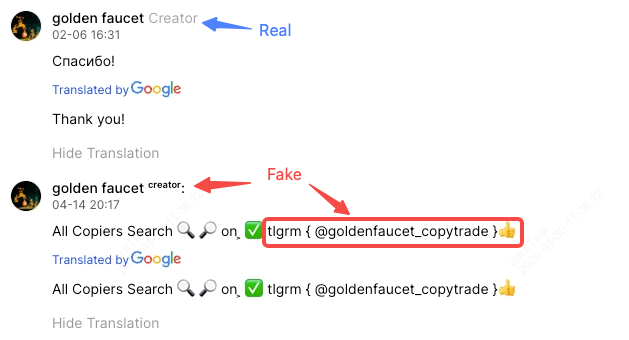
How to spot impersonators copy traders
Social engineering has reached peak sophistication in 2026, with scammers utilizing AI to mimic the writing style and post frequency of top traders. These Shadow Accounts create a sense of urgency, commenting under official BingX Insight posts with exclusive links to private Telegram groups or WhatsApp VIP mentorships. Their goal is to move you off-platform where BingX’s security guarantees no longer apply, leading to fee-advance fraud or wallet-draining smart contracts.
Read more: What Is a Social Engineering Attack in Crypto? A Complete Guide (2026)
How to Avoid Fraud and Impersonation Scams in Copy Trading
Use the Identity Verification Protocol: only trust accounts bearing the blue Creator or Trader label next to the nickname. A genuine BingX trader will never ask for private transfers, profit-sharing payments via external wallets, or personal contact info. Always verify a trader's performance data directly on their BingX profile; if the data tab is empty or hidden, it is a high-probability red flag.
Top 3 BingX Tools Minimize Copy Trading Risk
BingX provides a professional-grade ecosystem designed to protect retail copiers. Using these tools correctly can reduce your risk exposure by up to 60%.
1. Copy Trading 2.0 Subaccounts
Every copy relationship on BingX now operates in an isolated subaccount. This ensures that a liquidation in one copy trade does not affect your main futures balance or other active copies. It provides a firewall for your capital.
2. Copy Trading Subsidy Vouchers
For new users, BingX offers Subsidy Vouchers. If your first copied trade ends in a loss, the platform covers that loss up to the voucher's face value. This allows you to test the Fixed Ratio and Fixed Amount settings with a safety net.
3. Smart Filtering and BingX AI Analysis
Instead of chasing the highest 7-day ROI, use the 12 core metrics in the Copy Trading Plaza. Focus on:
- Max Drawdown (MDD): How much has the trader lost at their worst point?
- Win Rate vs. Profit Factor: Is the trader consistently right, or do they just have one big lucky win?
- Copier PnL: Are the people following the trader actually making money?
Professional Copy Trading Risk Management Framework (2026 Guide)
Implementing a structured risk management framework is essential for maintaining portfolio longevity and maximizing the efficiency of automated trading.
- Capital Allocation: Limit your exposure to a maximum of 10–20% of your total account balance per individual trader to prevent a single strategy failure from compromising your entire portfolio.
- Diversification: Copy between 5–7 traders with uncorrelated asset focuses, such as BTC, mid-cap altcoins, and commodities like Gold, to balance market-specific risks.
- Regular Review: Commit 2–3 hours weekly to auditing trader performance, checking for strategy drift, and rebalancing your funds based on recent drawdown data.
- Safety Reserves: Maintain 20–30% of your dedicated copy trading funds in stablecoins like USDT to serve as a liquid buffer for market emergencies or new high-potential opportunities.
Final Thoughts: How to Stay Safe in the Copy Trading Ecosystem
Copy trading is a powerful tool for participation in the financial markets, but it requires a disciplined approach. In 2026, the most successful copiers are not those who find the perfect trader, but those who build the most resilient systems around their trades.
By using 0-slippage execution, setting equity-based stop-losses, and verifying Creator labels, you can enjoy the benefits of professional expertise while keeping your assets secure on BingX.
Risk Reminder: Digital asset prices are subject to high market risk. Always perform your own due diligence before allocating funds to a lead trader.
Related Reading
- How to Manage Risks in Copy Trading on BingX: Key Features You Should Know
- Copiers | Risk Reminder on Copy Trading
- Copiers | Risk Warning on Copy Trading
- How to Use BingX AI for Smarter Copy Trading
FAQs on Copy Trading Risks
1. Can I lose more than the amount I allocated to a trader?
In Isolated Margin or Subaccount modes, your risk is generally limited to the funds transferred to that specific copy relationship. However, high-leverage trades can result in the rapid loss of that entire amount.
2. Why is my ROI lower than the copy trader’s ROI?
Discrepancies occur due to slippage, trading fees, and profit sharing - the 10-30% cut the trader takes. Using the 0 Slippage tool can help align your results more closely.
3. How do I know if a copy trader is a scammer?
Check for the Creator label. Click their profile; a real trader has verifiable history and data. A scammer's profile will often be empty and try to get you to leave the BingX platform, which is risky.
