



Pinterest (PINS) is a visual discovery and shopping platform where people plan purchases and advertisers reach them through sponsored content. Its large audience and Taste Graph give brands a way to connect ads with intent rather than passive browsing. AI recommendations and Performance+ campaigns could improve conversion, but Pinterest still competes for budgets with much larger ad platforms and must turn engagement into repeat spending.
The latest quarter showed audience and advertising growth alongside a slower forward outlook. Pinterest Q2 2026 revenue rose 18% to $1.1797 billion, monthly active users reached 640 million and adjusted EBITDA grew to $311.3 million. Management guided Q3 revenue growth of 13% to 15%. The question is whether better ad targeting and shopping tools can sustain monetization and cash flow as the reported growth rate eases.
The PINS stock forecast for 2026 now centers on two competing views:
- The monetization case: Better AI advertising, shopping tools and audience data increase advertiser returns, supporting margins and a recovery toward the article's $32 bull scenario.
- The growth-slowdown case: Moderating ad growth, uneven international monetization and recurring stock compensation limit earnings quality, making an editorial $18 downside scenario possible.
This guide breaks down the PINS stock forecast, 2026 price scenarios, key risks and analyst outlooks, drawing on Pinterest's August 4 Q2 earnings release, official product updates and dated analyst actions through October 14, plus how to trade PINS stock futures on BingX TradFi with USDT collateral.
Top 5 Things for Pinterest Investors to Know in October 2026
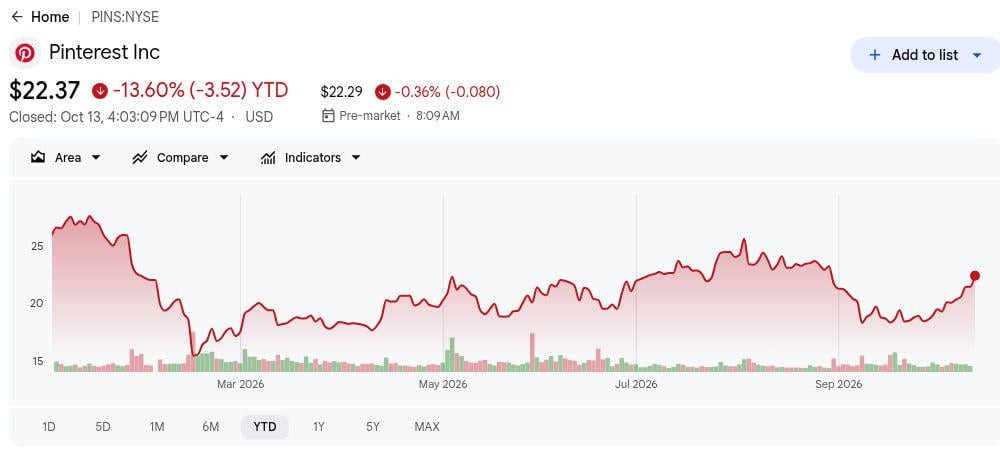
- PINS closed at $22.37, down 13.60% year to date. The stock has lagged despite Q2 revenue rising 18%. A lower valuation may improve its appeal if future cash flows hold up, making advertising demand and upcoming earnings important tests of a potential recovery.
- Q2 revenue of $1.18 billion exceeded management guidance. Sales surpassed the $1.153 billion upper bound by 2.3%, while $311.3 million in adjusted EBITDA beat the $276 million ceiling. These results demonstrate stronger execution, with next-quarter growth remaining the key forward test.
- 640 million users and 7% ARPU growth strengthened monetization. Monthly active users increased 11%, while global revenue per user reached $1.86. Further growth depends on converting international engagement into advertising spending, where monetization remains significantly lower.
- Q3 revenue growth guidance of 13% to 15% signals moderation. Management projected $1.190 billion to $1.210 billion in revenue and raised its annual adjusted EBITDA margin outlook from 29% to approximately 30%. Improved efficiency could offset slower growth if advertising and AI investments generate profitable demand.
- Over $2 billion in buybacks increased per-share value potential. Pinterest repurchased 111 million shares YTD at an average price of $18.17. Continued cash generation could support shareholder returns, while James Dibbo's October 26 CFO transition adds a checkpoint for capital allocation and investment discipline.
What Is Pinterest (PINS)?

Pinterest is a San Francisco-based visual discovery and shopping platform where users explore ideas, save products, and plan purchases across home design, fashion, food, and travel. Its business relies primarily on digital advertising, with brands paying for sponsored placements as users search, save, and compare products. Unlike traditional social media platforms, Pinterest captures users during the planning and shopping process, giving advertisers opportunities to reach consumers with purchase intent. Revenue growth depends on audience expansion, advertising demand, and how effectively the platform converts engagement into sales.
Pinterest is expanding its advertising capabilities through its Taste Graph, Pinterest Assistant, and Performance+ automation, which use AI to improve product recommendations, targeting, and campaign performance. Its Shopify integration simplifies advertising for merchants, while the February 2026 acquisition of tvScientific expanded Pinterest into connected-TV advertising. An LG campaign test reported 73% greater household reach and 24% more new customers, demonstrating the potential of cross-screen advertising. These initiatives aim to improve monetization, increase revenue per user, and attract more advertising spending as Pinterest strengthens its position in visual commerce.
Pinterest (PINS) Q2 2026 Earnings Overview: Strong Ad Growth Meets a Slower Q3 Outlook
Pinterest reported $1.1797 billion revenue, up 18% and above its $1.153 billion guidance ceiling, with non-GAAP diluted EPS of $0.43 versus $0.33 a year earlier. U.S. and Canada revenue grew 18% to $880 million. Adjusted EBITDA reached $311.3 million, yet Q3 revenue guidance implied slower 13% to 15% growth. The quarter improved cash economics without resolving the pace of future advertiser demand.
|
Financial Metric |
Guidance / Consensus |
Reported / Actual |
Surprise |
|
Q2 revenue |
1.133B–1.153B guidance |
$1.1797B |
Beat. $26.7M above guidance ceiling; up 18% YoY. |
|
Non-GAAP diluted EPS |
$0.33 a year earlier |
$0.43 |
Improved. Up $0.10, or 30%, year over year. |
|
GAAP net income / loss |
$38.8M profit a year earlier |
$46.7M loss |
Weakened. $85.5M swing from profit to loss. |
|
Monthly active users |
578M a year earlier |
640M |
Expanded. Up 11% year over year. |
|
Adjusted EBITDA |
256M–276M guidance |
$311.3M |
Beat. $35.3M above guidance ceiling; up 24% YoY. |
|
Free cash flow |
$196.7M a year earlier |
$269.9M |
Improved. Up $73.2M, or 37%, year over year. |
|
Q3 revenue outlook |
18% Q2 growth |
1.190B–1.210B |
Slower. Guided 13%–15% year-over-year growth. |
|
Full-year adjusted EBITDA margin outlook |
29% prior outlook |
~30% |
Raised. Up about 1 percentage point. |
- Revenue growth of 18% exceeded management guidance. Sales rose from $998.2 million, surpassing the $1.133 billion to $1.153 billion outlook. Stronger advertising products and commercial engagement supported growth, although sustained advertiser spending remains essential to maintaining momentum.
- U.S. and Canada revenue growth of 18% strengthened Pinterest's largest market. Revenue reached $880 million, with ARPU rising 14% to $8.30. Europe grew 12% and Rest of World 38%, although their smaller revenue bases limit their ability to offset a domestic slowdown.
- Adjusted EPS of $0.43 benefited from substantial share repurchases. Non-GAAP net income rose 9% to $249.5 million, while diluted shares fell from 689.8 million to 577.6 million. Buybacks amplified per-share earnings growth, making underlying profitability important when assessing future EPS performance.
- Free cash flow increased 37% to $269.9 million. Operating cash flow reached $292.9 million despite a $46.7 million GAAP loss. The company added back $324.5 million in stock-based compensation, including restructuring awards, making dilution-adjusted returns important when evaluating cash generation.
- The 30% full-year EBITDA margin outlook signals improving profitability. Management raised its expectation from 29%, with Q3 adjusted EBITDA guidance of $335 million to $355 million. The midpoint implies a roughly 28.8% quarterly margin, suggesting efficiency gains could support earnings despite slower revenue growth.
Pinterest (PINS) 2026 Investment Outlook: $32 Bull Case vs. $18 Bear Case
Pinterest's 2026 outlook depends on whether its growing audience and better shopping tools can lift advertiser returns while revenue growth moderates. Stronger domestic monetization, Performance+ adoption and disciplined spending support upside. A weaker ad market, uneven international yield or higher product costs would make the recent cash-flow improvement harder to sustain.
The Bull Case: Better Ad Monetization Pushes PINS Toward $32
The Bull Case assumes U.S. and Canada ARPU maintains its Q2 momentum as Performance+ and Shopify integration bring more repeat campaigns to the platform. Pinterest Assistant could turn product discovery into higher-converting traffic. If advertising revenue grows faster than engineering and sales costs, adjusted EBITDA and cash flow would strengthen even without another surge in users.
A move toward $32 would require Q3 revenue near or above $1.210 billion, strong holiday demand and confidence in the roughly 30% annual adjusted EBITDA margin outlook. Better advertiser returns and rising profit estimates would provide confirmation.
The Base Case: Guided Growth Keeps PINS Between $22 and $27
The Base Case assumes Q3 revenue lands within the $1.190 billion to $1.210 billion range and advertiser yield improves gradually. The 640 million user base and $269.9 million of Q2 free cash flow support continued product investment, but guided growth of 13% to 15% gives investors limited reason to price in immediate reacceleration.
PINS could trade mainly between $22 and $27 if domestic ARPU remains firm, European monetization improves and margin guidance holds. A revenue miss or weaker cash conversion would pressure the range; stronger holiday sales would lift its upper end.
The Bear Case: Slower Advertising Growth Pulls PINS Toward $18
The Bear Case assumes advertisers shift budgets when Pinterest campaigns deliver weaker incremental returns. U.S. and Canada account for $880 million of quarterly revenue, so softer domestic spending would be difficult for smaller regions to offset. Lower ad yield would also reduce operating leverage as Pinterest continues funding AI, shopping tools and sales teams.
A move toward $18 would become more likely if Q3 revenue falls below $1.190 billion, holiday commentary weakens or margin guidance is cut. Lower earnings estimates and the cost of recurring stock compensation would add pressure despite continued user growth.
PINS Stock Price Forecasts for 2026 By Wall Street Analysts
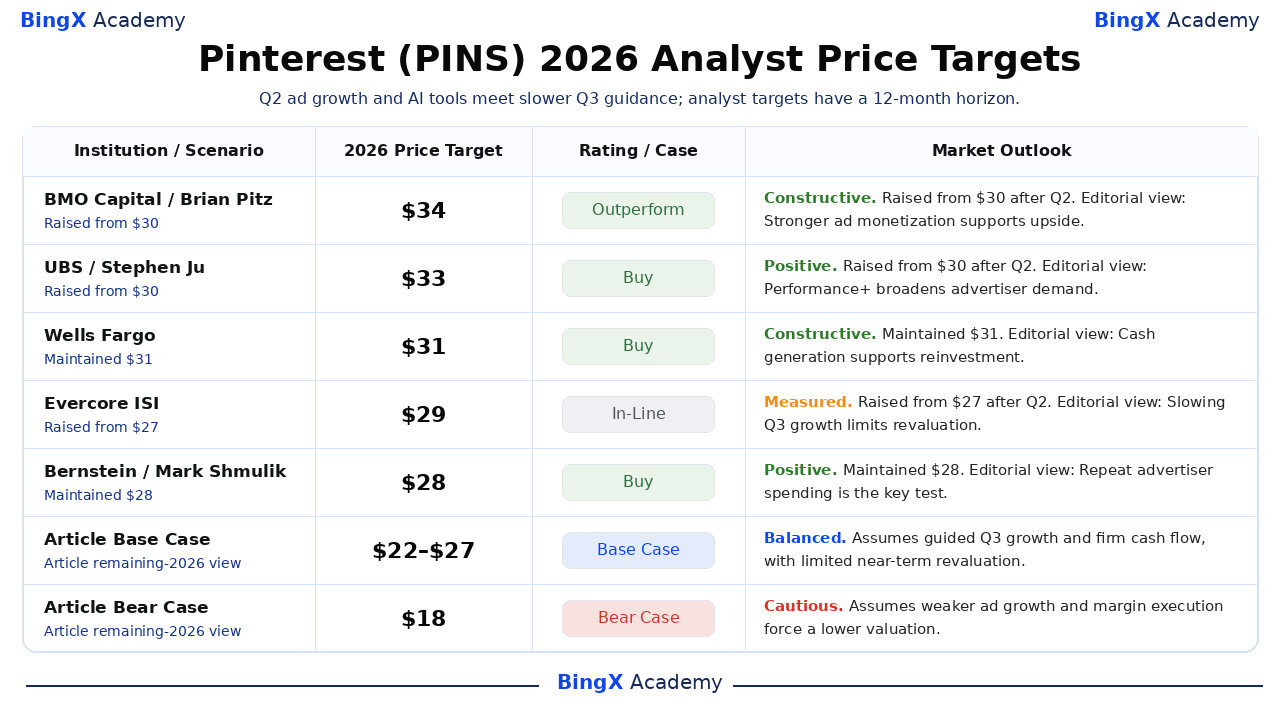
These five named third-party actions use a 12-month horizon extending beyond December 2026. Where the published notes omit detailed rationales, Market Outlook explanations are explicitly labeled editorial interpretations. Wells Fargo's rating follows the provider's normalized Buy category. Base and Bear rows are separate remaining-2026 article scenarios.
|
Institution / Scenario |
2026 Price Target |
Rating / Case |
Market Outlook |
|
BMO Capital |
$34 |
Outperform |
Constructive. August 5: Brian Pitz raised from $30 to $34, maintaining Outperform. Editorial view: Stronger ad monetization supports upside. |
|
UBS |
$33 |
Buy |
Positive. August 5: Stephen Ju raised from $30 to $33, maintaining Buy. Editorial view: Performance+ broadens advertiser demand. |
|
Wells Fargo |
$31 |
Buy |
Constructive. October 12: Ken Gawrelski maintained Buy and the $31 target. Editorial view: Cash generation supports reinvestment. |
|
Evercore ISI |
$29 |
In-Line |
Measured. August 5: Mark Mahaney raised from $27 to $29, maintaining In-Line. Editorial view: Slowing Q3 growth limits revaluation. |
|
Bernstein |
$28 |
Buy |
Positive. August 20: Mark Shmulik maintained Buy and the $28 target. Editorial view: Repeat advertiser spending is the key test. |
|
Article Base Case |
22–27 |
Base Case |
Balanced. Assumes guided Q3 growth and firm cash flow, with limited near-term revaluation. |
|
Article Bear Case |
$18 |
Bear Case |
Cautious. Assumes weaker ad growth and margin execution force a lower valuation. |
How to Trade Pinterest (PINS) Stock on BingX
Trade Pinterest's AI advertising, shopping monetization and cash-flow outlook using BingX TradFi and BingX AI tools. Because PINS can react sharply to advertiser demand, user metrics and quarterly guidance, traders should define both the catalyst and risk limits before entering a position.
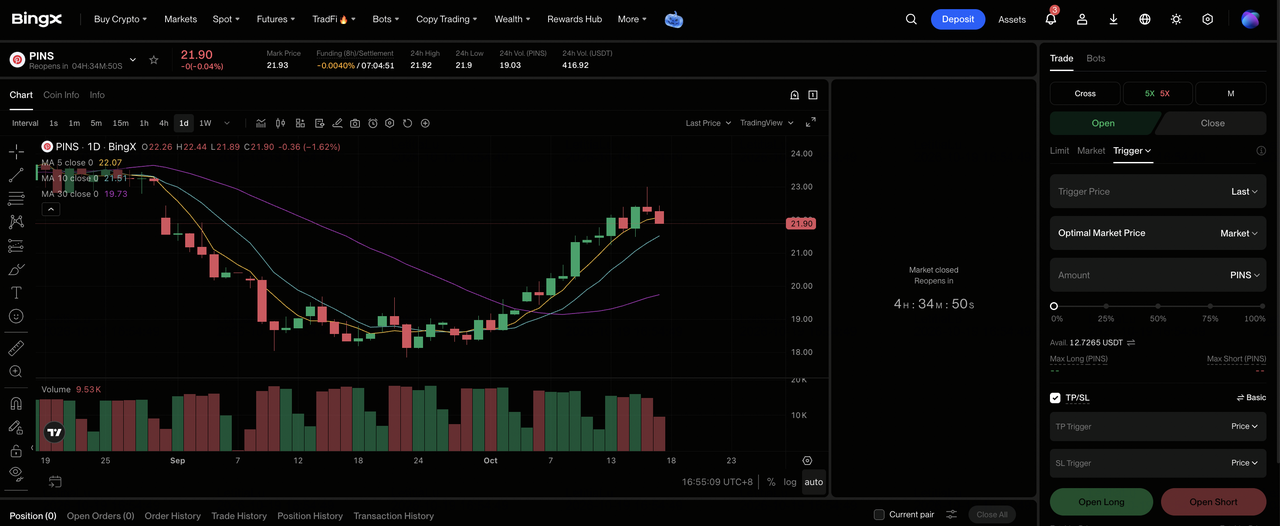
Step 1: Access BingX TradFi. Sign up and navigate to the specialized TradFi section on the BingX exchange dashboard.
Step 2: Select Pinterest (PINS). Search for and select the PINS-USDT perpetual futures contract.
Step 3: Choose your direction. Select Open Long if you expect stronger advertiser returns, domestic ARPU and disciplined spending to support growth. Select Open Short if you expect weaker ad demand, slowing monetization or a reduced margin outlook.
Step 4: Select leverage and margin mode. Choose Isolated or Cross-Margin based on your risk tolerance. PINS's 13.60% YTD decline shows why conservative leverage and clear position sizing are important.
Step 5: Execute strict risk protocols. Set Take-Profit and Stop-Loss (TP/SL) levels before or immediately after entering the trade. PINS can react quickly to earnings, MAUs, ARPU, advertising budgets, AI product updates and capital-allocation decisions.
Top 5 Risks to Watch for Pinterest Investors in 2026
Pinterest's expanding audience, improving monetization, and stronger cash generation support its long-term growth potential. However, advertising demand, international profitability, shareholder dilution, capital allocation, and AI competition remain important factors shaping future earnings and valuation.
- Slower advertising demand could pressure margins. Q3 guidance points to revenue growth moderating to 13% to 15%. Further reductions in advertiser spending could weaken revenue against ongoing engineering and sales expenses, limiting operating leverage and earnings growth.
- International monetization may lag audience growth. Rest of World reached 377 million monthly active users in Q2, but ARPU remained at $0.23. Expanding engagement creates substantial opportunity, although slower advertiser adoption could delay meaningful revenue and profit contributions.
- Stock-based compensation could offset per-share gains. Pinterest added back $324.5 million in share-based compensation in Q2 cash flow. Continued equity grants can dilute shareholders unless repurchases offset issuance, potentially reducing cash available for growth investment.
- Aggressive buybacks could reduce financial flexibility. Pinterest repurchased over $2 billion in shares YTD, while cash and marketable securities declined to $1.275 billion. Further repurchases could limit resources for product investment and acquisitions, making capital allocation especially important during the October CFO transition.
- AI advertising competition could limit profitability. Performance+ and tvScientific aim to improve targeting, measurement, and advertiser returns, but competing platforms are investing heavily in similar capabilities. Higher acquisition costs or weaker repeat spending could pressure margins and limit valuation upside.
Final Thoughts: Should You Invest in Pinterest in 2026?
Pinterest's improving advertising performance provides a stronger foundation for its investment outlook, with Q2 revenue rising 18%, domestic monetization strengthening, and free cash flow increasing 37%. Performance+ automation, Shopify integration, and tvScientific could expand advertiser reach and improve conversion, creating opportunities for further revenue and margin growth. The key is whether these initiatives can sustain advertiser spending and profitability as near-term revenue growth moderates.
The $32 bull case depends on stronger advertising demand, holiday spending, and continued margin improvement, while the $18 bear case reflects weaker monetization and valuation pressure. The $22 to $27 base case assumes steady execution within management's guidance. Investors can track upcoming Q3 results, domestic ARPU trends, advertiser returns, and dilution-adjusted cash flow to assess whether Pinterest's AI and shopping investments can support a sustained recovery.
Risk Reminder: Investing in PINS involves the risk of capital loss. Advertising cycles, AI competition, international monetization, stock-based compensation, and capital allocation decisions can affect future earnings and share-price performance. Investors should assess these risks and conduct independent research before investing.
Related Reading
- Shopify (SHOP) Price Prediction 2026: Can Payments and AI Commerce Push SHOP Toward $210?
- Reddit (RDDT) Price Prediction 2026: Can AI Data Opportunities Push RDDT Toward $300?
- Meta (META) Price Prediction 2026: Can AI Monetization Push META Toward $1,000?
- Snap Inc. (SNAP) Price Prediction 2026: Can Advertising and Subscription Growth Push SNAP Toward $10
- Alibaba (BABA) Price Prediction 2026: Can 45% Cloud Growth Push BABA Toward USD $230?
