



Pfizer (PFE) is a global biopharmaceutical company whose prescription portfolio spans oncology, internal medicine, vaccines, inflammation and immunology, and rare diseases. Eliquis, Vyndaqel, Prevnar, Padcev and other medicines now carry more of the earnings base as pandemic-related demand declines. The breadth provides several routes to growth, though PFE remains sensitive to patent expirations, clinical outcomes, drug pricing and the productivity of recent acquisitions.
The latest quarter showed that transition progressing without removing the long-term earnings gap. Pfizer Q2 2026 revenue reached $15.0 billion, adjusted diluted EPS was $0.77 and the non-COVID portfolio grew enough to offset a 95% decline in Paxlovid revenue and a 34% decline in Comirnaty revenue. Management raised annual revenue guidance, though the investment case still depends on converting oncology and obesity assets into durable post-patent growth.
The PFE stock forecast for 2026 now centers on two competing views:
- The pipeline, portfolio and savings case: Eliquis, Vyndaqel, Padcev and newer Seagen assets can sustain non-COVID growth as $9.7 billion of planned savings improves earnings power and supports a move toward $38.
- The patent, clinical and pricing-pressure case: faster erosion in established products, pipeline disappointments or weaker acquisition returns could leave earnings below the level required for a rerating and pull PFE toward $22.
This guide breaks down the PFE stock forecast, 2026 price scenarios, key risks and analyst outlooks, drawing on Pfizer's August 4 Q2 2026 earnings release, quarterly filing and market data through September 15, plus how to trade PFE stock futures on BingX TradFi with USDT collateral.
Top 5 Things for Pfizer Investors to Know in September 2026
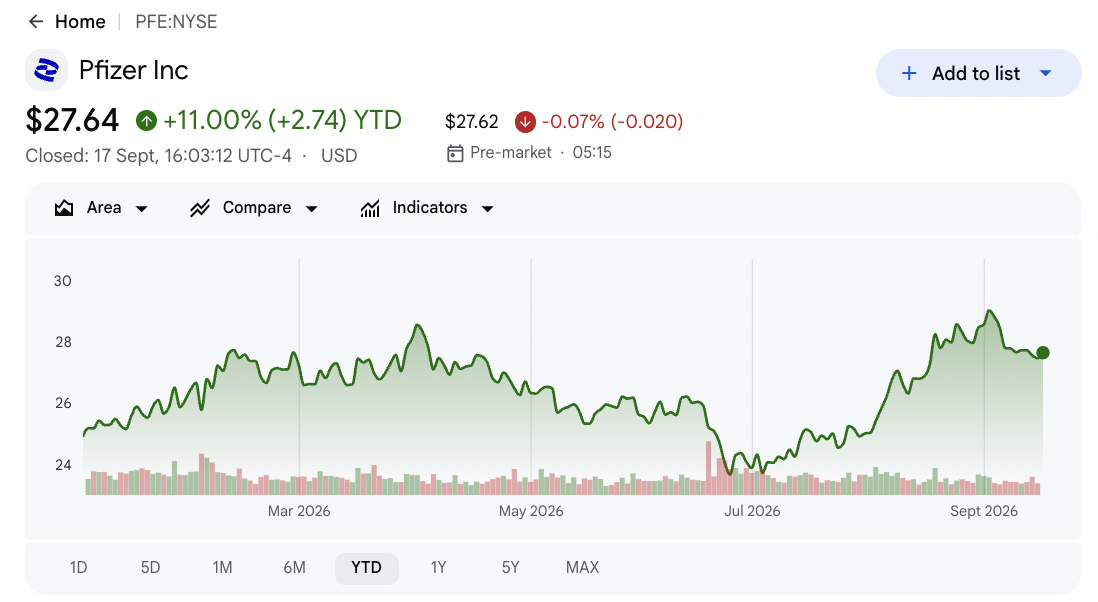
- PFE closed at $27.55 on September 15 and was up 10.29% YTD: Shares traded near the $28.39 analyst average and below the $35 Street high. Further upside depends on whether pipeline progress and cost savings can outweigh approaching patent losses.
- Q2 revenue reached $15.0 billion, up 1% operationally: Sales beat the $14.95 billion consensus by about $50 million. Strong Eliquis and newer-product demand offset another sharp decline in pandemic-related revenue.
- Adjusted EPS of $0.77 beat consensus by $0.09: The result topped the $0.68 estimate and supported unchanged full-year guidance of $2.80 to $3.00. Cost control helped earnings despite acquisition and intangible-asset charges.
- 2026 revenue guidance increased to $60.5 billion to $62.5 billion: The midpoint rose by $500 million as non-COVID products performed about $1.5 billion better than initially expected. Paxlovid and Comirnaty remain volatile offsets.
- Pfizer now targets $9.7 billion of savings through 2029: The company added $2.5 billion to previously announced programs. Savings can support margins and the dividend, though cuts still need to preserve research productivity and commercial execution.
What Is Pfizer (PFE)?

Pfizer is a research-based pharmaceutical company that discovers, develops, manufactures and markets prescription medicines and vaccines worldwide. Its revenue comes from patented products sold through wholesalers, hospitals, pharmacies and public-health programs, with alliance revenue also generated through products such as Eliquis. The portfolio covers oncology, internal medicine, vaccines, specialty care and primary care. That operating model combines large clinical-development programs, regulated manufacturing, global commercialization and lifecycle management across medicines with different patent durations.
Its long-term strategy is centered on replacing aging franchises with oncology, obesity and specialty-care growth. The $43 billion Seagen acquisition expanded Pfizer's antibody-drug conjugate portfolio through Padcev and other cancer assets, while the $10 billion Metsera transaction added obesity candidates including berobenatide. Pfizer continues vaccine partnerships with BioNTech and Valneva, and works with Arvinas on breast-cancer therapy. These relationships broaden the pipeline, though their value depends on clinical success, approvals, launch execution and commercial returns over several years rather than one quarter.
Read More: Top Pharma Stocks to Buy in 2026: Cancer Drugs, Weight-Loss Drugs, mRNA, and New Medicines
Pfizer (PFE) Q2 2026 Earnings Overview: EPS Beat, Higher Revenue Guidance and Portfolio Transition
Pfizer reported Q2 revenue of $15.0 billion versus roughly $14.95 billion expected, adjusted diluted EPS of $0.77 versus $0.68 consensus and reported loss per share of $0.06. Eliquis alliance revenue reached about $2.16 billion as Paxlovid revenue fell 95% to $60 million and Comirnaty declined 34% to $260 million. Management raised annual revenue guidance to $60.5 billion to $62.5 billion and retained $2.80 to $3.00 of adjusted EPS guidance, separating stronger operating execution from continuing patent and portfolio risk.
Read More: Pfizer (PFE) Q2 2026 Earnings: $15.03B Revenue Beat and Newer Drug Growth Lift Shares 1.52%
|
Financial Metric |
Guidance / Consensus |
Reported / Actual |
Surprise |
|
Q2 2026 revenue |
$14.95B consensus |
$15.0B |
Beat. About $50M above consensus; up 1% operationally. |
|
Adjusted diluted EPS |
$0.68 consensus |
$0.77 |
Beat. $0.09 above consensus. |
|
Reported diluted EPS |
— |
$(0.06) |
Loss. Acquisition and intangible charges affected GAAP results. |
|
Eliquis alliance revenue |
— |
$2.16B |
Strong. Demand helped offset COVID-product erosion. |
|
Paxlovid revenue |
— |
$60M |
Declined. Down 95% YoY. |
|
Comirnaty revenue |
— |
$260M |
Declined. Down 34% YoY. |
|
2026 revenue outlook |
$59.5B–$62.5B prior |
$60.5B–$62.5B |
Raised. Midpoint increased $500M. |
|
2026 adjusted EPS outlook |
$2.80–$3.00 prior |
$2.80–$3.00 |
Reaffirmed. Portfolio strength offset COVID pressure. |
|
Savings through 2029 |
$7.2B previously targeted |
$9.7B total |
Expanded. Added $2.5B of planned savings. |
- Revenue of $15.0 billion beat consensus by about $50 million: Sales grew 1% operationally despite sharply lower COVID revenue. The mix shows established and acquired medicines are carrying more of the portfolio, though growth remains modest ahead of major patent losses.
- Adjusted EPS of $0.77 beat the $0.68 estimate by $0.09: The result supports Pfizer's full-year range of $2.80 to $3.00. Reported EPS of negative $0.06 still shows how acquisition accounting and intangible charges can separate GAAP and adjusted profitability.
- Eliquis generated about $2.16 billion as Paxlovid fell to $60 million: Paxlovid declined 95% and Comirnaty fell 34%, increasing the importance of non-COVID growth. Eliquis, Vyndaqel and Padcev remain key bridges to later pipeline launches.
- The revenue-guidance midpoint increased by $500 million: The new $61.5 billion midpoint reflects non-COVID products running about $1.5 billion above the original plan. COVID seasonality and foreign exchange still limit how much of that strength reaches guidance.
- Total targeted savings reached $9.7 billion through 2029: The additional $2.5 billion can protect margins during loss-of-exclusivity pressure. Pfizer still needs to reduce costs without slowing the oncology and obesity programs intended to rebuild growth after 2028.
Read More: Merck (MRK) Price Prediction 2026: Can Pipeline Momentum Push MRK Stock Toward $170?
Pfizer (PFE) 2026 Investment Outlook: $38 Bull Case vs. $22 Bear Case
Pfizer's 2026 outlook depends on whether newer medicines, pipeline progress and cost savings can offset declining COVID revenue and approaching patent losses. The main upside comes from stronger oncology and obesity programs, while the main risk is that new launches fail to replace aging products quickly enough.
The Bull Case: Stronger Drug Growth Pushes PFE Toward $38
The Bull Case assumes Eliquis, Vyndaqel, Padcev and other non-COVID products maintain growth, while obesity and oncology programs reach important milestones. The $9.7 billion savings plan also improves margins without weakening launches, helping revenue finish near the upper end of $60.5 billion to $62.5 billion guidance.
A move toward $38 would require sustained estimate upgrades, favorable clinical or regulatory decisions and clearer evidence that newer products can replace major patent losses after 2028. Strong cash flow and improving returns from acquired assets would strengthen the case.
The Base Case: Steady Earnings Keep PFE Between $28 and $31
The Base Case assumes non-COVID growth and cost savings broadly offset declining COVID sales and early patent pressure. Revenue stays within guidance, adjusted EPS remains near $2.90 and pipeline progress continues without materially changing the long-term growth outlook.
PFE could trade mainly between $28 and $31 under these conditions. Stable guidance, a stronger product mix and disciplined spending would support the range. Delayed pipeline progress and continued uncertainty around patent expirations would cap the upper end.
The Bear Case: Patent Losses and Drug Setbacks Pull PFE Toward $22
The Bear Case assumes established products decline faster while major pipeline assets are delayed, fail trials or launch below expectations. Acquisition-related investment then generates less revenue than planned, weakening the earnings recovery even if cost reductions continue.
A move toward $22 would become more likely if annual revenue falls below $60.5 billion, adjusted EPS drops under $2.80 or management lowers long-term pipeline expectations. Pricing pressure or weaker dividend coverage would add further pressure.
PFE Stock Price Forecasts for 2026 By Wall Street Analysts
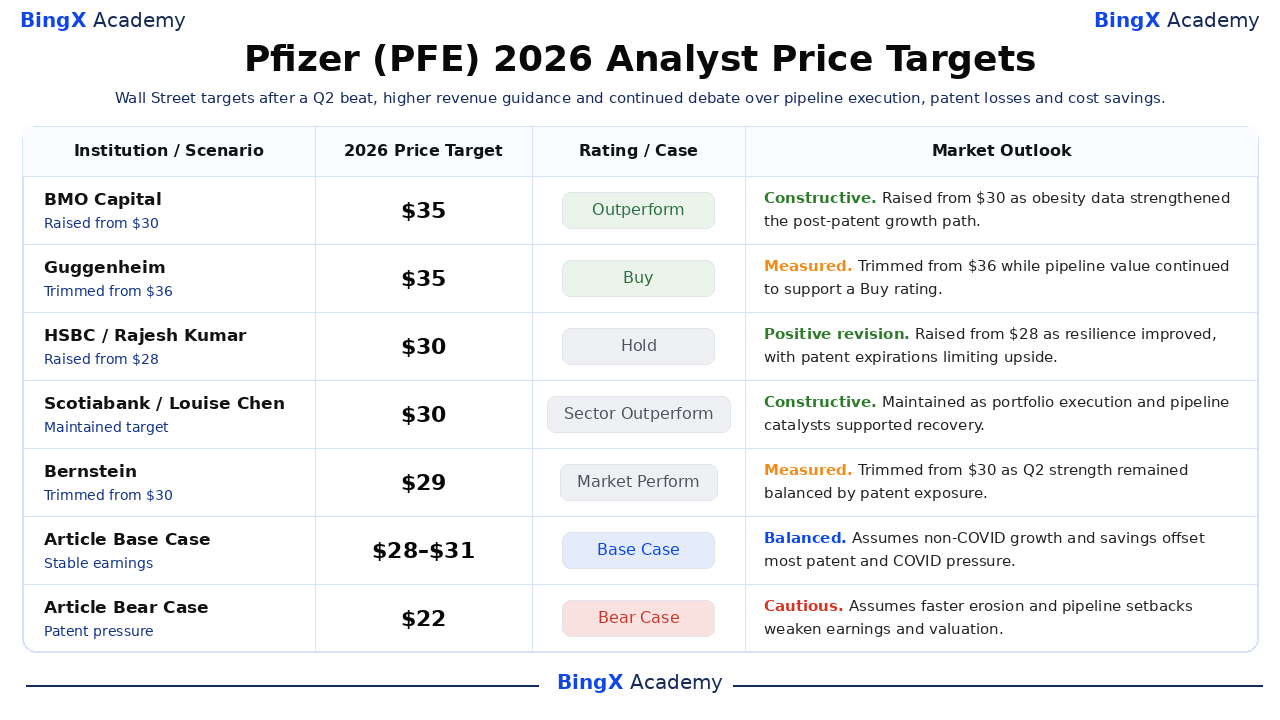
These five dated actions span $29 to $35 and show a market split between pipeline optimism and patent-cliff caution. They are third-party reference points rather than a single forecast or price promise. The Base and Bear rows are BingX Academy editorial scenarios.
|
Institution / Scenario |
2026 Price Target |
Rating / Case |
Market Outlook |
|
BMO Capital / Evan Seigerman |
$35 |
Outperform |
Constructive. September 9: raised from $30 after obesity-program data improved the pipeline outlook. |
|
Guggenheim / Seamus Fernandez |
$35 |
Buy |
Measured. July 13: trimmed from $36 while pipeline value continued to offset execution risk. |
|
HSBC / Rajesh Kumar |
$30 |
Hold |
Positive revision. September 10: raised from $28 as resilience improved, with patent expirations limiting upside. |
|
Scotiabank / Louise Chen |
$30 |
Sector Outperform |
Constructive. August 24: maintained as portfolio execution and pipeline catalysts supported recovery. |
|
Bernstein / Courtney Breen |
$29 |
Market Perform |
Measured. August 21: trimmed from $30 as Q2 strength remained balanced by patent exposure. |
|
Article Base Case |
$28–$31 |
Base Case |
Balanced. Assumes non-COVID growth and savings offset most patent and COVID pressure. |
|
Article Bear Case |
$22 |
Bear Case |
Cautious. Assumes faster erosion and pipeline setbacks weaken earnings and valuation. |
How to Trade Pfizer (PFE) Stock on BingX
Trade Pfizer's portfolio-growth, pipeline and savings outlook using BingX TradFi and BingX AI tools. Because PFE can react to trial results, regulatory decisions, patent rulings and guidance, traders should define the catalyst and risk limits before entering a position.
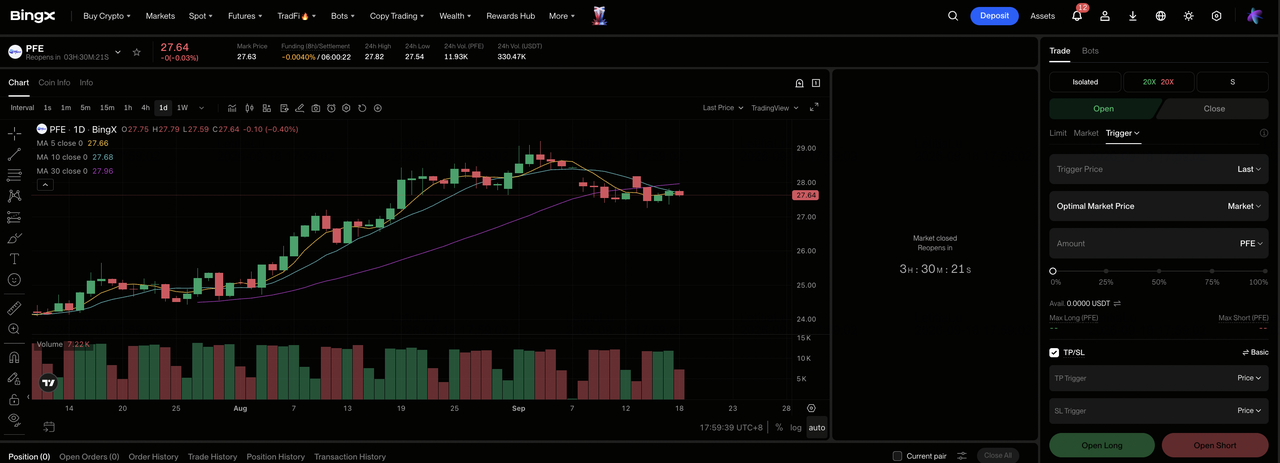
Step 1: Access BingX TradFi. Sign up and navigate to the specialized TradFi section on the BingX exchange dashboard.
Step 2: Select Pfizer (PFE). Search for and select the PFE-USDT perpetual futures contract.
Step 3: Choose your direction. Select Open Long if non-COVID growth and pipeline progress support estimates. Select Open Short if patent erosion or clinical setbacks weaken earnings.
Step 4: Select leverage and margin mode. Choose Isolated or Cross-Margin based on your risk tolerance. The $22 to $38 scenario span shows why conservative leverage is important.
Step 5: Execute strict risk protocols. Set Take-Profit and Stop-Loss (TP/SL) levels before or immediately after entering the trade.
Top 5 Risks to Watch for Pfizer Investors in 2026
Pfizer's outlook depends on patent expirations, pipeline execution, acquisitions, pricing policy and COVID demand. These risks can affect future revenue, cash flow and valuation.
- Patent expirations could remove billions from revenue: If newer products do not replace lost exclusivity, sales and margins could fall even as Pfizer cuts costs. Lower earnings would also weaken dividend coverage.
- Clinical failures could erase pipeline value: Late-stage oncology and obesity programs still depend on positive efficacy, safety and regulatory outcomes. A failed study could trigger write-downs and force Pfizer to spend more on replacement assets.
- Seagen and Metsera may take longer to deliver returns: Pfizer committed $43 billion to Seagen and $10 billion to Metsera. Slower launches or development delays could reduce acquisition returns and leave more of the earnings case dependent on cost savings.
- Drug-pricing pressure could weaken margins: Government negotiations, rebates and payer restrictions can reduce realized prices. If prescription growth does not offset lower pricing, product profit could fall faster than headline revenue.
- COVID revenue remains volatile: Paxlovid fell 95% and Comirnaty declined 34% in Q2. Seasonal demand, government purchasing and virus circulation can still move annual results away from expectations.
Final Thoughts: Should You Invest in Pfizer in 2026?
Pfizer's Q2 beat, higher revenue guidance and expanded $9.7 billion savings program show a company stabilizing after the COVID reset. The stock also offers exposure to a broad marketed portfolio and oncology and obesity pipelines. The central issue is whether those assets can replace the earnings lost to patent expirations rather than only support the current base.
The Bull Case needs pipeline wins and stronger margins to support $38. The Bear Case reflects faster erosion, weaker acquisition returns and a move toward $22. Conservative traders may watch annual adjusted EPS, non-COVID growth, pivotal clinical results, acquisition returns and free cash flow before treating the recovery as durable enough to support a sustained valuation rerating.
Risk Reminder: Trading and investing in equities like PFE involves a risk of capital loss. Clinical failures, regulatory decisions, patent losses, pricing pressure, acquisition execution and leveraged trading can produce rapid losses. Conduct independent research before allocating capital.
Related Reading
- Top Pharma Stocks to Buy in 2026: Cancer Drugs, Weight-Loss Drugs, mRNA, and New Medicines
- Moderna (MRNA) Price Prediction 2026: Can Cancer Vaccine Momentum Push MRNA Stock Toward $180?
- Merck (MRK) Price Prediction 2026: Can Pipeline Momentum Push MRK Stock Toward $170?
- Novo Nordisk (NVO) Price Prediction 2026: Can Wegovy Momentum Push NVO Toward $60?
- AbbVie (ABBV) Price Prediction 2026: Can Immunology Drug Growth Push ABBV Toward $325?
- Eli Lilly (LLY) Price Prediction 2026: Can Weight-Loss Drug Demand Push LLY Toward $1,600?
