
The global capital markets in mid-2026 are preparing for an unprecedented tech milestone as artificial intelligence startups transition to public stock exchanges. OpenAI, the pioneer behind ChatGPT, has officially taken the first definitive step toward what could become one of the largest public market debuts in financial history.
The company announced it has submitted a confidential S-1 filing with the US Securities and Exchange Commission (SEC). Wall Street analysts indicate that OpenAI is aiming for a formal listing window between September and November 2026, targeting a historic valuation milestone that could approach 1 trillion dollars.
The upcoming public offering marks a massive evolution for an organization that began in 2015 as a non-profit research lab. Now structured as a commercial powerhouse, OpenAI is balancing skyrocketing enterprise adoption against unprecedented data center infrastructure expenses. For global investors looking to capitalize on this shifting ecosystem ahead of the official opening bell, tracking the OpenAI Pre-IPO market has become a core tactical focus. You will also discover how to trade OpenAI Pre-IPO Futures on BingX TradFi with USDT collateral.
Read more: SpaceX (SPCX) Price Prediction 2026: $227 Street-High AI Fusion or Trillion-Dollar Valuation Bubble?
Key Highlights: Top 5 Things for AI Investors to Know in 2026
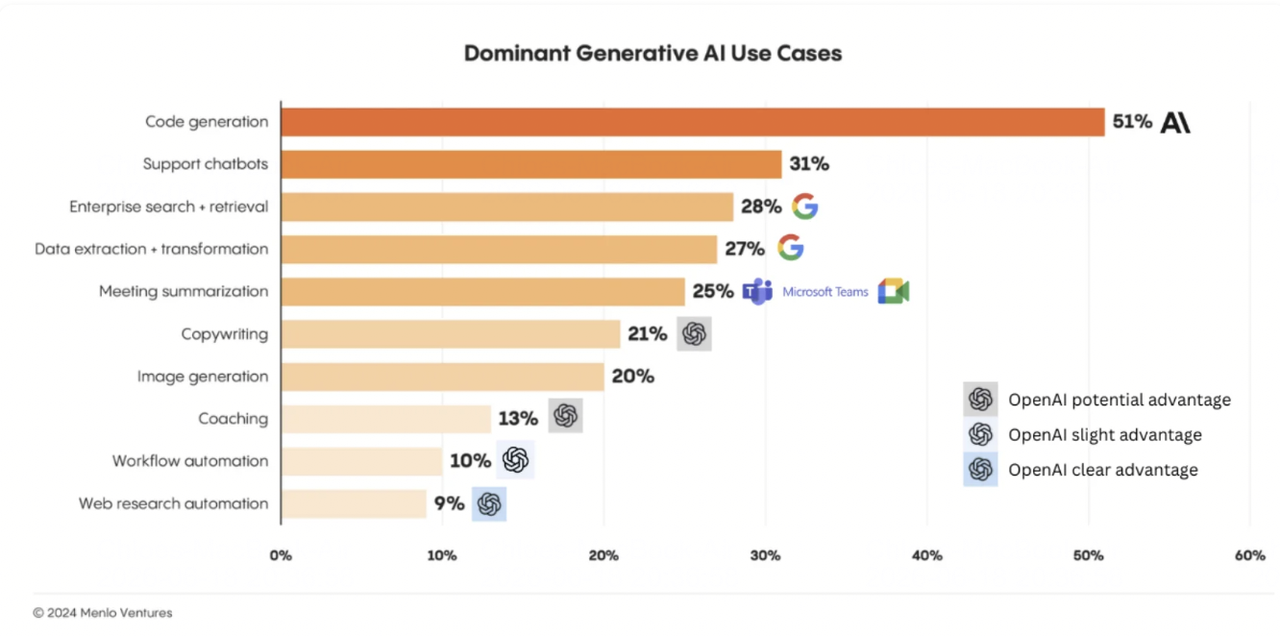
Source: Menlo Ventures
- The Historic 1 Trillion Dollar Valuation Target: Private market funding rounds throughout early 2026 placed OpenAI's valuation between $730 billion and $852 billion. Bullish institutional underwriters estimate that formal public listing will target a market capitalization ranging from $850 billion to $1.1 trillion.
- Explosive Revenue Met with Massive Infrastructure Burn: OpenAI’s annualized revenue run rate has surpassed $20 billion, climbing past $30 billion in mid-2026. Their revenue is up from $13 billion in 2025. However, training frontier models requires immense computing power. The company faces a projected net loss of $14 billion in 2026 alone, with cash flow positive status not expected until roughly 2029 or 2030.
- The S-1 Race Against Anthropic: A fierce competitive horse race is playing out in the tech sector. OpenAI's confidential filing is timed to front-run chief rival Anthropic, the maker of Claude AI, which also filed confidential paperwork for its own late 2026 public listing at a projected $900 billion to $965 billion valuation.
- The 1 Billion User Milestone: ChatGPT user engagement continues to break records, currently tracking between 900 million and 920 million weekly active users globally. The platform is steadily approaching the symbolic 1 billion active user threshold, supported by its newly launched January 2026 advertising tier.
- Corporate Restructuring Hurdles: To successfully complete its public debut, OpenAI must fully finalize its complex corporate migration from a non-profit capped structure into a traditional for-profit public benefit corporation, an operational shift heavily scrutinized by institutional underwriters like Goldman Sachs and Morgan Stanley.
2026 High-Growth Tech IPO Wave Comparison
The table below contrasts the core financial projections, backing entities, and core challenges defining the primary mega-cap companies preparing for or completing listings in the 2026 market cycle.
|
Pre-IPO Asset |
Projected / Realized Valuation |
Lead Underwriters / Financial Backers |
Operational Growth Milestones |
Core Roadblocks & Structural Risks |
|
$850 Billion to $1.1 Trillion |
Goldman Sachs, Morgan Stanley, Microsoft, SoftBank |
Annualized revenue tracking above $20B to $24B; ChatGPT approaching 1B monthly active users. |
A $14B annualized cash burn rate in 2026; over $600B in cumulative infrastructure commitments needed by 2030; Elon Musk copyright and damages litigation. |
|
|
Anthropic |
$900 Billion to $965 Billion |
Amazon, Google, Menlo Ventures |
Target 2026 revenue run rate pushing toward $20B to $26B via Claude enterprise adoption. |
Rapidly narrowing product differentiation; high compute reliance on external cloud providers. |
|
SpaceX |
$1.77 Trillion (June 2026 Debut) |
Institutional Consortium, Elon Musk |
Raised $75B in record-breaking listing; major commercial rollouts for Starlink networks. |
Intense regulatory oversight across aerospace frameworks; steep capital expenditures for deep space infrastructure. |
Data Source Verifications
- OpenAI Financials: Consolidated from official Wall Street Journal, Bloomberg, and Reuters investigative briefs published throughout early 2026, alongside internal revenue statements affirmed by CFO Sarah Friar.
- Competitive Metrics: Sourced from TechCrunch venture funding archives, Similarweb traffic distribution data sets tracking AI platform market shares, and prediction markets consensus data via platforms like Polymarket.
Read more: Polymarket vs. Kalshi: Which Prediction Market Platform Should You Use in 2026?
OpenAI's Key Growth Phases Over the Years
The Non-Profit Research & Core Technology Pivot (2015 to 2017)
Incepted on December 11, 2015, as a non-profit research laboratory, OpenAI mirrored the early evolution of deep learning from an academic curiosity into a specialized global tech giant. Early structural growth relied heavily on open-source research contributions, reinforcement learning benchmarks, and laying the initial generative model architectures that would fundamentally alter the software industry.
The Commercial Transition and Early API Era (2018 to 2023)
To fund the astronomical computing power required for large-scale training, the organization restructured, creating a "capped-profit" commercial arm. OpenAI navigated massive model development loops, successfully unveiling GPT-3 and eventually breaking internet adoption records with the launch of ChatGPT. Concurrently, it diversified its ecosystem via heavy enterprise partnerships, establishing its multi-billion-dollar alliance with Microsoft to integrate models into global cloud supply chains.
The Frontier Model Boom and Commercial Value-Up Revolution (2024 to 2026)
Faced with exponential demands for generative AI clusters, OpenAI’s underlying models became irreplaceable components of advanced enterprise workflows alongside global graphics giants like NVIDIA. Combined with aggressive corporate restructuring efforts, executive optimization, and the rollout of advanced multi-modal reasoning engines starting in late 2024, OpenAI broke through previous private valuation ceilings to establish fresh historic highs in secondary markets.
Read more: What Is Polymarket and How to Trade on the Decentralized Prediction Market? (2025)
The OpenAI Thesis for 2026: 5 Pillars of Market Valuation
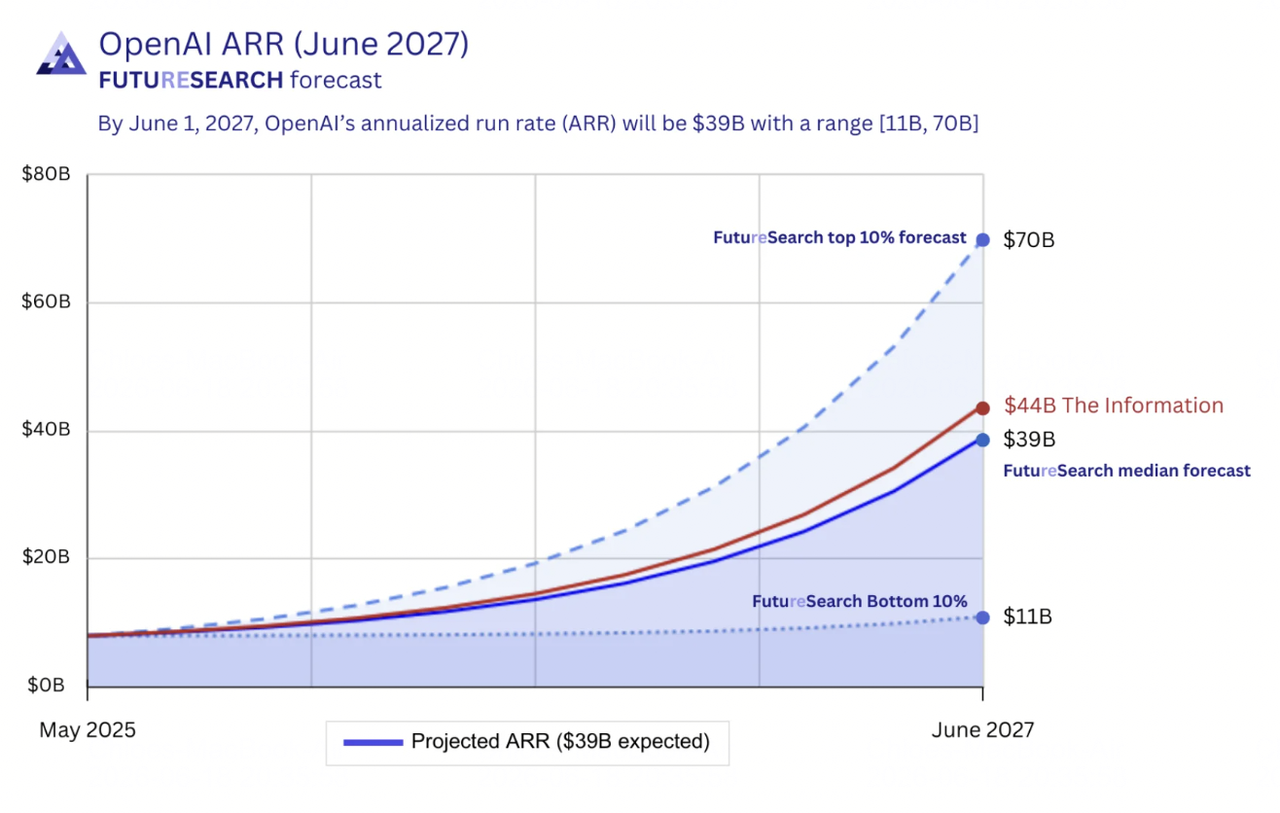
Source: FutureSearch
1. The Insatiable Global Demand for Frontier Model Architectures
Artificial intelligence training and inference clusters require massive pipelines of frontier models to avoid workflow bottlenecks and software limitations. OpenAI's leading position in multi-modal models and reasoning-focused systems effectively commands a structural moat over high-density enterprise software fabrication, turning global tech CapEx directly into OpenAI corporate revenue.
2. Dissecting the Commercial "Value-Up" Structural Re-Rating
Historically, OpenAI suffered from a "Structural Discount"—trading in private markets at lower implied multiples than pure-play software giants due to its restrictive, capped-profit structure and non-profit governance oversight. The executive team's multi-year corporate framework explicitly targets the transition into a traditional for-profit public benefit corporation, eliminating capital distribution caps and creating clear return-on-equity targets that directly lift the company's baseline valuation floor.
3. Favorable Macro Backdrop and Institutional Cash Buffers
With major global central banks navigating rangebound interest rate environments in 2026, foreign institutional capital is aggressively rotating toward asset classes with clear, un-correlated fundamental growth. This cash inflow provides a highly stable backdrop for international investors tracking OpenAI’s private secondary equity performance in USD ahead of its listing.
4. Transition to Long-Term Enterprise Supply Frameworks
To secure critical AI software access amidst ongoing technological shifts, top-tier Fortune 500 operators are shifting away from short-term Spot usage toward multi-year, built-to-order enterprise custom software contracts. This structural shift provides OpenAI's commercial lines with unprecedented revenue visibility, predictable recurring cash flows, and insulated pricing power.
5. Highly Attractive Growth Multiples Relative to TAM Expansion
Despite hitting record private equity valuations in early 2026, the underlying corporate revenue expansion has rapidly outpaced implied price gains. Given the company's compounding scale, OpenAI trades at compelling forward price-to-sales metrics relative to its projected total addressable market (TAM) expansion, making it an attractive value proposition when measured against overextended legacy technology multiples.
OpenAI Valuation Forecasts for 2026: Bull vs. Bear Outlook
Institutional analysts maintain an active and highly optimistic stance on the OpenAI Pre-IPO landscape, balancing the incredible pace of frontier model adoption against standard macroeconomic considerations.
|
Institution / Analyst |
2026 Projected Valuation |
Market Outlook |
|
Citigroup / Top Desks |
$1,150 Billion ($1.15T) |
Highly Bullish: Perfect execution of advanced model volume ramps coupled with structural intelligence deficits across enterprise platforms through 2030. |
|
Mizuho |
$1,090 Billion ($1.09T) |
Bullish: Upgraded based on immense, long-term AI-driven data demand and sustained software pricing power in enterprise cloud contracts. |
|
JPMorgan Chase & Co. |
$920 Billion |
Overweight: Positive on structural revenue expansion and market-shattering corporate growth dynamics. |
|
Market Consensus (Aggregated) |
$798.50 Billion |
Moderate Buy: Balanced expectation of robust premium subscription conversion versus temporary near-term consolidation following massive private-market valuation gains. |
|
UBS Group |
$545 Billion |
Neutral: Cautious on high infrastructure capital burn, intense compute density expenses, and general tech-sector valuation multiple contraction. |
Source: Aggregated from private exchange metrics, Bloomberg terminal feeds, and major institutional equity research notes as of June 2026.
OpenAI's Bull Case: Data Centers and AI Training Drive OpenAI Toward $1.15 Trillion
Bulls point to the structural extension of the current artificial intelligence upcycle. With LLM architectures scaling exponentially, enterprise data accumulation and processing needs are accelerating past a 30% compound annual growth rate. If OpenAI scales its next-generation architecture smoothly into broader distribution, successfully converts its 900+ million weekly users into paying cohorts, and optimizes its operating margins, the company is poised for an extended valuation re-rating toward its highest institutional targets.
The Bear Case for OpenAI IPO: Capital Burn Shocks, Regulatory Hurdles Pressure Listing
Bears highlight that despite massive structural AI demand, the infrastructure landscape remains inherently capital-intensive and heavily dependent on continuous liquidity injections. If sovereign wealth funds or hyperscalers briefly pause their aggressive infrastructure CapEx outlays, or if the company faces extensive data center construction and chip delivery delays, the market could experience a valuation contraction. This capital strain could compress rich sentiment multiples and draw the OpenAI Pre-IPO implied pricing down toward historical private market basins.
Read more: How to Trade SpaceX Pre-IPO on BingX Pre-IPO: SPACEX (VNTL), SPACEX (PreStocks), and SPCX
OpenAI IPO Deep Dive: Financial Profile and Capital Burn Dynamics
The central narrative of the upcoming roadshow revolves around OpenAI's unique financial architecture. The enterprise is scaling at a pace that mirrors internet giants like Google or Meta during their hyper-growth phases, yet its capital requirements are completely unprecedented.
The Revenue Engines
OpenAI has successfully diversified its income streams beyond the basic $20 per month ChatGPT Plus subscription. Key revenue pillars now include the premium $200 per month ChatGPT Pro tier, usage-based GPT API developer licensing used by over one million companies, and a 20% revenue share framework integrated into Microsoft Azure cloud products.
Furthermore, the January 2026 introduction of programmatic advertising to free-tier users in the United States has unlocked a scalable monetization channel. Strategic government and enterprise custom deployments, such as the $500 billion Stargate infrastructure initiative backed by SoftBank and Oracle, provide massive single-transaction windfalls.
The Computing Cost Paradigm
Despite a $24 billion revenue run rate, the cost of training and operating frontier AI systems is massive. To maintain its market lead, aggregate data center and infrastructure spending across OpenAI and its tech partners is projected to exceed $600 billion by 2030. Analysts estimate that the average user conversion rate from free to premium tiers is holding at approximately 6%. This modest conversion rate places immediate pressure on net profit margins, creating an estimated $207 billion funding gap that OpenAI must bridge through its public listing and subsequent secondary equity raises.
Competitive Risks and Market Share Pressures of OpenAI IPO
While OpenAI benefits from massive first-mover brand equity, the competitive environment is intensifying. Similarweb data indicates that Google Gemini has successfully expanded its web traffic share from 5.7% to 21.5%, while ChatGPT's dominant share retracted from 86.7% to 64.5% over the same relative period.
Simultaneously, alternative open-source alternatives like Meta's Llama models are exerting downward pricing pressure on commercial API margins. Additionally, ultra-efficient foreign models like China's DeepSeek have entered the international landscape, delivering comparable benchmarking performance at a fraction of standard computing costs.
How to Trade OpenAI Pre-IPO on BingX
Because OpenAI remains technically private until the official S-1 SEC registration statement goes effective, retail traders cannot purchase shares through a standard stock brokerage account. To democratize access to these historic tech events, BingX TradFi allows users to trade speculative price movements via specialized derivative instruments.
How to Trade OpenAI Pre-IPO Stock Futures on BingX TradFi
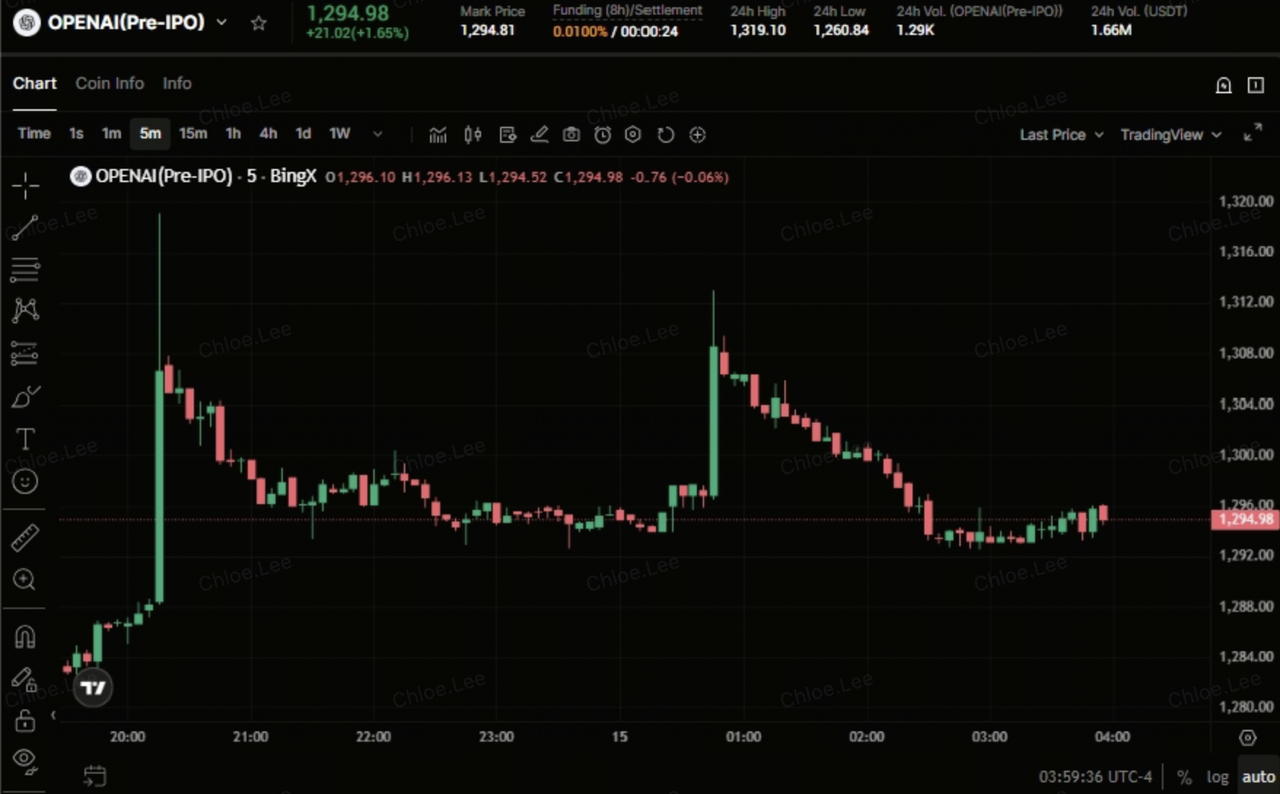
OPENAI(Pre-IPO)-USDT perpetual contract on BingX futures market
As OpenAI navigates this historic period of extreme public float volatility and rapid corporate changes, tactical traders can capture two-way daily price action through the BingX ecosystem.
- Access BingX TradFi: Navigate directly to the dedicated TradFi tab on the primary BingX trading dashboard.
- Select OpenAI: Locate the specialized OpenAI Pre-IPO futures contract.
- Choose Your Trading Direction: Select Open Long if you believe in OpenAI's success and select Open Short if you believe in selloffs after the IPO.
- Configure Leverage and Margin Parameters: Implement your preferred Isolated or Cross-Margin allocations alongside strict, defensive leverage tiers to maximize capital safety.
- Establish Risk Protocols: Deploy advanced BingX Take-Profit and Stop-Loss (TP/SL) orders to completely insulate your trading balance from unexpected gap moves during highly volatile extended after-hours trading sessions.
Conclusion: Navigate OpenAI IPO and the AI Wave on BingX
The upcoming public debut of ChatGPT's parent company is a pivotal moment for the technology sector. While investor enthusiasm for generative AI remains incredibly high, operational realities mean that OpenAI must continuously balance rapid user growth against unprecedented infrastructure costs. For active market participants, following the OpenAI Pre-IPO asset class offers a unique, high-exposure pathway to navigate the evolving artificial intelligence landscape before the historic listing officially takes place.
Risk Reminder: Pre-IPO derivative assets carry heightened volatility and liquidity risks. Valuations are speculative and based on unverified private market exchanges, regulatory shifts, and media reports. Traders should practice disciplined position sizing and strict risk management across all active trades.
