

Nokia (NOK) is a Finnish connectivity company supplying fixed, IP, optical and mobile network infrastructure, network software and patent licensing. Its equipment carries traffic for telecommunications operators, cloud providers, enterprises and public-sector networks. Traditional carrier spending remains important, while optical systems and IP routing for AI data centers are becoming larger growth engines. This transition broadens Nokia's opportunity, though demand timing, component supply, currency and restructuring remain important risks for the U.S.-listed ADR.
The latest quarter showed that the AI infrastructure shift is contributing measurable growth. Nokia Q2 net sales reached EUR 4.815 billion ($5.489 billion), up 9% in constant currency, as AI and Cloud sales more than doubled to EUR 446 million ($508 million). Comparable operating profit rose 18% to EUR 434 million ($495 million), though EUR 390 million ($445 million) of restructuring charges pushed reported operating profit into a EUR 50 million ($57 million) loss.
The NOK stock forecast for 2026 now centers on two competing views:
- The AI networking and margin case: EUR 2.8 billion ($3.192 billion) of AI and Cloud orders, expanding optical capacity and the NVIDIA AI-RAN platform could support sustained Network Infrastructure growth and stronger operating leverage.
- The conversion and restructuring case: Supply constraints, uneven cloud orders and EUR 800 million ($912 million) of expected restructuring charges could delay revenue recognition and reduce the earnings benefit from higher demand.
This guide breaks down the NOK stock forecast, 2026 price scenarios, key risks and analyst outlooks, drawing on Nokia's July 23 Q2 2026 report, detailed financial release and market data through September 15, plus how to trade NOK stock futures on BingX TradFi with USDT collateral.
Top 5 Things for Nokia Investors to Know in September 2026
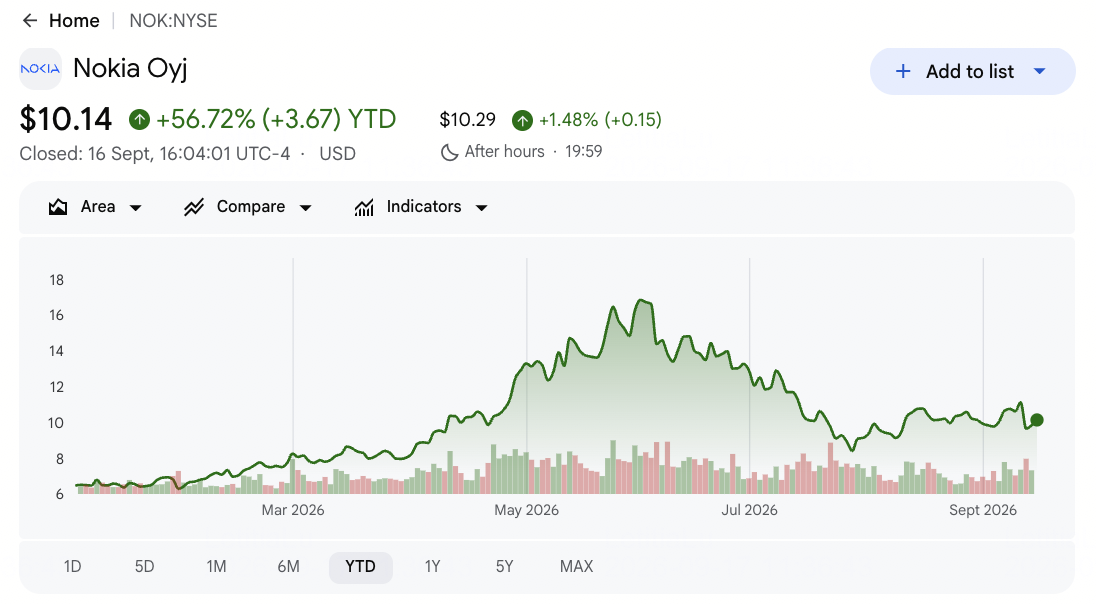
- The NOK ADR closed at $9.84, up 52.09% YTD: Shares still traded 43.6% below the $17.45 June high, showing that the AI-networking re-rating remains volatile. Order conversion and margin delivery now matter more than headline demand alone.
- Q2 net sales reached EUR 4.815 billion ($5.489 billion), up 9% in constant currency: Network Infrastructure grew 12%, offsetting a more mature telecom base. Optical and IP demand are becoming a larger part of Nokia's revenue mix.
- AI and Cloud sales rose 105% to EUR 446 million ($508 million): Optical Networks grew 20% and IP Networks expanded 16%. The growth links Nokia's AI opportunity directly to reported segment results.
- AI and Cloud order intake reached EUR 2.8 billion ($3.192 billion): Management expects roughly half to convert into revenue within 12 months. The remaining timing gap explains why large order wins do not immediately become sales or cash flow.
- Comparable operating profit guidance stands at EUR 2.1 billion ($2.394 billion) to EUR 2.6 billion ($2.964 billion): The EUR 100 million ($114 million) revision reflects discontinued-business presentation rather than stronger operations. Nokia still expects profit growth to accelerate in Q4 after broadly flat Q3 performance.
What Is Nokia (NOK)?
Nokia is a global network-equipment and technology-licensing company headquartered in Finland. Network Infrastructure sells optical transport, IP routing, fixed-access and data-center connectivity systems, making AI networking and optical connectivity increasingly important growth areas. Mobile Infrastructure supplies radio access, core-network and cloud-native products used by telecom operators, while Nokia Technologies licenses patents developed across decades of wireless research. Revenue therefore comes from equipment shipments, software, services and intellectual-property royalties across telecom, cloud, enterprise and government customers.
The current strategy reallocates investment toward AI networking, optical capacity and software-defined mobile networks. Nokia and NVIDIA developed a commercial AI-RAN platform, with operator work involving T-Mobile, Orange, SoftBank, BT, Elisa, NTT DOCOMO and Vodafone. Dell, Red Hat, Quanta and Supermicro support the server ecosystem. Nokia is also expanding optical production through a San Jose fab, tenfold test and packaging capacity in Pennsylvania and a planned Arizona indium-phosphide site, supporting higher demand for optical links inside AI data centers and larger cloud networks expected in 2027 and 2028.
Read More: Top AI Networking Stocks 2026: AI Fabric, Switches, Copper, Fiber, and Optics Connectivity
Nokia (NOK) Q2 2026 Earnings Overview: Revenue, AI Demand and Operating Profit
Nokia delivered Q2 net sales of EUR 4.815 billion ($5.489 billion), up 8% reported and 9% in constant currency, while comparable diluted EPS rose to EUR 0.07 ($0.08) from EUR 0.04 ($0.05). Comparable operating profit increased 18% to EUR 434 million ($495 million) and beat the EUR 382 million ($435 million) consensus. AI and Cloud sales reached EUR 446 million ($508 million), up 105%, though restructuring pushed reported operating profit into a loss and kept execution central to the outlook.
Read More: Nokia (NOK) Q2 2026 Earnings News: €434M Profit Beat Fails to Prevent a 5.35% ADR Selloff
|
Financial Metric |
Guidance / Consensus |
Reported / Actual |
Surprise |
|
Q2 net sales |
EUR 4.443B (USD $5.065B) a year earlier |
EUR 4.815B (USD $5.489B) |
Grew. Up 8% reported and 9% in constant currency. |
|
Q2 comparable diluted EPS |
EUR 0.06 (USD $0.07) consensus |
EUR 0.07 (USD $0.08) |
Beat. One euro cent above consensus and up 75% year over year. |
|
Q2 comparable operating profit |
EUR 382M (USD $435M) consensus |
EUR 434M (USD $495M) |
Beat. EUR 52M (USD $59M) above consensus and up 18%. |
|
Q2 comparable operating margin |
8.3% a year earlier |
9.00% |
Expanded. Improved by 70 basis points. |
|
AI and Cloud net sales |
Prior-year base implied by 105% growth |
EUR 446M (USD $508M) |
Accelerated. More than doubled year over year. |
|
AI and Cloud order intake |
N/A |
EUR 2.8B (USD $3.192B) |
Strong. Roughly half is expected to convert within 12 months. |
|
Network Infrastructure sales |
EUR 1.825B (USD $2.081B) a year earlier |
EUR 2.037B (USD $2.322B) |
Grew. Up 12% in constant currency. |
|
FY2026 comparable operating profit outlook |
Prior EUR 2.0B (USD $2.28B) to EUR 2.5B (USD $2.85B) |
EUR 2.1B (USD $2.394B) to EUR 2.6B (USD $2.964B) |
Technically revised. Operations remain unchanged after discontinued-business reclassification. |
|
FY2026 capital expenditure assumption |
Prior plan higher |
EUR 800M (USD $912M) to EUR 900M (USD $1.026B) |
Reduced. Real-estate changes offset continued optical-capacity investment. |
- Net sales of EUR 4.815 billion ($5.489 billion) grew 9% in constant currency: Reported growth reached 8%, showing limited FX drag. Stronger Network Infrastructure demand helped offset slower parts of the portfolio.
- Comparable EPS of EUR 0.07 ($0.08) rose 75%: The result beat the EUR 0.06 ($0.07) consensus, while reported EPS was zero. Restructuring and other adjustments still matter despite stronger underlying profitability.
- AI and Cloud sales of EUR 446 million ($508 million) rose 105%: Optical Networks grew 20% and IP Networks increased 16%. AI demand is now contributing to reported revenue rather than remaining only in the order pipeline.
- Comparable gross margin reached 46.0%, up 70 basis points: Comparable operating margin also improved 70 basis points to 9.0%. Better Network Infrastructure mix supported profitability, though supply costs and product mix remain key variables.
- AI and Cloud orders reached EUR 2.8 billion ($3.192 billion): Management expects about half to convert into revenue within 12 months. Timing and semiconductor constraints can still shift sales, cash flow and working capital between quarters.
Nokia (NOK) 2026 Investment Outlook: USD $21 Bull Case vs. USD $8 Bear Case
The NOK ADR outlook depends on whether the EUR 2.8 billion ($3.192 billion) AI and Cloud order intake converts into higher revenue and margins before supply constraints or restructuring offset the benefit. Network Infrastructure growth, optical-capacity investment and NVIDIA-backed AI-RAN create a broader opportunity. Telecom spending cycles, currency translation and EUR 800 million ($912 million) of expected restructuring charges keep the earnings path uneven.
The Bull Case: Strong AI Networking Demand Pushes NOK Toward $21
The Bull Case assumes AI and Cloud orders convert on schedule, Optical Networks maintains double-digit growth and new U.S. capacity eases supply constraints. NVIDIA-backed AI-RAN pilots also progress toward commercial deployments, expanding Nokia's opportunity beyond traditional equipment upgrades.
A move toward $21 would require Network Infrastructure growth near the 12% to 14% annual target, comparable operating margin near or above 9% and stronger Q4 profit as guided. Continued cloud orders and named operator deployments would strengthen the case.
Read More: Top AI Networking Stocks 2026: AI Fabric, Switches, Copper, Fiber, and Optics Connectivity
The Base Case: Steady Network Growth Keeps NOK Between $14 and $17
The Base Case assumes optical and IP demand remains strong, though only about half of the AI order intake converts within 12 months. Mobile Infrastructure grows more slowly, while restructuring and higher component costs limit margin expansion.
The NOK ADR could trade mainly between $14 and $17 under these conditions. Comparable operating profit within the EUR 2.1 billion ($2.394 billion) to EUR 2.6 billion ($2.964 billion) range and stable free cash flow would support the band. Delayed optical shipments or weaker Q4 performance would cap the upper end.
Read More: Top AI Optical Stocks to Buy in 2026: Photonics, Optics, Fiber, and Data Center Interconnects
The Bear Case: Slower AI Orders Pull NOK Toward $8
The Bear Case assumes cloud orders convert more slowly, telecom customers reduce spending and component costs pressure margins. EUR 800 million ($912 million) of restructuring charges and EUR 700 million ($798 million) to EUR 800 million ($912 million) of related cash outflows would then weigh more heavily on free cash flow.
A move toward $8 would become more likely if Network Infrastructure growth falls below 12% to 14%, comparable margin weakens or AI-RAN pilots fail to convert into commercial deployments. A weaker euro could add further pressure to ADR earnings.
NOK Stock Price Forecasts for 2026 By Wall Street Analysts
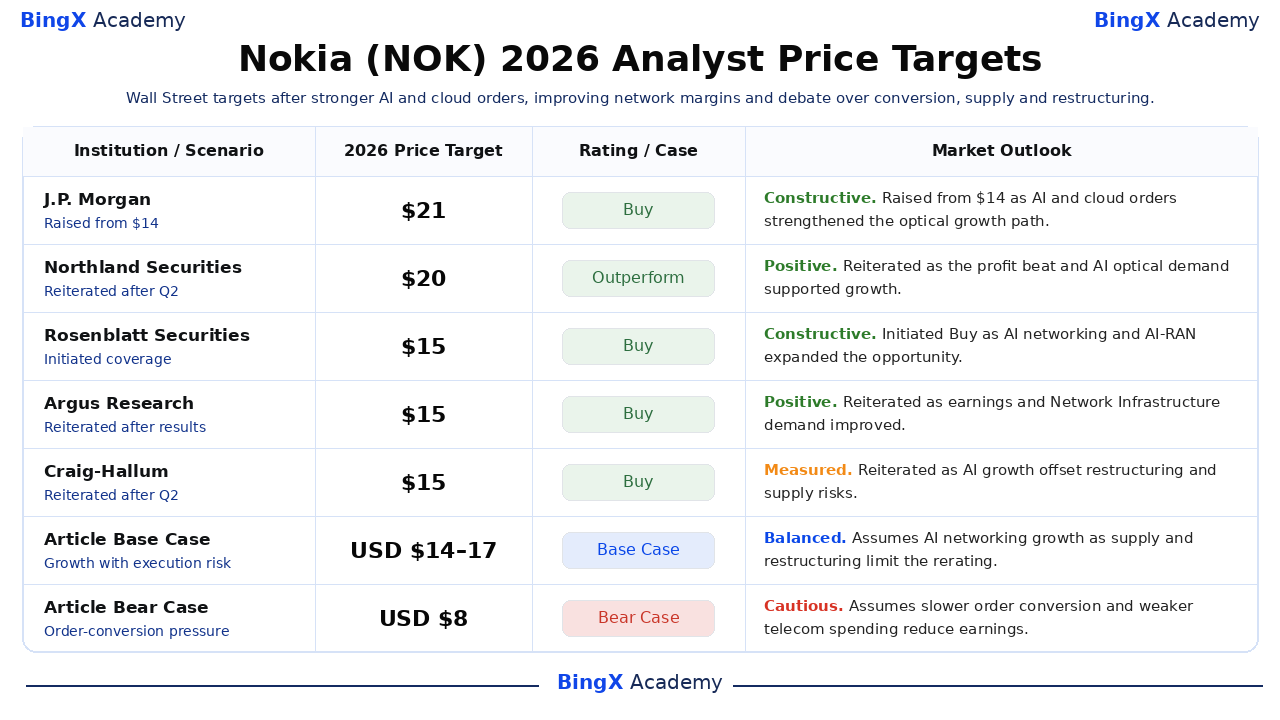
These dated analyst actions span USD $15 to USD $21 per ADR and reflect different assumptions about AI optical demand, AI-RAN commercialization, margin improvement and restructuring. They are third-party reference points rather than price promises. The final Base and Bear rows are BingX Academy editorial scenarios.
|
Institution / Scenario |
2026 Price Target |
Rating / Case |
Market Outlook |
|
J.P. Morgan / Sandeep Deshpande |
USD $21/ADR |
Buy |
Constructive. August 19: raised from USD $14 as AI and cloud orders strengthened the optical growth path. |
|
Northland Securities / Tim Savageaux |
USD $20/ADR |
Outperform |
Positive. July 24: reiterated after the profit beat and stronger AI optical demand. |
|
Rosenblatt Securities / Michael Genovese |
USD $15/ADR |
Buy |
Constructive. September 15: initiated Buy as AI networking and AI-RAN expanded the opportunity. |
|
Argus Research / Jim Kelleher |
USD $15/ADR |
Buy |
Positive. July 23: reiterated as earnings and Network Infrastructure demand improved. |
|
Craig-Hallum / Christian Schwab |
USD $15/ADR |
Buy |
Measured. July 24: reiterated as AI growth offset restructuring and supply risks. |
|
Article Base Case |
USD $14-$17/ADR |
Base Case |
Balanced. Assumes AI networking growth as supply and restructuring limit the rerating. |
|
Article Bear Case |
USD $8/ADR |
Bear Case |
Cautious. Assumes slower order conversion and weaker telecom spending reduce earnings. |
How to Trade Nokia (NOK) Stock on BingX
Trade Nokia's AI-networking, optical-capacity and AI-RAN outlook using BingX TradFi and BingX AI tools. Because the NOK ADR can react sharply to cloud orders, margins, currency and restructuring, traders should define both the catalyst and risk limits before entering a position.
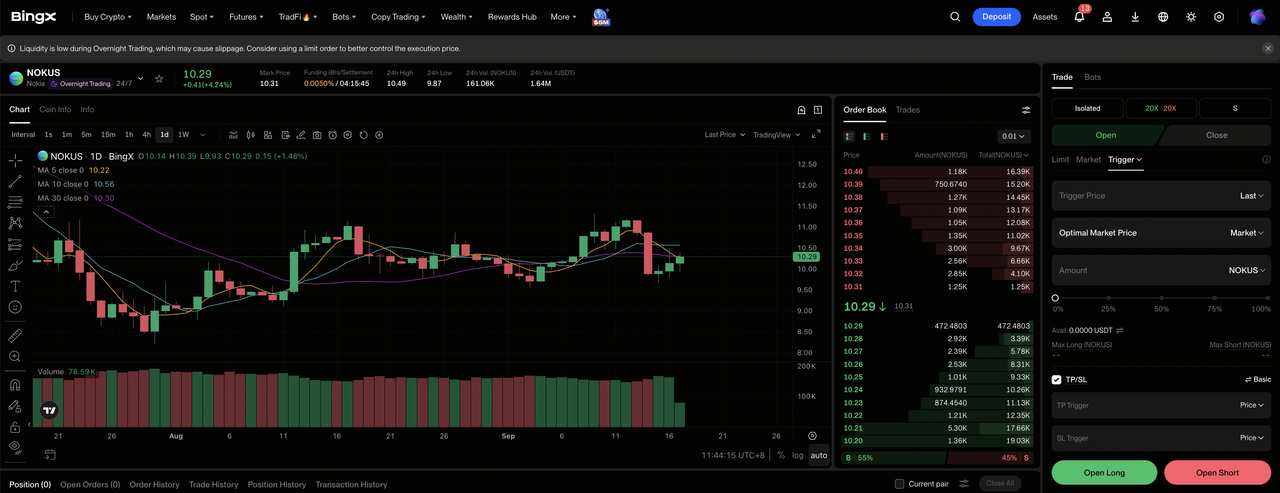
Step 1: Access BingX TradFi. Sign up and navigate to the specialized TradFi section on the BingX exchange dashboard.
Step 2: Select Nokia (NOK). Search for and select the NOK-USDT perpetual futures contract.
Step 3: Choose your direction. Select Open Long if AI orders convert and optical margins improve. Select Open Short if supply constraints, restructuring or telecom weakness reduce earnings.
Step 4: Select leverage and margin mode. Choose Isolated or Cross-Margin based on your risk tolerance. NOK remained 43.6% below its June high at the September 15 close, showing why conservative leverage is important.
Step 5: Execute strict risk protocols. Set Take-Profit and Stop-Loss (TP/SL) levels before or immediately after entering the trade. NOK can react quickly to cloud orders, component costs, margins, currency and AI-RAN deployments.
Top 5 Risks to Watch for Nokia Investors in 2026
Nokia's ADR value depends on order conversion, supply, telecom spending, restructuring and currency. These risks can affect revenue, cash flow and translated per-share earnings.
- AI orders could convert more slowly than expected: Nokia expects about half of EUR 2.8 billion ($3.192 billion) of AI and Cloud orders to become revenue within 12 months. Delays could defer sales and leave new capacity underused.
- Optical supply constraints could limit shipments: Nokia is expanding capacity in San Jose, Pennsylvania and Arizona. Component shortages or ramp delays could raise costs and prevent strong cloud demand from converting into revenue on schedule.
- Telecom spending remains cyclical: Carriers still represent a large part of Nokia's revenue base. Weaker spending or delayed network upgrades could offset growth from AI customers and reduce utilization.
- Restructuring could absorb cash before savings arrive: Expected 2026 charges reach EUR 800 million ($912 million), with related cash outflows of EUR 700 million ($798 million) to EUR 800 million ($912 million). Execution delays could pressure free cash flow and postpone margin gains.
- Currency moves can affect ADR returns: Nokia reports in euros while the ADR trades in U.S. dollars. A weaker euro can reduce translated revenue, profit and dividends even if underlying operations remain unchanged.
Final Thoughts: Should You Invest in Nokia in 2026?
Nokia's Q2 results provided measurable support for the AI-networking thesis. AI and Cloud sales rose 105%, order intake reached EUR 2.8 billion ($3.192 billion) and comparable operating profit exceeded consensus. NVIDIA-backed AI-RAN and expanded U.S. optical capacity widen the long-term opportunity. The next test is converting those orders while managing restructuring costs and supply constraints.
The Bull Case requires strong order conversion and continued margin improvement to support $21. The Bear Case reflects weaker telecom spending, slower optical shipments and restructuring pressure that could pull the ADR toward $8. Investors can track Network Infrastructure growth, Q4 profit acceleration and free-cash-flow conversion for evidence that the AI re-rating is sustainable.
Risk Reminder: Trading and investing in equities like NOK involves a high risk of capital loss. Order delays, supply constraints, telecom spending, restructuring, currency moves and leveraged trading can produce rapid losses. Conduct independent research before allocating capital.
Related Reading
- Top AI Networking Stocks 2026: AI Fabric, Switches, Copper, Fiber, and Optics Connectivity
- Top AI Optical Stocks to Buy in 2026: Photonics, Optics, Fiber, and Data Center Interconnects
- Marvell (MRVL) 2026 Outlook: Can AI & Silicon Momentum Drive Stock to $150?
- Broadcom (AVGO) Price Prediction 2026: Can AI Revenue Growth Push AVGO Toward $600?
- Lumentum Stock Forecast 2026: Can AI Optics Boom, AI Data Center Supercycle Drive LITE Above $1,200?
- Ciena (CIEN) Price Prediction 2026: Can AI Optical Networking Push CIEN Toward $400?
