

Maximizing yield on Uniswap pools in 2026 requires moving past passive deposit strategies. With the decentralized finance (DeFi) landscape dominated by sophisticated, automated market-making structures, liquidity providers (LPs) must balance capital efficiency against structural risks. Navigating this environment successfully hinges on understanding the core evolution of the protocol: choosing between the precise execution of v3’s concentrated liquidity or the algorithmic automation unlocked by v4’s custom hooks.
In the 2026 DeFi ecosystem, the highest-yielding opportunities have shifted away from speculative meme pairs toward utility-driven markets, specifically Artificial Intelligence (AI) agents and Real-World Assets (RWAs). However, entering these high-volume pipelines exposes LPs to severe volatility and impermanent loss. To capture multi-digit annual percentage yields (APYs) without experiencing portfolio degradation, successful providers rely on a programmatic tool stack, shifting from manual adjustments to automated yield vaults and dynamic rebalancing protocols.
This guide breaks down the optimal liquidity strategies for 2026, comparing protocol architectures, mapping the most profitable token pools, and outlining advanced risk mitigation frameworks to ensure your crypto infrastructure remains highly profitable.
What Is Uniswap and How to Earn Yield By Providing Liquidity on Uniswap Pools?
Uniswap is a decentralized exchange protocol that pioneered the Automated Market Maker (AMM) model, commanding a dominant share of the onchain trading ecosystem. By replacing traditional centralized order books with smart-contract-driven liquidity pools, the platform facilitates peer-to-contract token swaps directly from user wallets. As a testament to its scale and deep liquidity architecture, the Uniswap API handles approximately 31% of MetaMask swaps on Ethereum Mainnet alone and has processed over $4.3 trillion in cumulative volume with zero infrastructure hacks.
To earn yield on Uniswap pools, users act as liquidity providers (LPs) by depositing a pair of tokens of equal market value into a smart contract. LPs generate passive income by capturing a proportional share of the trading fees, ranging from 0.01% for stablecoins up to 1.0% for exotic assets, accumulated whenever traders swap against that specific pool. In modern protocol versions like v3 and v4, providers must set a tight, custom price range to concentrate their capital where trading volume is heaviest, which multiplies fee generation but requires active range management or the use of automated vaults to mitigate the risk of impermanent loss.
Read more: What Is Uniswap? A Complete Guide to UNI Token, Fee Switch, and V1-V4 Features
Why Providing Liquidity on Uniswap Requires Strategic Planning
In 2026, the Uniswap Protocol commands over 30% of native wallet swaps across major networks like Ethereum Mainnet, Arbitrum, and Base. This massive volume generates millions of dollars in daily transaction fees, but it also creates a hyper-competitive environment for LPs. Deploying capital without analyzing historical volume-to-liquidity ratios, fee tiers, and token correlations can lead to capital erosion.
Unlike early AMM iterations where LPs blindly deposited tokens across an infinite price curve, modern provisioning requires micro-managing your positions. A sharp price divergence in a volatile pool can trigger severe impermanent loss, which occurs when the asset ratio shifts away from your initial deposit values. If the accumulated trading fees fail to outpace this divergence, the position becomes net-negative upon withdrawal.
Advanced planning requires matching your target asset pair with the correct network infrastructure, selecting optimized fee tiers, ranging from 0.01% for stablecoins to 1.0% for exotic assets, and deploying automated guardrails to rebalance your price bands before your capital falls out of range.
Read more: What Are the Top 10 Ways to Earn Passive Income from Crypto in 2026?
Uniswap v3 Concentrated Liquidity vs. Uniswap v4 Custom Hooks: A Comparison
The architecture you select directly influences your capital efficiency, execution risks, and overall yield potential. While v3 remains highly effective for active, hands-on range positioning, v4 introduces an entirely new primitives layer driven by singleton contracts and customizable lifecycle extensions.
Technical Architecture Breakdown: Uniswap V3 vs. V4 Performance
|
Feature |
Uniswap v3 Architecture |
Uniswap v4 Architecture |
Optimization Impact |
|
Liquidity Distribution |
Concentrated within custom price intervals (±5% boundaries). |
Concentrated ranges supplemented by dynamic contract parameters. |
Multiplies capital efficiency up to 4000x over traditional AMMs. |
|
Contract Structure |
Factory pattern (separate deployment contract for every single pool). |
Singleton pattern (all liquidity pools housed within a single contract). |
Cuts pool creation and multi-hop swap gas costs by 60% to 99%. |
|
Logic Customization |
Fixed fee tiers (0.01%, 0.05%, 0.3%, 1.0%). |
Infinite customization via pre-swap, post-swap, and design-stage Hooks. |
Allows developers to code custom automated actions directly inside the pool. |
|
Impermanent Loss Management |
Manual rebalancing or reliance on external smart contract managers. |
Native mitigation via dynamic fees, time-weighted oracles, and auto-withdrawal. |
Minimizes structural leakage onchain without external MEV dependencies. |
Uniswap v3: The Precision Engine for Active LPs
Uniswap v3 is built around concentrated liquidity, enabling you to allocate your capital to specific, narrow price ranges where the majority of trading volume occurs. By tightening your boundaries around the current spot price, your capital efficiency multiplies, allowing you to capture a significantly larger share of the pool’s transaction fees with less collateral.
However, v3 requires constant surveillance. If the market price moves outside your selected range, your liquidity turns entirely into the depreciating asset of the pair, your position goes inactive, and you stop earning fee rewards until you manually shift your range.
Uniswap v4: Algorithmic Flexibility via Custom Hooks
Uniswap v4 retains the core concentrated liquidity mechanics of v3 but introduces Hooks, plugins that execute custom code at specific lifecycle checkpoints of a pool, such as before or after a swap, or when a position is modified. This eliminates the boundary lines between liquidity pools and external asset management strategies.
Through v4 hooks, a pool can natively calculate dynamic fees based on market volatility, execute time-weighted average market makers (TWAMMs) to break up massive institutional orders, or automatically lend out idle, out-of-range capital to lending markets like Aave to maintain yield generation. Furthermore, the Singleton contract design consolidates all pools into a single smart contract space, radically reducing gas fees for multi-hop trades and capital reallocations.
Read more: Uniswap V1 vs V2 vs V3 vs V4: Full Guide to Uniswap Features and Key Version Differences
What Are the Top 5 High-Volume Uniswap Pools to Watch in 2026?
In 2026, the highest fee generation is concentrated within institutional Real-World Assets like tokenized treasuries, commodities, and real estate yields and decentralized Artificial Intelligence infrastructure tokens like compute networks and autonomous agent protocols.
Using data derived from Uniswap Analytics and DeFiLlama, these five high-volume pairs represent prime opportunities for liquidity placement due to deep trading volumes and sustained arbitrage actions.
1. VIRTUAL / WETH on Base Network with 0.30% Fee Tier
- Ecosystem Focus: AI-Driven Technologies (Autonomous Agents)
- Strategy Profile: High Volatility / High Fee Yield
Virtuals Protocol acts as a primary launchpad for autonomous AI agents. Because retail and institutional speculators rapidly rotate capital into various AI sub-tokens, the underlying VIRTUAL/WETH pool handles millions in daily transactional volume. LPs deploying tightly bounded positions (±10%) can capture substantial fees, though they must monitor the fast-moving downside risk typical of early-stage AI tokens.
2. USDY / USDC on Ethereum Mainnet with 0.05% Fee Tier
- Ecosystem Focus: Real-World Assets (Ondo Tokenized Short-Term Treasuries)
- Strategy Profile: Highly Correlated / Minimal Impermanent Loss
Ondo Finance's USDY provides institutional exposure to US Treasuries. Because USDY acts as a yield-bearing dollar stablecoin, pairing it against USDC creates a highly correlated asset pair. Price divergence is mathematically predictable, allowing LPs to set extremely narrow concentration limits, e.g., ±1%. This achieves massive fee generation with near-zero exposure to structural impermanent loss.
3. RNDR / WETH on Arbitrum Layer-2 with 0.30% Fee Tier
- Ecosystem Focus: AI Decentralized Compute Networks
- Strategy Profile: Moderate Volatility / Consistent Volume
Render Network remains the industry standard for decentralized GPU computing. Arbitrum’s ultra-low transaction costs keep the RNDR/WETH pool highly active for high-frequency algorithmic traders and arbitrageurs. Volatility moves in line with broader tech and AI market cycles, providing predictable trading volumes above $1.5M daily.
4. ONDO / USDC on Ethereum Mainnet with 0.30% Fee Tier
- Ecosystem Focus: RWA Market Infrastructure
- Strategy Profile: Volatile Asset vs. Stablecoin
ONDO acts as the governance and utility token for RWA institutional expansion. Pairing ONDO with a stablecoin like USDC offers a balanced yield profile: the stablecoin side insulates the portfolio during market corrections, while the volatile ONDO side captures upside transaction spikes. Maintaining a 60/40 ratio favoring the stable asset during volume expansions provides optimized risk-adjusted returns.
5. CLANKER / WETH on Base Network with 1% Fee Tier
- Ecosystem Focus: AI Autonomous Deployer Pools
- Strategy Profile: Ultra-High Volatility / Maximum Fee Capture
Clanker is an AI-powered autonomous deployer contract that generates localized token markets based on natural language prompts. Operating on the maximum 1% fee tier due to extreme asset price swings, this pool yields significant returns for risk-tolerant providers. The high volume is driven by constant automated bot transactions and arbitrageurs rebalancing the pool depth against external decentralized exchanges.
How to Provide Liquidity on Uniswap Pools and Earn Yield
Deploying capital into Uniswap pools allows you to act as an automated market maker and secure a steady stream of passive transaction fees.
- Prepare Your Web3 Wallet: Ensure your non-custodial wallet, such as MetaMask or Trust Wallet, is funded with an equivalent market value of the two tokens you intend to pool. Learn more about how to connect your MetaMask wallet to Uniswap dApp.
- Connect to the Uniswap Interface: Navigate to the official Uniswap Web App, click "+ New Position," and select your target token pair and network, e.g., Base, Arbitrum, or Ethereum.
- Choose Your Fee Tier: Select a fee bracket, e.g., 0.01%, 0.05%, 0.3%, or 1%, that aligns with the expected price volatility of your chosen asset pair.
- Set Your Price Concentration Range: Define the upper and lower price boundaries where your capital will actively facilitate trades and generate rewards.
- Approve and Deposit Capital: Input your deposit amounts, approve the smart contract token allowances, review your configuration, and click Add to mint your active LP position.
Read more: How to Connect Uniswap (UNI) to MetaMask
How to Trade Uniswap (UNI) on BingX
Trading or hedging the native UNI governance token is highly streamlined on BingX, where users can leverage the platform's advanced liquidity engine and specialized AI-driven market analysis tools.
1. Buy or Sell UNI on the Spot Market
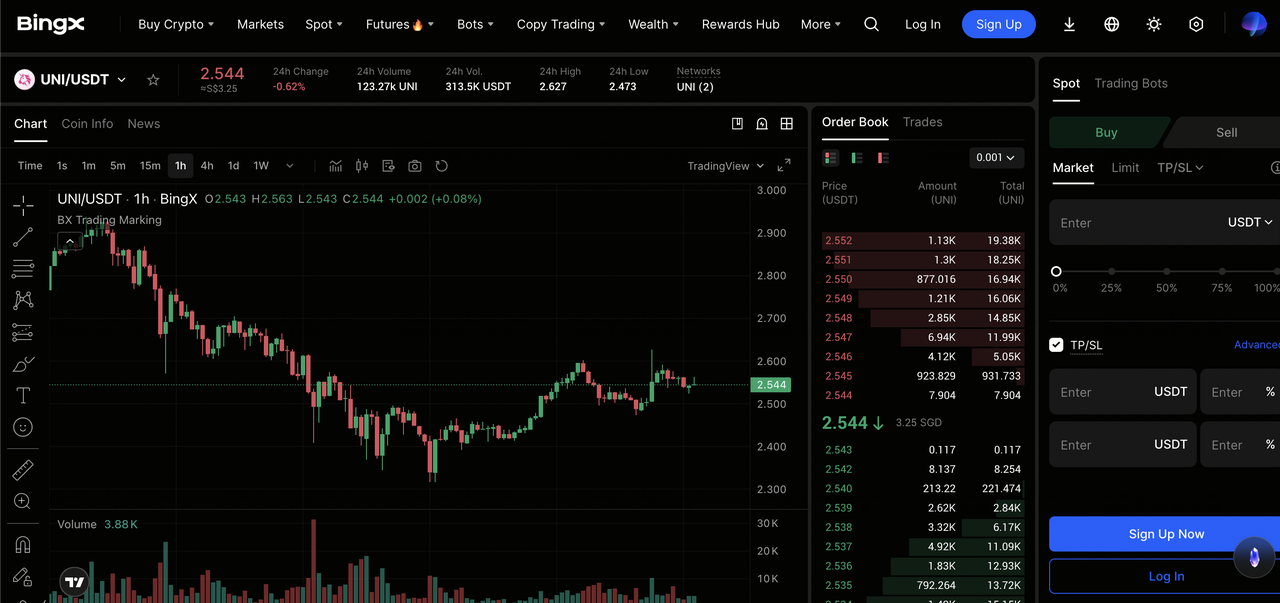
UNI/USDT trading pair on the BingX spot market
For long-term investors looking to accumulate actual UNI tokens, navigate to the BingX Spot Market and locate the UNI/USDT pair. Select a Limit Order to specify your exact entry price or a Market Order to execute the trade immediately at the best available global spot rate. Once filled, your UNI tokens will settle instantly into your Fund Account, where they can be held securely or transferred to a private Web3 wallet.
2. Long or Short UNI/USDT Perpetuals on the Futures Market
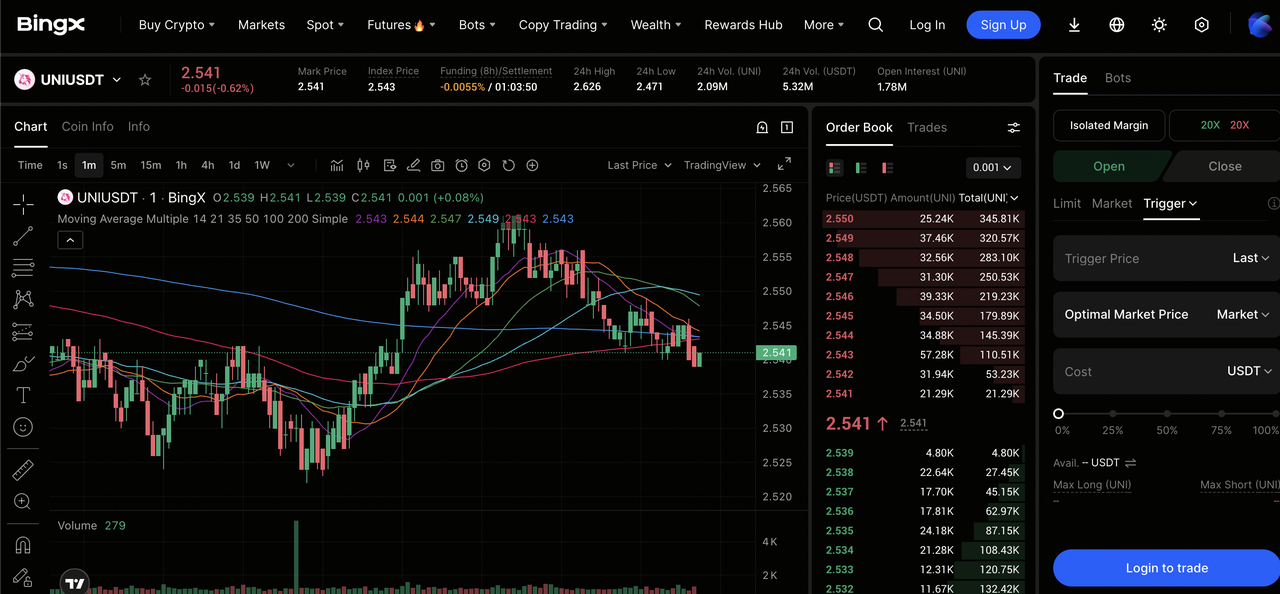
UNI/USDT perpetual contract on BingX futures market
For advanced traders looking to capitalize on short-term market swings or hedge their active onchain LP positions against price downturns, BingX offers UNI Perpetual Futures. Traders can open Long positions to profit from upward price momentum or utilize Short positions to insulate their broader portfolio during bearish trends.
BingX features a unique dual-price mechanism for liquidation logic, meaning a futures position is safely insulated from sudden wick manipulation and will only be closed if the mark price and the latest market price both reach your designated liquidation threshold.
How to Manage Impermanent Loss on Uniswap Pools
For active LPs, managing impermanent loss mathematically boils down to a single formula. The loss relative to simply holding the underlying tokens is calculated as:
IL = (2 * square root of (P1 / P0)) / (1 + (P1 / P0)) - 1
Where P0 represents the initial price ratio of the asset pair and P1 represents the current price ratio. A two-fold (2x) shift in price ratios leads to an automatic 5.7% loss in principal value relative to holding, while a three-fold (3x) divergence escalates that leakage to 13.4%.
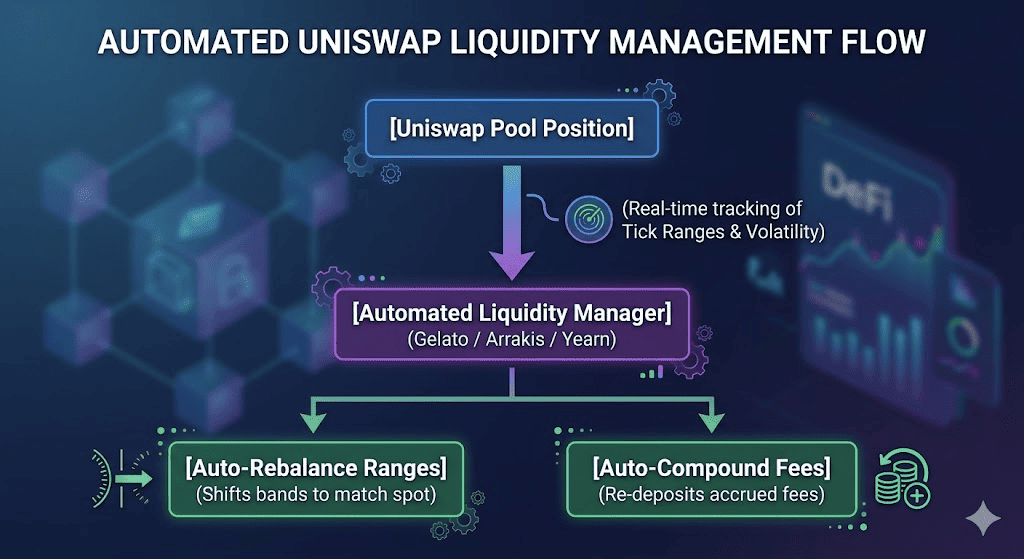
To prevent price swings from neutralizing your fee profits, integrating automated liquidity managers and yield optimization tools is highly recommended.
1. Dynamic Rebalancing via Gelato Network and Arrakis Finance
Manually adjusting range ticks requires constant network execution and high gas spending. Automated liquidity managers like Gelato Network or Arrakis Finance use offchain keepers and smart contract triggers to dynamically shift your concentration bands as spot prices move. If a token in an AI pair surges, the automation contract shifts your tick intervals upward, preventing your position from converting fully into a single asset and going dormant.
2. Auto-Compounding with DeFi Aggregators
Trading fees collected on Uniswap do not automatically compound into your position; they sit idle inside the pool contract until manually claimed. Automated vaults like Yearn Finance or custom Gelato scripts execute automated, programmatic extraction calls. By continuously harvesting earned fees and re-depositing them back into your designated price ranges, these platforms boost your effective annual percentage yield through compounded interest without requiring manual user transactions.
3. Layer-2 Scaling Strategies on Base and Arbitrum
Executing frequent position adjustments on Ethereum Mainnet can rapidly erode profit margins due to variable gas fee spikes. To optimize your capital infrastructure, deploy your liquidity strategies across Layer-2 platforms. Networks like Arbitrum and Base reduce transaction routing costs down to pennies, allowing automated bots to rebalance your price zones bi-weekly based on volume-weighted formulas without leaking capital to high block fees.
Final Thoughts: Designing a Resilient Yield Engine on Uniswap for 2026
Sustaining profitability within Uniswap pools in 2026 demands a structured framework that respects market volatility. While high-utility AI and RWA pools offer deep trading volume and impressive fee metrics, they must be approached with the correct tool stack.
For stable or highly correlated asset sets, utilizing Uniswap v3’s narrow concentrated price intervals delivers unmatched efficiency. For complex, volatile pairs, transitioning to Uniswap v4 pools equipped with custom automated hooks, or outsourcing execution entirely to automated portfolio managers, safeguards your capital against unexpected structural price divergence. Diversifying your deployment across multiple pools, setting strict rebalancing triggers, and routing positions through Layer-2 gas environments will ensure your assets function as a highly optimized, resilient yield engine.
Risk Reminder: Providing liquidity on decentralized protocols exposes capital to smart contract exploits, execution slippage, and sudden impermanent loss. Always analyze pool depth and verify smart contract audits before funding a position.
Related Reading
- What Is Uniswap? A Complete Guide to UNI Token, Fee Switch, and V1-V4 Features
- What Are the Top 10 Ways to Earn Passive Income from Crypto in 2026?
- Uniswap V1 vs V2 vs V3 vs V4: Full Guide to Uniswap Features and Key Version Differences
- How to Connect Uniswap (UNI) to MetaMask
- What Is Unipeg (uPEG) On-chain Art on Uniswap and How Does It Work?
FAQs on How to Maximize Uniswap Pool Yields
1. How exactly do Uniswap liquidity pools generate passive returns?
Liquidity providers earn income directly from the transaction fees paid by traders swapping tokens within the pool. By default, every swap triggers a fee, e.g., 0.05%, 0.30%, or 1.0%, that is distributed proportionally to all active LPs based on their share of the pool liquidity within the active trading price range.
2. What happens if the token market price moves completely outside my selected range?
If the spot price moves past your chosen upper or lower boundaries, your liquidity position becomes 100% composed of the less valuable asset in the pair and goes inactive. While inactive, your position stops earning any transaction fees until the market price moves back into your designated tick interval or you manually execute a transaction to shift your range.
3. Can unverified users provide liquidity on Uniswap in 2026?
Yes. Because Uniswap is a permissionless, decentralized protocol driven entirely by smart contracts, any user with a non-custodial Web3 wallet can deposit assets into a pool without completing KYC (Know Your Customer) verifications. However, navigating external non-custodial fiat off-ramps later to cash out those earnings into traditional banking networks will require identity verification on a regulated gateway like BingX.
