
Fermi is a development-stage AI infrastructure and private-power company building Project Matador in the Texas Panhandle. The campus is designed to combine behind-the-meter natural gas generation, utility power, solar, batteries and longer-term nuclear capacity with hyperscale data centers. That integrated model targets AI customers that need gigawatt-scale power faster than conventional grid interconnection can provide, though the company remains pre-revenue and dependent on construction, permits and external capital.
The investment case changed in August when Fermi signed a 15-year lease with TensorWave covering 222 MW and approximately $6.5 billion of contracted revenue over the initial term. Fermi Q2 still produced no revenue and a $25.8 million net loss, with $91.7 million of cash and restricted cash at June 30. Subsequent financing raised more than $431 million, giving the project more runway as management targets about 200 MW of initial commercial power over six months and 1.5 GW over 18 to 24 months.
The FRMI stock forecast for 2026 now centers on two competing views:
- The tenant-conversion and first-power case: TensorWave milestones, additional customer commitments and on-schedule power delivery could convert Project Matador from a development platform into contracted infrastructure revenue.
- The construction and financing case: project delays, higher capital requirements or weaker tenant demand could push revenue further out and increase dilution before the campus reaches commercial scale.
This guide breaks down the FRMI stock forecast, 2026 price scenarios, key risks and analyst outlooks, drawing on Fermi's August 13 Q2 2026 release, 10-Q and market data through September 18, plus how to trade FRMI stock futures on BingX TradFi with USDT collateral.
Top 5 Things for Fermi Investors to Know in September 2026
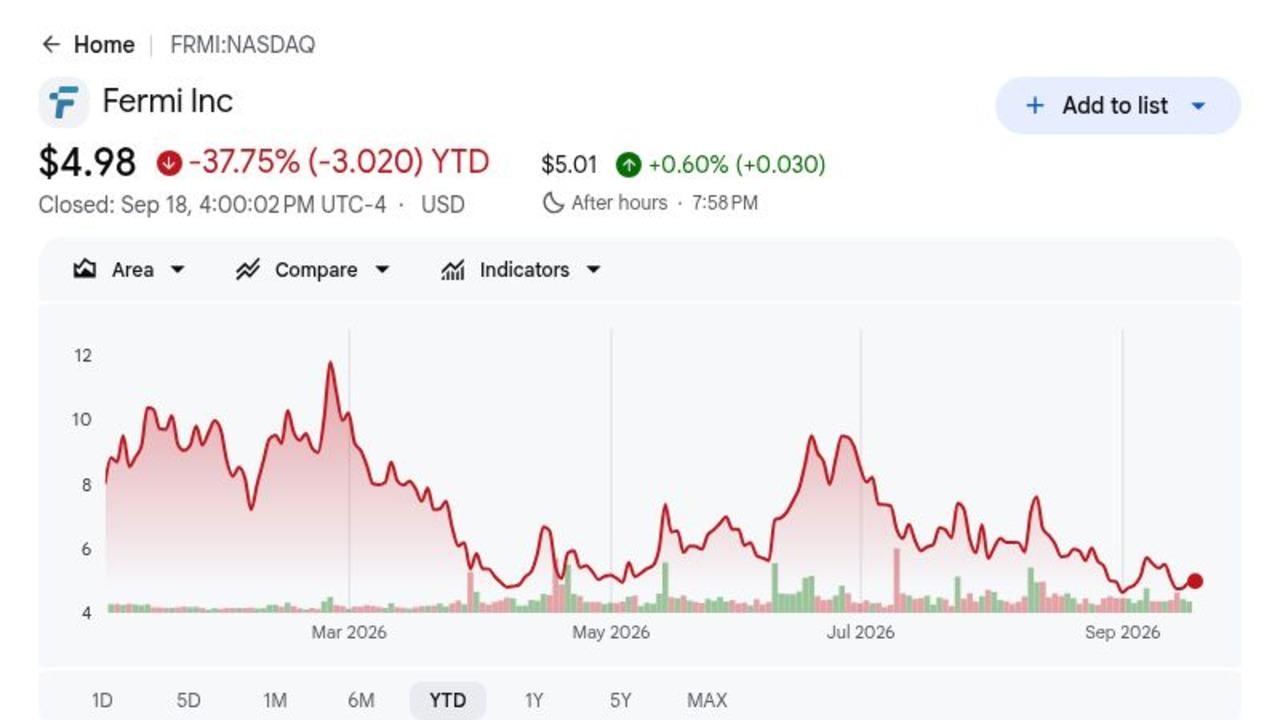
- FRMI closed at $4.98 on September 18, about 76% below its $21 IPO price: The discount reflects pre-revenue risk even after the TensorWave lease improved commercial visibility. Further upside now depends on construction progress and contracted capacity converting into future cash flow.
- The TensorWave lease represents about $6.5 billion of revenue over 15 years: Phase one covers 222 MW, with two expansion options that could triple the customer's footprint. The agreement gives Fermi a measurable commercial anchor, though revenue still depends on timely project delivery.
- Q2 net loss widened to $25.8 million, or $0.04 per share: The per-share loss beat the $0.05 consensus, while G&A reached $26.8 million. The result highlights the cost of operating a development-stage platform before major lease revenue begins.
- Project Matador PP&E reached about $1.55 billion: Fermi invested $185.0 million during Q2 as three Siemens F-class turbines increased landed power assets to 1.5 GW. Returns now depend on construction discipline, customer demand and timely utilization.
- More than $431 million of 5% convertible notes extended liquidity: The $9.52 conversion price and $14.64 capped-call strike reduce near-term dilution risk. Debt and construction spending remain substantial, making financing and project execution central to per-share value.
What Is Fermi (FRMI)?

Fermi America develops private electric grids and data-center campuses for artificial intelligence and advanced computing. Its main asset is Project Matador, an approximately 8,400-acre Texas Panhandle site intended to integrate power generation, transmission, cooling, fiber and computing facilities behind the meter. Fermi plans to earn revenue through long-term data-center leases and power arrangements rather than selling software or chips. The model requires heavy upfront construction before contracted tenant revenue begins.
The long-term plan centers on scaling Project Matador toward 17 GW, subject to customer contracts, financing and permits. TensorWave became the first anchor customer through a 222 MW lease with two expansion options, and Hillcore Energy Capital agreed to a structure for about 2.6 GW of incremental generation. Siemens supplied three F-class turbines, with Primoris and TSK supporting engineering and construction. CEO Lee McIntire brings experience from Bechtel, CH2M Hill and TerraPower as the project moves from site work toward first power.
Read More: Top AI Energy Stocks to Buy in 2026: Nuclear, Gas, Fuel Cells, and the AI Power Buildout
Fermi (FRMI) Q2 2026 Earnings Overview: Operating Progress Meets Capital Intensity
Fermi remained pre-revenue in Q2 2026 and reported a $25.8 million net loss, or $0.04 per share, versus a $0.05 loss consensus. General and administrative expense reached $26.8 million, total cash and restricted cash stood at $91.7 million, and gross property, plant and equipment reached about $1.55 billion after $185.0 million of quarterly investment. The later $431 million convertible-note financing improved runway, though construction and debt still make milestone execution more important than near-term revenue.
Read More: Fermi America (FRMI) Q2 FY2026 Earnings Overview: $25.8M Net Loss Triggers a 13.16% Price Selloff
|
Financial Metric |
Guidance / Consensus |
Reported / Actual |
Surprise |
|
Q2 revenue |
Pre-revenue |
$0 |
Measured. Development-stage. The result updates the operating baseline. |
|
Q2 net loss |
$6.3M prior-year loss |
$25.8M |
Measured. Widened on buildout. The result updates the operating baseline. |
|
Q2 loss per share |
$0.05 loss consensus |
$0.04 loss |
Beat. by $0.01. The result updates the operating baseline. |
|
Cash and restricted cash |
— |
$91.7M |
Measured. fore July financing. The result updates the operating baseline. |
|
Property, plant and equipment |
$935.3M at Dec. 2025 |
$1.55B |
Measured. uildout advanced. The result updates the operating baseline. |
|
Q2 capital invested in PP&E |
— |
$185.0M |
Measured. Project spending continued. The result updates the operating baseline. |
|
Outstanding debt |
$109.8M at Dec. 2025 |
$520.1M |
Measured. Financing dependence rose. The result updates the operating baseline. |
- Q2 revenue remained at $0: Fermi is still in the development stage, so current valuation depends on construction progress and future lease revenue rather than reported sales. The key test is whether contracted capacity begins converting into operating revenue on schedule.
- Q2 net loss widened to $25.8 million: Higher development and corporate spending reflect the scale of the Project Matador buildout. Losses are likely to remain elevated until contracted data-center capacity begins generating revenue.
- Loss per share of $0.04 beat consensus by $0.01: The narrower-than-expected per-share loss offers limited evidence of cost control, though the business remains pre-revenue. Construction and financing progress matter more than quarterly EPS at this stage.
- Cash and restricted cash reached $91.7 million before the July financing: The balance provided near-term liquidity ahead of additional capital raises. Fermi still needs to match spending with construction milestones and contracted customer demand.
- Property, plant and equipment reached $1.55 billion: The growing asset base shows that Project Matador is moving from planning into physical infrastructure. Returns now depend on completing capacity on time and converting those assets into contracted data-center revenue.
Fermi (FRMI) 2026 Investment Outlook: $18 Bull Case vs. $3 Bear Case
Fermi's 2026 outlook depends on whether Project Matador reaches key construction and power milestones while the TensorWave lease moves closer to revenue generation. The upside comes from converting contracted capacity into operating infrastructure, while financing, construction timing and dilution remain the main risks.
The Bull Case: TensorWave and First Power Push FRMI Toward $18
The Bull Case assumes Project Matador stays on schedule, first power arrives as planned and the 222 MW TensorWave lease moves toward service. Additional customer commitments and successful turbine deployment would improve confidence that Fermi can turn its large power position into recurring data-center revenue.
A move toward $18 would require clear construction milestones, adequate liquidity and limited dilution as spending rises. Progress toward TensorWave delivery, more contracted megawatts and evidence that project costs remain within budget would strengthen the case.
The Base Case: Steady Project Progress Keeps FRMI Between $7 and $11
The Base Case assumes construction and power infrastructure continue advancing while TensorWave remains committed, though meaningful revenue is still some distance away. Fermi maintains enough liquidity to fund development, but capital intensity keeps investors focused on delivery rather than long-term contract value alone.
FRMI could trade mainly between $7 and $11 under these conditions. Continued Project Matador progress, stable financing and no major customer delays would support the range. Slower construction or additional equity issuance would cap the upper end.
The Bear Case: Project Delays and Dilution Pull FRMI Toward $3
The Bear Case assumes construction milestones slip, power infrastructure takes longer to complete or customer deployment schedules move out. Fermi would then continue carrying development and financing costs without corresponding lease revenue.
A move toward $3 would become more likely if TensorWave delivery is delayed, construction spending rises materially above plan or Fermi needs substantial additional equity financing. The long-term project value could remain intact, but a longer path to revenue and greater dilution would pressure the stock.
FRMI Stock Price Forecasts for 2026 By Wall Street Analysts
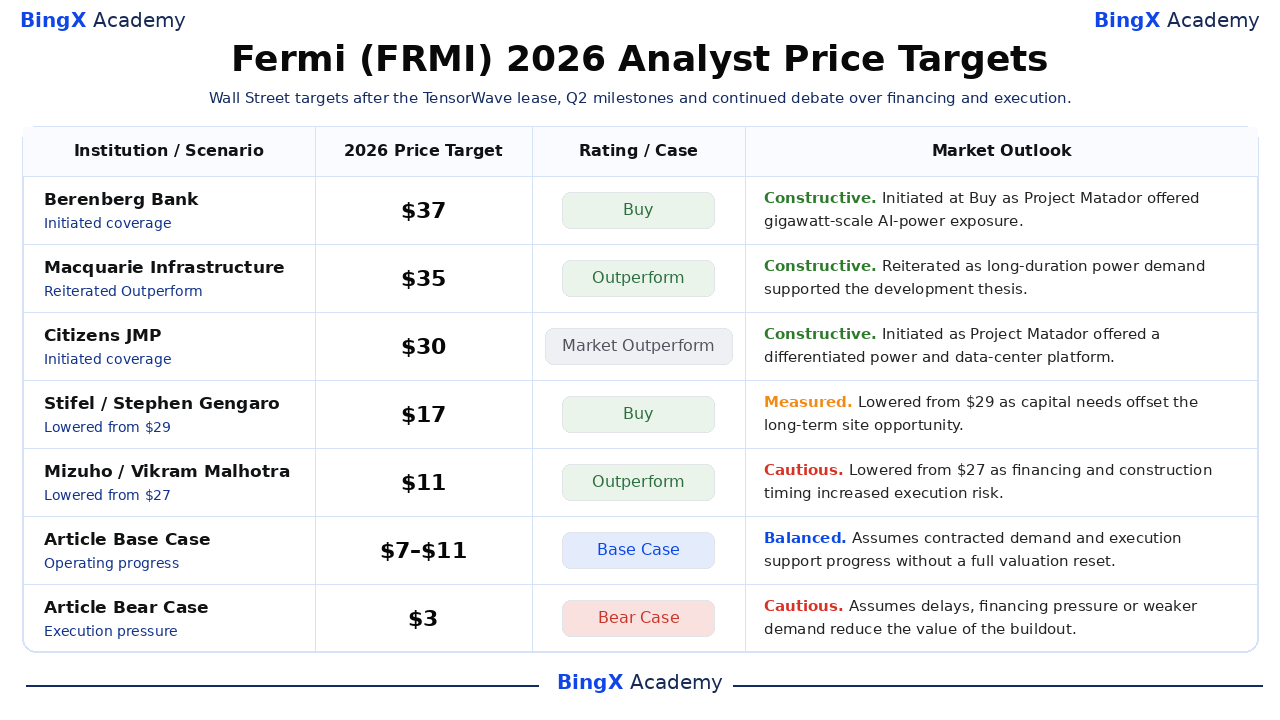
Analyst actions show a wide spread between long-term strategic potential and near-term execution risk. The table retains dated actions and uses the article's Base and Bear cases only as editorial scenarios. The dispersion reflects different assumptions for customer timing, capital intensity, margins and conversion into per-share cash flow.
|
Institution |
2026 Price Target |
Rating |
Market Outlook |
|
Berenberg Bank |
$37 |
Buy |
Constructive. October 27: Initiated coverage after the IPO around Project Matador’s gigawatt-scale AI-power opportunity. |
|
Macquarie Infrastructure |
$35 |
Outperform |
Constructive. November 12: Reiterated Outperform as contracted-power potential supported the long-duration development thesis. |
|
Citizens JMP |
$30 |
Market Outperform |
Constructive. February 9: Initiated coverage on the potential value of the Project Matador power and data-center platform. |
|
Stifel |
$17 |
Buy |
Measured. June 23: Lowered the target from $29 as capital needs and execution timing offset the site opportunity. |
|
Mizuho |
$11 |
Outperform |
Cautious. July 28: Lowered the target from $27 as financing, tenant timing and construction risk increased. |
|
Article Base Case |
$7–$11 |
Base Case |
Balanced. Assumes operating progress supports the project without a full valuation reset. |
|
Article Bear Case |
$3 |
Bear Case |
Cautious. Assumes delays or weaker demand compress earnings and valuation. |
How to Trade Fermi (FRMI) Stock on BingX
Trade Fermi's operating milestones, demand outlook and valuation using BingX TradFi and BingX AI tools. Because FRMI can react sharply to earnings, guidance and project updates, define the catalyst and risk limits before entering a position.
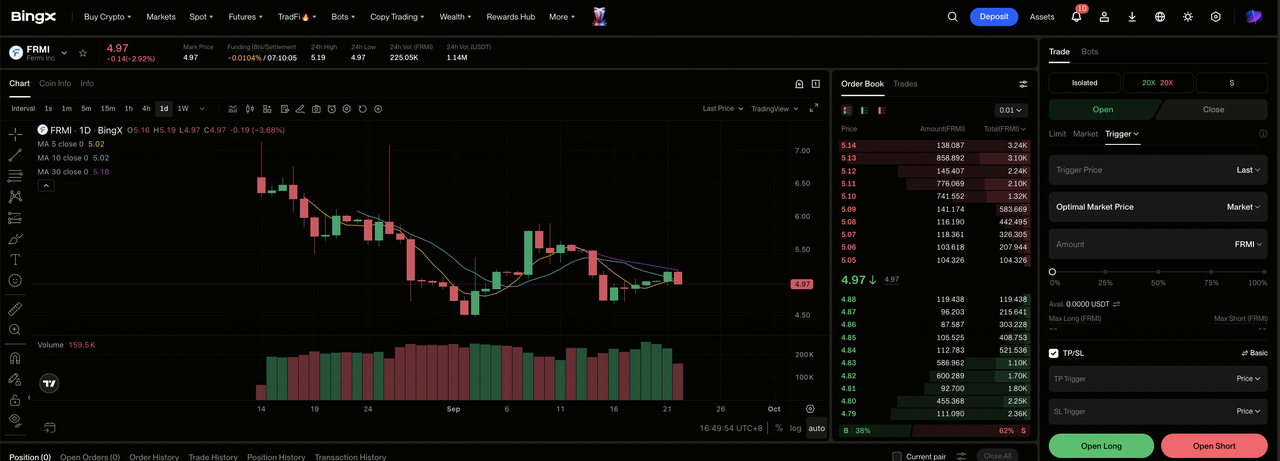
Step 1: Access BingX TradFi. Sign up and navigate to the specialized TradFi section on the BingX exchange dashboard.
Step 2: Select Fermi (FRMI). Search for and select the FRMI-USDT perpetual futures contract.
Step 3: Choose your direction. Select Open Long if execution and demand strengthen. Select Open Short if delays, weaker utilization or financing pressure damage the thesis.
Step 4: Select leverage and margin mode. Choose Isolated or Cross-Margin based on your risk tolerance. The stock's large 2026 range shows why conservative leverage and clear sizing matter.
Step 5: Execute strict risk protocols. Set Take-Profit and Stop-Loss (TP/SL) levels before or immediately after entering the trade. Monitor earnings, guidance, financing and named project milestones.
Top 5 Risks to Watch for Fermi Investors in 2026
Fermi's outlook depends on construction progress, financing, customer commitments and future AI infrastructure demand. These risks can delay revenue, increase dilution or reduce the value assigned to Project Matador.
- Project delays could push revenue further out: Fermi remains pre-revenue while Project Matador is under construction. Delays in power, buildings or customer delivery would extend cash burn before lease payments begin.
- Heavy financing needs could pressure per-share value: Large-scale data-center construction requires substantial debt and equity capital. Higher borrowing costs or additional share issuance could reduce future returns for existing shareholders.
- TensorWave creates customer-concentration risk: The 222 MW first-phase lease is a major commercial anchor for Project Matador. A deployment delay, contract change or weaker expansion demand from TensorWave could materially affect utilization and revenue timing.
- Slower AI infrastructure demand could reduce project returns: Fermi is building capacity for long-term AI and HPC demand. If hyperscaler or AI-cloud spending slows, new infrastructure could take longer to lease and earn acceptable returns.
- The pre-revenue valuation leaves little room for execution misses: FRMI's current value depends heavily on future contracted cash flow rather than current earnings. Missed milestones, higher construction costs or weaker customer demand could compress the valuation well before revenue begins.
Final Thoughts: Should You Invest in Fermi in 2026?
Fermi's 2026 thesis has measurable support from reported financials and named strategic milestones. The opportunity depends on converting demand into revenue and cash flow without losing financial flexibility. Investors should monitor the next operating milestones, customer commitments, capital spending and margins together. The next completed reporting period should make that conversion more visible and separate temporary enthusiasm from durable operating progress.
The Bull Case requires consistent execution and improving returns to support $18. The Bear Case reflects delays, weaker demand or financing pressure that could pull FRMI toward $3. A conservative approach would wait for evidence that current investment is producing durable per-share value. The next completed reporting period should make that conversion more visible and separate temporary enthusiasm from durable operating progress.
Risk Reminder: Stock-linked perpetual futures involve leverage and can amplify losses. Analyst targets and article scenarios are conditional reference points, not guarantees.
Related Reading
- Top AI Energy Stocks to Buy in 2026: Nuclear, Gas, Fuel Cells, and the AI Power Buildout
- Top High-Performance Computing (HPC) Stocks to Watch in 2026: Accelerated Computing Market Leaders
- Top AI Data Center Stocks to Buy in 2026: Cloud, Servers, and AI Compute Infrastructure
- Bloom Energy (BE) Price Prediction 2026: Can AI Data-Center Power Push BE Toward $350?
- Oklo (OKLO) Price Prediction 2026: Can Nuclear Milestones Push OKLO Toward $100?
