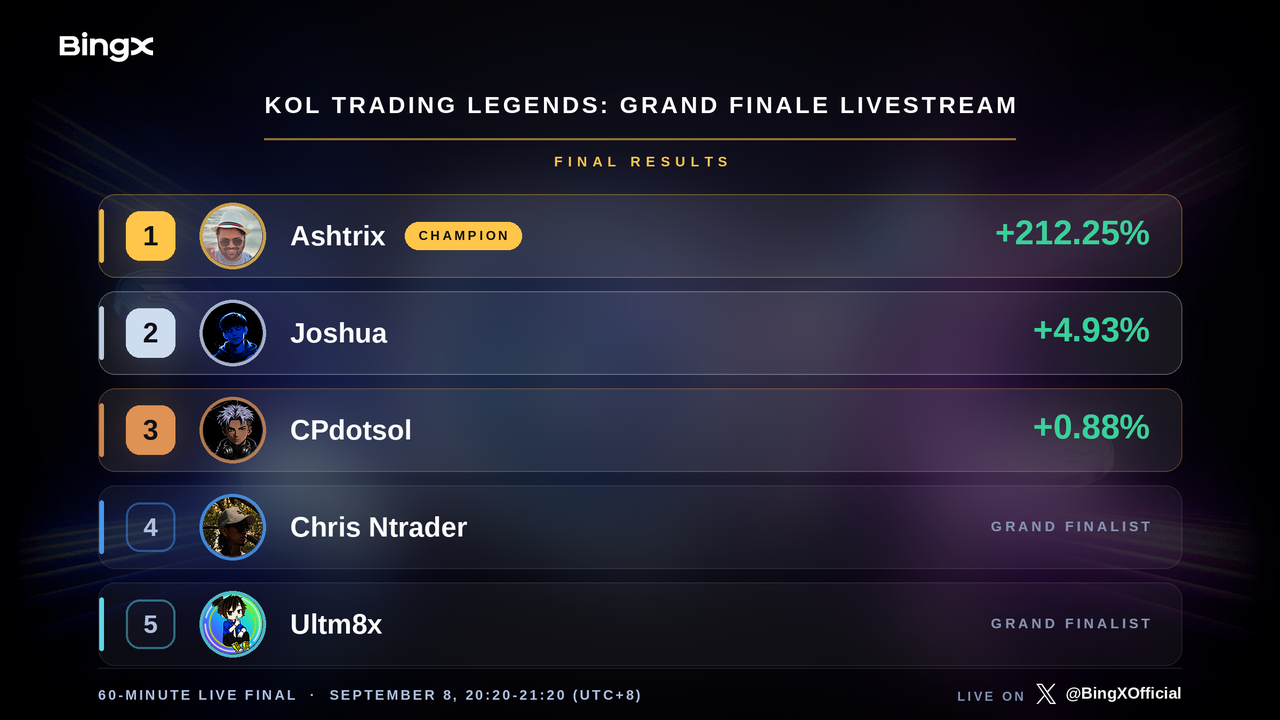
On the evening of 8 September 2026, the BingX KOL Trading Legends Grand Finale went live on X. Five KOLs who had fought their way through the qualifying rounds traded side by side, on camera, with the scoreboard updating in real time. In front of the whole audience, Ashtrix took the crown with +212.25% in a single hour. Together with Joshua, CPdotsol, Chris Ntrader and Ultm8x, he gave us an hour of trading you could not look away from.
|
Risk disclaimer. All trading data in this article comes from BingX VST Demo Funds. VST is a demo trading token with no real-world value. The high leverage and concentrated single-instrument positions described here are an extreme approach built to chase a ranking under contest rules; in a live account the risk would be severe. Do not copy it directly. Past performance does not indicate future results. This article shares trading experience only and is not investment advice.
|
What follows is a breakdown of how Ashtrix traded, with his Copy Trading link at the end.
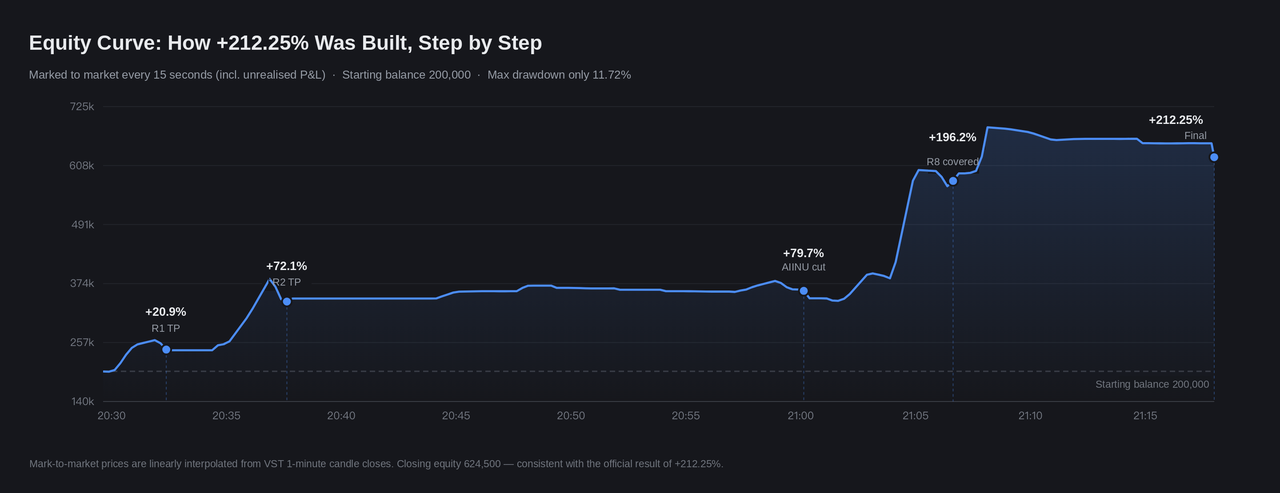
1. One Hour, 200K to 620K+
|
Metric
|
Value
|
Metric
|
Value
|
|
Total profit
|
+$424,500
|
ROI
|
+212.25%
|
|
Active trading time
|
48 min 22 s
|
Orders filled
|
60 (100% market orders)
|
|
Position rounds
|
10
|
Win rate
|
90%
|
|
Average hold
|
4 min 47 s
|
Shortest hold
|
2 min 06 s
|
|
Average winning round
|
+$49,358
|
Average losing round
|
−$19,718
|
|
Payoff ratio
|
2.50
|
Profit factor
|
22.5
|
|
Expectancy per round
|
+$42,450
|
Max drawdown
|
11.72%
|
|
Calmar (return / drawdown)
|
18.1
|
Sharpe (per-minute)
|
0.50
|
What stands out:
-
Max drawdown 11.72% — at 20× leverage, equity never fell more than 12% below a prior high
-
Payoff ratio 2.50, profit factor 22.5
-
Win rate 90% — only one of ten rounds went against him
A high win rate stacked on top of a high payoff ratio, with drawdown kept inside an acceptable range.
2. Trade Review: The Champion's Five Strategies
2.1 Instrument selection: go where the volatility is
Ashtrix touched only four pairs all session — $INDEX, $MARSCOIN, $CATE and $AIINU — every one of them a newly listed, low-cap, high-volatility contract.
|
Pair
|
1-hour range
|
Rounds
|
Direction
|
Net P&L
|
Share of net profit
|
|
$INDEX
|
38.1%
|
4
|
3 long / 1 short
|
+$391,902
|
92.3%
|
|
$MARSCOIN
|
33.0%
|
3
|
2 long / 1 short
|
+$38,358
|
9.0%
|
|
$CATE
|
15.1%
|
2
|
1 long / 1 short
|
+$13,959
|
3.3%
|
|
$AIINU
|
10.6%
|
1
|
1 long
|
−$19,718
|
−4.6%
|
|
How to apply it: Volatility is the raw material of short-term trading. Before you place an order, "is there a move in this coin today?" is a more useful question than "should I be long or short?"
|
2.2 Cut it early: wrong direction, closed inside six minutes
$AIINU was the only losing round of the night. He went long at 20:53:55, waited six minutes for a bounce that never came, and closed at 21:00:15 for −$19,718.
That stop saved him twice over. First in capital: after he left, $AIINU bounced only as far as $0.2401 and never returned to his $0.2417 cost basis, closing the session at $0.2312. Holding to the bell would have cost 86.7% of the margin on that position.
Second in opportunity: 52 seconds after cutting, he was in a new $INDEX position, and the next two rounds brought in +$247,666. With the money still stuck in $AIINU, none of that happens.
|
How to apply it: The real cost of holding a losing position is not the unrealised loss — it is the capital and the time locked up inside it. Opportunity cost is the item traders overlook most often and pay for most dearly.
|
2.3 No preset bias: 18 seconds from long to short
At 21:03:13 Ashtrix closed his entire $INDEX long. Eighteen seconds later he was short 22.22 million units at almost exactly the same price. Over the next three minutes $INDEX collapsed from $0.0463 to $0.0366, and that single round netted +$200,850 — 47% of his profit for the whole session.
What gave him the confidence to flip was not a forecast. After the +7.9% marubozu at 21:02, the 21:03 candle printed a stalling doji with a tiny body.
|
How to apply it: Long and short are tools, not identities. How fast you can admit the direction has changed is the core skill in short-term trading.
|
2.4 Market orders only — 60 orders, 60 complete fills
All 60 orders were market orders and every one filled completely. Not a single partial fill, not a single resting limit order — including his largest single ticket, a notional of more than $1,000,000, which also filled instantly.
But he never dumped size in one go. Entries were split across 3–5 orders and built in 30–60 seconds; exits were split across 4–6 orders and cleared in 10–30 seconds. The 22.22 million-unit short took 17 seconds to build and 18 seconds to close.
He never adjusted leverage — cross margin at 20× from start to finish. Risk was controlled through holding time and position concentration instead.
|
How to apply it: A market order buys certainty of execution. Scaling in and out buys control of pace.
|
2.5 Win rate is not the point — payoff is
Nine wins from ten rounds, but the pullback buy and the short reversal alone produced 72% of the profit. The other eight rounds together contributed less than 30%.
|
Time
|
Cumulative ROI
|
What happened
|
|
20:32
|
+20.9%
|
First $INDEX round closed in profit
|
|
20:37
|
+72.1%
|
Pullback buy closed — +$102,540 from one round
|
|
20:52
|
+80.8%
|
$CATE long and $MARSCOIN short banked back to back
|
|
21:00
|
+79.7%
|
$AIINU cut — the only real drawdown of the session
|
|
21:03
|
+97.0%
|
Breakout chase on $INDEX closed, +$46,816
|
|
21:06
|
+196.2%
|
The $INDEX short fully covered — ROI doubles in one move
|
|
21:18
|
+212.25%
|
The last $MARSCOIN round closes and the result is final
|
Through the first 35 minutes he was only up +80%. The contest was decided in the three minutes after 21:03. For most rounds the job was not to make money — it was to avoid losing the stake, and to still be standing when those two trades arrived.
|
How to apply it: If your system has no mechanism for catching a large move, a high win rate just keeps you walking on the spot.
|
3. Case Study: $INDEX
Ashtrix traded four rounds on $INDEX across 33 orders, and they produced 92% of his profit for the night. The chart below marks the entry and exit of each of those four rounds.
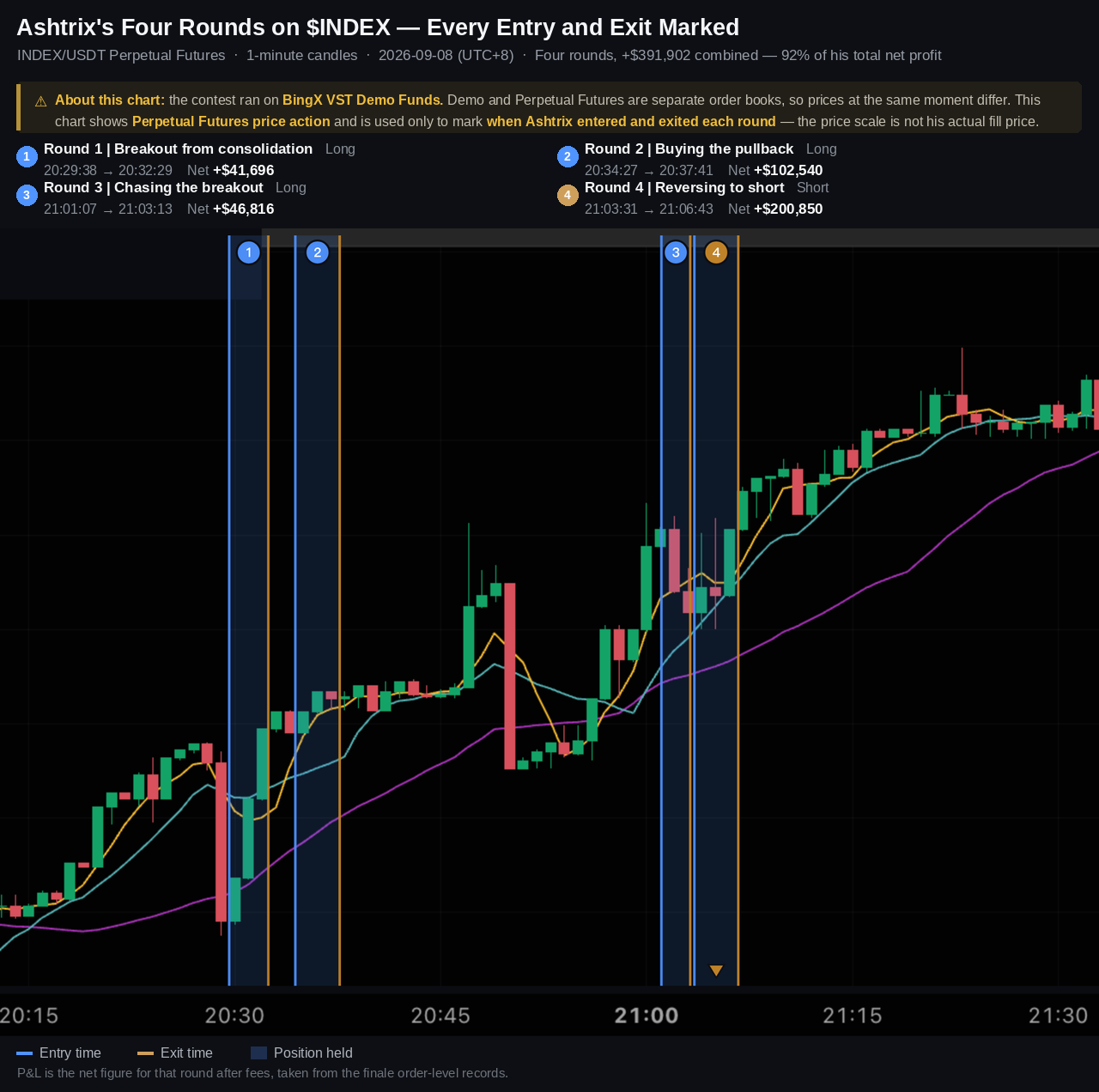
Round 1 | Breakout from consolidation · 20:29:38 → 20:32:29 · +$41,696
$INDEX was ranging at $0.0435. He bought in the final minute of that range and the next candle was a +11.5% marubozu. After the move to $0.0489, the 20:31 candle narrowed to a 2.4% range — momentum fading — and the moment 20:32 broke down he exited across four orders. He did not sell the high, but he avoided the drop to $0.0424 that came immediately after.
Round 2 | Buying the pullback · 20:34:27 → 20:37:41 · +$102,540
Price fell back to $0.0418. Inside 40 seconds he bought 22.17 million units across four orders at an average of $0.043591, buying into the reversal candle.
The exit is the more instructive half. The 20:37 candle broke down with a 16.7% range, and he sold into the collapse across six orders — the first at $0.050104, all but the exact high, then chasing price down through $0.047746, $0.047693, $0.047628 and $0.047617. Selling into the fall, not betting on a bounce.
20:40 – 21:00 | Twenty straight minutes, not one order
For those twenty minutes no $INDEX candle moved more than 0.6%. He shifted his attention to $CATE and $MARSCOIN and did not open a single $INDEX position.
|
How to apply it: Not trading is a decision too. In a window with no volatility, entering is just donating to fees and slippage.
|
Rounds 3 & 4 | Chasing the breakout, then reversing to short · 21:01:07 → 21:06:43 · +$247,666
At 21:01 the dead-flat range broke out on volume and he entered on the very first candle of the break. At 21:02 came a +7.9% marubozu — but 21:03 printed a stalling doji. He read it as a bull trap, took profit on the long, and eighteen seconds later he was short.
The next candle was a −26.5% collapse, from $0.0463 down to $0.0366. Price bottomed at $0.03658 at 21:05, and on the first bounce at 21:06 he covered the entire position across four orders at an average of $0.036895.
|
How to apply it: Every one of his entries maps to a price structure you can name out loud — the end of a range, a reversal candle off a pullback, a breakout on volume, a stalling doji. Write down the reason for the entry and the exit first, then place the order.
|
4. In Ashtrix's Own Words
After the win, the champion shared this with the people who followed him through the season:
|
Being #1 across 4 countries is not just an achievement for me — it’s an emotion and the result of 8 years of hard work, setbacks, and countless tough nights. 🥹
From blowing my capital multiple times to receiving $10,000 in prize money, I’ve come a long way. 🧿
To everyone who is learning to trade, I just want to say one thing — Don’t Give Up. 💪🏻
Sometimes, it only takes one or a few trades to change your entire journey. 🔥
Trust the process. Trust yourself. You’ve got this. 💪🏻
Thank you to each and every person who supported me, believed in me, or pushed me to keep going. 😇
This is just the beginning. There’s still a long way to go and much more to achieve. 🚀
We’re going to make history together. ❤️🙌
— Ashtrix, Champion, KOL Trading Legends Season 1
|
5. The Contest Is Over, but Copy Trading Is Just Beginning
That hour in the finale was one public contest. All five finalists will be opening Copy Trader accounts on BingX, and through Copy Trading you can mirror every entry, add and exit they make — learning how a top trader executes, in live markets.
Go to the BingX Copy Trader pages:
-
Chris Ntrader https://bingx.com/CopyTrading/1602142768954130437
Copy Trading campaign: [link]
Notes
-
Finale replay: https://x.com/i/broadcasts/1mGPaZbjDydJN — you are welcome to watch it back.
-
The trading data in this article comes from the finale order-level records, published with the KOLs' consent. Because the contest ran on BingX VST Demo Funds, which matches orders on its own separate book, prices differ from the Perpetual Futures market. Amounts are shown in demo trading tokens, marked with $, and carry no real-world value.
