

Pons (PONS) is a Robinhood Chain launchpad token linked to a non-custodial interface for creating and trading tokens from a wallet. Instead of arranging a token contract, liquidity pool, and liquidity lock as separate steps, the legacy Pons V1 flow combines them into one on-chain launch. The documented PONS reference token has a fixed supply of 1 billion tokens, and its legacy pool uses a 1% fee tier.
As of September 2026, PONS is documented as a graduated token launched through the legacy factory, while Pons also documents a separate V2 architecture for new launches. The ecosystem has four key parts: PONS is a legacy launch token and buyback target, the V1 factory creates locked liquidity, the Pons interface displays launch and pool information, and Robinhood Chain supplies the EVM environment. This guide explains what Pons is, how the launchpad works, how PONS tokenomics function, the main risks to consider, and how to trade PONS on BingX.
What Is Pons (PONS)?
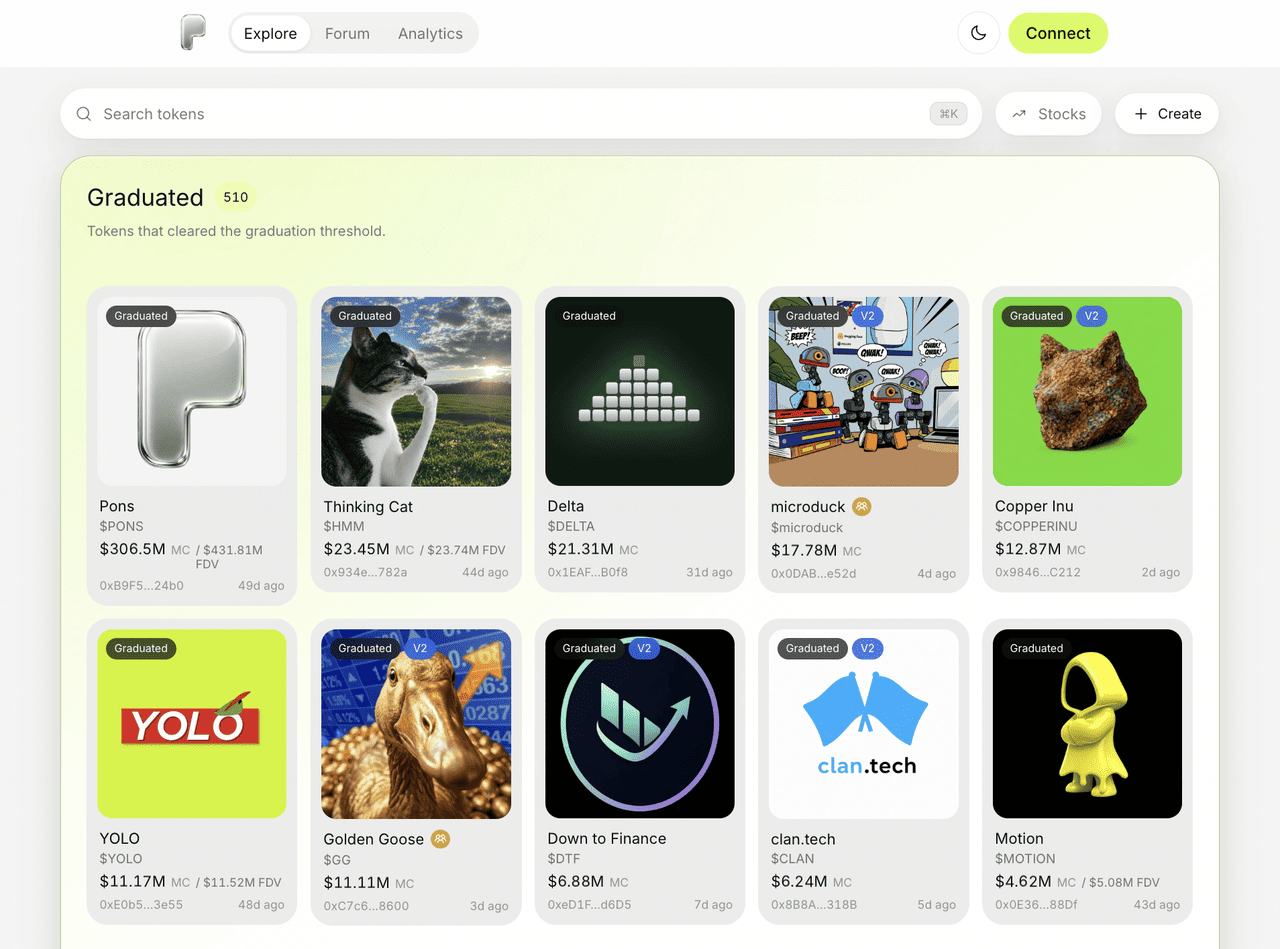
Pons is a non-custodial token launchpad built on Robinhood Chain. In its documented legacy V1 design, each launch creates a fixed-supply token, pairs it with WETH in a Uniswap V3 pool, and locks the resulting liquidity-position NFT. PONS is the project’s graduated reference token, launched through that legacy factory and still traded in its original pool.
PONS is not documented as a conventional governance token with voting rights or a published allocation schedule. Instead, its role is tied to the legacy Pons ecosystem, where protocol funds can be used to buy PONS and send the purchased tokens to a burn address. The official documentation does not disclose investor allocations, treasury shares, or a public vesting schedule, so those details should not be inferred from third-party token pages. The core idea behind Pons is straightforward: token creation and initial liquidity are bundled into the same on-chain launch flow, reducing the number of separate steps creators would otherwise need to manage.
Key components of the Pons ecosystem include:
- Legacy V1 factory: The V1 factory creates a fixed-supply token, initializes a V3 pool, and locks the position NFT in the launch flow.
- Locked liquidity pool: Each legacy token trades against WETH in its own pool, with the position lock intended to remove a simple liquidity-withdrawal path.
- Reference token PONS: PONS is a graduated legacy launch used in the documentation as a reference token and is the stated target of protocol buybacks.
Read More: What Is Robinhood Chain? A Beginner’s Guide to Robinhood’s Blockchain Strategy in 2026
How Does Pons Work?
Pons works as a Robinhood Chain-native launchpad whose legacy launch contracts, locked liquidity positions, and fee-funded buyback process are coordinated by the factory, the pool locker, and the PONS token.
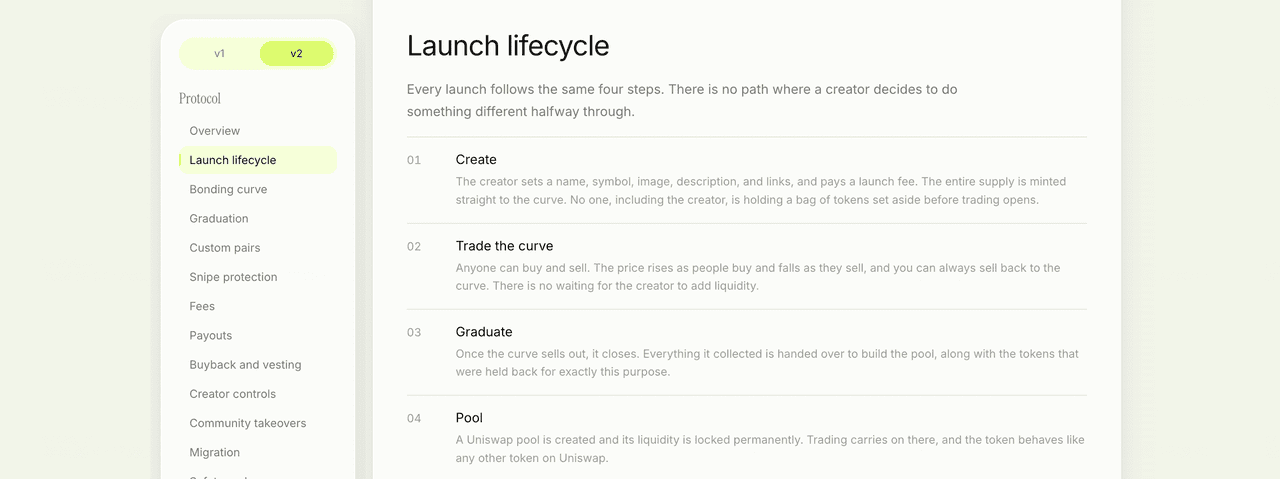
- Token creation and pool setup: In the legacy V1 flow, the factory deploys a fixed-supply ERC-20 and opens a one-sided Uniswap V3 liquidity position in a single transaction. The documented V1 token pairs against WETH.
- Liquidity locking: The V1 position NFT is locked after the pool is created. This design is intended to prevent the launch liquidity from simply sitting in a creator-controlled wallet.
- Temporary launch protections: The first two blocks have anti-snipe rules, including an initial-buy restriction, a wallet holding cap, and a cumulative buy cap. Selling and wallet-to-wallet transfers are not restricted by those temporary launch limits.
- Graduation tracking: The interface tracks a launch against its paired-principal threshold. For the documented PONS reference token, graduation did not move the token to another pool, because trading continued in the same pool.
- Fees and PONS buybacks: The legacy launch fee split is snapshotted per token. Pons states that protocol funds can buy PONS through an automated TWAP and send purchased tokens to a burn address, although the stated 80% buyback share is not yet immutable.
Pons vs. Pump.fun: What’s the Difference Between the Token Launchpads?
Pons and Pump.fun are both token launchpads designed to simplify the process of creating and trading new tokens, but they operate on different networks and use different launch mechanics. Pons runs on Robinhood Chain, while Pump.fun is centered on Solana and uses a bonding-curve model before tokens graduate to PumpSwap.
|
Comparison |
Pons |
Pump.fun |
|
Core model |
Token launchpad on Robinhood Chain with V1 and V2 launch systems. |
Token launchpad using a bonding curve before graduation to PumpSwap. |
|
Network |
Robinhood Chain |
Solana |
|
Launch process |
V1 creates the token and locked Uniswap V3 liquidity in one flow; V2 uses a bonding curve before graduation to a locked Uniswap V4 pool. |
Tokens begin trading immediately on a bonding curve and automatically migrate to PumpSwap after reaching the graduation threshold. |
|
Main users |
Creators and traders exploring new Robinhood Chain tokens. |
Creators and traders launching and trading primarily memecoin-style tokens. |
|
Liquidity model |
Locked Uniswap liquidity after launch or graduation, depending on the version. |
Bonding-curve liquidity first, followed by protocol-owned PumpSwap liquidity after graduation. |
|
Main advantage |
Combines token creation and liquidity setup within the Robinhood Chain ecosystem. |
Simple launch process with immediate price discovery and automatic graduation. |
|
Main tradeoff |
Smaller, newer single-chain ecosystem with experimental-token risk. |
Highly speculative token environment where prices can move sharply during and after the bonding-curve phase. |
The main difference is the launch architecture and ecosystem. Pons is built specifically for Robinhood Chain and now supports both its legacy V1 model and a V2 bonding-curve-to-Uniswap flow, while Pump.fun uses a bonding curve followed by automatic migration to PumpSwap. Both reduce the technical work required to launch a token, but users still face high volatility, liquidity, and smart-contract risks when trading newly launched assets.
Read More: What Is Pump.fun and How to Launch a Memecoin on This Solana Launchpad?
What Are the Pons (PONS) Tokenomics?
PONS tokenomics center on a fixed 1 billion-token supply, a legacy WETH liquidity pool, and protocol-funded buybacks that can remove PONS from circulation through burns. PONS itself was launched through the legacy Pons factory and remains a graduated reference token trading in the same locked Uniswap V3 pool. The official documentation does not publish a separate PONS allocation or vesting schedule.
PONS Token Utility and Supply Mechanisms
- Fixed 1 billion-token supply: Pons V1 launches use a fixed supply of 1 billion tokens, and the official reference-token documentation identifies PONS as a legacy launch created under that system. No additional minting mechanism is documented.
- Legacy WETH liquidity pool: PONS trades against WETH in its original locked Uniswap V3 pool on Robinhood Chain. The documented pool fee is 1%, and graduation does not move liquidity to a new pool.
- Protocol buyback and burn: Pons states that protocol funds can be used to buy PONS from the market and send the purchased tokens to a burn address, permanently reducing the supply counted as circulating. A burn does not guarantee higher prices or stronger liquidity.
- Legacy fee structure: Tokens launched through the legacy factory retain the original 90% creator / 10% protocol liquidity-fee split. Because PONS was launched through that legacy factory, this is the relevant documented V1 fee structure for its launch.
- Burn-adjusted supply matters more than unlocks: The docs define burn-adjusted market capitalization using total supply minus burned supply. Since no public PONS vesting or allocation schedule is documented, on-chain burns and liquidity conditions are more relevant supply signals than a conventional token-unlock calendar.
PONS Token Allocation
The official Pons documentation confirms a fixed 1 billion-token PONS supply, but it does not publish a conventional allocation breakdown for team, investors, community, treasury, or ecosystem reserves. It also does not provide a public vesting or unlock schedule for PONS.
|
Allocation |
Amount / Share |
Official Status |
|
Total Supply |
1,000,000,000 PONS |
Confirmed |
|
Team |
Not disclosed |
No official allocation published |
|
Investors |
Not disclosed |
No official allocation published |
|
Community / Airdrop |
Not disclosed |
No official allocation published |
|
Treasury / Ecosystem |
Not disclosed |
No official allocation published |
|
Vesting / Unlock Schedule |
Not disclosed |
No official schedule published |
Because no formal allocation schedule is disclosed, PONS supply analysis should focus on the fixed total supply, burned balance, and liquidity in the legacy WETH pool rather than assuming a conventional token-unlock structure. Any team, investor, or community allocation percentages found outside the official Pons documentation should be treated as unverified unless the project publishes them directly.
How to Trade Pons (PONS) on BingX
BingX offers two ways to gain exposure to Pons. Spot trading is for users who want to buy and hold PONS directly, while perpetual futures are for active traders who want long or short exposure to PONS price movements.
Spot Trading: Buy and Own PONS Directly
Spot trading is the most straightforward way to buy Pons on BingX. When users buy PONS on the spot market, they own the asset directly and can hold it in the BingX spot account, transfer it, or withdraw it to a compatible self-custody wallet if withdrawals are supported.
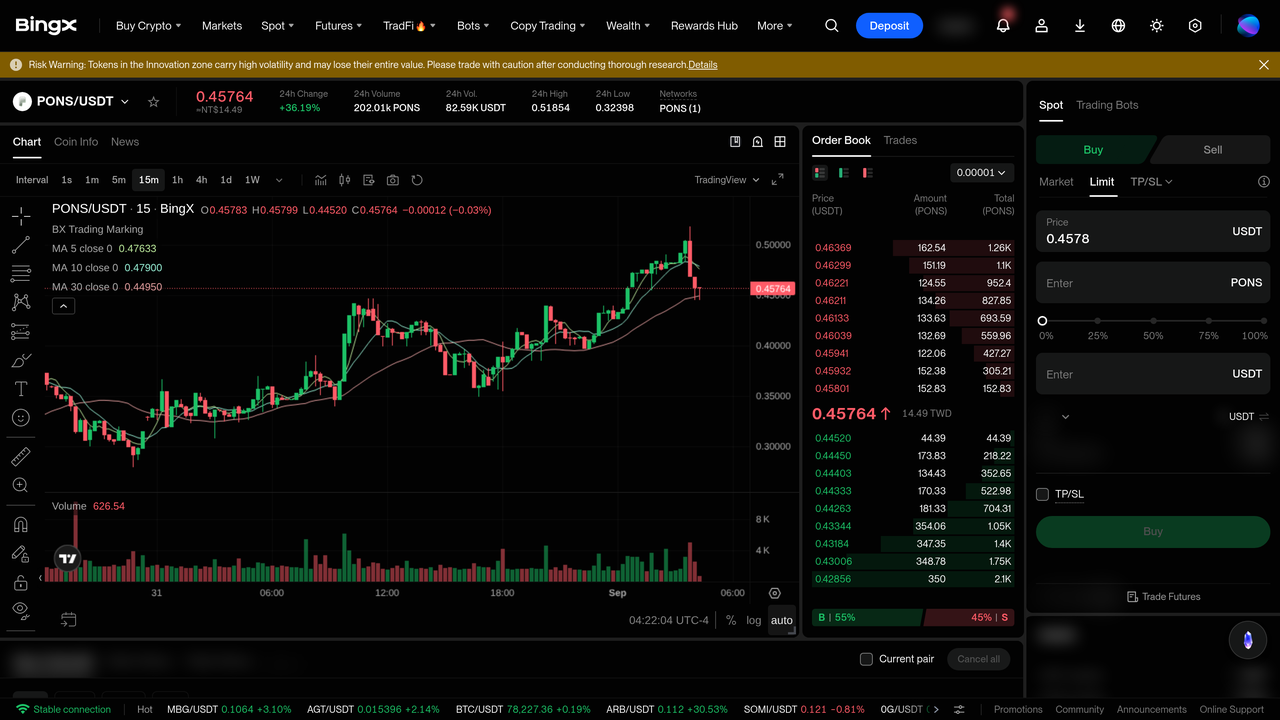
Step 1: Account setup and security. Sign up and log into your BingX account, complete the identity verification (KYC) required in your region, and enable two-factor authentication.
Step 2: Fund your spot account. Deposit USDT or another supported asset into your BingX spot account. Where available, users can also use supported fiat on-ramp options.
Step 3: Navigate to the spot market. Search for the PONS/USDT trading pair.
Step 4: Place your order. Choose a market order to buy PONS immediately at the current price, or use a limit order to set the price you want to pay.
Step 5: Manage your PONS. Once filled, your PONS appears in your spot account. You can keep it on BingX for convenience or withdraw it to a compatible self-custody wallet if withdrawals are supported.
Futures Trading: Trade PONS Price Movements
For active traders, BingX may offer USDT-margined PONS perpetual futures. Futures allow users to trade PONS price movements without holding the underlying asset, with the flexibility to open long positions if they expect PONS to rise or short positions if they expect PONS to fall.
Because futures involve leverage, they can amplify both gains and losses. This approach is more suitable for traders who already have a clear risk plan and understand liquidation risk.
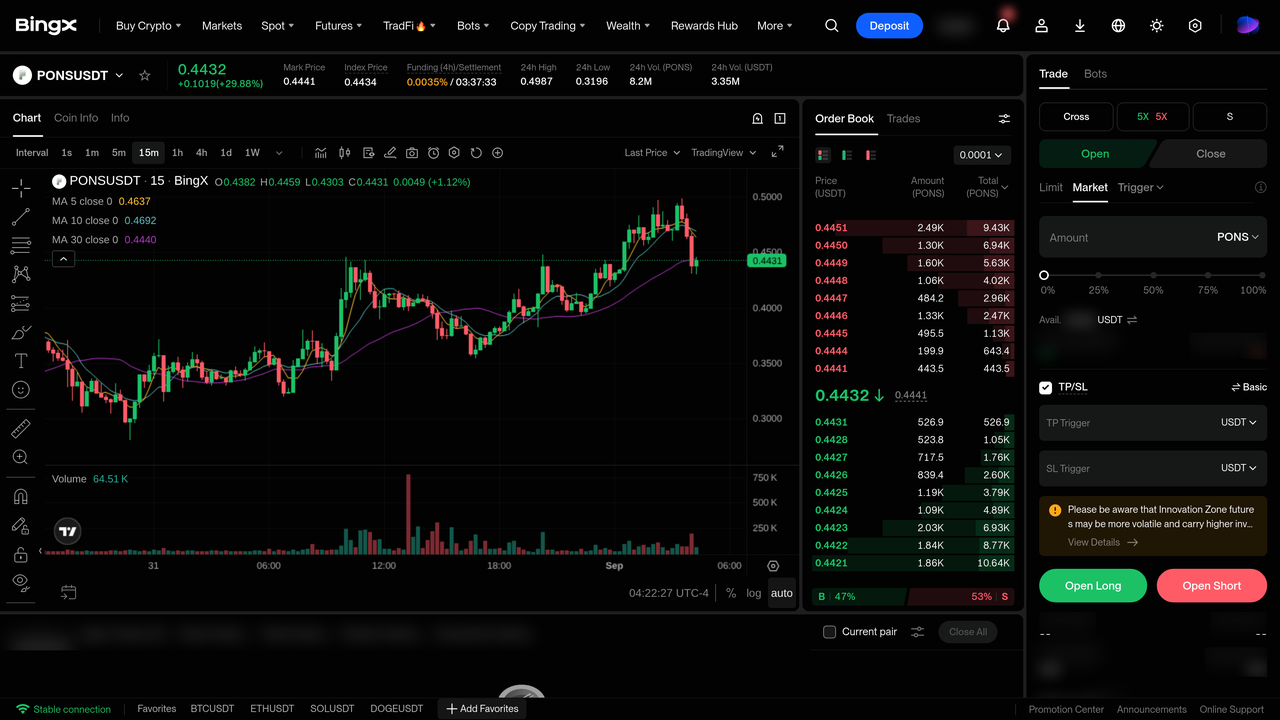
Step 1: Account setup and security. Sign up and log into your BingX account, complete the identity verification (KYC) required in your region, and enable two-factor authentication.
Step 2: Transfer collateral. Move USDT from your spot account into your futures account, where it will serve as margin.
Step 3: Select the contract. Search for the PONS-USDT perpetual contract.
Step 4: Set direction and leverage. Open long if you expect PONS to rise, or open short if you expect PONS to decline. Choose leverage based on your risk tolerance and position size.
Step 5: Execute the trade. Enter the order amount and choose a market or limit order depending on your trading plan.
Step 6: Manage risk. Set stop-loss and take-profit orders before or immediately after entering the position. Profit and loss settle dynamically in USDT.
Risks and Considerations Before Investing in Pons (PONS)
Pons's investment case depends on whether its bundled legacy launch flow and protocol-funded buyback process can outweigh experimental-token liquidity, execution, and disclosure constraints. The following factors could change that conclusion.
- Volatility and thin liquidity: Pons warns that tokens launched through its interface can be volatile, illiquid, or lose all value. Past performance does not guarantee future results.
- Allocation and vesting disclosure: The official documentation does not publish a PONS allocation or vesting schedule. That makes it harder to assess supply ownership and future distribution from documentation alone.
- Buyback policy changes: The stated 80% protocol-fee buyback share is not immutable. A future decentralized or automated implementation could change how the mechanism operates.
- Smart-contract and infrastructure exposure: The launch flow depends on smart contracts, wallets, RPCs, and indexers, all of which can fail. Users should review transaction previews before approving on-chain actions.
- Token identity and concentration: Pons warns that names and symbols can be copied. Before treating concentration as a holder signal, users should distinguish wallets, liquidity pools, lockers, contracts, and burn addresses.
Final Thoughts: Should You Invest in Pons (PONS) in 2026?
Pons is a Robinhood Chain launchpad whose documented PONS reference token comes from its legacy V1 factory and locked-liquidity design. Its 2026 story is anchored by the legacy PONS pool, the separation between V1 and V2 launch architectures, and the stated protocol-fee buyback process.
The key question for 2026 is whether Pons can convert its launch workflow and buyback mechanism into durable demand without relying on unsupported tokenomics assumptions. Its one-transaction legacy launch flow and locked position design set it apart from general-purpose liquidity protocols, but PONS remains exposed to experimental-market liquidity, policy changes, and incomplete allocation disclosure. For investors and traders, the most important metrics to watch are the burn address, legacy-pool liquidity, PONS trading activity, and any official change to the buyback policy.
Related Reading
- What Is Robinhood Chain? A Beginner’s Guide to Robinhood’s Blockchain Strategy in 2026
- What Is Arrow Finance (ARROW)? A Beginner's Guide to the Robinhood Chain Lending Protocol in 2026
- What Is Cash Cat (CASHCAT)? A Beginner’s Guide to the Robinhood Chain Meme Coin in 2026
- What Is Uniswap? A Complete Guide to UNI Token, Fee Switch, and V1-V4 Features
- What Are the Best Memecoin Launchpads to Know in 2026?
FAQs About Pons (PONS)
1. What makes Pons different from other token launchpads?
Pons combines token creation and liquidity setup into one on-chain launch flow. In the legacy V1 system, launches create a fixed-supply token, a WETH trading pool, and permanently locked liquidity in the same process.
2. What blockchain is PONS on?
PONS runs on Robinhood Chain, an EVM-compatible network. Pons documentation lists Robinhood Chain as the protocol network and identifies ETH as its native asset.
3. Is the PONS supply publicly disclosed?
Yes. The official documentation lists a fixed supply of 1 billion tokens for Pons V1 launches. However, it does not publish a PONS-specific allocation or vesting schedule covering categories such as team, investors, or treasury.
4. How does Pons reduce PONS supply?
Under the documented V1 mechanism, protocol funds can be used to buy PONS and send the purchased tokens to a burn address, permanently reducing circulating supply. Legacy launches use the original 90% creator / 10% protocol liquidity-fee split, while current V1 launches use a 70% / 30% split.
5. Which wallets support PONS?
PONS can be held in self-custody wallets that support Robinhood Chain and compatible EVM assets. Users should verify the network and official token address before transferring funds, as similar token names and symbols can exist
