
DAPPOS (DOS) is a Web3 AI Operating System that combines AI-assisted task planning with intent-based on-chain execution. Instead of requiring users to assemble prompts, tools, wallets, and transaction steps separately, DAPPOS documents a system that turns a request into an execution plan and coordinates the required actions. It sits at the intersection of AI agents, Web3 automation, and intent execution.
DAPPOS documents xBubble as its flagship low-prompt AI product and describes a broader Web3 AI OS with Intelligence and Execution layers. The ecosystem has four core parts: DOS is the utility and governance token, xBubble packages AI workflows, Bubble Pilot selects task paths, and the Intent Execution Network coordinates on-chain outcomes. This guide explains what DAPPOS is, how the Web3 AI Operating System works, how DOS tokenomics function, the main risks to consider, and how to trade DOS on BingX.
What Is DAPPOS (DOS)?
DAPPOS is a Web3 AI system whose documentation combines an Intelligence Layer for Web3 research and reasoning with an Execution Layer for intent-based workflows. The project describes xBubble as a product that turns short requests into finished work across tasks such as research, automation, documents, and Web3 activity. Its architecture is designed to make a task definition, a selected workflow, and an execution path work together rather than asking a user to manually connect each tool.
DOS is the Ethereum ERC-20 utility and governance token of this system. Official materials describe potential roles in selected premium services, intent-execution fees, eligible staking-based participation, delegation, and governance. Availability, discounts, and eligibility depend on product and protocol rules in effect when a feature is used, so these roles should not be interpreted as universally available features.
The core idea behind DAPPOS is simple: a user should be able to state an intended result while a documented AI and execution stack handles the specialized workflow steps.
Key components of the DAPPOS ecosystem include:
- xBubble: A low-prompt product that uses SOP-powered agents to turn short requests into task outputs.
- Bubble Pilot: A routing component that identifies a task type, selects a matching SOP, and can fall back to a general-purpose agent.
- Bubble Engine: A Web3-focused AI layer that the documentation describes as using Contextual RAG and Compound Memory.
- Intent Execution Network: A network design in which matchers, service providers, and execution validators coordinate documented on-chain intent outcomes.
How Does DAPPOS Work?
DAPPOS works as an Ethereum-linked Web3 AI system whose AI products, intent execution, and participation mechanisms are coordinated by SOPs, controller-based routing, and the DOS token.
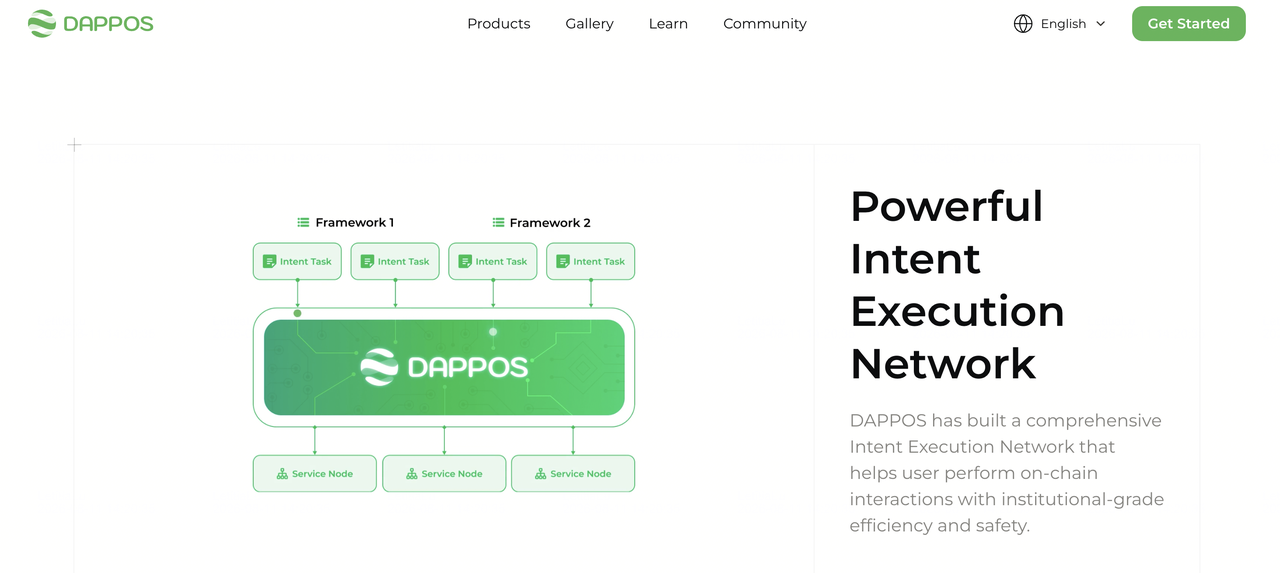
- SOP packages define reusable workflows: DAPPOS documentation says an xBubble SOP can package skills, runtime, APIs, MCPs, and model selection into a task-specific workflow.
- Bubble Pilot routes the request: Bubble Pilot identifies the task type and seeks a matching SOP. When no dedicated SOP fits, the documentation says it can use a general-purpose agent path.
- The Multi-Agent Framework selects a subgraph: The documented framework uses a StateGraph and controller nodes to route work into search, DeFi, or opportunity-oriented subgraphs.
- Intent terms set a measurable outcome: The Order Management System describes an intent around user-provided value, a desired result, and predefined failure compensation, with outcomes intended to be objectively determinable on-chain.
- Matching, execution, and verification follow: The execution documentation describes matching a counterparty, carrying out the task, and verifying the result. Validators can challenge failures, with a DPoS vote determining the outcome described by the protocol.
dappOS vs. CoW Swap: Key Differences Between Intent-Based Web3 Platforms
dappOS and CoW Swap both use intent-based systems to reduce the number of on-chain steps users need to manage manually, but they are built for different use cases. CoW Swap focuses specifically on token trading, allowing users to express the trade they want while its system handles execution and routing. dappOS applies the intent model more broadly, helping users complete multi-step Web3 actions across applications and networks without manually managing every transaction.
CoW Swap is therefore more specialized around swap execution, while dappOS covers a wider range of on-chain workflows. For users, the difference is mainly whether they need an intent-based trading tool or a broader execution layer for interacting with Web3 applications.
|
Comparison |
DAPPOS |
CoW Swap |
|
Core model |
Web3 AI Operating System with intelligence and execution layers |
Intent-based batch-auction trading protocol |
|
Main users |
Users seeking AI-assisted Web3 research, planning, and execution |
Users seeking trade execution through a trading-specific intent system |
|
Token demand |
DOS is documented for fees, selected services, participation, and governance |
Protocol design is focused on trading execution rather than DAPPOS-style AI service utility |
|
Main use case |
Multi-step Web3 tasks and intent workflows |
Token swaps and trade settlement |
|
Main advantage |
Broader AI workflow and on-chain execution scope |
Specialized trading-intent focus |
|
Main tradeoff |
More moving parts and product-rule dependencies |
Narrower scope outside trading workflows |
DAPPOS focuses on combining AI task handling with on-chain execution, while CoW Swap offers a trading-specific intent model. The choice depends on whether users prioritize broader Web3 automation or a specialized trading workflow.
What Are the DAPPOS (DOS) Tokenomics?
DOS tokenomics center on a documented 1 billion DOS total supply, category-specific allocation schedules, and utility tied to fees, participation, and governance. Investors receive the largest documented allocation at 22.5%, while the whitepaper schedule should not be treated as proof of completed unlocks or circulating supply at any given date.
DOS Token Utility and Supply Mechanisms
- Selected premium services: Official materials describe DOS as a token for selected premium services and potential AI-consumption-credit eligibility, subject to product rules in effect when the feature is used.
- Intent-execution fees: Documentation describes DOS as a payment option for intent-execution transaction fees and describes fee-discount terms relative to certain other payment options.
- Service qualification: Eligible participants may use DOS for staking-based qualification and performance collateral under applicable network rules.
- Delegation: DOS holders may be able to delegate to eligible ecosystem participants where the protocol rules support it.
- Governance: Official materials describe DOS as a governance token for proposals and voting, while the practical scope of governance can evolve.
DOS Token Allocation
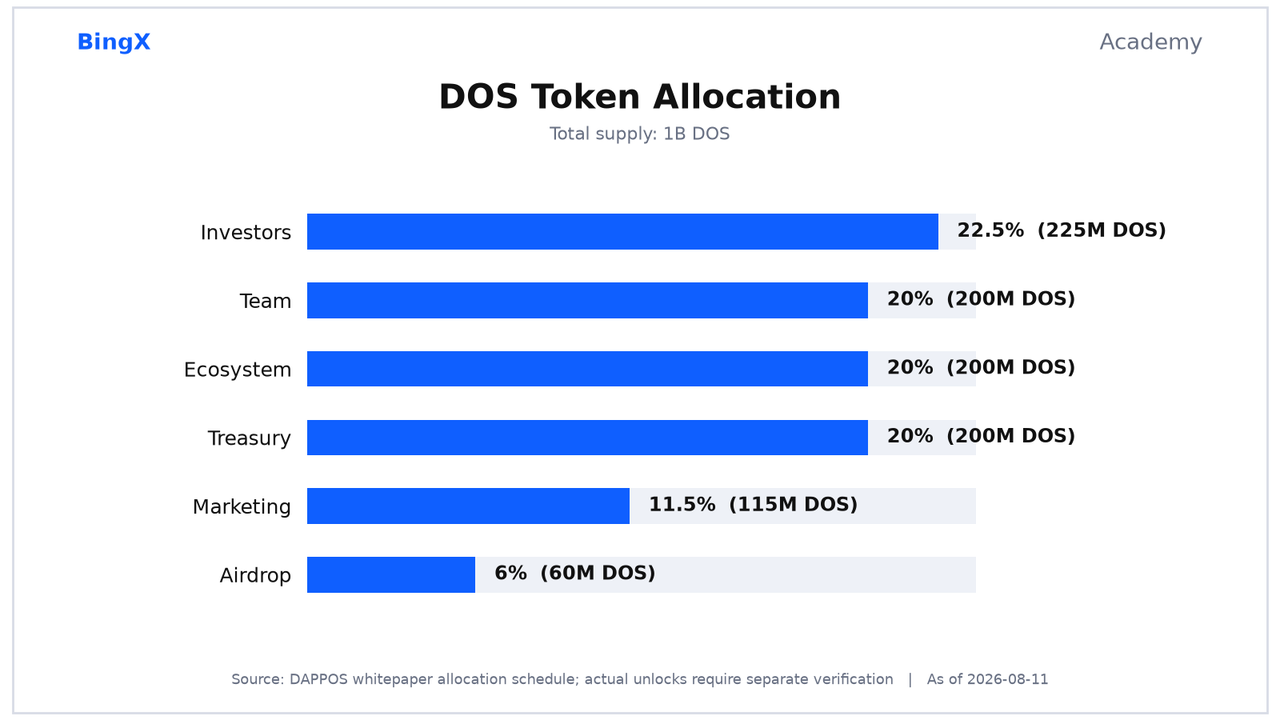
Source: DOS Whitepaper
- Investors: 22.5%, or 225M DOS. The whitepaper schedule assigns the largest allocation to investors, with a stated 12-month cliff followed by 48-month linear distribution.
- Team: 20%, or 200M DOS. Team tokens carry the same stated 12-month cliff and 48-month linear distribution schedule.
- Ecosystem: 20%, or 200M DOS. This allocation is intended for ecosystem-related purposes under the documented schedule.
- Treasury: 20%, or 200M DOS. Treasury allocation is a documented category, but token holders should verify governance and release conditions separately.
- Marketing: 11.5%, or 115M DOS. Marketing has its own whitepaper schedule and should be evaluated alongside actual token-release data when available.
- Airdrop: 6%, or 60M DOS. The whitepaper identifies an airdrop category, while actual distribution timing requires separate verification at the time of review.
By 2026, DOS supply dynamics depend on the balance between ecosystem demand and tokens released under the documented schedule. Because categories have different release terms, investors should monitor official unlock communications and on-chain circulating-supply evidence when evaluating potential supply pressure.
How to Trade dappOS (DOS) on BingX
BingX offers two practical ways to gain exposure to dappOS (DOS), depending on whether the goal is direct ownership or short-term trading. Spot trading is better suited for users who want to buy and hold DOS directly, while futures trading is designed for active traders who want long or short exposure to DOS price movements.
Spot Trading: Buy and Own DOS Directly
Spot trading is the most straightforward way to buy dappOS on BingX. When users buy DOS on the spot market, they own the asset directly and can hold it in their BingX spot account, transfer it, or withdraw it to a supported self-custody wallet if withdrawals are available.
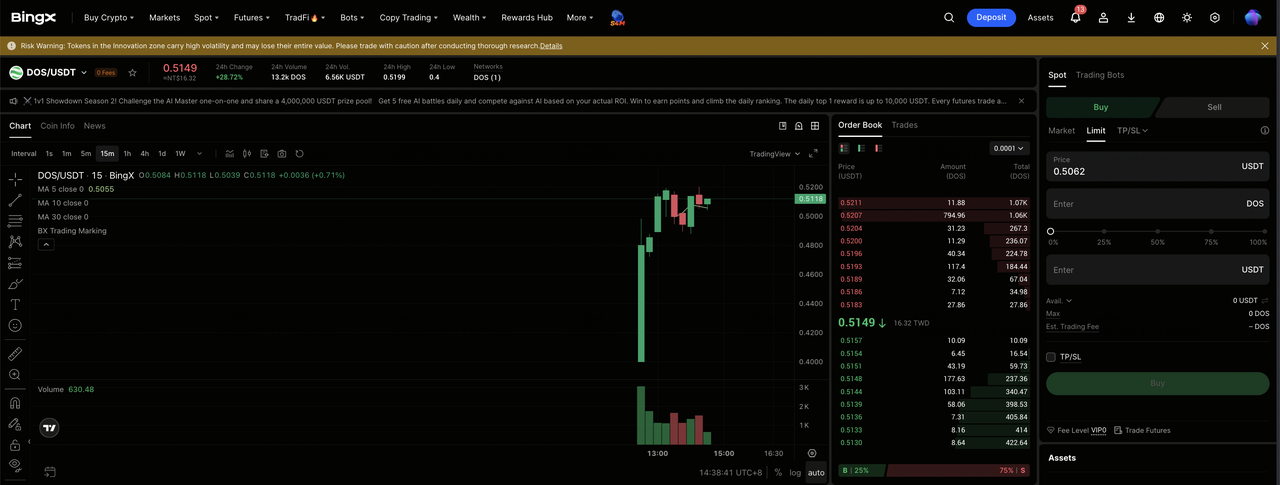
Step 1: Account setup and security. Sign up and log into your BingX account, complete the identity verification (KYC) required in your region, and enable two-factor authentication.
Step 2: Fund your spot account. Deposit USDT or another supported asset into your BingX spot account. Where available, users can also use supported fiat on-ramp options.
Step 3: Navigate to the spot market. Search for the DOS/USDT trading pair.
Step 4: Place your order. Choose a market order to buy DOS immediately at the current price, or use a limit order to set the price you want to pay.
Step 5: Manage your DOS. Once filled, your DOS appears in your spot account. You can keep it on BingX for convenience or withdraw it to a supported self-custody wallet if withdrawals are available.
Futures Trading: Trade DOS Price Movements
For active traders, BingX may offer USDT-margined DOS perpetual futures. Futures allow users to trade DOS price movements without holding the underlying asset, with the flexibility to open long positions if they expect DOS to rise or short positions if they expect DOS to fall.
Because futures involve leverage, they can amplify both gains and losses. This approach is more suitable for traders who already have a clear risk plan and understand liquidation risk, particularly for newer tokens where price movements can be volatile.
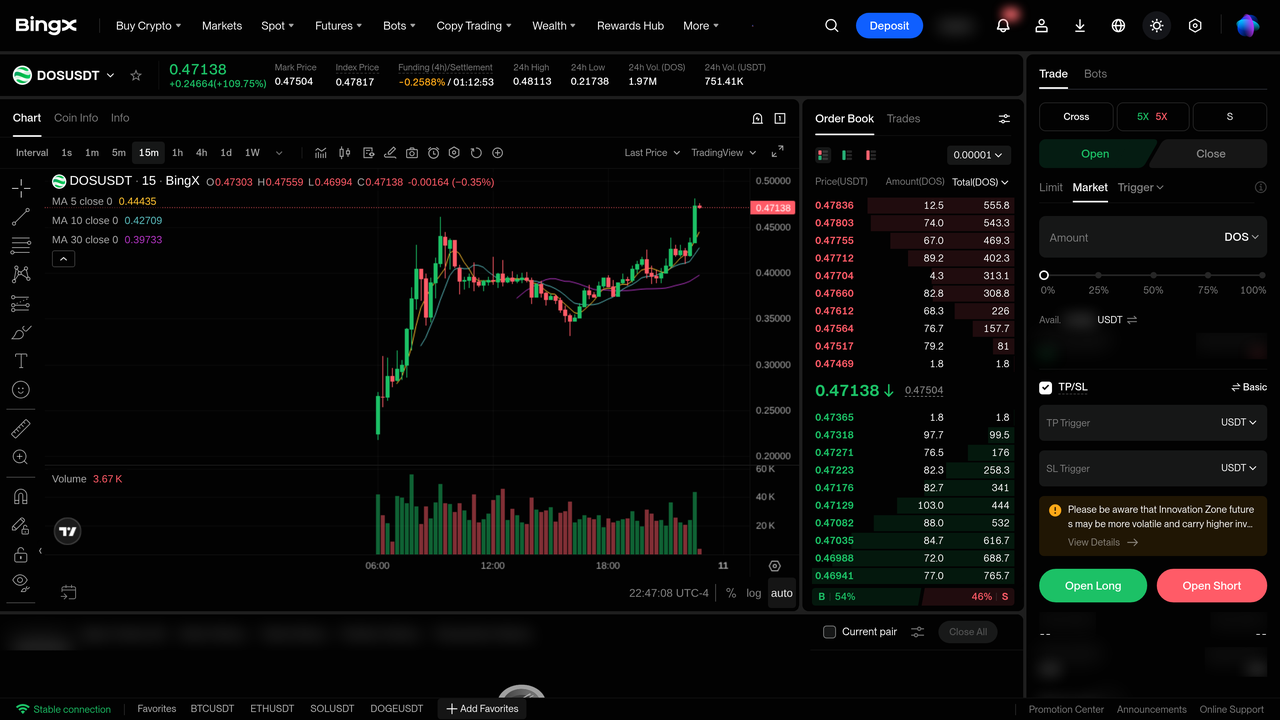
Step 1: Account setup and security.Sign up and log into BingX, complete the identity verification (KYC) required in your region, and enable two-factor authentication.
Step 2: Transfer collateral. Move USDT from the spot account to the futures account, where it is used as margin.
Step 3: Select the contract. Open the DOS-USDT perpetual.
Step 4: Set direction and leverage.Open long or short based on the trading thesis. Select leverage and position size within the defined risk limit.
Step 5: Execute the trade. Enter the order amount and use a market or limit order according to the trading plan.
Step 6: Manage risk. Set stop-loss and take-profit controls before or immediately after entry. Profit and loss settle dynamically in USDT.
Risks and Considerations Before Investing in DAPPOS (DOS)
DAPPOS must convert its documented AI workflow and intent-execution design into sustained product use before DOS utility can be assessed with confidence. Token releases, execution complexity, and changes to participation rules could weaken that outcome.
- Product adoption: DOS utility depends on continued adoption of DAPPOS products and on the availability of relevant premium, fee, and participation features.
- Supply and unlocks: The whitepaper provides allocation and vesting schedules, but scheduled releases can create supply pressure. Actual unlocks and circulating supply should be confirmed with official or on-chain evidence dated near the review.
- Execution and smart contracts: Intent matching, execution, and verification involve matchers, service providers, execution validators, and contracts. Completed audits are useful disclosures but are not a guarantee against vulnerabilities or operational failures.
- Volatility: DOS can experience large price swings, and past performance does not guarantee future results. The futures interface also places active traders in a leveraged market.
- Governance and rule changes: Staking eligibility, delegation terms, fee discounts, and governance scope can change through product or protocol rules.
Final Thoughts: Should You Invest in DAPPOS (DOS) in 2026?
DAPPOS is a Web3 AI Operating System that combines SOP-based agents, task routing, and intent-execution workflows. Its 2026 story is anchored by xBubble, the documented Web3 AI OS architecture, and the continued development of its Intent Execution Network.
The key question for 2026 is whether DAPPOS can convert its AI workflow design into sustained product use and clearly defined DOS utility. Its combination of AI planning and on-chain execution sets it apart from a trading-only intent protocol, but DOS remains exposed to adoption, release-schedule, and execution risks. For investors and traders, the most important metrics to watch are product usage, intent-execution activity, official unlock disclosures, circulating-supply evidence, governance updates, and DOS futures liquidity.
Related Reading
- How to Use ChatGPT and Grok AI to Analyze On-Chain Data, Whale Moves, and Altcoin Trends
- What Is MetaMask and How to Set Up a MetaMask Wallet?
- What Are the Top 10 AI Crypto Projects to Watch in 2026?
- What Are the Top 10 AI Agent Crypto Projects of 2026?
- What Are the Top 7 DeFAI (AI + DeFi) Projects to Watch in 2026?
FAQs About DAPPOS (DOS)
1. What makes DAPPOS different from other Web3 AI projects?
DAPPOS documents a two-layer design that connects AI research and reasoning with intent-based execution. Its xBubble product, SOP system, and Intent Execution Network are intended to make specialized workflows easier to access, although product capability and availability should be verified as they evolve.
2. What blockchain is DOS on?
DOS is issued as an Ethereum ERC-20 token. Users should verify the official contract address and supported network before transferring tokens, because names and tickers can be copied across networks.
3. Is the DOS supply publicly disclosed?
The DAPPOS whitepaper documents a 1 billion DOS total supply and a six-category allocation schedule. It also documents vesting terms, but readers should not assume a planned schedule equals circulating supply or completed unlocks at any given date.
4. Which wallets support DOS?
DOS can be stored in Ethereum-compatible wallets, including MetaMask and other supported wallets. Users should always confirm they are using the correct network and verify the official contract before transferring DOS to avoid loss of funds.
