

Capricorn (APR), previously known as aPriori, is a Monad-focused DeFi infrastructure project that combines liquid staking with onchain liquidity. Rather than leaving staked MON unavailable, its model issues aprMON as a reward-bearing liquid staking token and pairs this staking base with exchange liquidity. It sits at the intersection of Monad DeFi, liquid staking, and MEV-aware market infrastructure.
Capricorn Tech's official APR documentation sets a 1 billion APR total supply, with 22% allocated to community incentives and 17% to ecosystem growth. The ecosystem has four documented components: APR is the project token, aprMON represents staked MON and accrued rewards, Capricorn Exchange provides liquidity infrastructure, and the project documentation describes order-flow coordination as a core architectural theme. This guide explains what Capricorn Tech is, how the protocol works, how APR tokenomics function, the main risks to consider, and how to trade APR on BingX.
What Is Capricorn Tech (APR) (prev. aPriori)?
Capricorn Tech (prev. aPriori) is a DeFi infrastructure system built around Monad liquid staking and onchain exchange liquidity. Its documentation describes an architecture that combines intelligent order-flow segmentation, MEV-aware infrastructure, and liquid staking. The official site identifies the project as an intelligent order-flow coordination layer for high-performance blockchains.
APR is the token at the center of Capricorn Tech. The documentation presents APR as a means of shared participation in the project's network of data and flow, while its stated distribution reserves allocations for contributors, ecosystem development, and community incentives. APR is not the same asset as aprMON, which is the reward-bearing receipt token minted when MON is staked through Capricorn Tech.
The core idea behind Capricorn Tech is simple: pair staked MON liquidity with onchain trading infrastructure so capital can remain productive across the ecosystem.
Key components of the Capricorn Tech ecosystem include:
- aprMON: A reward-bearing liquid staking token that represents MON deposited into Capricorn Tech's staking vault and its accrued rewards.
- Capricorn Exchange: An onchain liquidity system with proactive AMM pools for oracle-informed pricing and concentrated pools for longer-tail pairs.
- APR: The project token, distributed across community, ecosystem, contributor, backer, foundation, and liquidity categories.
How Does Capricorn Tech Work?
Capricorn Tech works as a Monad-native DeFi system whose staking vault, exchange pools, and token distribution are coordinated by liquid staking, oracle-informed liquidity design, and the APR token.
- MON enters a staking vault: Users deposit MON into Capricorn Tech's vault, which the documentation says delegates tokens across a curated validator set and can rebalance delegations.
- aprMON represents the stake: The vault issues aprMON to represent a holder's share of the vault and accrued rewards. aprMON uses a reward-bearing model, so balances do not automatically increase as rewards accrue.
- Proactive pools use oracle inputs: Capricorn's PAMM pools refresh spreads and depth every block using oracle feeds. The pool contract maintains reserves and slippage accounting, while a separate pricing engine provides oracle-adjusted quotes.
- Concentrated pools serve price discovery: Capricorn CL pools let liquidity providers select active price ranges. A position outside its range does not participate in swaps or earn trading fees.
- Aggregation is the documented swap route as of August 2026: Capricorn's documentation says that its exchange does not support a swap front end, so swaps reach its pools through Monad DEX aggregators.
Capricorn Tech vs. Jito: Key Differences Between Onchain Liquid Staking Protocols
Capricorn Tech and Jito belong in the same reader decision because both connect liquid staking with MEV-related infrastructure and DeFi liquidity. The comparison is useful because Capricorn Tech focuses on Monad staking and exchange liquidity, while Jito specializes in Solana liquid staking and validator-side MEV infrastructure, so they are not functional equivalents. They differ in their native ecosystems, liquidity architecture, and documented token roles.
Capricorn Tech focuses on the Monad-specific connection between staking liquidity and exchange design, while Jito offers a Solana-specific liquid staking and MEV framework. The choice depends on whether users prioritize exposure to Monad DeFi or Solana liquid staking infrastructure.
Read More: What Is Jito (JTO) Solana Liquid Staking and How to Buy on BingX?
|
Comparison |
Capricorn Tech |
Jito |
|
Core model |
Monad liquid staking plus onchain liquidity pools |
Solana liquid staking plus MEV infrastructure |
|
Main users |
MON stakers and Monad DeFi users |
SOL stakers and Solana DeFi users |
|
Token demand |
APR is presented as participation in Capricorn's network of data and flow |
JTO is used for governance in the Jito ecosystem |
|
Main use case |
Receive aprMON while supporting Monad staking and access Capricorn liquidity |
Receive JitoSOL while participating in Solana liquid staking |
|
Main advantage |
Links a liquid staking base with PAMM and concentrated liquidity designs |
Established focus on liquid staking and MEV distribution on Solana |
|
Main tradeoff |
Depends on Monad ecosystem adoption, pool liquidity, and protocol execution |
Depends on Solana conditions and its validator and MEV infrastructure |
What Are the Capricorn Tech (APR) Tokenomics?
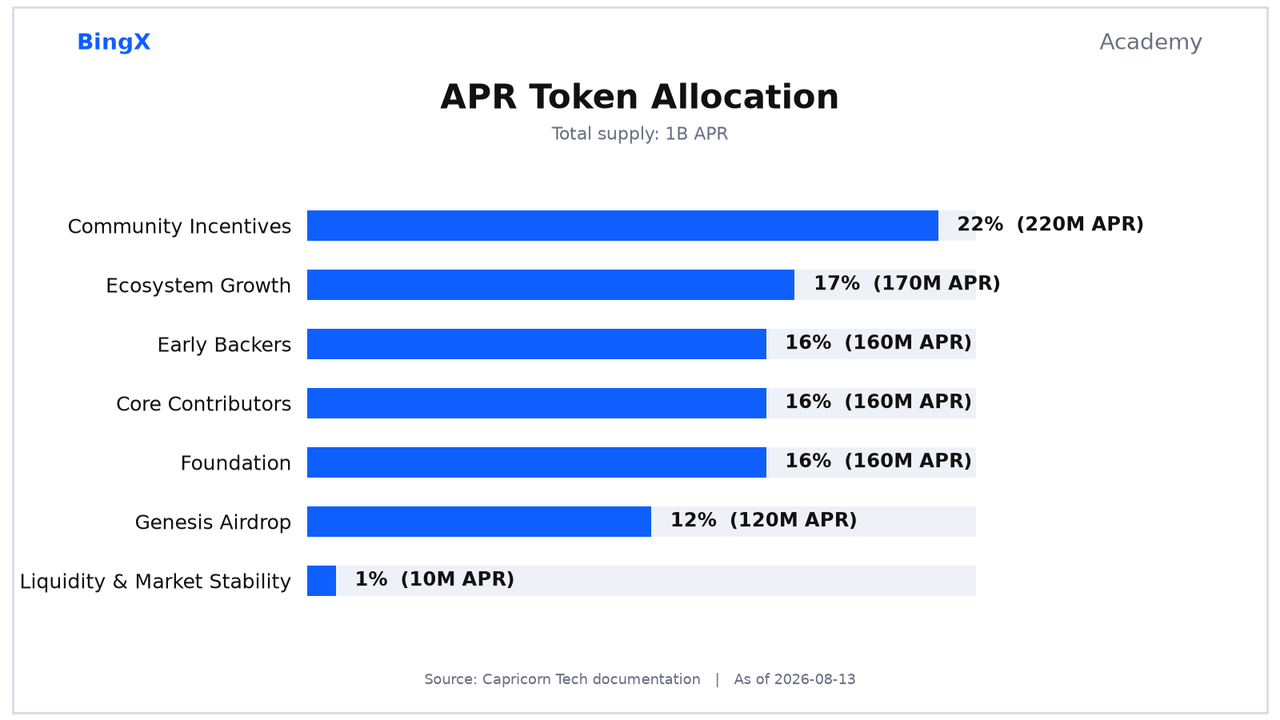
APR tokenomics center on a fixed 1 billion APR supply, category-specific vesting schedules, and allocations intended for community participation and ecosystem development. Community incentives are the largest disclosed allocation at 22%, followed by ecosystem growth at 17%.
APR Token Utility and Supply Mechanisms
- Network participation: Capricorn Tech describes APR as the token at the center of the project and as a representation of shared participation in its network of data and flow.
- Genesis distribution: The genesis airdrop was intended for qualifying community members, specified NFT holders, early aprMON holders, testnet APR holders, and contributors to the project's order-flow data initiatives.
- Community incentives: The 22% community allocation is designated for future airdrops, staking rewards, governance incentives, and partnership programs.
- Ecosystem growth: The 17% ecosystem allocation is intended for adoption initiatives, strategic partnerships, and projects that expand the Capricorn Tech ecosystem.
- Vesting controls: Backer, contributor, foundation, community-incentive, and ecosystem-growth allocations have disclosed release schedules, so unlock timing is a key supply consideration.
APR Token Allocation
Source: Capricorn Tech Docs
- Community Incentives: 22%, or 220M APR. This allocation covers future airdrops, staking rewards, governance incentives, and partnership programs; 10% unlocks on day 1, followed by quarterly vesting over four years.
- Ecosystem Growth: 17%, or 170M APR. This allocation supports adoption, strategic partnerships, and ecosystem projects; 10% unlocks on day 1, followed by quarterly vesting over four years.
- Long-Term Stakeholders: 32%, or 320M APR. This combines Early Backers at 16%, or 160M APR, and Core Contributors at 16%, or 160M APR. Backers have a three-year schedule with a one-year cliff, while core contributors have a four-year schedule with a one-year cliff.
- Foundation: 16%, or 160M APR. This reserve supports long-term operations, community initiatives, and grants; 10% unlocks on day 1, followed by quarterly vesting over four years.
- Genesis Airdrop: 12%, or 120M APR. This category is dedicated to early contributors and community expansion, including specified onchain activity and contribution programs.
- Liquidity & Market Stability: 1%, or 10M APR. The documentation designates this allocation as exchange liquidity intended to reduce volatility and support early market phases.
As of August 2026, APR's supply dynamics depend on the balance between community and ecosystem releases and the longer vesting schedules for backers and core contributors. Because allocation categories unlock on different timetables, investors should monitor official unlock disclosures and the use of community and ecosystem allocations when evaluating potential supply pressure.
How to Trade Capricorn Tech (APR) on BingX
BingX offers two ways to gain exposure to Capricorn Tech. Spot trading is for users who want to buy and hold APR directly, while perpetual futures are for active traders who want long or short exposure to APR price movements.
Spot Trading: Buy and Own APR Directly
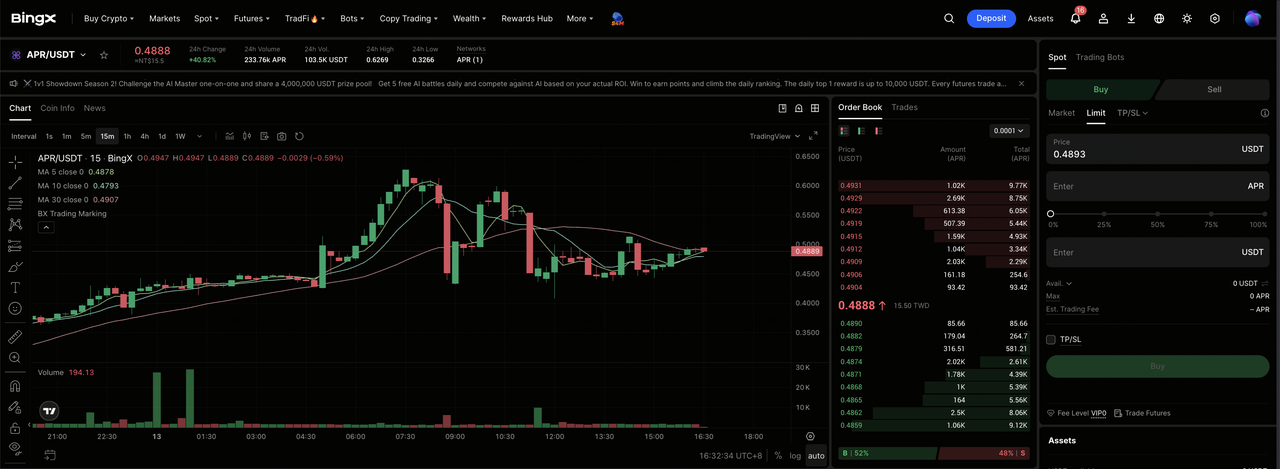
Step 1: Account setup and security.Sign up and log into BingX, complete the identity verification (KYC) required in your region, and enable two-factor authentication.
Step 2: Fund your spot account.Deposit USDT or another supported asset into the spot account. Where available, supported fiat on-ramp options may also be used.
Step 3: Open the spot market. Search for the APR/USDT pair.
Step 4: Choose an order type. Use a market order to buy APR at the available market price, or a limit order to set a target purchase price.
Step 5: Manage your APR. After the order fills, APR appears in the spot account. It can remain on BingX or be withdrawn to a self-custody wallet only after confirming the supported network and official contract.
Futures Trading: Trade APR Price Movements
BingX lists a USDT-margined APR perpetual. Because leverage can amplify both gains and losses, futures are intended for traders who understand liquidation and have a defined risk plan.
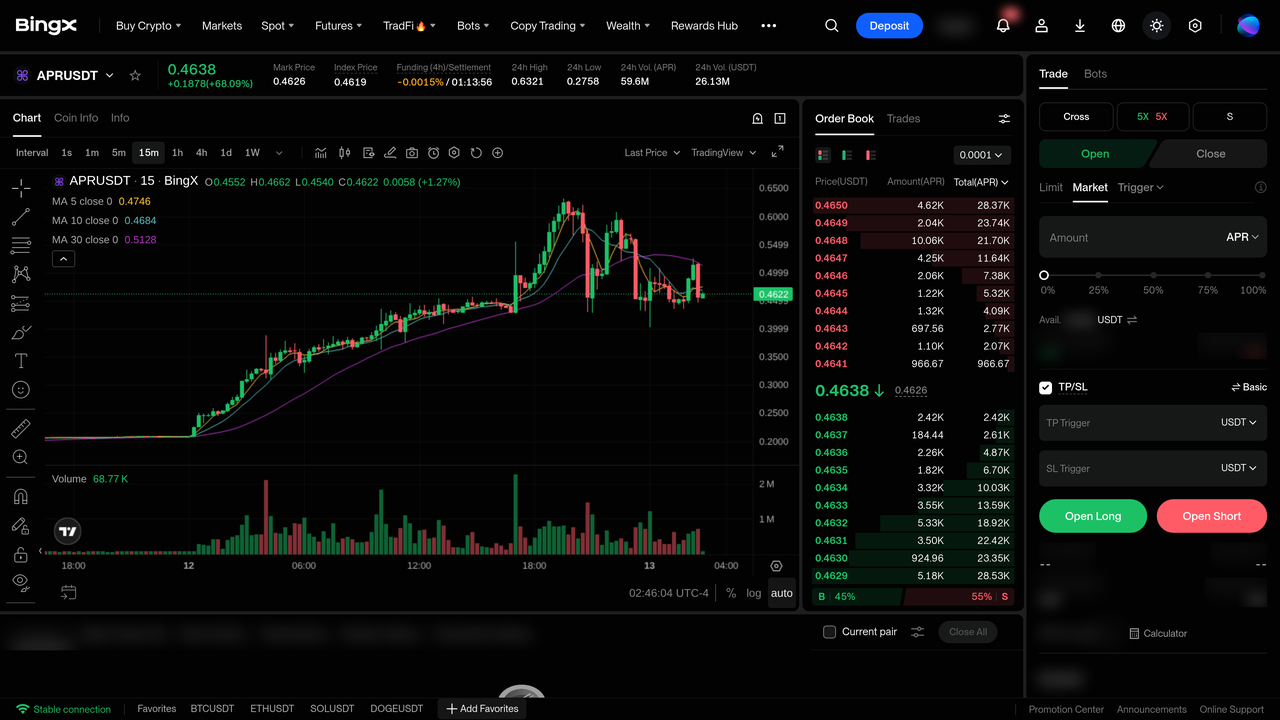
Step 1: Transfer collateral. Move USDT from the spot account to the futures account, where it is used as margin.
Step 2: Select the contract. Open the APR-USDT perpetual.
Step 3: Set direction and leverage.Open long or short based on the trading thesis. Select leverage and position size within the defined risk limit.
Step 4: Execute the trade. Enter the order amount and use a market or limit order according to the trading plan.
Step 5: Manage risk. Set stop-loss and take-profit controls before or immediately after entry. Profit and loss settle dynamically in USDT.
Risks and Considerations Before Investing in Capricorn Tech (APR)
Capricorn Tech’s investment case depends on whether its staking and liquidity products can gain sustained adoption across Monad. Investors should weigh that potential against token supply, protocol, liquidity, and execution risks.
- Supply unlock risk: APR allocations follow different vesting schedules, including one-year cliffs for early backers and core contributors. Future unlocks could increase circulating supply and selling pressure.
- Smart contract and oracle risk: Capricorn relies on staking vaults, liquidity pools, and pricing infrastructure. Bugs, integration failures, or unreliable oracle data could affect redemptions, execution, or pool pricing.
- Liquid staking and liquidity-provider risk: aprMON can trade away from its underlying value during stressed conditions, while concentrated liquidity positions can become inactive or leave providers holding mostly one asset.
- Execution and Monad ecosystem dependency: Capricorn depends on Monad validator infrastructure, aggregator routing, and adoption of its staking and liquidity products. Its documentation also states that Capricorn Exchange currently lacks its own swap front end.
- APR token volatility: APR can experience sharp price swings as liquidity, circulating supply, and market sentiment change. Traders should use position sizing and risk controls appropriate to the product they choose.
Final Thoughts: Should You Invest in Capricorn Tech (APR) in 2026?
Capricorn Tech is a Monad-focused DeFi system that connects a liquid staking vault, aprMON, and onchain liquidity infrastructure. Its 2026 story is anchored by APR's current Capricorn identity after the aPriori rebrand, the rollout of Monad-facing staking and pools, and execution of the disclosed community and ecosystem allocations.
The key question for 2026 is whether Capricorn Tech can convert its staking and liquidity architecture into recurring use without undermining confidence through unlocks, liquidity fragmentation, or technical failures. Its reward-bearing aprMON design and proactive-pool approach distinguish it from a standalone staking product, but APR remains exposed to protocol, market, and ecosystem risks. For investors and traders, the most important metrics to watch are aprMON adoption, pool liquidity, validator and redemption performance, official APR unlock disclosures, aggregator routing, and Monad DeFi activity.
Related Reading
- Liquid Staking vs. Native Staking vs. Pool Staking: Which Should You Choose? (2026)
- What Are the Top Liquid Staking Protocols to Know in 2026?
- What Is Monad (MON), the EVM-Compatible Layer-1 Blockchain?
- Top 7 Crypto Projects in the Monad Ecosystem to Watch in 2026
- How to Stake Monad (MON) on the Monad Network
- How to Connect Monad (MON) to MetaMask
FAQs About Capricorn Tech (APR)
1. What makes Capricorn Tech different from other liquid staking projects?
Capricorn Tech combines Monad liquid staking with DeFi liquidity infrastructure rather than offering staking as a standalone product. Its ecosystem includes the reward-bearing aprMON liquid staking token alongside proactive and concentrated liquidity pools.
2. What blockchain is APR on?
APR launched on Ethereum and can be claimed on Ethereum and BNB Chain, while Capricorn’s documentation states that the remaining supply will unlock on Monad. Users should verify the supported network and official contract address before transferring APR.
3. What is the total supply of APR?
Capricorn Tech has a fixed total supply of 1 billion APR. The project discloses seven allocation categories and vesting schedules covering early backers, core contributors, the foundation, community incentives, and ecosystem growth.
4. Which wallets support APR?
Wallet compatibility depends on the network being used, including Ethereum, BNB Chain, and Monad. Users should make sure their wallet supports the correct network and verify the official APR contract before transferring tokens.
5. Is Capricorn Tech the same project as aPriori?
Yes. Capricorn was previously known as aPriori and uses the APR token. It should not be confused with the separate Solana meme token named Capricorn, which uses the CAPRICORN ticker.
