

Bubblemaps (BMT) is an onchain intelligence platform that visualizes token-holder relationships and transaction links. Instead of reading long address lists, Bubblemaps turns wallet data into an interactive map for examining clusters and token history. It sits in the onchain analytics and crypto-investigation narrative.
Bubblemaps documents a maximum supply of 1 billion BMT, with 25.6% circulating at TGE. The ecosystem has four key parts: BMT is the coordination token, Bubblemaps V2 visualizes holder data, the Intel Desk organizes community investigation cases, and the API and iframe tools support integrations. This guide explains what Bubblemaps is, how the platform works, how BMT tokenomics functions, the main risks to consider, and how to buy BMT on BingX.
What Is Bubblemaps (BMT)?
Bubblemaps is a blockchain analytics platform available across BNB Chain and Solana, among other supported networks. Its maps represent prominent token holders as bubbles, use bubble size to show holdings, and draw links where onchain transfers connect addresses. This visual model helps analysts move from a raw holder list to questions about how wallets may be related.
BMT is the utility and coordination token for the Intel Desk and Bubblemaps V2. It is used to vote on investigation cases, create or fund bounties, and support contributor incentives, while holding BMT can unlock specified advanced platform experiences. The project also documents BMT as SPL and BEP-20, so network selection and the official contract must be checked before a transfer.
The core idea behind Bubblemaps is simple: public wallet data becomes easier to investigate when ownership and transfers are shown as relationships rather than isolated addresses.
Key components of the Bubblemaps ecosystem include:
- Bubblemaps V2: The application presents holder bubbles, transfer links, historical views, and address context for token research.
- Intel Desk: The community investigation layer lets participants prioritize cases and surface contributor findings.
- BMT: The token coordinates voting, bounties, incentives, and access across the Intel Desk and V2 experiences.
- API and iframe tools: These integration products let third parties embed or consume Bubblemaps analytics.
How Does Bubblemaps Work?
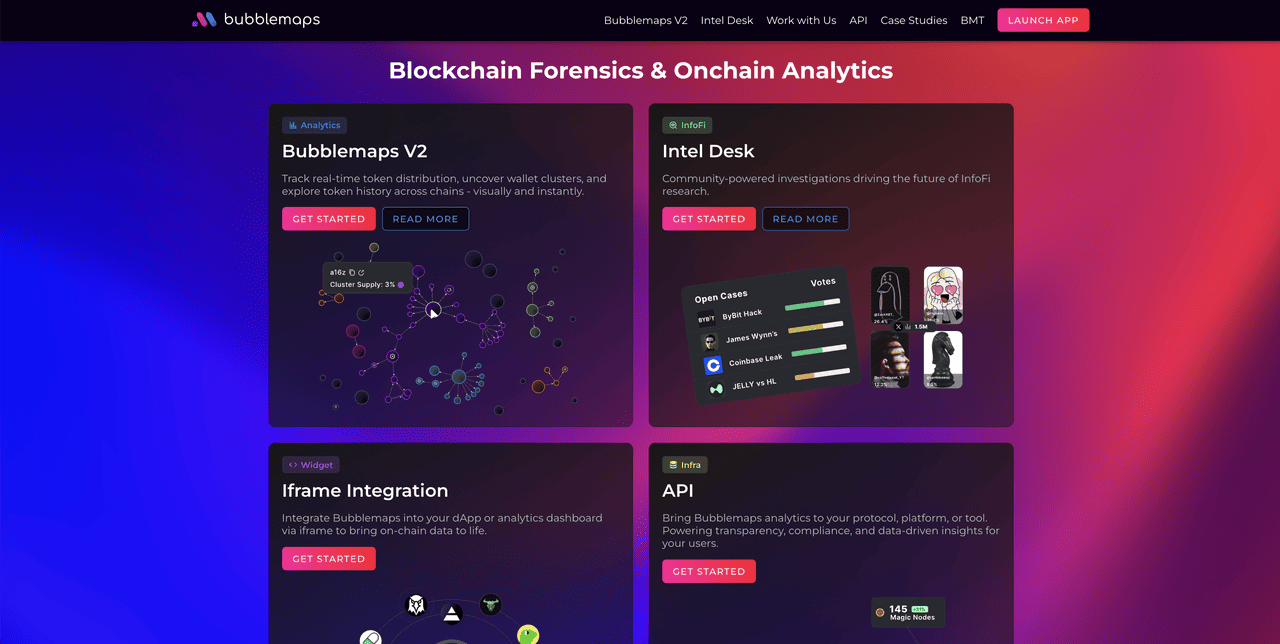
Bubblemaps works as a cross-chain analytics platform whose visual maps, investigation workflow, and incentives are coordinated by holder data, transfer history, and the BMT token.
- Token search establishes the map: An analyst selects a token name or contract address to open its holder view. The documented V2 model focuses on the top 250 holders for the selected token.
- Bubbles show ownership context: Each bubble represents a holder at the map's recorded refresh time and its size reflects the amount held. Labels can distinguish regular wallets from contracts, centralized exchange addresses, and decentralized exchange addresses.
- Links show transfer relationships: A link means that an onchain transfer occurred between two holders. Users can inspect transfer details and filter displayed transfers by token or amount.
- Clusters create investigation leads: Connected groups can reveal patterns worth checking, but a cluster alone does not prove common ownership or misconduct. The relevant context may include liquidity, vesting, bridges, contracts, or ordinary operational flows.
- Intel Desk directs community research: Participants vote on cases, with vote share influencing a case multiplier, while featured contributors accumulate points and can be rewarded across seasons.
Bubblemaps vs. Arkham: What Are the Key Differences between Onchain Intelligence Platforms?
Bubblemaps and Arkham are often compared because both help users investigate onchain activity, wallet holdings, and relationships between addresses. The main difference is how they organize that information: Bubblemaps emphasizes visual wallet clusters and community-led investigations, while Arkham focuses more on entity intelligence, address tracking, balances, and transaction data.
|
Comparison |
Bubblemaps |
Arkham |
|
Core model |
Interactive holder bubbles and transfer links. |
Address, entity, balance, and transaction intelligence. |
|
Main users |
Researchers examining wallet relationships and token distribution. |
Traders and researchers tracking wallets, entities, and fund movements. |
|
Token demand |
BMT supports Intel Desk voting, bounties, incentives, and feature access. |
Basic platform research does not require a protocol token. |
|
Main use case |
Turning wallet relationships into research leads. |
Tracking entities, addresses, balances, and transactions. |
|
Main advantage |
Visual clustering and a community investigation layer. |
Detailed entity attribution and transaction tracking. |
|
Main tradeoff |
Clusters require careful interpretation and external context. |
Relationship patterns can be less visually intuitive. |
Bubblemaps is stronger for visually discovering connections between wallets, while Arkham is more useful for tracking specific entities and transaction activity in detail. The better choice depends on whether the researcher prioritizes relationship discovery or address-level intelligence.
What Are the Bubblemaps (BMT) Tokenomics?
BMT tokenomics are designed around a mix of community participation, ecosystem growth, and long-term contributor incentives. Its supply structure combines immediately available tokens with multi-year vesting schedules, which means circulating supply can expand gradually as different allocations unlock over time.
BMT Token Utility and Supply Mechanisms
BMT is designed primarily to support the Intel Desk and Bubblemaps V2 rather than functioning only as a governance token. Its main utilities include:
- Submit and vote on investigation cases: BMT holders can help decide which Intel Desk investigations should receive priority and Bubblemaps research resources.
- Fund investigation bounties: Users can use BMT to create bounties around specific cases, adding incentives for community investigators.
- Earn contributor rewards: Intel Desk uses BMT-based incentives to reward users who contribute useful investigation leads, evidence, and research.
- Unlock advanced Bubblemaps features: Holding BMT can provide access to advanced tools and experiences across Intel Desk and Bubblemaps V2.
- Support ecosystem growth: Part of the BMT ecosystem allocation is designed to incentivize Intel Desk participation, Bubblemaps V2 adoption, and broader ecosystem development.
BMT Token allocation
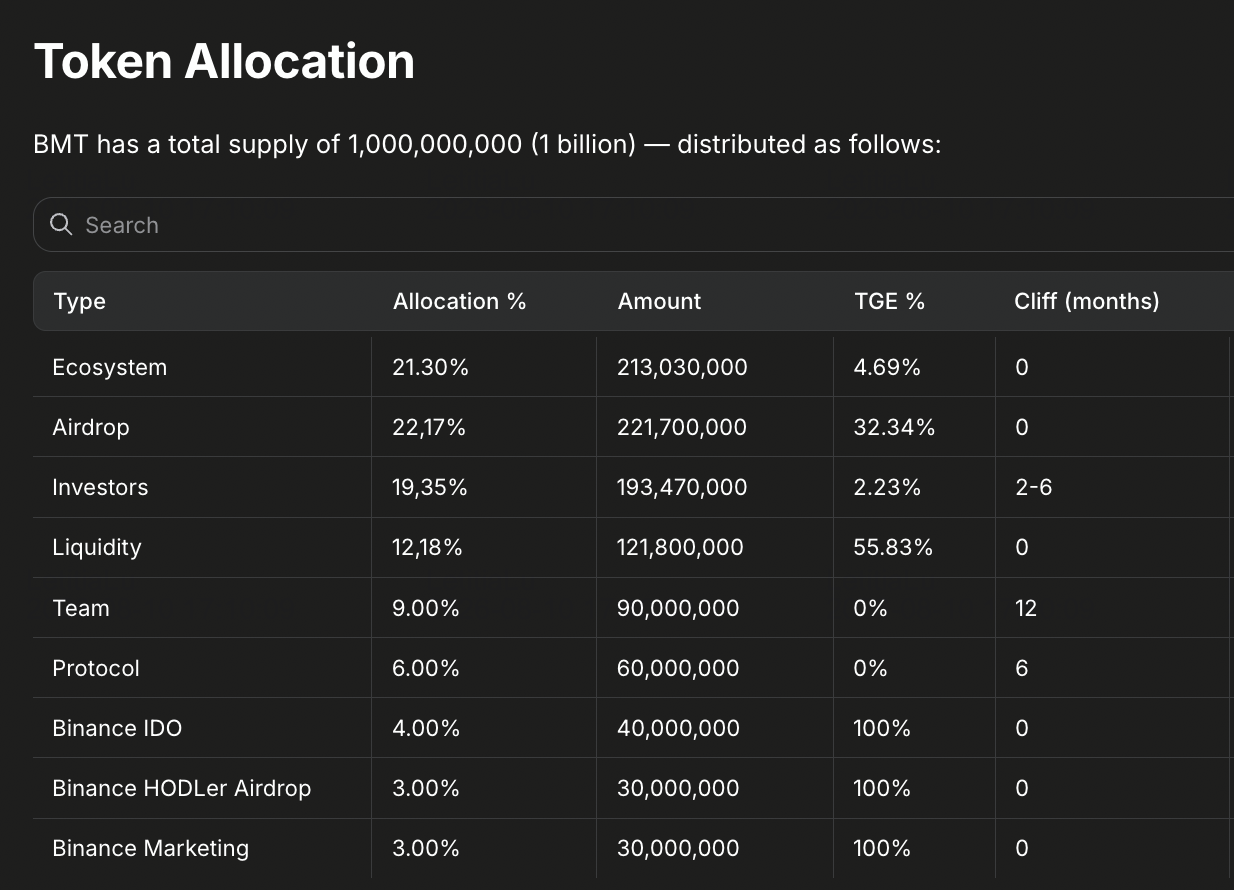
BMT has a fixed maximum supply of 1 billion tokens, with allocations spread across airdrops, ecosystem incentives, investors, liquidity, the team, protocol development, and Binance-related distributions. The largest allocation is the Airdrop at 22.17%, followed by the Ecosystem at 21.30%.
Source: Bubblemaps Wiki
- Airdrop: 22.17%, or 221.7M BMT. The schedule lists 32.34% available at TGE, followed by 12 months of vesting.
- Ecosystem: 21.30%, or 213.03M BMT. Vesting runs for 36 months and supports Intel Desk incentives, Bubblemaps V2 adoption rewards, and ecosystem grants.
- Investors: 19.35%, or 193.47M BMT, with a two-to-six-month cliff and 10-to-20-month vesting period.
- Liquidity: 12.18%, or 121.8M BMT. The schedule lists 55.83% available at TGE, followed by six months of vesting.
- Team and Protocol: The team receives 9.00%, or 90M BMT, with a 12-month cliff and 36-month vesting period. The protocol receives 6.00%, or 60M BMT, with a six-month cliff and 36-month vesting period.
- Binance allocations: Binance Wallet IDO receives 4.00%, while the Binance HODLer Airdrop and Binance Marketing each receive 3.00%. These allocations are listed as fully available at TGE.
BMT utility is closely tied to the Intel Desk and Bubblemaps V2. Holders can participate in investigation case voting, fund case bounties, earn contributor incentives, access selected advanced features, and support ecosystem participation and adoption.
As of August 2026, BMT supply dynamics depend on both platform adoption and scheduled token releases. Because each allocation follows a different vesting schedule and the supply is designed to fully unlock over four years after listing, holders should monitor major unlocks, circulating supply growth, ecosystem incentives, and Intel Desk activity.
How to Buy Bubblemaps (BMT) on BingX
BingX offers BMT through its spot market, letting users buy and hold BMT directly. Spot trading suits users who want direct ownership of the token.
Spot Trading: Buy and Own BMT Directly
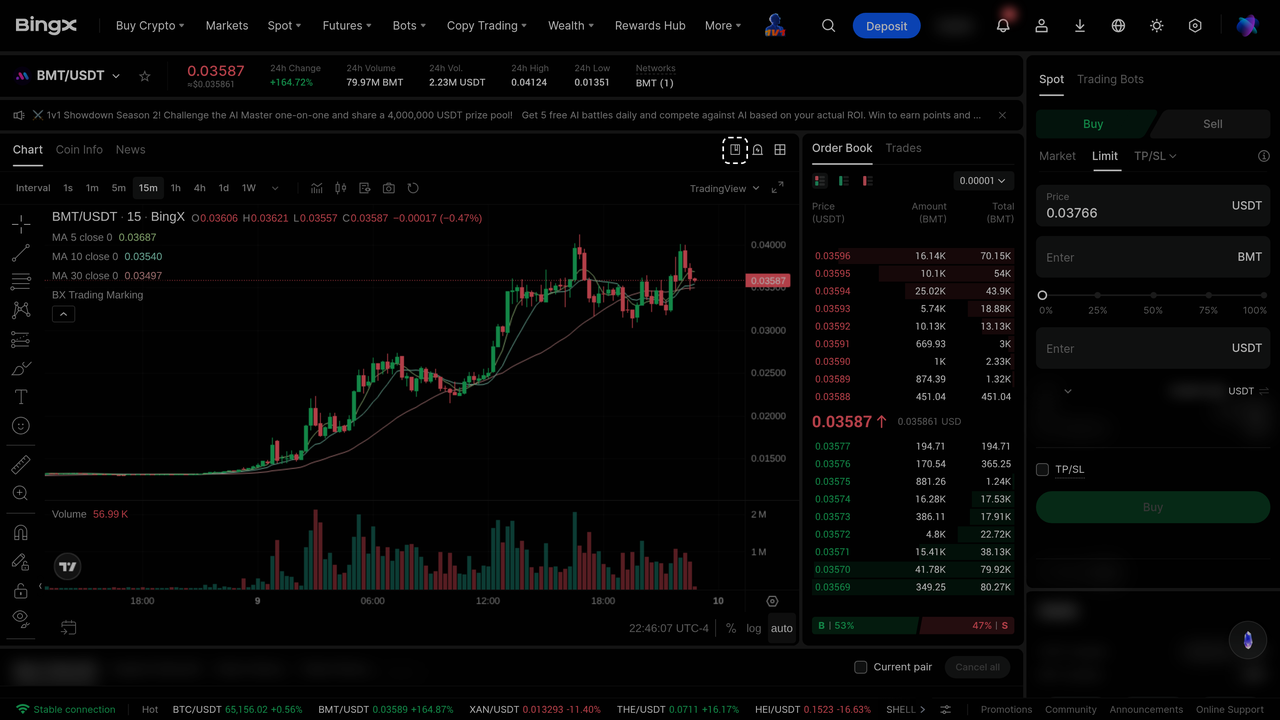
- Step 1: Account setup and security. Sign up and log into your BingX account, complete the identity verification required in your region, and enable two-factor authentication.
- Step 2: Fund your spot account. Deposit USDT or another supported asset into your BingX spot account. Where available, you can also use supported fiat on-ramp options.
- Step 3: Navigate to the spot market. Search for the BMT/USDT trading pair.
- Step 4: Place your order. Choose a market order to buy BMT immediately at the displayed price, or use a limit order to set the price you want to pay.
- Step 5: Manage your BMT. Once filled, your BMT appears in your spot account. You can keep it on BingX for convenience or withdraw it to a compatible self-custody wallet after confirming the correct network and official contract.
Top 5 Risks to Consider Before Investing in Bubblemaps (BMT)
Bubblemaps combines onchain visualization, community investigations, and BMT-based platform utility, but the token still carries risks related to supply growth, volatility, data interpretation, and platform adoption.
- Token unlocks may increase selling pressure: BMT allocations follow different cliffs and vesting schedules, so future unlocks can increase circulating supply and weigh on price.
- BMT can be highly volatile: Large price swings can occur over short periods, especially when liquidity is thinner or market sentiment changes quickly.
- Onchain data can be misinterpreted: Wallet clusters and transfer links are research signals, not proof of common ownership or wrongdoing. Bridges, liquidity pools, contracts, and operational wallets can create misleading patterns.
- Token utility depends on platform adoption: Demand for BMT is partly tied to continued use of Intel Desk, Bubblemaps V2, bounties, and related ecosystem features. Weaker adoption could reduce the practical demand for the token.
- Cross-chain transfers carry operational risk: BMT is available across multiple networks, including Solana and BNB Chain. Using the wrong network or an unofficial contract address can result in lost funds.
Final Thoughts: Should You Invest in Bubblemaps (BMT) in 2026?
Bubblemaps stands out for combining visual onchain analytics with community-led investigations through the Intel Desk. In 2026, the main growth case for BMT depends on whether Bubblemaps V2, investigation activity, and token-based incentives can translate into sustained platform usage.
For investors, the key signals to watch are token unlocks, circulating supply, Intel Desk participation, BMT-funded bounties, V2 usage, and supported-network activity. Bubblemaps has a differentiated research model, but BMT still carries meaningful risks from supply expansion, volatile trading conditions, data misinterpretation, and uncertain long-term adoption.
Related Reading
- Top 10 On-Chain Analysis Tools for Crypto Traders: Free List for 2026
- How to Use ChatGPT and Grok AI to Analyze On-Chain Data, Whale Moves, and Altcoin Trends
- What Are the Top 7 DeFAI (AI + DeFi) Projects to Watch in 2026?
- What Are the Top 10 AI Crypto Projects to Watch in 2026?
- Top AI Tokenized Stocks to Watch in 2026
FAQs About Bubblemaps (BMT)
1. What makes Bubblemaps different from other onchain analytics platforms?
Bubblemaps visualizes token holders and wallet transfers as interactive relationship maps rather than only showing address data in tables. Its Intel Desk also adds a community-led investigation layer where users can propose, prioritize, and contribute to research cases.
2. What blockchain is BMT on?
BMT is available on Solana and BNB Chain. Users should verify the official contract address and select the correct network before transferring tokens.
3. What is the maximum supply of BMT?
BMT has a maximum supply of 1 billion tokens. Bubblemaps documents nine allocation categories with different cliffs and vesting schedules, with the full supply designed to unlock over four years after listing.
4. Which wallets support BMT?
BMT can be stored in wallets that support Solana or BNB Chain. Users should confirm network compatibility and verify the official BMT contract before sending tokens.
5. Does a Bubblemaps cluster mean the wallets belong to the same person?
No. A cluster shows relationships between wallets based on transfers, but it does not prove common ownership, intent, or wrongdoing. Liquidity pools, bridges, contracts, exchange wallets, and other operational addresses can also create visible connections.
