
BingX Stocks Trading brings U.S. stocks and ETFs into the same platform you already use for crypto. With USDT or USDC, users can buy and hold shares in listed companies and ETFs, making it easier to add traditional market exposure without moving funds to a separate brokerage account.
For users familiar with stock perpetuals, Stocks Trading offers a different type of exposure. Instead of trading a leveraged contract that tracks a stock's price, users buy and hold the shares directly, with returns tied to the value of those holdings and any eligible distributions. This guide explains how BingX Stocks Trading works, what assets are available, how to get started, and the key fees and risks to understand before investing.
Key Takeaways
BingX Stocks Trading brings U.S. stock and ETF investing into the same platform you already use for crypto. Before placing your first order, these are the main features, costs, and settlement rules to understand.
- Buy and hold U.S. stocks and ETFs: Orders are executed through Alpaca Securities LLC, giving users access to listed shares and ETFs rather than stock-linked derivatives.
- Pay with USDT or USDC: Purchases can be funded from your Spot Account using USDT or USDC, with trades settled in USDC.
- Start from 5 USDC with fractional shares: The minimum order is 5 USDC or 0.0001 shares, making higher-priced stocks accessible without buying a full share.
- No leverage or liquidation: Stocks Trading uses fully paid share purchases, so there are no funding fees or forced liquidation mechanics. Your maximum loss is limited to the amount invested.
- Zero trading fees with 24/5 access and T+1 settlement: Trading spans overnight, pre-market, regular, and after-hours sessions. Costs are reflected in the spread, while sale proceeds become withdrawable after next-day settlement.
What Is BingX Stocks Trading?
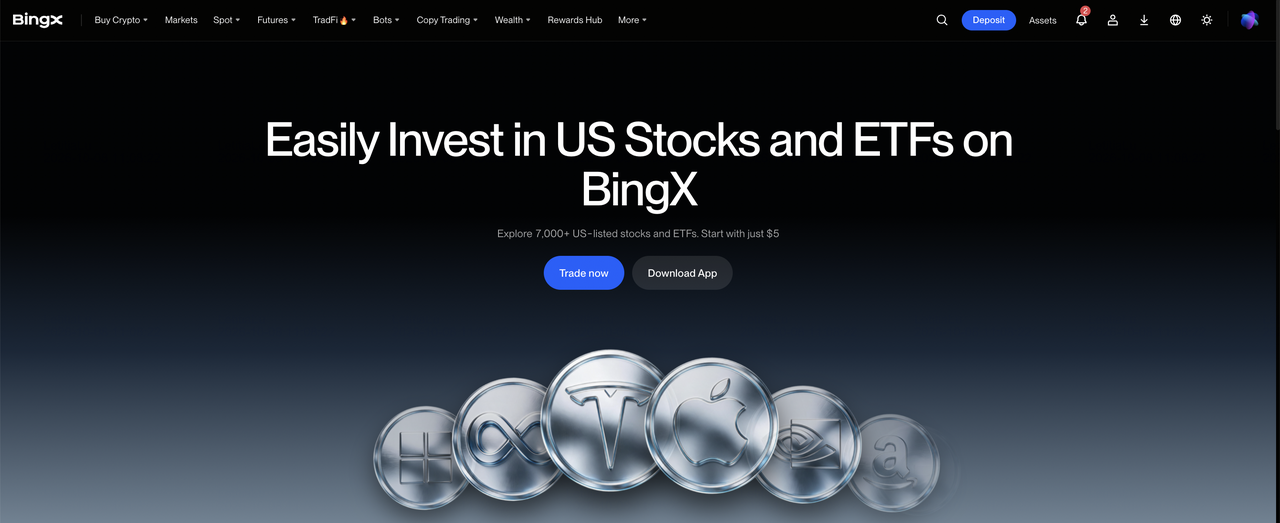
BingX Stocks Trading gives eligible users a simple way to add U.S. stocks and ETFs to their portfolio without leaving the BingX platform. Users can fund purchases with USDT or USDC, access more than 7,000 U.S. securities, and buy fractional shares from 5 USDC or 0.0001 shares. It is a securities trading product rather than a tokenized-stock product or stock perpetual, with orders executed through Alpaca Securities LLC and securities held under its regulated custody structure. Eligible stocks and ETFs may also pay dividends or distributions, which are credited in USDC according to the applicable rules.
The product extends BingX beyond crypto by giving users direct access to traditional market investments through the same account they already use for digital assets. Stocks provide exposure to individual companies, while ETFs can spread exposure across broad markets, sectors, or investment themes. Because Stocks Trading uses fully paid securities rather than leveraged derivatives, there is no funding rate or liquidation price to manage, while 24/5 trading access, fractional investing, and T+1 settlement make it easier to build and manage longer-term positions alongside a crypto portfolio.
How Does BingX Stocks Trading Work?
BingX Stocks Trading connects the BingX account and crypto funding system with U.S. stock-market execution through Alpaca Securities LLC. Users can choose from more than 7,000 U.S. stocks and ETFs, pay with USDT or USDC, and hold the resulting shares in regulated custody. Trades settle in USDC on a T+1 basis.
Because these are fully paid stock purchases rather than leveraged contracts, there is no margin ratio, funding rate, or liquidation price. The value of the position simply moves with the underlying stock or ETF, while fractional shares allow users to start from 5 USDC or 0.0001 shares.
|
Item |
Details |
|
Executing broker |
Alpaca Securities LLC |
|
Asset custody |
Held by Alpaca under regulated custody, separate from BingX corporate assets |
|
Supported assets |
7,000+ U.S. stocks and ETFs |
|
Payment currency |
USDT or USDC |
|
Settlement currency |
USDC |
|
Minimum order |
5 USDC or 0.0001 shares |
|
Leverage |
None |
|
Settlement cycle |
T+1 |
BingX Stocks Trading vs. BingX TradFi Stocks Perpetuals: What Are the Differences?
BingX Stocks Trading and stock perpetuals can both provide exposure to U.S. companies, but they are designed for different purposes. Stocks Trading is built around buying and holding shares or ETFs, while BingX TradFi perpetuals are USDT-margined derivatives that track price movements without expiry. One focuses on owning the asset, while the other focuses on trading its price.
The difference matters most in how returns, costs, and risk work. Stocks Trading has no leverage or liquidation risk and may include eligible dividends or ETF distributions, making it more suitable for longer-term portfolio building. Stock perpetuals allow users to go long or short and use leverage, but they also introduce margin requirements, possible funding payments, and liquidation risk during sharp market moves.
|
Comparison |
BingX Stocks Trading |
BingX Stock Perpetuals |
|
What you hold |
Shares in a stock or ETF |
A derivative linked to the stock price |
|
Leverage |
None |
Available |
|
Main risk |
The holding can lose value |
Margin losses can trigger liquidation |
|
Trade direction |
Buy and later sell holdings |
Go long or short |
|
Income |
Eligible dividends or ETF distributions |
No shareholder dividend entitlement |
|
Costs |
Spread-based execution; ETFs may charge fund expenses |
Trading fees and possible funding payments |
|
Trading schedule |
Supported U.S. stock sessions |
Instrument-specific; some support 24/7 trading |
|
Best suited for |
Longer-term holding and portfolio building |
Shorter-term directional or leveraged trading |
What Stocks and ETFs Can You Buy on BingX?
BingX Stocks Trading provides access to more than 7,000 U.S. stocks and ETFs, covering major companies as well as broad-market, sector, thematic, and income-focused investments. This gives users several ways to build stock-market exposure, from buying a single company they know well to using an ETF for broader diversification or choosing dividend-paying securities for potential income. The available selection can change, so users should check the Stocks market page for the latest listings and trading conditions.
- Individual stocks: Invest in companies such as Apple, NVIDIA, Microsoft, Amazon, or Tesla. Returns depend heavily on the performance and valuation of that specific business.
- Broad-market ETFs: Invest in funds that hold a wide group of companies, such as those tracking the S&P 500 or Nasdaq 100. These can spread exposure across many stocks rather than relying on one company.
- Sector and thematic ETFs: Invest in funds focused on areas such as semiconductors, AI, technology, or healthcare. Examples include semiconductor-focused ETFs such as SOXX and DRAM, which provide more targeted exposure to a specific industry or investment theme.
- Dividend-paying stocks and ETFs: Some eligible stocks and ETFs may distribute dividends. On BingX, eligible dividend payments are automatically credited to the account in USDC, adding a potential income component alongside changes in the share price.
Before buying, check what the stock or ETF actually holds, how concentrated it is, whether it pays eligible distributions, and whether that exposure fits your portfolio.
How to Buy Stocks and ETFs With Crypto on BingX: A Step-by-Step Guide
BingX Stocks Trading lets eligible users buy U.S. stocks and ETFs with USDT or USDC from the same BingX account. Before placing an order, complete KYC, enable Stocks Trading, and make sure enough supported funds are available.
Step 1: Sign Up, Complete KYC, and Enable Stocks Trading
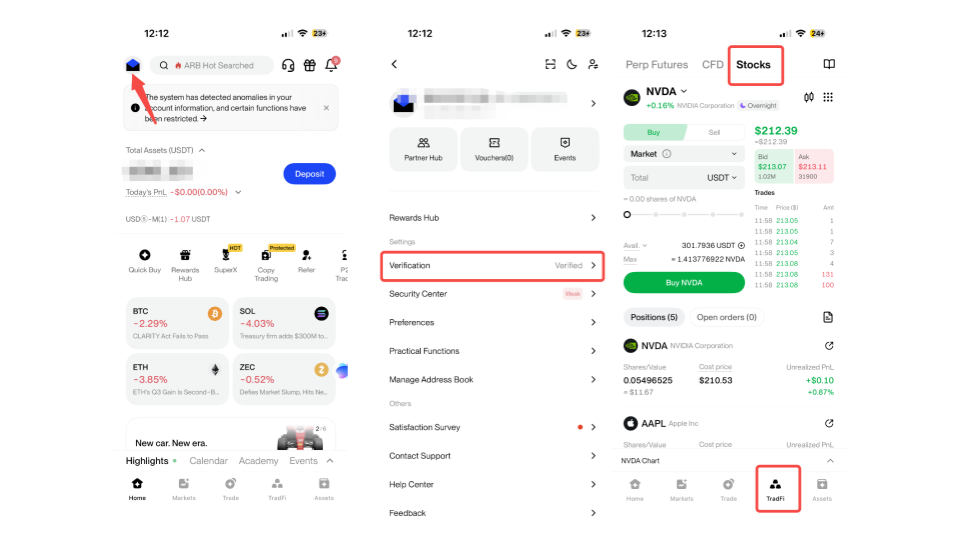
Sign up or log in to BingX, go to "Profile > Identity Verification", and complete the required KYC steps. Then open "TradFi > Stocks" and accept the Stock Trading Risk Disclosure the first time you access the product.
Step 2: Prepare USDT or USDC
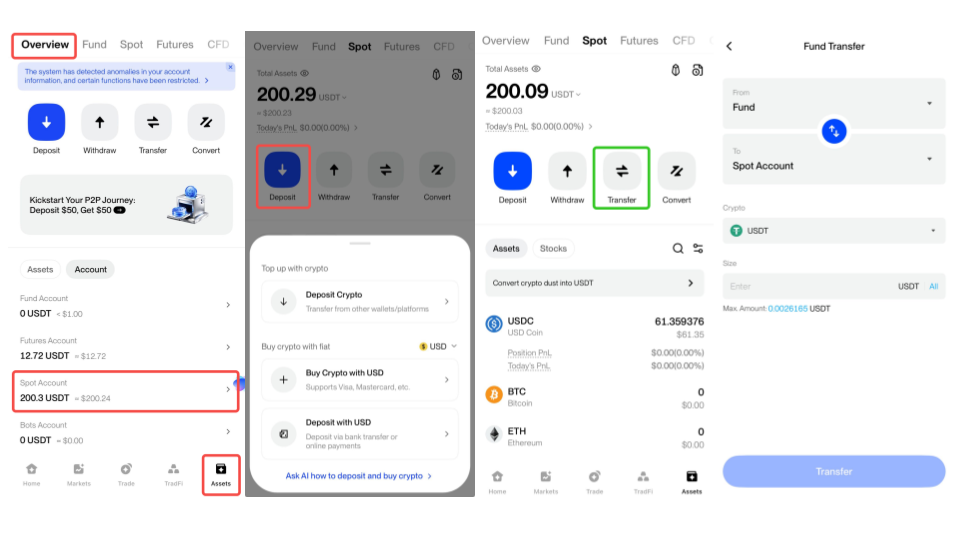
Make sure your Spot Account has enough USDT or USDC.
If needed, transfer funds from the Fund Account or Wealth Account. BingX also supports combined payment, using the Spot balance first and covering the remainder from supported Fund or Wealth balances.
Step 3: Buy or Sell a Stock or ETF
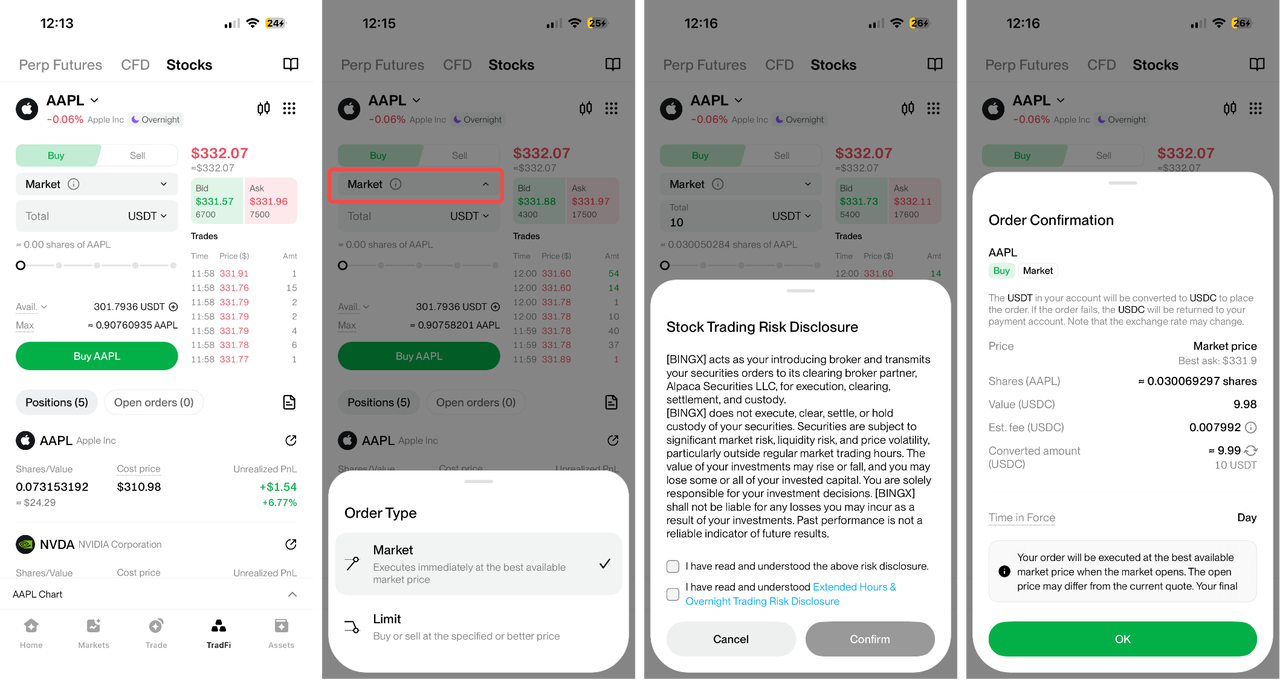
Go to Stocks > Market, choose a stock or ETF, and select "Buy" or "Sell". Enter the purchase amount, share quantity, or amount to sell, then choose the order type and review the details before confirming. The minimum purchase is 5 USDC or 0.0001 shares.
- Market order: Executes at the available market price during market hours. Orders placed outside market hours wait until the market reopens.
- Limit order: Executes only when the specified price is available with sufficient liquidity.
Stocks can be sold without waiting for T+1 settlement. T+1 affects when sale proceeds become available for withdrawal.
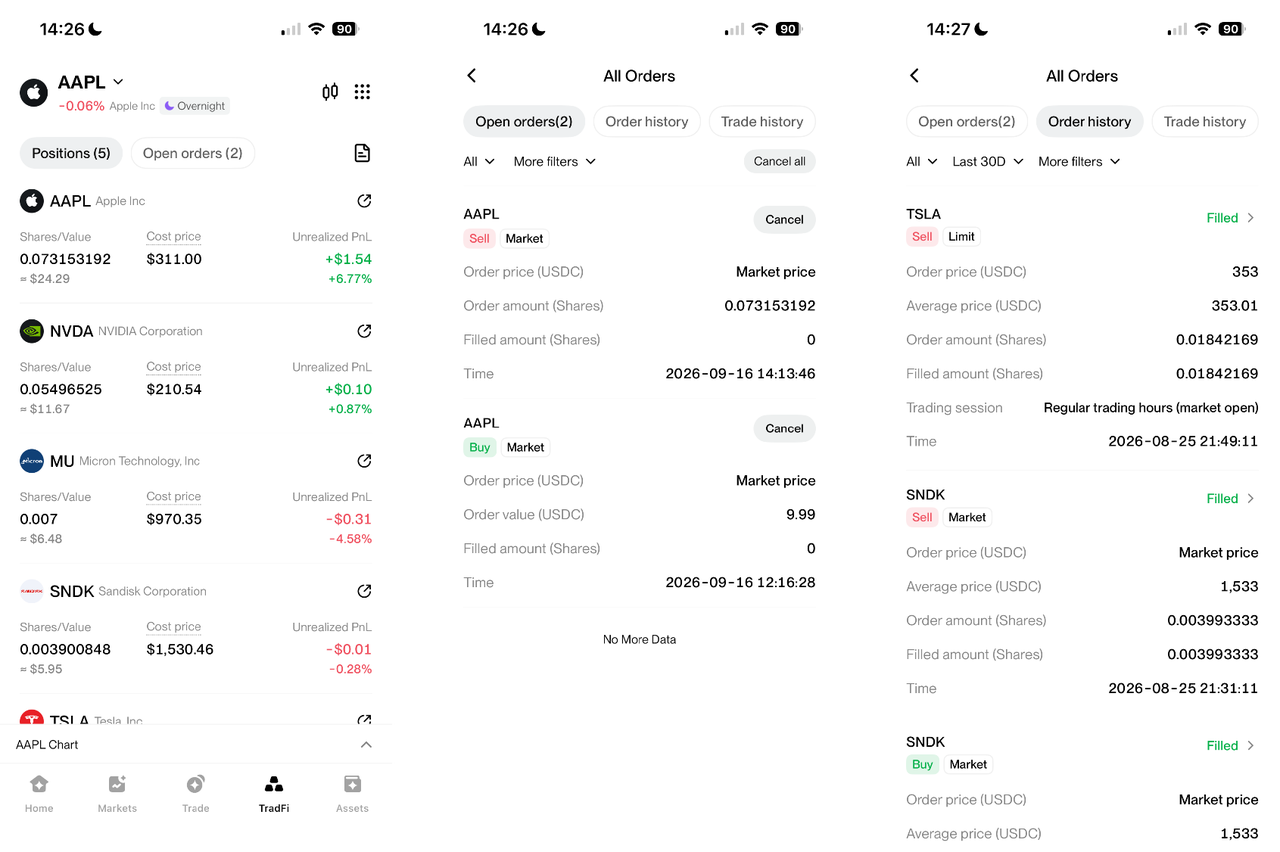
Step 4: Review Positions and Orders
Open Stocks > Positions to view current holdings and P&L. Use All Orders to check open orders, completed trades, canceled orders, and order history.
How Much Does BingX Stocks Trading Cost? Fees, Hours, and Settlement Explained
BingX Stocks Trading combines zero-commission access with extended U.S. market hours and T+1 settlement. Before placing an order, users should still understand how spreads, session liquidity, ETF expenses, and withdrawal timing can affect the overall trading experience.
1. Fees and Trading Costs: Zero Commission, Spread-Based Pricing
BingX Stocks Trading charges no separate trading commission. Instead, trading costs are reflected in the spread, which is the difference between the buy and sell price. The spread can vary by security and market conditions, so wider spreads may increase the effective cost of buying or selling, especially during periods of lower liquidity.
ETFs may also have ongoing fund expenses that are reflected in their performance rather than charged as a separate BingX trading fee. Taxes may apply to dividends or realized gains depending on individual circumstances, so users should consider the full cost of holding an investment rather than looking only at the commission rate.
2. Trading Hours: 24/5 Market Access
BingX Stocks Trading supports overnight, pre-market, regular, and after-hours sessions across the U.S. trading week. This gives users more flexibility to react to company earnings, economic releases, and other market events without being limited to regular U.S. exchange hours.
Liquidity can still differ significantly between sessions. Overnight and extended-hours trading may have fewer buyers and sellers, which can lead to wider spreads or less consistent execution. U.S. market holidays and daylight-saving changes can also affect when specific sessions are available.
3. T+1 Settlement: Next-Business-Day Withdrawal
Stocks can be sold after purchase without waiting for the original trade to settle. However, proceeds from a sale generally become available for withdrawal after T+1 settlement, meaning one business day after the trade date, subject to applicable account restrictions.
For example, a stock sold on Friday would normally settle on Monday if there is no U.S. market holiday. The position is already sold at that point, but the proceeds are not considered fully settled and withdrawable until the settlement cycle is complete.
Top 5 Risks to Know Before Buying Stocks and ETFs
Buying stocks and ETFs on BingX is straightforward, but the investments still carry normal market risk alongside product, liquidity, and settlement considerations.
- Stock and ETF prices can fall sharply: Weak earnings, expensive valuations, recessions, or unexpected events can reduce the value of a position. An individual company can also fail, creating the risk of a total loss.
- Diversification may be narrower than it looks: Holding several technology stocks plus a technology ETF can create substantial overlap. Check the ETF's largest holdings and whether multiple positions depend on the same sector or market trend.
- Liquidity can affect the price you receive: Overnight and extended-hours sessions may have wider spreads and fewer buyers and sellers. Market orders can execute at a less favorable price than expected, while limit orders may not fill.
- Funding and custody add operational dependencies: Purchases use USDT or USDC, while securities are held through the executing broker and custodian. Stablecoin risk, platform access, and broker operations are separate from the investment performance of the stock or ETF.
- Settlement, eligibility, and taxes still apply: T+1 settlement affects when sale proceeds become withdrawable, while product availability depends on account and regional eligibility. Dividends and realized gains may also create tax obligations depending on your jurisdiction.
Final Thoughts
BingX Stocks Trading gives users a direct way to move from crypto into U.S. stocks and ETFs without leaving the BingX platform. It can be used to build positions in individual companies, diversify through broad-market or thematic ETFs, and add traditional market exposure alongside an existing crypto portfolio. Fractional shares and crypto funding also make it easier to start with a smaller allocation rather than committing to a full share.
The main priority is still the investment itself. Understand the company or fund, choose a position size that fits your portfolio, and consider spreads, trading hours, dividend eligibility, and T+1 settlement before placing an order. The convenience of buying stocks with USDT or USDC works best when it supports a clear investment thesis, realistic expectations, and a holding period that matches your goals.
Related Reading
- What Is a Multi-Asset Trading Platform? A Guide to Trading Crypto and TradFi on BingX
- How to Buy U.S. Stocks on BingX With USDT or USDC: A Beginner's Guide
- BingX U.S. Stocks Trading vs. Stock Perpetuals: What Are the Key Differences?
- BingX U.S. Stocks Trading vs. Tokenized Stocks: What Are the Key Differences?
- Crypto vs. U.S. Stocks: Why Crypto Traders Are Turning to U.S. Stocks?
- Top 7 U.S. Stocks to Watch in 2026 and How to Buy on BingX
- Top 8 U.S. ETFs to Invest for Beginners in 2026 and How to Buy on BingX
FAQs About BingX Stocks Trading
1. Can I buy U.S. stocks with crypto on BingX?
Yes. BingX Stocks Trading supports purchases with USDT or USDC, so users can move from crypto balances into U.S. stocks and ETFs without funding the account through a traditional bank transfer. Other cryptocurrencies need to be converted into a supported payment currency first.
2. Do I own shares through BingX Stocks Trading?
Yes. BingX Stocks Trading provides share ownership through the Alpaca brokerage and custody arrangement rather than a derivative position that only tracks the stock price. This means the position is treated as a stock or ETF holding rather than a leveraged perpetual contract.
3. Can I buy less than one share on BingX?
Yes. Fractional shares are supported, with a minimum purchase of 5 USDC or 0.0001 shares. This makes it possible to invest in higher-priced companies without committing enough capital to buy one full share.
4. Can I use leverage to buy stocks on BingX?
No. BingX Stocks Trading does not use leverage, margin, funding payments, or liquidation. Users who want leveraged long or short exposure can use BingX Stock Perpetuals as a separate derivatives product with different risk mechanics.
5. Do stocks and ETFs pay dividends on BingX?
Eligible stocks and ETFs may pay dividends or distributions, but these payments are not guaranteed and depend on the security. When applicable, eligible dividend payments are credited in USDC according to the product rules and relevant eligibility dates.
6. Can I withdraw funds immediately after selling a stock?
Not immediately. Stocks can be sold without waiting for settlement, but the sale proceeds generally become withdrawable after the T+1 settlement cycle. That means the funds usually become available one business day after the trade date, subject to applicable account restrictions.
