
The U.S. stock market in 2026 is being driven by a powerful mix of artificial intelligence, cloud infrastructure, semiconductors, consumer technology, digital platforms, and next-generation connectivity. Many of the strongest opportunities sit in companies with dominant market positions, large addressable markets, and direct exposure to long-term technology spending. For investors, the key is understanding which businesses are translating those trends into revenue, earnings, and durable competitive advantages.
This guide focuses on seven U.S. stocks worth watching in 2026, ranging from mega-cap technology leaders to companies with critical roles in the AI supply chain and emerging infrastructure themes. It compares their market position, 2026 performance, core businesses, growth drivers, and key risks, then explains how eligible users can buy and hold selected U.S. stocks through BingX Stocks Trading using USDT or USDC.
What Is BingX Stocks Trading?
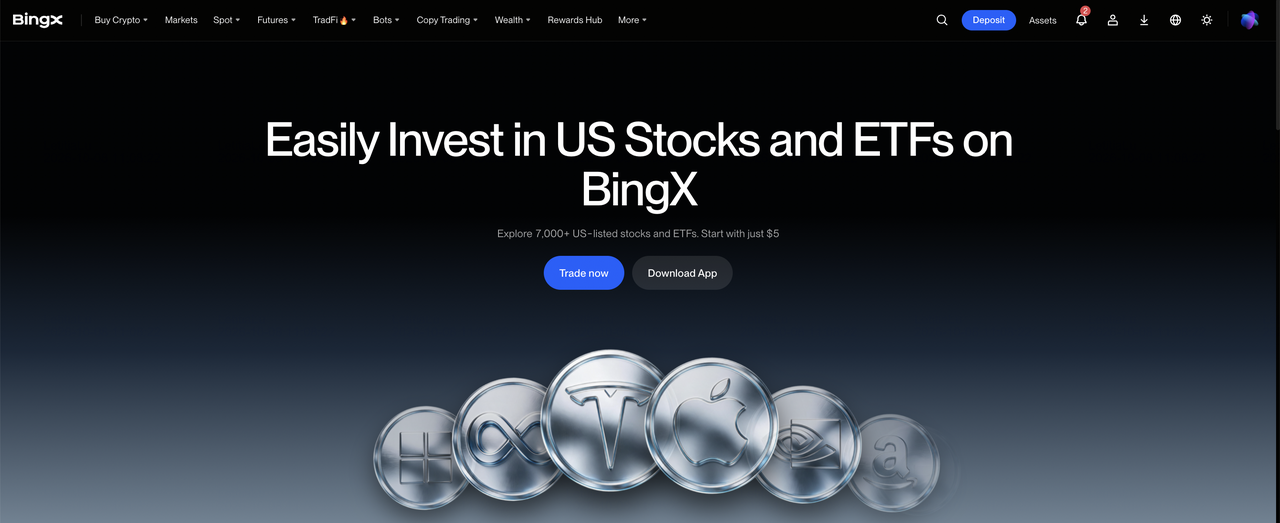
BingX Stocks Trading lets eligible users buy and hold U.S. stocks and ETFs alongside crypto through the same BingX account. Users can pay with USDT or USDC, access over 7,000 U.S. securities, and buy fractional shares from 5 USDC or 0.0001 shares. Unlike tokenized stocks or stock perpetuals, Stocks Trading provides brokerage-held securities, with orders executed through Alpaca Securities LLC and assets held under its regulated custody structure. Stocks offer exposure to individual companies, while ETFs cover broader markets, sectors, and investment themes. Eligible holdings may receive dividends or distributions in USDC. With fully paid securities, no leverage, funding rates, or margin-based liquidation, plus 24/5 trading access and T+1 settlement, BingX Stocks Trading provides a practical way to build longer-term positions alongside crypto.
Read More: What Is BingX Stocks Trading? A Beginner's Guide to Trading U.S. Stocks and ETFs With Crypto
How to Evaluate U.S. Stocks in 2026: A Beginner’s Guide to Growth, Valuation, and Risk
The U.S. stock market in 2026 is being shaped by artificial intelligence, AI hardware, memory, cloud infrastructure, consumer technology, and digital platforms. These themes offer strong growth potential, but they have also lifted expectations and valuations. For newer investors, the key is to understand where growth comes from, whether it is improving financial performance, and how much future success is already priced into the stock.
- Start with the company’s core revenue drivers. Look at where revenue comes from and how directly the business benefits from trends such as AI accelerators, HBM, data-center spending, or cloud usage.
- Look for growth that improves earnings and cash flow. Revenue growth is more valuable when it also supports stronger margins, profits, and free cash flow. Pricing, product mix, capacity, and customer demand can all affect the outcome.
- Compare growth with valuation. A strong business can still deliver weak returns if expectations are too high. Consider whether earnings growth can justify the price investors are paying.
- Understand the broader investment cycle. AI spending on GPUs, memory, networking, data centers, and power supports many companies, but demand can weaken if customers slow capital investment.
- Keep portfolio concentration under control. Holding several AI, semiconductor, memory, and cloud stocks can still create exposure to the same technology cycle. Position size and sector overlap matter.
Read More: What Is BingX Stocks Trading? A Beginner's Guide to Trading U.S. Stocks and ETFs With Crypto
Top U.S. Stocks to Invest in 2026: Market Cap and YTD Performance Overview
The companies below span several of the strongest investment themes in the 2026 U.S. market, from AI hardware and memory to cloud platforms, consumer technology, digital advertising, and satellite connectivity. Grouping them by business exposure makes it easier to see where each company fits before comparing market capitalization and YTD performance.
- AI Hardware and Memory: NVIDIA and Micron supply the computing and memory infrastructure behind AI workloads, including accelerators, networking, DRAM, NAND, and high-bandwidth memory.
- Cloud, AI, and Digital Platforms: Alphabet, Amazon, and Meta combine large digital businesses with growing AI investment across cloud computing, advertising, search, and consumer applications.
- Consumer Technology: Apple remains centered on devices, services, and its broader hardware ecosystem, with AI increasingly integrated across its products.
- Satellite and Next-Generation Infrastructure: SpaceX adds exposure to satellite connectivity, launch services, and space infrastructure through a different growth model from traditional technology platforms.
The table below compares their approximate market capitalization and 2026 YTD performance before looking more closely at the business model, growth drivers, and risks behind each stock.
|
Company |
Ticker |
Approx. market cap |
2026 YTD total return |
Core business and AI exposure |
|
NVIDIA |
NVDA |
$5.77 trillion |
28.58% |
AI accelerators, networking, and computing software |
|
Apple |
AAPL |
$4.89 trillion |
23.06% |
Consumer devices, services, and AI integration |
|
Alphabet |
GOOGL |
$4.19 trillion |
11.30% |
Search, advertising, cloud, and AI models |
|
Amazon |
AMZN |
$2.75 trillion |
11.03% |
E-commerce, AWS, advertising, and AI computing |
|
SpaceX |
SPCX |
$2.21 trillion |
+6.82% since June 12 close*E6 |
Space launch, satellite connectivity, and AI infrastructure |
|
Meta |
META |
$1.84 trillion |
12.22% |
Social platforms, digital advertising, and AI applications |
|
Micron |
MU |
$1.17 trillion |
266.55% |
DRAM, NAND storage, and high-bandwidth memory |
What Are the Top U.S. Stocks for Beginners in 2026?
The stocks below provide a practical starting point across AI hardware, memory, cloud computing, consumer technology, digital platforms, and space infrastructure. They vary in market size, growth profile, valuation, and risk, so each should be evaluated based on what the business does, what could drive future growth, and how the stock fits within a broader portfolio.
1. NVIDIA (NVDA)
- Market Cap: Approx. $5.8 trillion | #1 by market capitalization
- Core Business: AI accelerators, data center networking, and computing software
- Highlight: Shares have surged about 1,490% since early 2023, making NVIDIA the defining stock of the AI infrastructure boom.
NVIDIA supplies the processors, networking equipment, and software used to train and run advanced AI models. Its GPUs have become core infrastructure for hyperscalers, AI labs, and enterprises building large-scale computing clusters, while CUDA and NVIDIA’s broader software stack help developers optimize workloads around its hardware. This combination of chips, networking, and software gives NVIDIA a central position across the AI data center ecosystem.
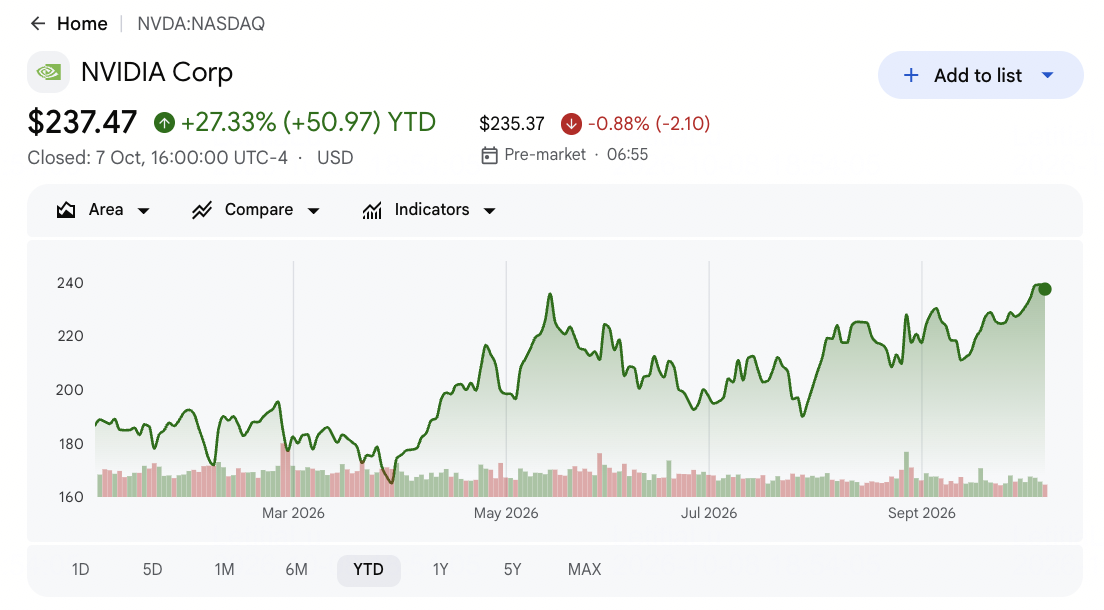
NVIDIA reported Q2 fiscal 2027 revenue of $96.22 billion, up 106% year over year, including $89.0 billion from data centers, up 117%. Its shares were also up 28.58% in 2026 through October 6, extending the gains that began with the generative AI boom in 2023. For investors, the key issues are whether hyperscaler spending can remain elevated, how quickly competing accelerators improve, the impact of export restrictions, and whether future earnings growth can continue to support NVIDIA’s premium valuation.
Read More: NVIDIA (NVDA) Price Prediction 2026: Can AI Infrastructure Growth Drive NVDA Toward $420?
2. Apple (AAPL)
- Market Cap: Approx. $4.9 trillion | #2 by market capitalization
- Core Business: Consumer hardware, software, and subscription services
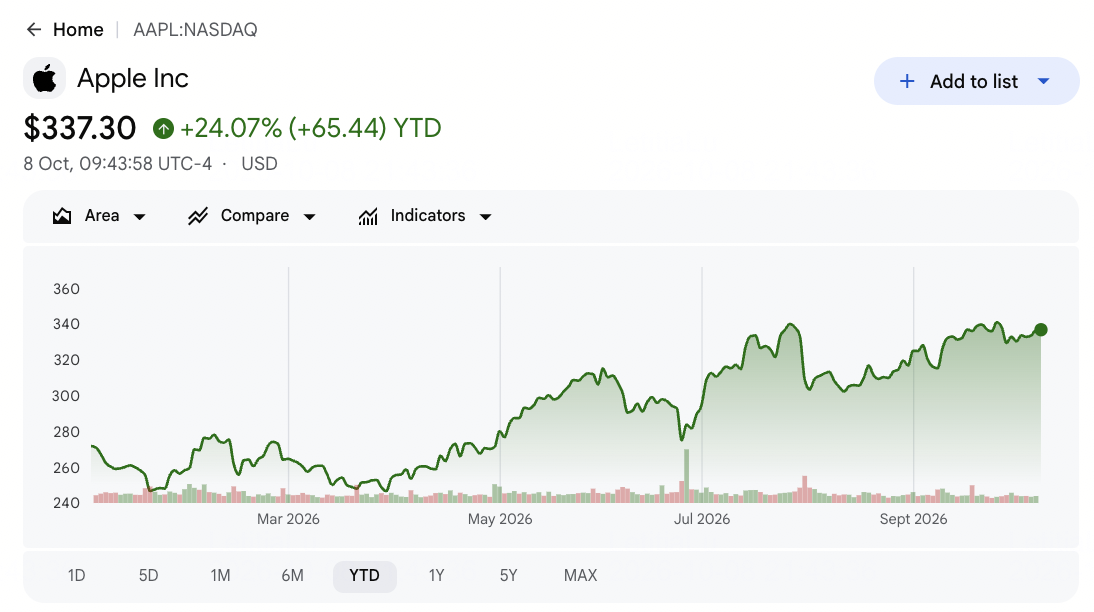
- Highlight: Shares are up 23.06% YTD in 2026, supported by resilient device demand, services growth, and expanding AI integration across Apple’s ecosystem.
Apple earns revenue from the iPhone, Mac, iPad, wearables, and a large services ecosystem that includes payments, subscriptions, and digital distribution. Its massive installed device base supports repeat purchases and recurring spending, while AI features can increase the value of its hardware and services without changing the core business model. This gives Apple a different type of AI exposure from chipmakers, with growth tied more closely to consumer adoption.
Apple reported Q3 fiscal 2026 revenue of $109.4 billion, up 16% year over year, while diluted EPS increased 29% to $2.02. AAPL returned 23.06% YTD through October 6. Investors should watch the pace of device upgrades, continued services growth, the commercial impact of new AI features, consumer spending, regulatory pressure, and whether earnings growth can support the valuation.
Read More: Apple (AAPL) Price Prediction 2026: Can Siri AI and the Foldable iPhone Push AAPL Past $400?
3. Alphabet (GOOGL)
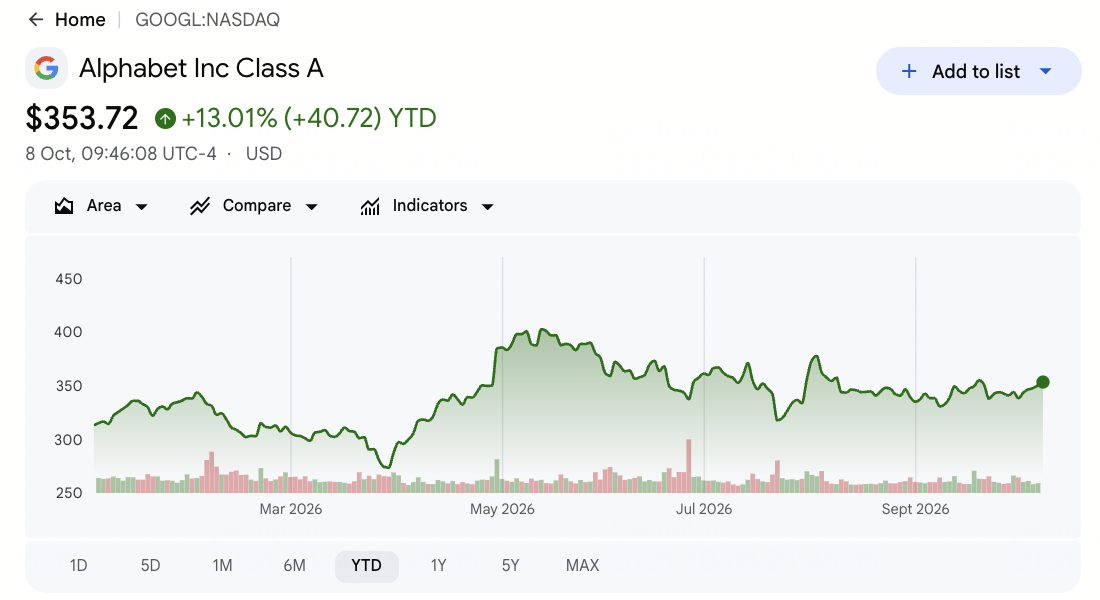
- Market Cap: Approx. $4.3 trillion | #3 by market capitalization
- Core Business: Search, digital advertising, Google Cloud, and AI models
- Highlight: Alphabet is combining its dominant search and advertising businesses with rapid cloud and AI growth, giving it several ways to monetize the AI cycle.
Alphabet owns Google Search, YouTube, and Google Cloud, creating multiple revenue streams across consumer activity and enterprise computing. Advertising remains the largest business, while Gemini models and Google’s AI infrastructure are becoming more important across search, productivity tools, and cloud services. This gives Alphabet both a defensive earnings base and direct exposure to rising AI demand.
Alphabet reported Q2 2026 revenue of $119.8 billion, up 24%, while Google Cloud revenue rose 82% to $24.8 billion. GOOGL returned 11.30% YTD through October 6. Investors should watch whether AI strengthens search engagement and cloud adoption, how quickly infrastructure spending converts into profits, and how competition, regulation, and antitrust developments affect the business.
Read More: Alphabet (GOOGL) Price Prediction 2026: Can 82% Cloud Growth and AI Push GOOGL Stock to $430?
4. Amazon (AMZN)
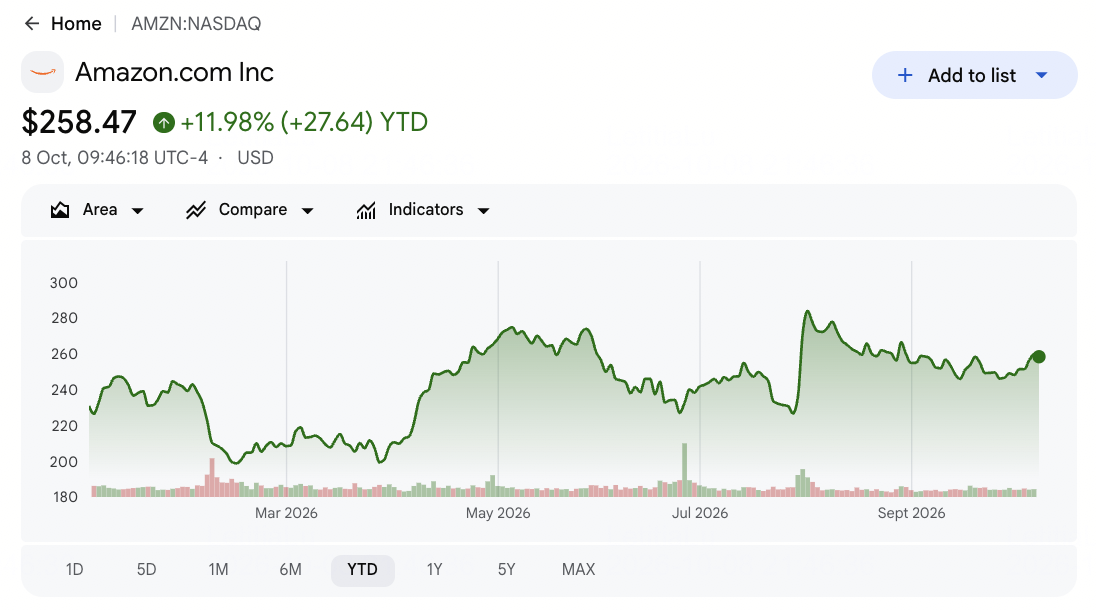
- Market Cap: Approx. $2.8 trillion | #5 by market capitalization
- Core Business: E-commerce, logistics, AWS cloud services, and advertising
- Highlight: AWS gives Amazon direct exposure to AI infrastructure growth, while retail and advertising provide additional large-scale revenue engines.
Amazon combines one of the world’s largest e-commerce and logistics networks with AWS, its cloud computing business. AWS provides the infrastructure businesses use to run software and AI workloads, while retail supports subscriptions, logistics services, and a rapidly growing advertising operation. This mix lets Amazon benefit from both consumer spending and enterprise technology investment.
Amazon reported Q2 2026 sales of $200.6 billion, up 20% year over year, including AWS revenue of $42.2 billion, up 37%. Operating income reached $27.5 billion, while AMZN returned 11.03% YTD through October 6. Investors should watch AWS growth and profitability, retail margins, advertising expansion, capital spending, and whether heavy AI infrastructure investment continues to generate attractive returns.
Read More: Amazon (AMZN) Price Prediction 2026: Can AWS and AI Growth Push AMZN Past $400?
5. SpaceX (SPCX)
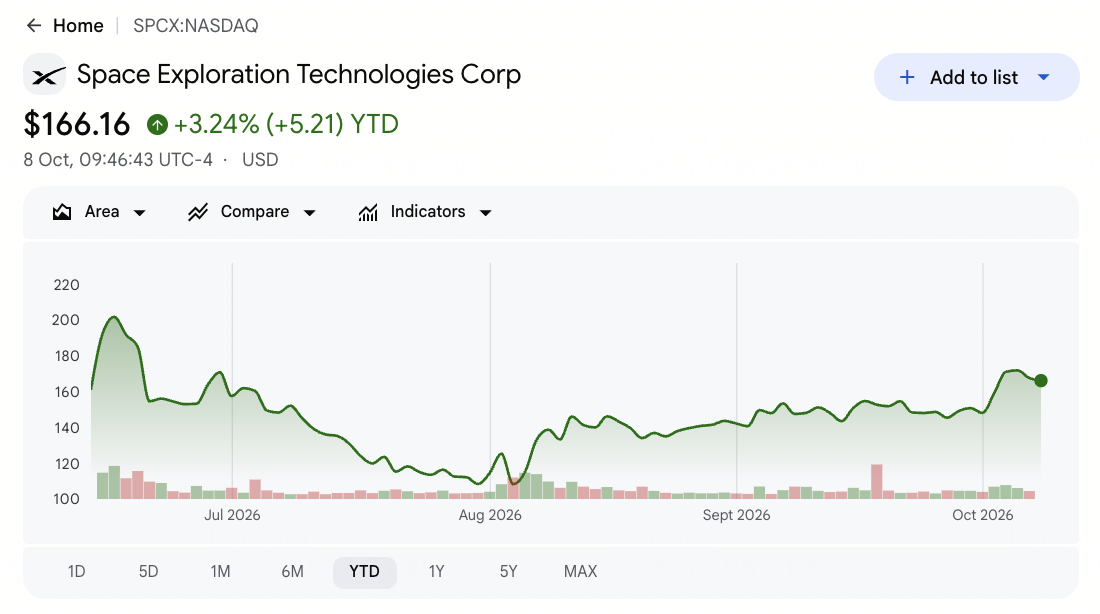
- Market Cap: Approx. $2.3 trillion | #7 by market capitalization
- Core Business: Space launch, satellite connectivity, and AI infrastructure
- Highlight: SpaceX became one of the world’s largest public companies after its June 2026 IPO, driven by Starlink growth, launch services, and expanding AI infrastructure ambitions.
SpaceX operates launch services and the Starlink satellite network, giving it exposure to commercial launches, government missions, and recurring connectivity revenue. Starlink provides a growing subscription-based business, while launch operations support both external customers and SpaceX’s own satellite expansion. Its AI infrastructure business adds another potential growth engine but also increases capital requirements.
SpaceX reported Q2 2026 revenue of $7.8 billion, up 92% year over year, while recording a $541 million net loss. SPCX returned 6.82% from its June 12 closing price through October 6. Investors should watch Starlink subscriber growth, launch execution, AI commercialization, capital spending, regulatory approvals, and whether a newly public company can justify its high valuation as reporting history develops.
Read More: SpaceX (SPCX) Price Prediction 2026: Can Starlink and Starship Push SPCX Toward $300?
6. Meta Platforms (META)
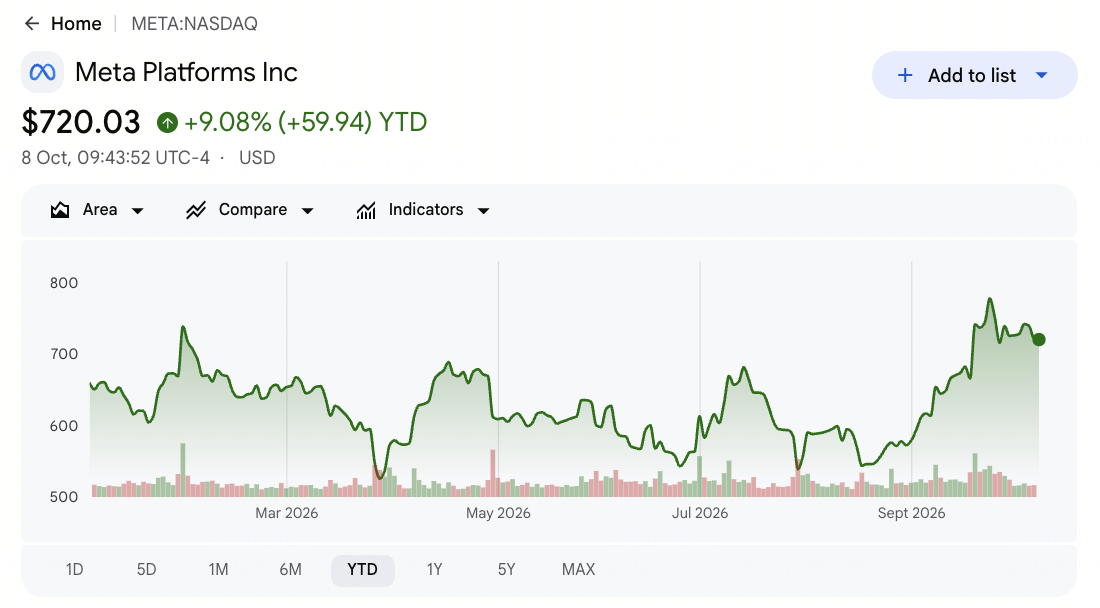
- Market Cap: Approx. $1.8 trillion | #8 by market capitalization
- Core Business: Social platforms, digital advertising, and AI-powered applications
- Highlight: Meta is converting heavy AI investment into stronger recommendations and advertising performance across some of the world’s largest social platforms.
Meta owns Facebook, Instagram, WhatsApp, and Messenger, with digital advertising generating most of its revenue. AI is increasingly used to improve content recommendations, ad targeting, and engagement, giving Meta a direct way to turn infrastructure spending into stronger monetization. Its large user base also provides distribution for new AI-powered products and services.
Meta reported Q2 2026 revenue of $60.8 billion, up 28% year over year. Ad impressions increased 14% and the average price per ad rose 12%, while META returned 12.22% YTD through October 6. Investors should watch capital spending, the return on AI investment, advertising demand, privacy regulation, and competition for user attention across social and AI applications.
Read More: Meta (META) Price Prediction 2026: Can AI Monetization Push META Toward $1,000?
7. Micron Technology (MU)
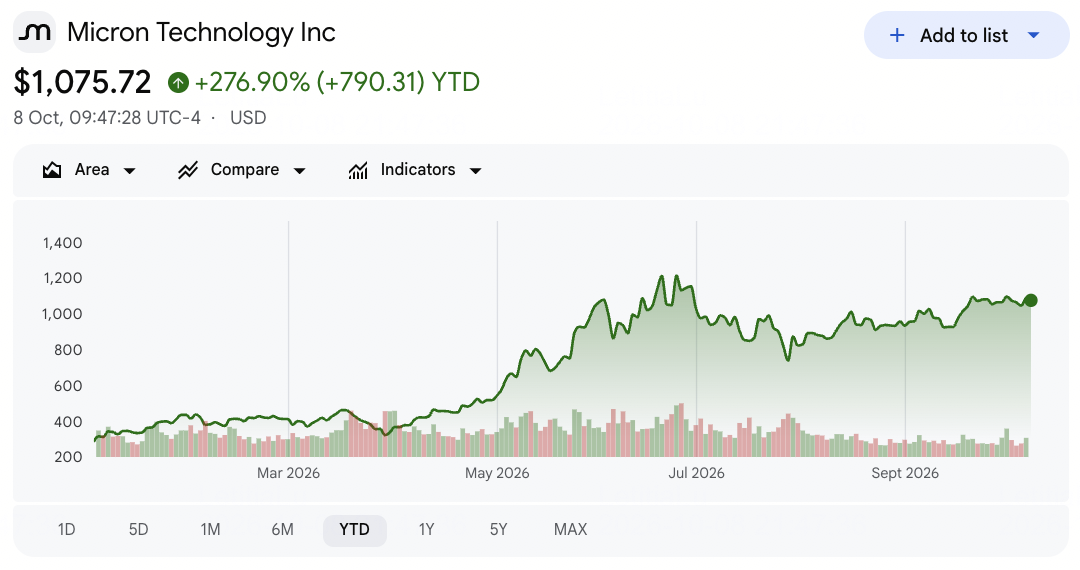
- Market Cap: Approx. $1.2 trillion | #14 by market capitalization
- Core Business: DRAM memory, NAND storage, and high-bandwidth memory
- Highlight: Shares have surged 266.55% YTD in 2026 as AI demand turned high-bandwidth memory into one of the fastest-growing parts of the semiconductor market.
Micron produces DRAM, NAND, and high-bandwidth memory used across data centers, PCs, mobile devices, and AI systems. HBM is especially important because it feeds data to AI accelerators at very high speed, placing Micron in a critical layer of the AI hardware stack alongside processors, networking, and storage. This gives the company direct exposure to the rapid expansion of AI computing infrastructure.
Micron reported Q4 fiscal 2026 revenue of $54.23 billion, compared with $11.32 billion a year earlier, while full-year revenue reached $133.19 billion. MU returned 266.55% YTD through October 6, the strongest performance in this group. Investors should watch HBM demand, memory pricing, new supply, manufacturing investment, customer concentration, and whether current earnings growth can remain strong enough to support the sharply higher valuation.
Read More: Micron (MU) Price Prediction 2026: Can AI Memory Demand Push MU Toward $2,100?
How to Start Investing in U.S. Stocks on BingX
BingX Stock Trading is designed for users who want to buy and hold U.S. stocks and ETFs directly from the same account used for crypto. The process starts with account setup and funding, then moves into the Stocks market where an order can be placed and managed through the same interface.
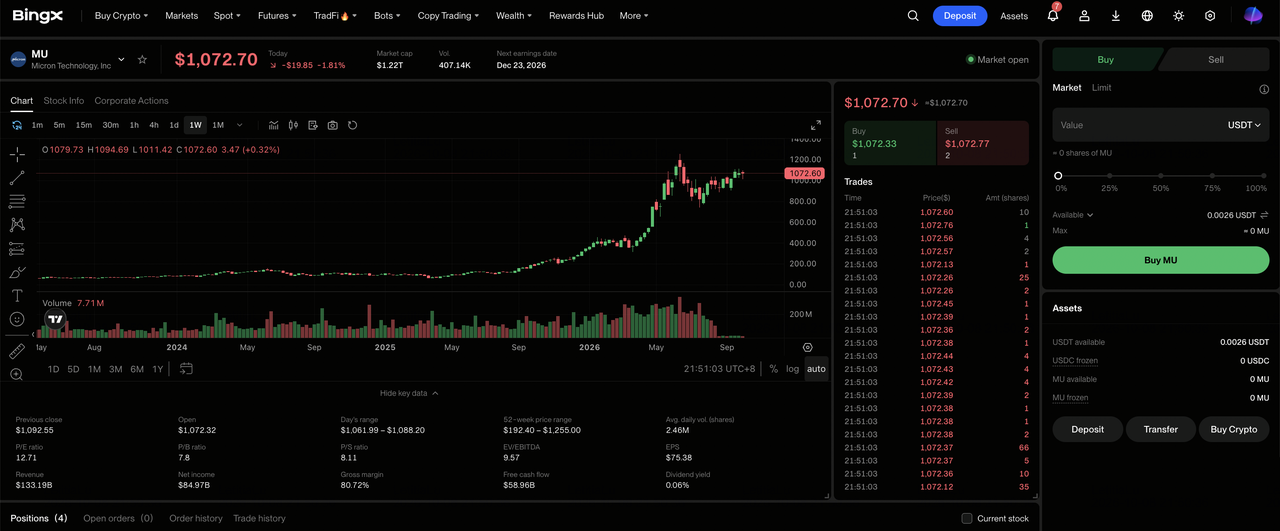
Step 1: Account setup and verification. Sign up or log in to BingX, complete KYC under "Profile → Identity Verification", then open "TradFi → Stocks" and accept the required Stock Trading Risk Disclosure.
Step 2: Prepare investment Fund. Make sure your Spot Account has enough USDT or USDC. Transfer funds from your Fund or Wealth Account if needed. Supported combined payments use the Spot balance first.
Step 3: Select your stock. Open "TradFi → Stocks" and search for a company such as NVIDIA, Apple, or Micron. Confirm the ticker, current availability, and trading conditions before selecting Buy.
Step 4: Choose the amount and order type. Enter the purchase amount or share quantity, select a market or limit order, and review the quoted price and spread before confirming. A market order submitted outside market hours waits until the market reopens.
Step 5: Review and manage your holdings. Open "Stocks → Positions" to check your shares and PnL, and use All Orders to review order status. Shares can be sold before settlement completes, and sale proceeds generally become withdrawable after T+1 settlement.
What Are the Risks of Investing in U.S. Stocks?
Even leading U.S. companies can experience sharp drawdowns. For investors focused on technology, AI, memory, and other high-growth themes, valuation, industry cycles, capital spending, and portfolio concentration can matter just as much as the long-term growth story.
- High valuations can amplify earnings disappointments. A company can continue growing and still see its stock fall if revenue, margins, or guidance miss already-high expectations. The stronger the rally, the more important the entry valuation becomes.
- Technology stocks can fall together. AI hardware, memory, cloud, and digital-platform companies often share exposure to technology spending and market sentiment. Owning several leading names therefore does not automatically create meaningful diversification.
- AI and hardware investment cycles can slow. GPUs, HBM, data centers, networking, and other infrastructure require significant capital spending. A slowdown in customer investment, weaker memory pricing, or excess capacity can quickly affect revenue and profitability.
- Regulation and execution can disrupt growth. Export restrictions, antitrust actions, privacy rules, manufacturing delays, and operational setbacks can change costs or limit market access. These risks vary significantly by company and industry.
- Strong rallies increase correction risk. Stocks that have already risen sharply can be more sensitive to changing interest rates, economic conditions, or investor expectations. Investors should consider position size and portfolio exposure rather than relying on recent performance alone.
Final Thoughts
The strongest U.S. stock opportunities in 2026 span several major growth themes, including AI infrastructure, memory, cloud computing, consumer technology, digital platforms, and next-generation connectivity. These areas can create meaningful long-term opportunities, but recent performance also shows that companies tied to the same broader trend can deliver very different returns depending on earnings growth, valuation, execution, and investor expectations.
For newer investors, the focus should stay on the business behind the stock, the quality of recent financial results, valuation, and how much exposure each position adds to the overall portfolio. Building positions gradually, reviewing earnings and industry trends, and keeping sector concentration under control can make the investment process more disciplined. Past returns can help show market momentum, but the longer-term outcome depends on whether future growth can continue to support the price paid.
Related Reading
- What Is BingX Stocks Trading? A Beginner's Guide to Trading U.S. Stocks and ETFs With Crypto
- How to Buy U.S. Stocks on BingX With USDT or USDC: A Beginner's Guide
- Top 10 AI Infrastructure Stocks to Buy in 2026: Chip Manufacturing and Design Leaders
- Top 8 U.S. ETFs to Invest for Beginners in 2026 and How to Buy on BingX
- BingX U.S. Stocks Trading vs. Stock Perpetuals: What Are the Key Differences?
