


AI infrastructure spending is expanding beyond GPUs. As data centers deploy larger clusters of accelerators, the networking systems that connect those chips have become an increasingly important part of the AI hardware stack. Ethernet switches, custom networking silicon, high-speed copper cables, and optical components all help move enormous amounts of data between GPUs, servers, and racks.
This guide looks at the top AI networking and connectivity stocks positioned across that buildout, from switch vendors and custom silicon designers to copper and optical connectivity specialists. It explains where each company fits in the AI data-center stack, the growth drivers investors should watch, and how selected stocks can be traded through USDT-margined perpetual contracts on BingX TradFi.
What Is AI Networking and Connectivity? The Three Layers Explained
AI networking and connectivity is the infrastructure that moves data between chips, servers, racks, and data centers. It is not a single product, but a stack of technologies that work together to keep AI systems connected. The easiest way to understand the market is through three layers: switching, copper connectivity, and optical connectivity.
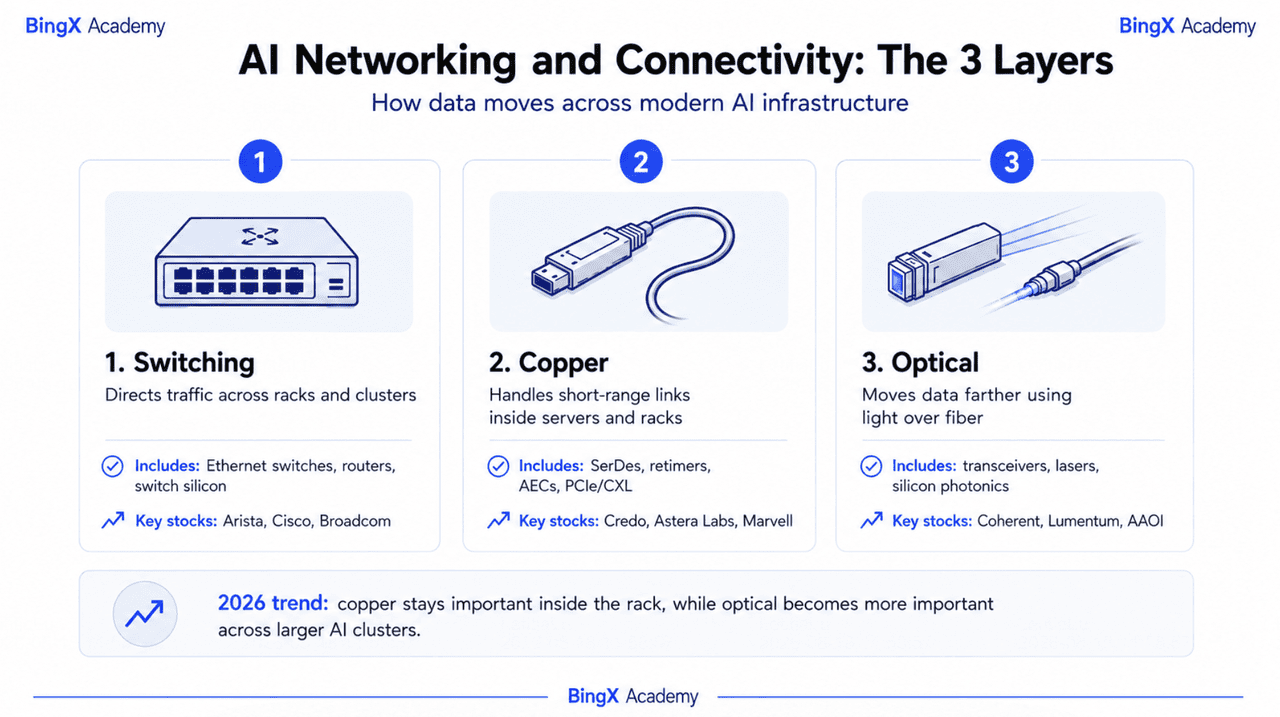
- The switching layer: directs traffic across the network. This layer determines where data goes between racks and clusters. It includes Ethernet switches, routers, and the networking silicon inside them. As AI clusters grow, high-speed Ethernet becomes increasingly important for connecting thousands of accelerators. Key companies include Arista Networks, Cisco, and Broadcom.
- The copper layer: connects chips and servers over short distances. Copper handles short-reach connections inside servers and racks, including SerDes, retimers, active electrical cables, PCIe, and CXL links. It remains attractive because it is relatively inexpensive and power-efficient over shorter distances. Credo Technology, Astera Labs, and Marvell are major companies in this part of the stack.
- The optical layer: moves data farther using light. When distances increase, electrical signals become harder and more power-intensive to maintain, so data is converted into light and transmitted over fiber. This layer includes optical transceivers, lasers, optical switches, and silicon photonics. Coherent, Lumentum, and Applied Optoelectronics are among the key suppliers.
The key trend in 2026 is that larger AI clusters require faster connections across all three layers. Copper remains important inside the rack, while optical connectivity becomes more important as data travels farther between racks and clusters. Each new networking-speed upgrade also creates demand for new switches, silicon, cables, and optical components.
2026 AI Connectivity Stocks Overview and Comparison by Supply Chain Role
AI connectivity stocks span the full data-movement stack, from Ethernet switching and custom silicon to copper interconnect and optical transport. This comparison shows how each company captures a different layer of the 2026 AI connectivity buildout.
|
Company |
Ticker |
Primary Role |
Key Advantages |
What to Watch in 2026 |
|
Broadcom |
AVGO |
Switch silicon + custom AI chips |
Makes switch chips and custom accelerators used by major cloud builders |
Leading AI networking chip supplier; exposure to Google, Meta, and OpenAI |
|
Arista Networks |
ANET |
AI Ethernet switching |
Pure-play leader in high-speed switches that connect AI clusters |
First-ever $3B quarter; targeting $3.5B in AI fabric sales |
|
Marvell Technology |
MRVL |
Custom silicon + optical + switching |
Spans custom chips, optical links, and switching in one portfolio |
$2B NVIDIA investment; 18 custom chip wins with cloud customers |
|
Cisco Systems |
CSCO |
AI networking and silicon |
Long-standing networking leader with its own switch chips and optics |
$9.3B in AI orders this year from major cloud customers including Microsoft |
|
Credo Technology |
CRDO |
High-speed copper connectivity |
Pure-play supplier of high-speed copper connectivity for AI servers |
Revenue up 157% year over year on AI cabling demand |
|
Astera Labs |
ALAB |
Chip-to-chip connectivity |
Makes retimers and PCIe connectivity products used inside AI racks |
PCIe 6 ramp; revenue up 93% as rack connectivity scales |
|
Coherent |
COHR |
Optical components |
Major supplier of optical components that move data using light |
Joined the S&P 500; $2B NVIDIA optics partnership |
|
Lumentum |
LITE |
Lasers and optical switching |
Leading supplier of lasers and optical circuit switches for AI infrastructure |
Revenue up 109%; margins above 50% on AI optical demand |
|
Applied Optoelectronics |
AAOI |
Optical transceivers |
Emerging U.S. supplier of high-speed data-center transceivers |
800G ramp; scaling toward a larger U.S. transceiver position |
2026 AI Connectivity Market Overview: Why the AI Network Is Repricing
The 2026 AI connectivity cycle is being driven by one clear shift: as AI clusters get larger, networking is becoming just as important as computing. Switch vendors, networking-chip designers, copper specialists, and optical suppliers are all benefiting from the same infrastructure buildout. Four trends explain where the strongest demand is emerging.
- Ethernet is becoming the dominant AI fabric. As large AI clusters scale out, Ethernet is gaining share as the standard network for connecting heterogeneous infrastructure. Arista is targeting at least $3.5 billion in AI fabric revenue in 2026, showing how quickly demand for high-speed Ethernet is expanding.
- 800G and 1.6T upgrades are resetting the networking hardware cycle. Every increase in bandwidth requires a new generation of switch silicon, SerDes, and optical modules. Broadcom has already shipped its 100-terabit Tomahawk 6 switch and is developing a 200-terabit successor, pushing the rest of the connectivity stack toward faster speeds.
- Custom AI chips are driving custom networking demand. Hyperscalers building their own accelerators also need networking designed around those systems. Broadcom says AI networking accounts for roughly 40% of its AI revenue, highlighting how closely custom compute and connectivity are now tied together.
- The shift from copper to optical is accelerating. Copper remains efficient over short distances, but higher speeds and larger clusters increasingly require optical links. Lumentum’s revenue has more than doubled as optical connectivity moves deeper into AI infrastructure, making the copper-to-optical transition one of the clearest growth drivers across the sector.
Read More: Top 10 AI Infrastructure Stocks to Buy in 2026: Chip Manufacturing and Design Leaders
What Are the Top AI Connectivity Stocks in 2026?
Nine names define the 2026 AI connectivity thesis across three layers:
- Switching and AI fabric: Broadcom (AVGO), Arista Networks (ANET), and Cisco Systems (CSCO).
- Copper and chip-to-chip connectivity: Marvell Technology (MRVL), Credo Technology (CRDO), and Astera Labs (ALAB).
- Optical and fiber connectivity: Coherent (COHR), Lumentum (LITE), and Applied Optoelectronics (AAOI).
1. Broadcom (AVGO)
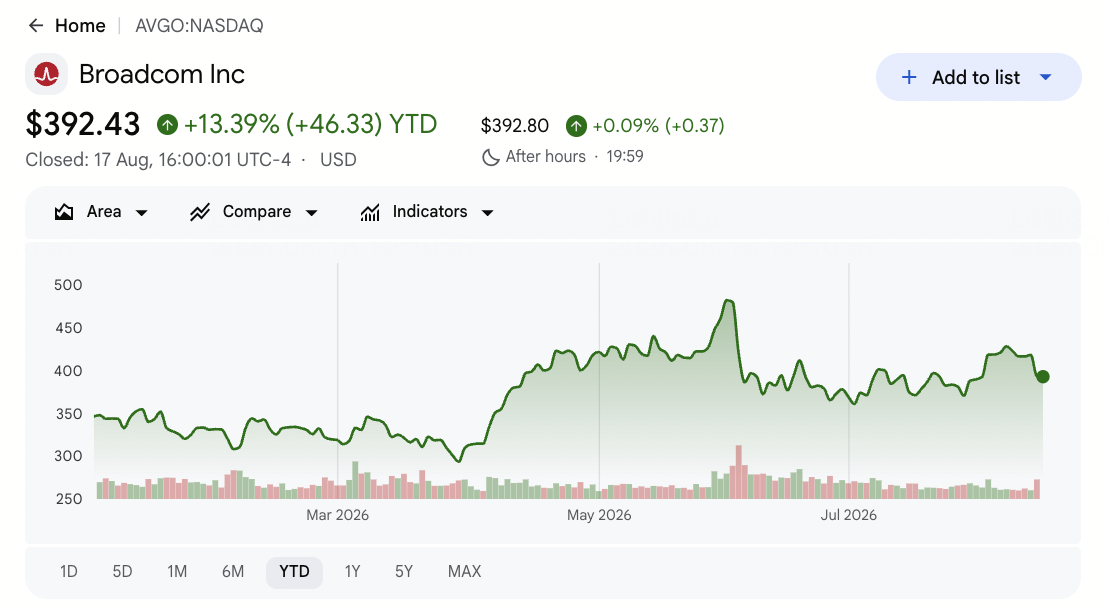
Core Role: Switch silicon and custom AI accelerators
Broadcom is the central silicon supplier for AI networking, making the Ethernet switch chips, SerDes, and custom AI accelerators (XPUs) that the largest cloud builders use to wire their clusters together. Its Tomahawk switches and Jericho routers are the de facto standard for hyperscale AI fabric, while its custom-silicon business designs the accelerators that sit inside those clusters, giving Broadcom exposure to both the compute and the connectivity of AI infrastructure.
Q2 FY2026 was a record, with total revenue of $22.2 billion, up 48% year over year, and AI semiconductor revenue of $10.8 billion, up 143%, driven by custom accelerators and AI networking. Management reiterated more than $100 billion in AI semiconductor revenue for FY2027, backed by multi-year deals with Google, Anthropic, OpenAI, and Meta. The main watch points are hyperscaler capex concentration and the durability of custom-chip demand, but Broadcom's dual position in switching and accelerators makes it the most direct large-cap play on AI connectivity.
Read More: Broadcom (AVGO) Stock Outlook for 2026: AI Infrastructure King or Margin Victim?
AVGO Price Trend (2020-2026 YTD)
|
Year |
Yearly High |
Yearly Low |
Annual Return |
Market Conditions |
|
2020 |
$37.00 |
$15.46 |
0.37 |
Pandemic recovery; networking and broadband demand |
|
2021 |
$67.50 |
$43.30 |
0.52 |
Data center networking cycle; supply constraints |
|
2022 |
$67.60 |
$44.20 |
-13.27% |
Tech sell-off; VMware deal announced |
|
2023 |
$92.50 |
$54.00 |
1.0419 |
AI networking narrative; custom silicon ramp |
|
2024 |
$185.00 |
$77.00 |
1.1049 |
VMware close; XPU business scales; stock split |
|
2025 |
$250.00 |
$130.00 |
0.5063 |
Custom silicon deals expand; AI networking leadership |
|
2026 YTD |
$480.77 (Jun) |
~$200 (Jan) |
+8% YTD |
Q2 AI rev +143%; $100B+ FY27 AI target; hyperscaler deals |
2. Arista Networks (ANET)
]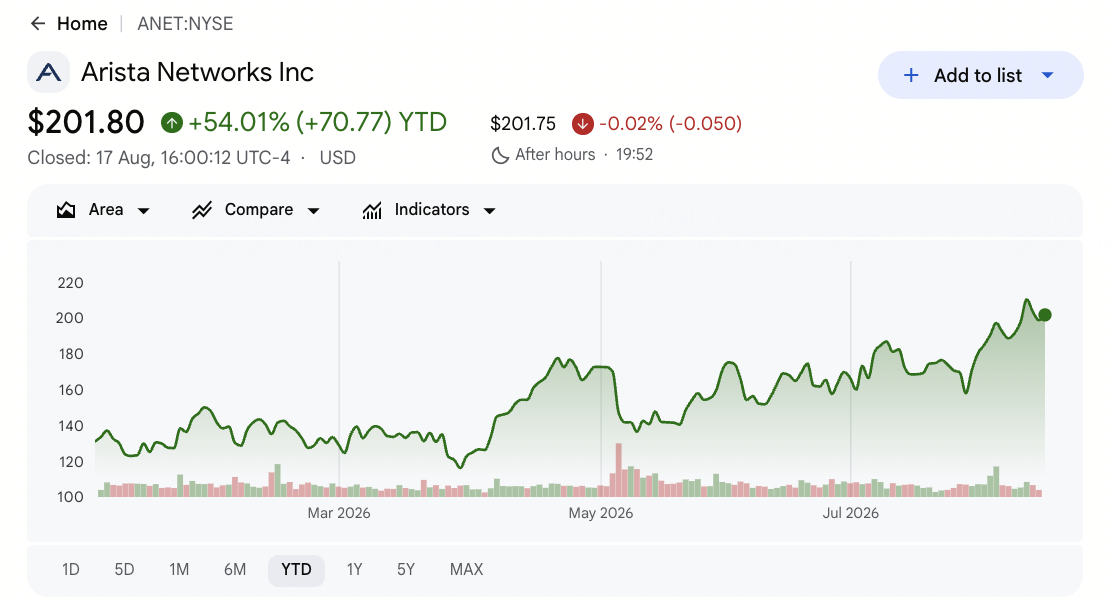
Core Role: Pure-play AI Ethernet switching
Arista is the pure-play leader in AI Ethernet switching, building the high-speed switches and AI fabric platforms that connect GPU clusters at scale. As Ethernet becomes the standard scale-out fabric for AI, Arista sits at the center of that shift, with a software-driven approach to congestion management, telemetry, and reliability that increasingly differentiates it from raw switch hardware.
Q2 2026 was Arista's first-ever $3 billion-plus quarter, with revenue of $3.04 billion, up 37.7% year over year, and non-GAAP EPS of $1.02. Management guided full-year 2026 revenue growth of about 40%, to roughly $12.6 billion, with an AI fabric goal of at least $3.5 billion and a pipeline of more than 100 customers. The main risk is the long-term threat that proprietary scale-up fabrics could limit Ethernet's reach in some deployments, but for now AI networking demand remains materially above available supply, making Arista a direct beneficiary of the fabric buildout.
ANET Price Trend (2020-2026 YTD)
|
Year |
Yearly High |
Yearly Low |
Annual Return |
Market Conditions |
|
2020 |
$30.00 |
$17.00 |
0.05 |
Pandemic disruption; cloud networking base |
|
2021 |
$47.00 |
$27.00 |
0.9789 |
Cloud titan demand; supply-constrained growth |
|
2022 |
$37.00 |
$24.00 |
-15.58% |
Tech sell-off; backlog build |
|
2023 |
$60.00 |
$34.00 |
0.9408 |
AI fabric narrative emerges; cloud strength |
|
2024 |
$120.00 |
$58.00 |
0.8773 |
AI Ethernet demand ramps; stock split |
|
2025 |
$135.00 |
$59.00 |
0.1855 |
AI fabric scales; hyperscaler orders build |
|
2026 YTD |
~$210 (Aug) |
~$115 (Nov) |
+45% YTD |
First $3B quarter; $3.5B AI fabric goal; 40% growth guide |
3. Marvell Technology (MRVL)
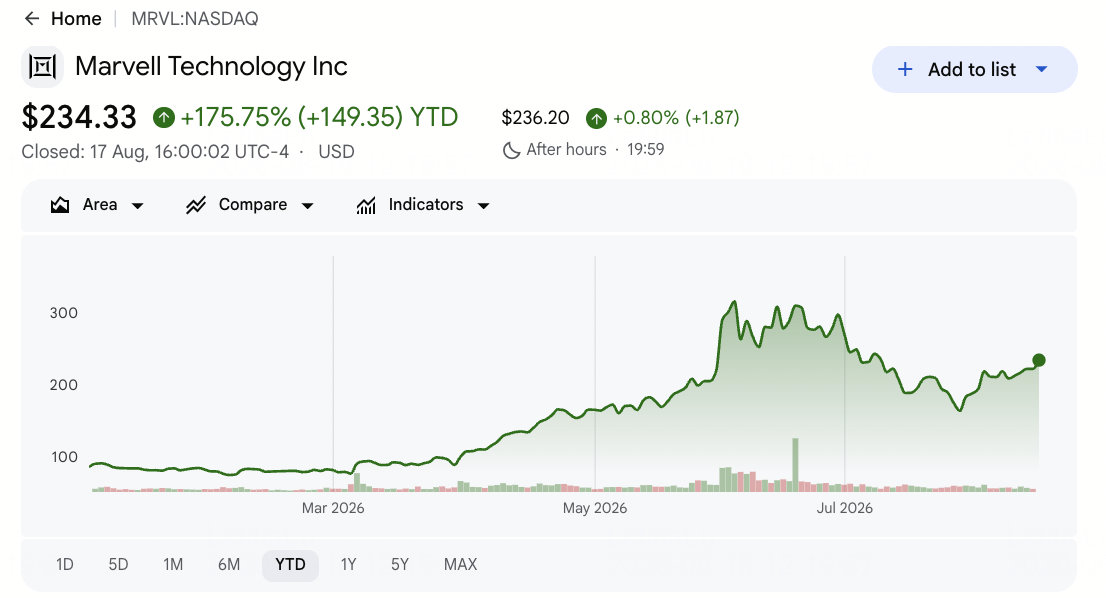
Core Role: Custom silicon, optical interconnect, and switching
Marvell occupies a differentiated niche across all three connectivity layers, designing custom AI silicon, optical interconnect components, and data center switches. This multi-product position lets Marvell benefit whether value flows to custom accelerators, copper SerDes, or optical links, and its custom-silicon business has scaled from zero to a multi-billion-dollar franchise in just a few years.
Q1 FY2027 delivered record revenue of $2.418 billion, up 28% year over year, with non-GAAP EPS of $0.80. Management raised its FY2027 and FY2028 outlook, citing more than 18 custom AI chip sockets with hyperscalers and a pipeline estimated at over $75 billion in lifetime revenue, while scale-out switching revenue is on track to exceed $600 million in FY2027. NVIDIA also took a reported $2 billion stake. The main risks are hyperscaler capex concentration and execution on the custom-silicon ramp, but Marvell's breadth across silicon, copper, and optics makes it one of the most diversified connectivity plays.
Read More: Marvell (MRVL) 2026 Outlook: Can AI & Silicon Momentum Drive Stock to $150?
MRVL Price Trend (2020-2026 YTD)
|
Year |
Yearly High |
Yearly Low |
Annual Return |
Market Conditions |
|
2020 |
$48.00 |
$20.00 |
0.85 |
Pandemic recovery; data infrastructure demand |
|
2021 |
$93.00 |
$40.00 |
0.85 |
5G and cloud networking ramp |
|
2022 |
$88.00 |
$38.00 |
-57.48% |
Tech sell-off; inventory correction |
|
2023 |
$73.00 |
$39.00 |
0.6369 |
AI custom silicon narrative emerges |
|
2024 |
$120.00 |
$50.00 |
0.8379 |
Custom AI silicon scales; optical demand grows |
|
2025 |
$130.00 |
$47.00 |
-22.82% |
XConn acquisition; custom silicon momentum |
|
2026 YTD |
~$200 (est.) |
~$50 (Apr) |
+231% YTD |
Record Q1 FY27; $2B NVIDIA stake; 18 custom sockets |
4. Cisco (CSCO)
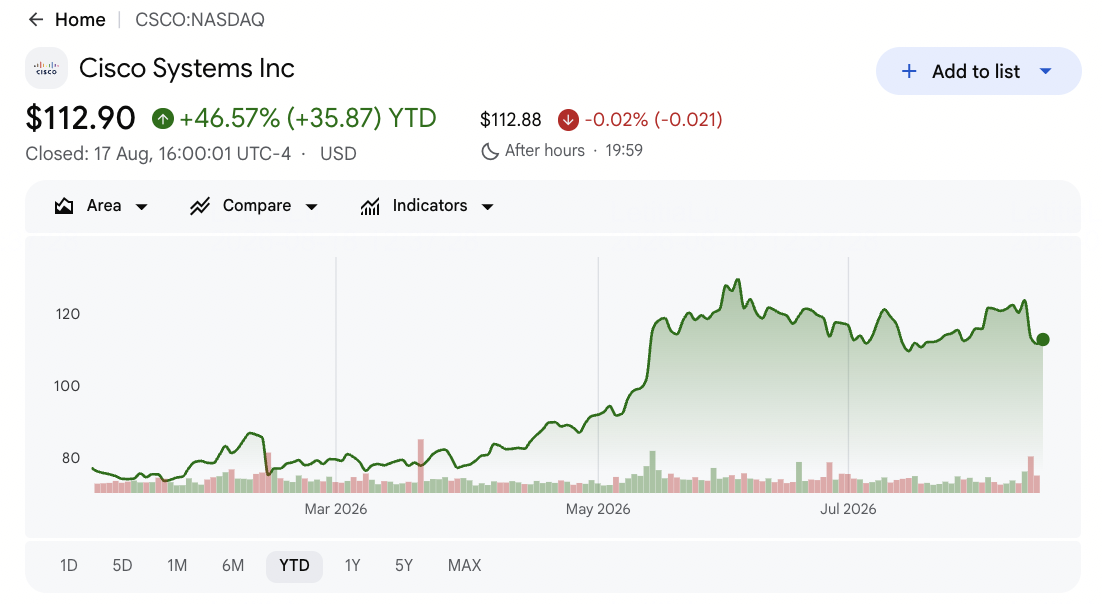
Core Role: AI networking, silicon, and optics
Cisco is the long-standing networking leader now repositioned around AI, building its own Silicon One switch chips, Acacia optical modules, and data center switching that connect AI clusters. While Cisco competes with pure-play switch vendors, its combination of silicon, optics, and scale gives it a broad footprint across the connectivity stack, and its hyperscaler momentum has made it a direct AI infrastructure beneficiary.
Cisco closed a record fiscal 2026 with Q4 revenue up 18% year over year, and AI infrastructure orders from hyperscalers reached $9.3 billion for the year, roughly 4.5 times the prior year. Acacia optics topped $1 billion in orders in a single quarter, and data center switching orders grew more than 40%. The main watch points are gross margin pressure from higher memory costs and execution on a restructuring expected to generate up to $1 billion in charges, but Cisco's networking supercycle, spanning both AI hyperscalers and an enterprise campus refresh, gives it durable connectivity exposure.
Read More: Cisco (CSCO) Stock Price Outlook for 2026: Can AI Growth and Splunk Drive CSCO Back to $90?
CSCO Price Trend (2020-2026 YTD)
|
Year |
Yearly High |
Yearly Low |
Annual Return |
Market Conditions |
|
2020 |
$50.28 |
$32.40 |
-5% |
Pandemic disruption; enterprise spending pause |
|
2021 |
$64.29 |
$42.62 |
0.43 |
Recovery; supply-constrained networking demand |
|
2022 |
$64.13 |
$40.82 |
-24% |
Tech sell-off; backlog digestion |
|
2023 |
$58.19 |
$43.94 |
0.04 |
Splunk acquisition announced; AI positioning |
|
2024 |
$61.00 |
$45.86 |
0.18 |
Splunk close; AI infrastructure orders begin |
|
2025 |
$80.00 |
$55.00 |
0.3 |
Surpasses dot-com high; hyperscaler orders ramp |
|
2026 YTD |
~$124 (Aug) |
~$76 (Jan) |
+53% YTD |
Record FY26; $9.3B AI orders; networking supercycle |
5. Credo Technology (CRDO)
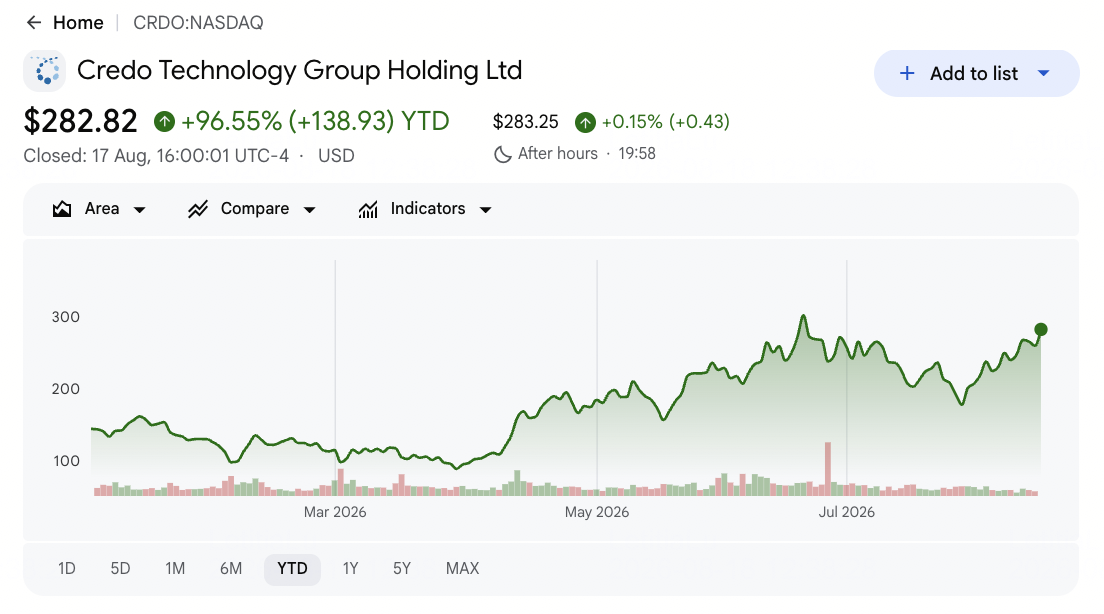
Core Role: High-speed copper connectivity and active electrical cables
Credo is a pure-play interconnect specialist making the high-speed copper links that connect AI servers within and across racks, led by its active electrical cables (AECs). As AI clusters scale and power efficiency becomes critical, copper cabling for short-reach connections has become a fast-growing niche, and Credo is one of the clearest pure-play beneficiaries of that demand.
Q4 FY2026 revenue reached $437 million, up 157% year over year, one of the fastest growth rates in the connectivity group. The main driver is surging demand for AECs as hyperscalers deploy denser AI clusters that need reliable, power-efficient copper links. The main risks are customer concentration and the smaller-cap volatility that comes with a business tied closely to the AI cabling cycle, but Credo offers direct, high-growth exposure to the electrical connectivity layer.
Note: Credo began trading on Nasdaq in January 2022, so multi-year historical data prior to the IPO is not directly comparable.
Read More: Credo Technology (CRDO) Price Prediction 2026: $300 AEC Hyper-Ramp or Premium Valuation Speedbump?
CRDO Price Trend (2022 IPO-2026 YTD)
|
Year |
Yearly High |
Yearly Low |
Annual Return |
Market Conditions |
|
2022 |
$20.00 |
$8.00 |
-30% |
Nasdaq IPO in January; early AEC adoption |
|
2023 |
$30.00 |
$8.50 |
0.48 |
AI connectivity narrative emerges |
|
2024 |
$85.00 |
$18.00 |
2.4 |
AEC demand accelerates; hyperscaler wins |
|
2025 |
$90.00 |
$35.00 |
-8% |
Copper connectivity scales with AI clusters |
|
2026 YTD |
~$180 (est.) |
~$60 (est.) |
+125% YTD |
Q4 FY26 revenue +157%; AEC demand surges |
6. Astera Labs (ALAB)
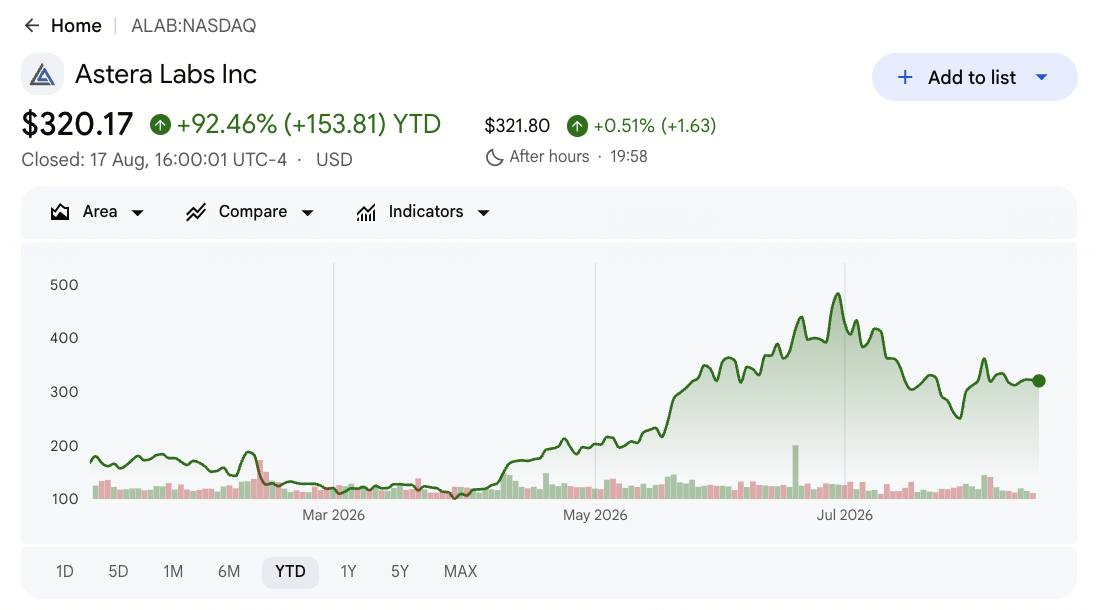
Core Role: Chip-to-chip connectivity and retimers
Astera Labs makes the connectivity silicon that links chips inside AI racks, including PCIe and CXL retimers, signal conditioners, and fabric switching. As AI systems grow more complex and rack-scale deployments expand, the short-reach links between accelerators, CPUs, and memory become a critical bottleneck, and Astera's connectivity roadmap sits directly in that path.
Q2 2026 revenue reached $308 million, up 93.4% year over year, with non-GAAP EPS of $0.61. Its PCIe Gen 6 products now represent more than half of revenue, up from about a third the prior quarter, and its Aries connectivity line delivered record quarterly revenue as inference deployments extended the PCIe demand cycle. The main risks are competition in retimers and the high-beta volatility typical of a fast-growing small cap, but Astera offers focused exposure to the chip-to-chip connectivity layer.
Note: Astera Labs began trading on Nasdaq in March 2024, so multi-year historical data prior to the IPO is not directly comparable.
Read More: Astera Labs (ALAB) Price Prediction 2026: Can Scorpio X-Series Push ALAB Stock to $500?
ALAB Price Trend (2024 IPO-2026 YTD)
|
Year |
Yearly High |
Yearly Low |
Annual Return |
Market Conditions |
|
2024 |
$95.00 |
$36.00 |
0.42 |
Nasdaq IPO in March; PCIe connectivity demand |
|
2025 |
$150.00 |
$40.00 |
0.18 |
AI rack-scale deployments scale; Gen 5 ramp |
|
2026 YTD |
~$180 (est.) |
~$70 (est.) |
+30% YTD |
Q2 revenue +93%; PCIe 6 over half of revenue |
7. Coherent (COHR)
Core Role: Optical components and data center photonics
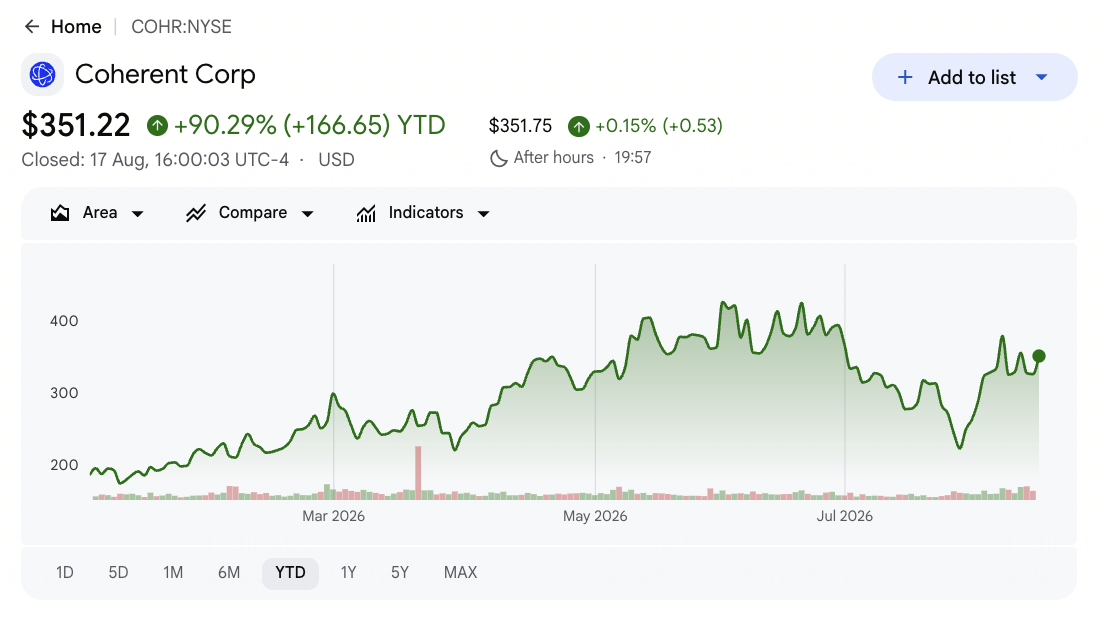
Coherent is a top maker of the optical components that carry AI data as light, including transceivers, lasers, and co-packaged optics (CPO). As copper reaches its distance limits, optical links take over for rack-to-rack and longer connections, and Coherent's datacenter and communications business has become the core of the company, driven by AI infrastructure demand.
Q3 FY2026 revenue reached a record $1.81 billion, up 21% year over year, with datacenter and communications making up 75% of the total and non-GAAP EPS up 55% to $1.41. Coherent joined the S&P 500 and announced a partnership with NVIDIA that combines a $2 billion equity stake with a multi-year CPO supply agreement, with full-year FY2026 revenue reaching $7.12 billion, up 22.5%. The main risks are execution on capacity expansion and the cyclicality of optical demand, but Coherent's scale and NVIDIA partnership make it a leading optical connectivity play.
Read More: Coherent (COHR) Stock Price Prediction 2026: Can the AI Optics King Break $460 After Hitting $440?
COHR Price Trend (2020-2026 YTD)
|
Year |
Yearly High |
Yearly Low |
Annual Return |
Market Conditions |
|
2020 |
$30.00 |
$8.00 |
0.45 |
Pandemic recovery; optical components base |
|
2021 |
$28.00 |
$19.00 |
0.15 |
II-VI merger period; optical demand |
|
2022 |
$40.00 |
$25.00 |
-30% |
Coherent acquisition close; integration |
|
2023 |
$55.00 |
$27.00 |
0.72 |
AI datacenter optics narrative emerges |
|
2024 |
$110.00 |
$42.00 |
1 |
Datacom transceiver demand ramps |
|
2025 |
$115.00 |
$55.00 |
0.05 |
AI optical demand accelerates; margin gains |
|
2026 YTD |
~$400 (est.) |
~$60 (est.) |
+104% YTD |
Record Q3; joins S&P 500; $2B NVIDIA CPO deal |
8. Lumentum (LITE)
Core Role: Lasers and optical circuit switching
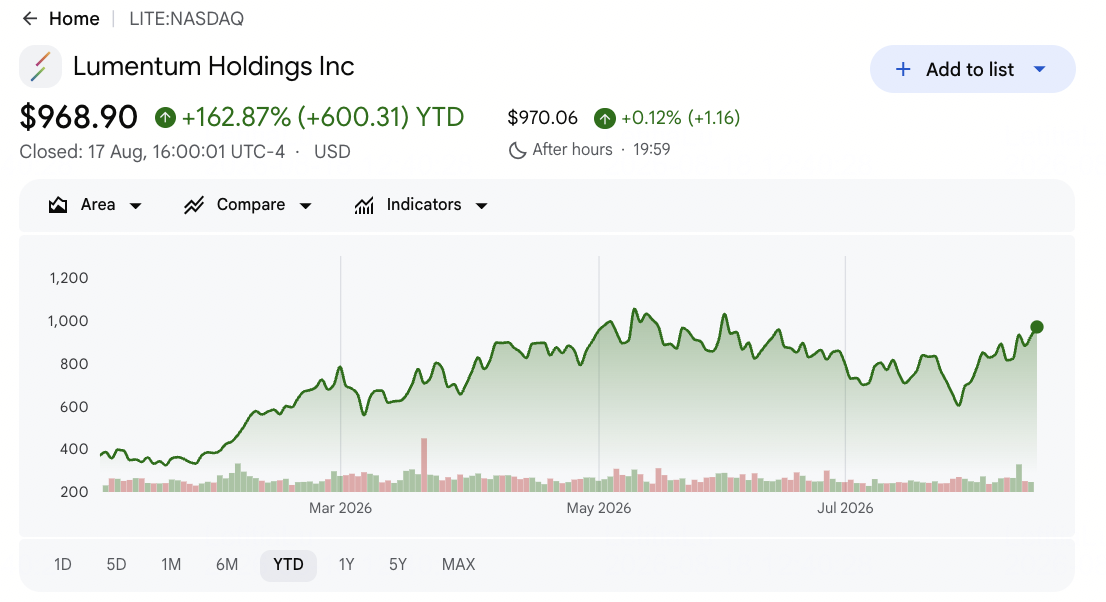
Lumentum is a leading supplier of the lasers, transceivers, and optical circuit switches (OCS) that route AI data as light. Its Cloud and Networking segment supplies optical and photonic components to cloud data center operators and AI infrastructure providers, and its OCS business, which redirects light paths between compute clusters, has become a distinctive growth driver as AI clusters scale.
Q4 FY2026 revenue reached $1.01 billion, up 109% year over year, with non-GAAP gross margin crossing 50% a quarter ahead of plan and non-GAAP EPS of $3.23. Growth was driven by cloud transceivers, OCS shipments doubling sequentially, and record laser demand, with management guiding Q1 FY2027 revenue to roughly $1.25 billion. The main risks are supply constraints in key laser categories and customer concentration in OCS, but Lumentum's laser and OCS leadership positions it at the heart of the optical connectivity shift.
Read More: Lumentum Stock Forecast 2026: Can AI Optics Boom, AI Data Center Supercycle Drive LITE Above $1,200?
LITE Price Trend (2020-2026 YTD)
|
Year |
Yearly High |
Yearly Low |
Annual Return |
Market Conditions |
|
2020 |
$95.00 |
$58.00 |
0.35 |
Pandemic disruption; telecom and 3D sensing |
|
2021 |
$105.00 |
$72.00 |
-6% |
Optical networking demand recovery |
|
2022 |
$107.00 |
$70.00 |
-30% |
Tech sell-off; telecom softness |
|
2023 |
$75.00 |
$42.00 |
-22% |
AI optics narrative begins; transition period |
|
2024 |
$110.00 |
$36.00 |
0.35 |
Cloud transceiver demand ramps |
|
2025 |
$130.00 |
$50.00 |
0.4 |
AI optical demand accelerates; OCS scales |
|
2026 YTD |
~$1,000 (est.) |
~$70 (est.) |
+157% YTD |
Q4 rev +109%; margins past 50%; OCS ramp |
9. Applied Optoelectronics (AAOI)
Core Role: Optical transceivers for AI data centers
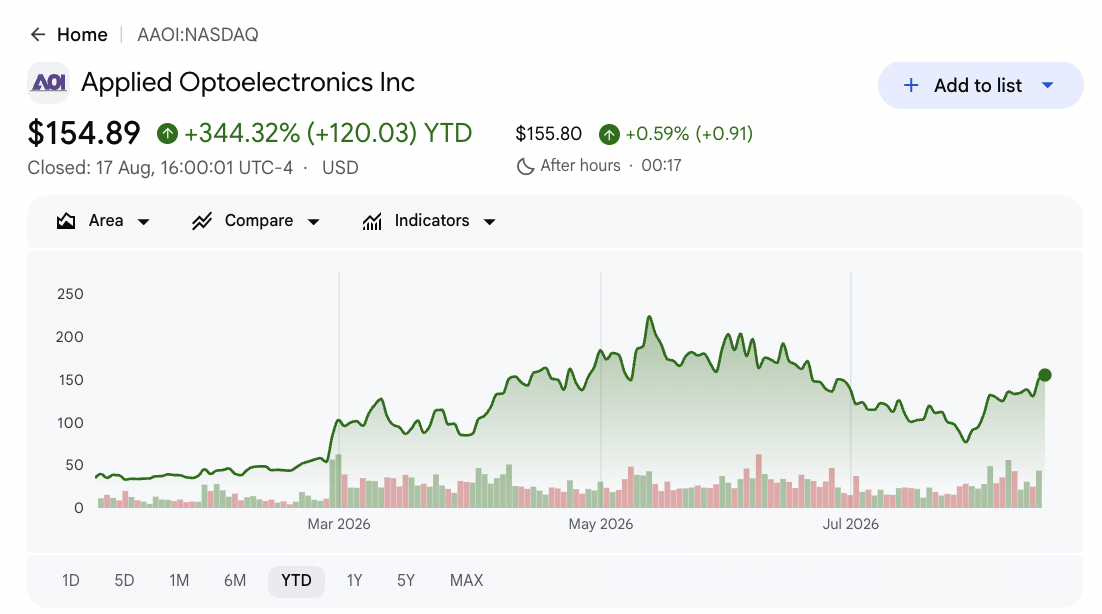
Applied Optoelectronics (AAOI) is an emerging U.S. producer of the optical transceivers that convert electrical data to light for high-speed data center links. The company is transforming from a cable-TV and legacy datacom supplier into a high-volume maker of AI-focused data center transceivers, with a focus on 800G and 1.6T products as AI-driven datacenter investment accelerates.
AAOI has delivered several consecutive quarters of record revenue, driven by broad-based demand across its datacenter and CATV businesses, and it completed its first volume shipment of 800G products to a large hyperscale customer, exiting the quarter with capacity of nearly 100,000 units of 800G transceivers per month. Management expects a strong 800G volume ramp with sequential revenue growth building through the year. The main risks are customer concentration, execution on capacity expansion, and high small-cap volatility, but AAOI offers focused exposure to the U.S. optical transceiver ramp.
Read More: AAOI Stock Prediction 2026: $260 Photonics Boom or Dilution Trap?
AAOI Price Trend (2020-2026 YTD)
|
Year |
Yearly High |
Yearly Low |
Annual Return |
Market Conditions |
|
2020 |
$16.00 |
$8.00 |
-35% |
Pandemic disruption; datacom softness |
|
2021 |
$14.00 |
$5.00 |
-40% |
Legacy datacom weakness |
|
2022 |
$6.00 |
$1.50 |
-55% |
Tech sell-off; restructuring |
|
2023 |
$25.00 |
$1.60 |
2.5 |
AI datacenter narrative; transceiver interest |
|
2024 |
$45.00 |
$8.00 |
0.5 |
800G development; hyperscaler engagement |
|
2025 |
$40.00 |
$15.00 |
-10% |
800G ramp begins; capacity expansion |
|
2026 YTD |
~$185 (May) |
~$18 (Jan) |
+170% YTD |
Record quarters; 800G volume ramp; capacity doubles |
How to Trade AI Connectivity Stocks on BingX
BingX offers a crypto-native way to gain exposure to leading AI networking and connectivity stocks without using a traditional brokerage account. The main execution path is through USDT-margined perpetual contracts on BingX TradFi, which allow active traders to go long or short and trade around earnings, hyperscaler capex announcements, switching and optics catalysts, and broader connectivity-cycle trends.
Long or Short AI Connectivity Stock Futures with USDT on BingX TradFi
For active traders looking to capitalize on short-term momentum, earnings volatility, or AI infrastructure catalysts, BingX TradFi allows users to trade connectivity-linked stock futures with USDT. These USDT-settled perpetual contracts mirror the price movements of underlying equities, offering flexible long and short exposure without requiring users to hold the physical stock.
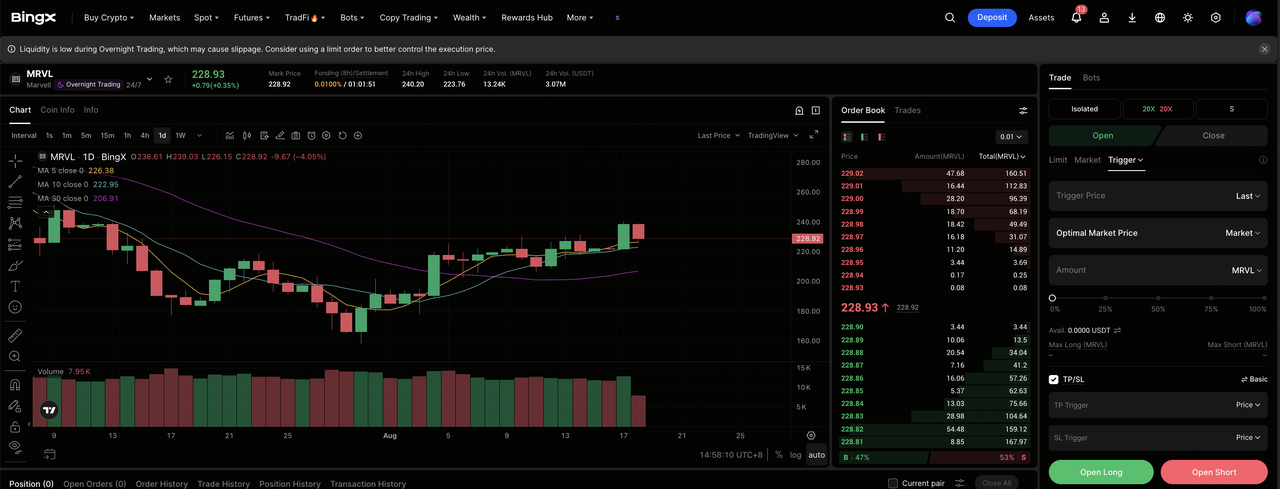
Step 1: Account setup and security. Sign up and log into your BingX account, complete the identity verification (KYC) required in your region, and enable two-factor authentication.
Step 2: Allocate trading capital. Transfer USDT from your spot wallet into your futures account, where it will serve as collateral.
Step 3: Select your contract. Navigate to the TradFi markets page or the futures trading section. Choose connectivity-linked perpetual contracts such as AVGO-USDT, ANET-USDT, MRVL-USDT, CSCO-USDT, CRDO-USDT, ALAB-USDT, COHR-USDT, LITE-USDT, or AAOI-USDT.
Step 4: Set direction and leverage. Open long if you expect the stock price to rise, or open short if you expect a pullback. Choose leverage based on your risk plan.
Step 5: Execute and manage risk. Set stop-loss and take-profit orders before submitting the trade. PnL settles dynamically in USDT.
Risks and Core Considerations When Trading AI Connectivity Stocks
The biggest risks for AI connectivity stocks come from the same forces driving their upside: concentrated hyperscaler spending, rapid technology shifts, intense competition, and premium valuations. That makes execution and timing especially important across the sector.
- Hyperscaler capex concentration: A large share of demand depends on a small group of cloud and AI infrastructure buyers. Any slowdown in AI spending could quickly affect switching, silicon, copper, and optical orders.
- Technology transition risk: The market is moving toward faster networking speeds, more optical connectivity, and new interconnect architectures. Companies that fall behind in 800G, 1.6T, or next-generation designs could lose share quickly.
- Competition and customer concentration: Connectivity suppliers face pressure from custom silicon, merchant chips, and supplier changes. Smaller names can be especially exposed if a major customer delays orders or switches vendors.
- Valuation and volatility: Many AI connectivity stocks trade at elevated valuations after strong rallies. Earnings misses, weaker margins, or slower order growth can trigger sharp multiple compression.
- Leverage and liquidation: These stocks can move quickly around earnings, capex updates, product launches, and AI demand commentary. Traders using USDT-margined futures should manage leverage, position size, and stop-loss levels carefully.
Final Thoughts: Should You Add AI Connectivity Stocks to Your 2026 Portfolio?
The nine names above offer different ways to participate in the 2026 AI connectivity buildout across all three layers. Broadcom, Arista, and Cisco anchor the switching layer, Marvell spans custom silicon and optics, Credo and Astera Labs lead high-speed copper connectivity, and Coherent, Lumentum, and Applied Optoelectronics supply the optical components that carry data as light. Together, they cover the full path data travels across an AI cluster, from switch chips and Ethernet fabric to copper cables and optical transceivers.
The trade-off is that each stock carries a different risk profile. The large-cap silicon and switching names face capex concentration and competition, the copper specialists face single-category and small-cap volatility, and the optical names face capacity execution and premium valuations. For traders using BingX TradFi, conservative position sizing, leverage control, and stop-loss orders are essential when trading AI connectivity stock futures through USDT-margined perpetual contracts.
Related Reading
- Top AI Server Stocks to Buy in 2026: Rack-Scale Systems, GPU Servers, and AI Servers Infrastructure
- Top AI Data Center Stocks to Buy in 2026: Cloud, Servers, and AI Compute Infrastructure
- Top AI Compute and GPU Stocks to Buy in 2026: The Shift to Inference and Custom Silicon
- Top AI Memory Stocks to Buy in 2026: DRAM, HBM, and AI Storage Demand Explained
- Top 10 AI Infrastructure Stocks to Buy in 2026: Chip Manufacturing and Design Leaders
- Top AI Cloud Infrastructure Stocks to Buy in 2026 Amid Hyperscaler Capex and the Neocloud Boom
