
Crypto and U.S. stocks give investors access to different sources of growth. Crypto provides exposure to blockchain adoption, digital payments, decentralized applications, and token-based economies, while U.S. stocks offer ownership in companies developing AI infrastructure, selling products and services, and generating earnings across the global economy.
For crypto traders, adding U.S. stocks can broaden the opportunity set without moving away from digital assets. As a multi-asset platform, BingX gives users access to both crypto and U.S. stocks within the same ecosystem. Stocks add established financial reporting, exposure to major technology and industry trends, and potential dividends, while crypto continues to offer exposure to network growth and digital-asset themes. With BingX Stocks Trading, eligible users can buy U.S. stocks and ETFs using USDT or USDC alongside their existing crypto activity. This guide explains the key differences between the two markets and how stocks can complement a broader portfolio.
Key Takeaways
As a multi-asset platform, BingX gives users access to both crypto and U.S. stocks, making it easier to add traditional market exposure alongside an existing digital-asset portfolio.
- Add business ownership to a crypto-heavy portfolio. U.S. stocks provide exposure to company earnings, cash flow, and potential dividends, creating a different source of return from token-based assets.
- Access major technology trends through operating companies. AI, semiconductors, cloud infrastructure, and automation can be evaluated through revenue, margins, investment spending, and customer demand.
- Use stocks for longer-term portfolio building. Established companies and diversified ETFs can support gradual investing, potential income, and exposure across multiple industries.
- Balance different risk and return drivers. Stocks and crypto can respond differently to business performance, adoption trends, interest rates, and market sentiment, helping broaden the portfolio.
- Buy U.S. stocks directly with crypto balances. BingX Stocks Trading lets eligible users use USDT or USDC and start with fractional purchases from 5 USDC, making stock exposure easier to add alongside crypto holdings.
Read More: What Is a Multi-Asset Trading Platform? A Guide to Trading Crypto and TradFi on BingX
What Is BingX Stock Trading?
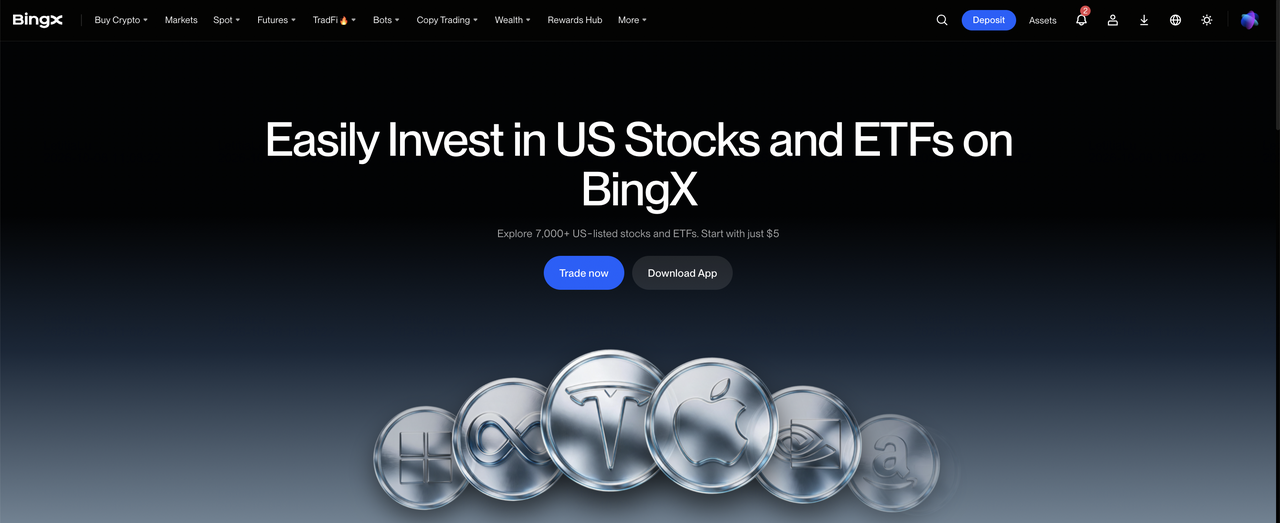
BingX Stocks Trading gives eligible users a straightforward way to buy and hold U.S. stocks and ETFs with USDT or USDC. Orders are executed through Alpaca Securities LLC and settled in USDC, while fractional investing starts from 5 USDC. This lowers the barrier to building positions in major U.S. companies or diversified ETFs, especially when a full share trades at a much higher price. Because the product is available within the same BingX account already used for crypto, users can add traditional market exposure without setting up a separate investment platform.
Because the securities are fully paid, there is no leverage, funding rate, or margin-based liquidation to manage. Returns come from changes in the value of the stock or ETF, together with any eligible dividends or distributions. This gives users a different way to build a portfolio compared with crypto, with more emphasis on company performance, earnings, valuation, and longer-term ownership. For users who want to diversify beyond digital assets, build positions gradually, or add U.S. market exposure alongside crypto, BingX Stocks Trading offers a simple and practical route within the broader BingX ecosystem.
Read More: What Is BingX Stocks Trading? A Beginner's Guide to Trading U.S. Stocks and ETFs With Crypto
Why Are Crypto Traders Exploring U.S. Stocks?
U.S. stocks give crypto-focused investors access to a broader set of businesses, industries, and return drivers. The appeal comes from company ownership, measurable financial performance, major technology trends, and easier access through crypto-funded accounts.
- Access AI and technology growth through operating companies. Investors can gain exposure to businesses supplying semiconductors, memory, AI networking, data center, cloud infrastructure, server, software, and automation. Revenue, margins, and customer demand help show whether a major theme is translating into commercial growth.
- Use financial results to evaluate an investment. Quarterly earnings, cash flow, balance sheets, and guidance provide regular checkpoints. Investors can compare expectations with actual demand, profitability, spending, and execution rather than relying mainly on price momentum.
- Broaden exposure beyond the crypto ecosystem. U.S. stocks provide access to industries such as healthcare, consumer goods, manufacturing, financial services, and enterprise technology. This can diversify returns across different parts of the economy.
- Add potential income and a longer-term investing framework. Some stocks pay dividends, while many ETFs make distributions. Combined with capital appreciation and regular investing, these features can support longer-term portfolio building.
- Use existing stablecoin balances to buy shares. BingX Stocks Trading lets eligible users purchase U.S. stocks and ETFs using USDT or USDC, with fractional investing from 5 USDC. This gives crypto traders a convenient way to add stock exposure within the same ecosystem.
Crypto vs. U.S. Stocks: What Are the Key Differences?
The biggest difference is what the investment represents and how it is evaluated. A stock is an ownership interest in a business, while a crypto asset may function as a network asset, payment instrument, governance token, or another type of digital claim. That affects the return drivers, research process, risk profile, and typical use within a portfolio.
|
Comparison |
Crypto |
U.S. Stocks |
|
Investment goals |
Network adoption, digital-asset growth, utility, or trading opportunities |
Business growth, capital appreciation, potential income, and portfolio building |
|
Ownership and income |
Token-specific rights; staking or other income depends on the mechanism |
Equity ownership; some companies and funds pay dividends or distributions |
|
Valuation drivers |
Supply, demand, usage, token economics, liquidity, and sentiment |
Earnings, cash flow, growth expectations, balance sheets, and valuation multiples |
|
Market stability |
Often more volatile, especially for speculative or thinly traded assets |
Varies widely; established companies and diversified funds can offer a different risk profile |
|
Growth trends |
Blockchain infrastructure, payments, DeFi, and digital networks |
AI, semiconductors, cloud, healthcare, industrial investment, and consumer demand |
|
Trading schedule |
Generally 24/7, subject to platform operation |
Defined market sessions and holidays; BingX Stocks Trading supports extended 24/5 access |
1. Investment Goals and Holding Periods: Business Ownership vs. Network Growth
Stocks are usually evaluated through business growth, profitability, valuation, and shareholder returns. Crypto may be assessed through network adoption, usage, token economics, and ecosystem growth. In both markets, the holding period should match the investment thesis.
2. Market Stability and Volatility: Established Businesses vs. Faster-Moving Assets
Established U.S. companies and diversified ETFs can offer a more measurable investment framework through regular financial reporting and business disclosures. Crypto can be more volatile, especially for smaller or less liquid assets, although risk varies significantly within both markets.
3. Growth Trends and Valuation: Financial Performance vs. Network Adoption
Crypto provides exposure to blockchain infrastructure, payments, DeFi, and digital networks, while stocks offer access to themes such as AI, semiconductors, cloud services, healthcare, and automation. The key difference is how growth is measured: stocks through revenue, margins, and cash flow; crypto through adoption, usage, liquidity, and token economics.
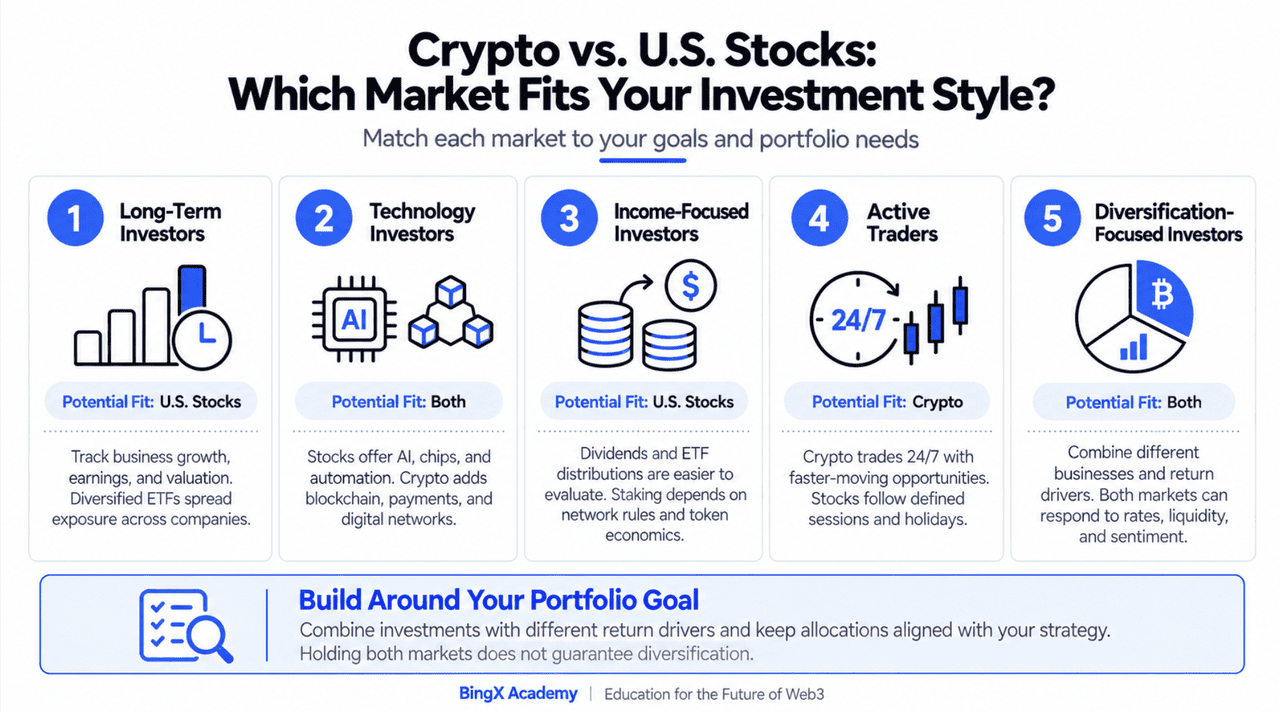
Crypto vs. U.S. Stocks: Which Market Fits Your Investment Style?
The better choice depends on the investment goal and the role each asset plays in the portfolio. Crypto and U.S. stocks can complement each other when they provide different sources of growth, income, and risk.
|
Investor Type |
Potential Fit |
Why |
|
Long-term investors |
U.S. stocks |
Business growth, earnings, and diversified ETFs |
|
Technology investors |
Both |
AI and semiconductors through stocks; blockchain and digital networks through crypto |
|
Income-focused investors |
U.S. stocks |
Dividends and ETF distributions are generally easier to evaluate |
|
Active traders |
Crypto |
24/7 trading and faster-moving market opportunities |
|
Diversification-focused investors |
Both |
Combines different businesses, technologies, and return drivers |
- Long-term investors may prefer stocks. Stocks provide a clearer framework for tracking earnings, business growth, and valuation, while diversified ETFs can spread exposure across companies.
- Technology investors can use both markets. Stocks offer exposure to AI, semiconductors, and automation, while crypto provides access to blockchain, payments, and decentralized networks.
- Income-focused investors may prefer stocks. Dividend-paying companies and ETFs can provide distributions, while crypto staking rewards depend on network rules and token economics.
- Active traders may prefer crypto. Crypto generally trades 24/7, while stocks follow defined market sessions and holidays.
- Diversification-focused investors can combine both. Adding stocks can broaden a crypto-heavy portfolio, but different assets can still respond to the same shifts in rates, liquidity, and market sentiment.
The goal is to combine investments with genuinely different return drivers and keep the total allocation aligned with the portfolio strategy.
How to Start Trading U.S Stock on BingX?
BingX Stock Trading is designed for users who want to buy and hold U.S. stocks and ETFs directly from the same account used for crypto. The process starts with account setup and funding, then moves into the Stocks market where an order can be placed and managed through the same interface.
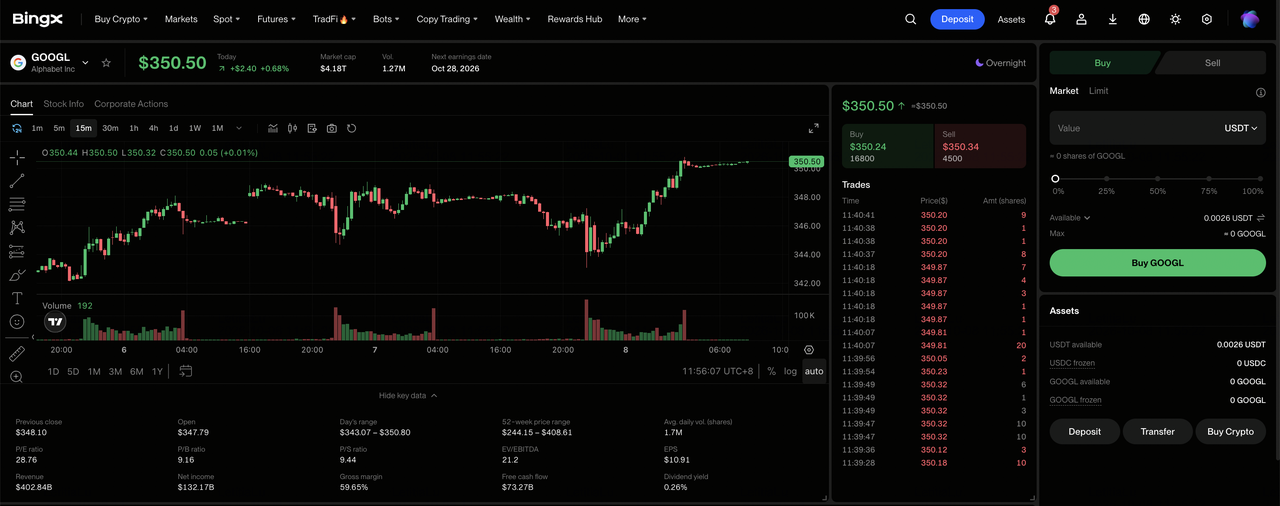
Step 1: Sign up and enable Stocks Trading. Sign up or log in to BingX, complete the required KYC, then open "TradFi > Stocks" and accept the Stock Trading Risk Disclosure.
Step 2: Prepare USDT or USDC. Make sure the Spot Account has enough USDT or USDC for the intended purchase. If needed, supported funds can be transferred from the Fund Account or Wealth Account.
Step 3: Find Google in the Stocks market. Open "TradFi > Stocks", search for GOOGLE, and confirm the company name and ticker before placing an order.
Step 4: Place the order. Choose "Buy", enter the purchase amount or share quantity, then select a market or limit order. A market order prioritizes execution at available prices, while a limit order executes only at the selected price or better when sufficient liquidity is available.
Step 5: Manage or sell the position. Once the order is filled, the Google holding appears under "Positions". Use "All Orders" to review open and completed orders, or select "Sell" when ready to reduce or close the position. T+1 settlement determines when sale proceeds become available for withdrawal.
Top 5 Risks to Know Before Adding U.S. Stocks
Adding U.S. stocks can broaden a crypto-heavy portfolio, but the benefits still depend on what is bought, the price paid, and how the position is managed. Company risk, valuation, market overlap, and trading rules can all affect returns.
- Stocks can still lose significant value. Weak earnings, slowing growth, valuation declines, or company-specific problems can push share prices sharply lower. Fully paid shares avoid margin-based liquidation, but the invested capital is still at risk.
- Stocks and crypto can fall at the same time. Growth stocks and digital assets may both react negatively to tighter liquidity, higher rates, or weaker risk appetite. Adding stocks does not automatically create diversification if the holdings share similar drivers.
- Strong growth themes can already be priced in. AI, semiconductors, and other popular sectors can attract high expectations. Even strong business growth may not support the share price if results fall short of what investors already expect.
- Trading and settlement rules affect flexibility. Extended-hours trading can come with lower liquidity and wider spreads, while limit orders may remain unfilled. T+1 settlement can also delay when sale proceeds become available for withdrawal.
- Funding and custody add operational considerations. Using stablecoins to buy stocks involves platform access, brokerage custody, payment arrangements, and regional eligibility in addition to normal investment risk. These factors should be reviewed alongside the company or ETF itself.
Final Thoughts
Crypto and U.S. stocks can play different roles within the same portfolio. Crypto offers exposure to network adoption, digital-asset growth, and faster-moving market themes, while U.S. stocks add business ownership, financial reporting, valuation frameworks, and potential dividends. Used together, they can broaden the opportunity set when each allocation has a clear purpose.
As a multi-asset platform, BingX makes it easier to manage both within the same ecosystem. Eligible users can buy U.S. stocks and ETFs with USDT or USDC and use fractional investing to build positions gradually. The key is to start with a clear goal, research the asset, and size each position based on the overall portfolio rather than treating stocks and crypto as interchangeable investments.
Related Reading
- What Is a Multi-Asset Trading Platform? A Guide to Trading Crypto and TradFi on BingX
- What Is BingX Stocks Trading? A Beginner's Guide to Trading U.S. Stocks and ETFs With Crypto
- Best Multi-Asset Trading Platforms in 2026: Which Platform Offers the Best Market Access?
- How to Buy U.S. Stocks on BingX With USDT or USDC: A Beginner's Guide
- BingX U.S. Stocks Trading vs. Stock Perpetuals: What Are the Key Differences?
- BingX U.S. Stocks Trading vs. Tokenized Stocks: What Are the Key Differences?
FAQs About Crypto and U.S. Stocks
1. Are U.S. stocks more stable than crypto?
It depends on the assets being compared. Established companies and diversified ETFs can offer a different risk profile from speculative crypto assets, but individual stocks, concentrated funds, and crypto-linked companies can still experience significant volatility.
2. Why might a crypto trader add U.S. stocks?
U.S. stocks add exposure to company earnings, cash flow, major industries, and potential dividends. They can complement crypto holdings when the goal is to broaden the portfolio across different businesses and sources of return.
3. Does holding both crypto and stocks guarantee diversification?
No. Crypto and stocks can still react to the same changes in interest rates, liquidity, and investor sentiment. Diversification depends on the underlying businesses, sectors, themes, and overall position sizes.
4. Can I buy actual U.S. shares with USDT on BingX?
Yes. Eligible users can buy U.S. stocks and ETFs through BingX Stocks Trading using USDT or USDC, with orders executed through Alpaca Securities LLC. Tokenized stocks and stock perpetuals are separate products.
5. Do stocks provide income like crypto staking?
Some stocks pay dividends and some ETFs make distributions, while crypto staking rewards come from network-specific mechanisms. The sources and risks are different, and neither guarantees a positive total return after price changes and costs.
6. Should I replace my crypto holdings with stocks?
Not necessarily. Stocks and crypto can serve different purposes within the same portfolio. The better approach depends on the investment goal, time horizon, risk tolerance, and what each holding contributes to the overall allocation.
