

idOS (Identity Operating System) is the foundational infrastructure for a Self-Sovereign internet. Moving beyond the limitations of centralized KYC and siloed data, idOS creates a chain-agnostic identity layer where users own their data and dApps access it only with explicit permission. Launched by a consortium of industry leaders including Ripple, Arbitrum, and NEAR, idOS bridges the gap between strict global regulations and the permissionless nature of DeFi and Web3.
$IDOS is currently a breakout performer in the Decentralized Identity (DeID) narrative. In early March 2026, following its listing on BingX, the token saw a 4.15% steady climb, outperforming several legacy privacy coins. As global regulatory bodies tighten Travel Rule requirements, IDOS has benefited from a sector rotation into Compliance-Fi protocols, infrastructure that allows projects to remain legal without sacrificing user decentralization.
This article breaks down the modular architecture of idOS, the utility of the $IDOS token, and a guide on how to trade IDOS on BingX.
What Is idOS (IDOS) and How Does It Work?
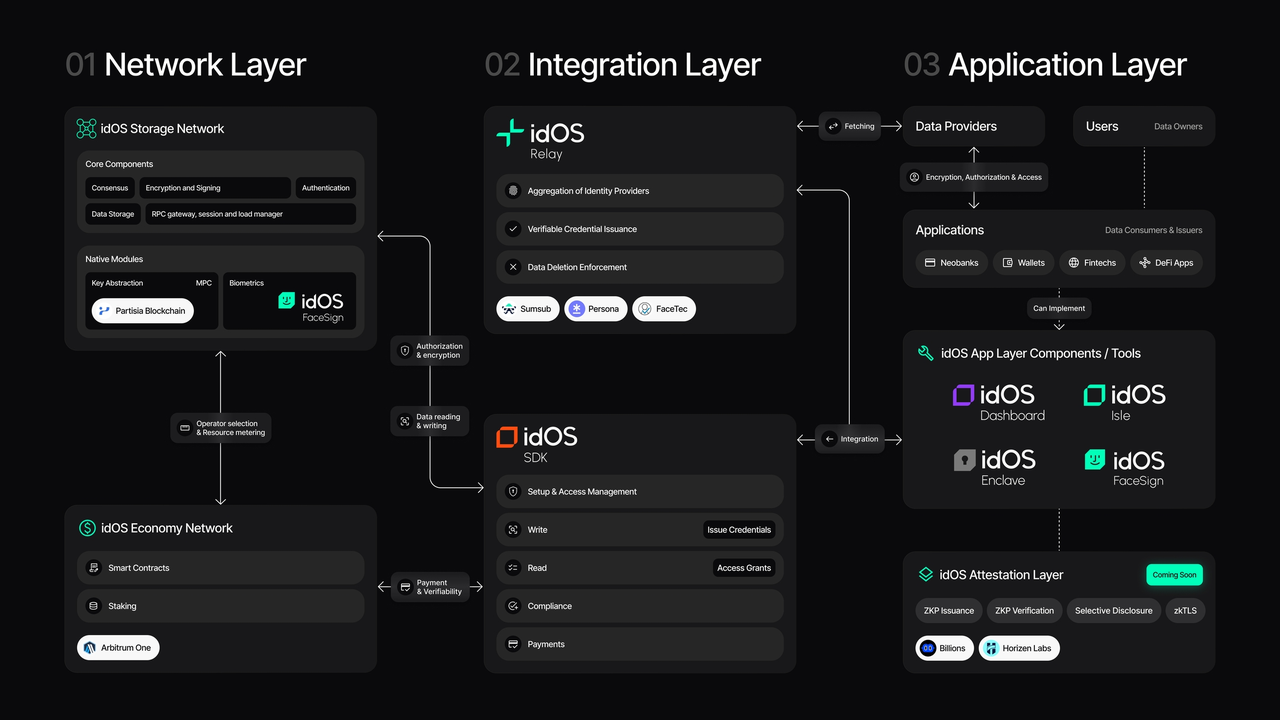
An overview of idOS Network | Source: idoOS docs
idOS functions as a decentralized storage and access management network for personal data. Unlike traditional databases, it doesn't store data in one place; instead, it uses a peer-to-peer network of nodes to manage encrypted Data Pods. It operates through three core pillars:
• The idOS Node Network: A decentralized network of storage providers, initially run by idOS Consortium members, that host encrypted user data. These nodes ensure data availability without ever being able to read the raw information.
• The Access Management Layer: A sophisticated encryption suite using MPC (Multi-Party Computation). Users hold the keys to their data; when a dApp requests a KYC check or age verification, the user grants a grant or access token that allows the dApp to verify the claim without seeing the underlying document.
• The idOS SDK: A developer-friendly toolkit that allows any dApp, on any chain, to integrate one-click onboarding. If a user has already verified their identity on a NEAR protocol app, they can instantly carry that verified status to an Arbitrum or Solana app via idOS.
By utilizing ZK-Proofs (Zero-Knowledge Proofs), idOS allows for Identity Reusability. A user verifies once and stays verified across the entire Web3 ecosystem, reducing onboarding friction from minutes of document uploading to a single wallet signature.
What Is the idOS Consortium?
idOS is not a siloed project; it is a collaborative effort. The idOS Consortium consists of major blockchain ecosystems and infrastructure providers that use and secure the network. Key members include:
1. Foundational Chains: Arbitrum, NEAR, Polkadot, and Gnosis.
2. Infrastructure Partners: Ripple, Circle, the issuer of USDC, and Aleph Zero.
3. Governance: These members act as the initial node operators and govern the protocol’s evolution through the idOS Association, ensuring the network remains neutral and chain-agnostic.
What Is the IDOS Token?
The IDOS token is the native utility asset that orchestrates the decentralized identity economy. With a fixed maximum supply of 1 billion tokens, it serves several critical functions:
• Network Fees: Users or dApps pay a small fee in IDOS to store data or process access requests.
• Node Incentives: Node operators earn IDOS rewards for providing storage, compute, and maintaining the high-availability requirements of the network.
• Governance: Token holders can vote on Verification Standards, essentially deciding which types of credentials, e.g., government IDs, social scores, or proof-of-humanity, the network supports.
• Staking for Privacy: To become a data validator or premium storage node, participants must stake IDOS, which acts as slashing collateral to ensure honest behavior and data protection.
idOS vs. Traditional KYC: Key Differences
|
Feature |
Traditional KYC (Siloed) |
idOS (Decentralized) |
|
Data Ownership |
Owned by the Company |
Owned by the User |
|
Security |
Centralized Honeypots |
Decentralized Encryption (MPC) |
|
Reusability |
None (Repeat for every app) |
Universal (Verify once, use everywhere) |
|
Interoperability |
Siloed (Web2) |
Chain-Agnostic (Web3) |
|
User Privacy |
Full data exposure to dApp |
ZK-Proofs (Selective Disclosure) |
Traditional KYC systems operate as fragmented, centralized honeypots, where financial institutions spend an estimated $200–$280 billion annually on compliance. In this legacy model, sensitive Personal Identifiable Information (PII) is duplicated and stored in isolated databases, creating high-risk targets for data breaches and forcing users to repeat 10-15 minute onboarding processes for every new service. Because these systems rely on static, paper-based documents, they suffer from high friction and lack interoperability, often leading to a 20-25% budget drain for fintechs solely dedicated to identity infrastructure.
In contrast, the idOS (Identity Operating System) utilizes a decentralized storage network where data is end-to-end encrypted with user-controlled keys, effectively eliminating single points of failure. By leveraging W3C Verifiable Credentials and persistent Access Grants, idOS enables KYC Reusability, allowing users to verify once and onboard to new applications in less than 5 seconds. This transition from manual verification to automated data orchestration reduces compliance costs by up to 10x for stablecoin neobanks and ensures that regulated entities can access cryptographically secure, tamper-proof audit trails without actually hosting the sensitive PII themselves.
What Are the Use Cases of idOS?
idOS is not a general-purpose storage solution; it is a specialized engine for the stablecoin economy and Agentic Finance. By providing a secure way to move identity data as fast as digital assets, it unlocks several high-value applications across the Web3 landscape:
• Stablecoin Neobanks and Wallets: Neobanks can integrate the idOS SDK to offer a one-click banking experience. Users who have already verified their identity through one partner, e.g., a card provider, can instantly access other financial modules, like on-ramps or high-yield savings, without resubmitting documents.
• KYC Passporting for DeFi: Regulated DeFi protocols can use idOS to verify that a participant is not on a sanctions list or resides in a permitted jurisdiction. This Passporting model allows a user to carry their verified status from a centralized exchange (CEX) to a decentralized lending platform seamlessly.
• Privacy-Preserving Age and Attribute Verification: Using Zero-Knowledge Proofs, idOS allows applications to verify specific traits, e.g., User is over 18 or User is a resident of the EU, without ever seeing the user’s passport or full name. This is critical for gaming, social platforms, and age-restricted marketplaces.
• TradFi-to-Onchain Onboarding: Traditional financial institutions looking to enter Web3 can embed idOS to empower their customers to securely migrate their existing compliance data to decentralized environments. This supports Tokenized Real-World Assets (RWAs) by ensuring only verified, eligible investors can interact with the assets.
By replacing repetitive, document-heavy checkpoints with cryptographically secure Access Grants, idOS reduces the operational cost of compliance for fintechs while returning data sovereignty to the end-user.
How to Trade idOS (IDOS) on BingX
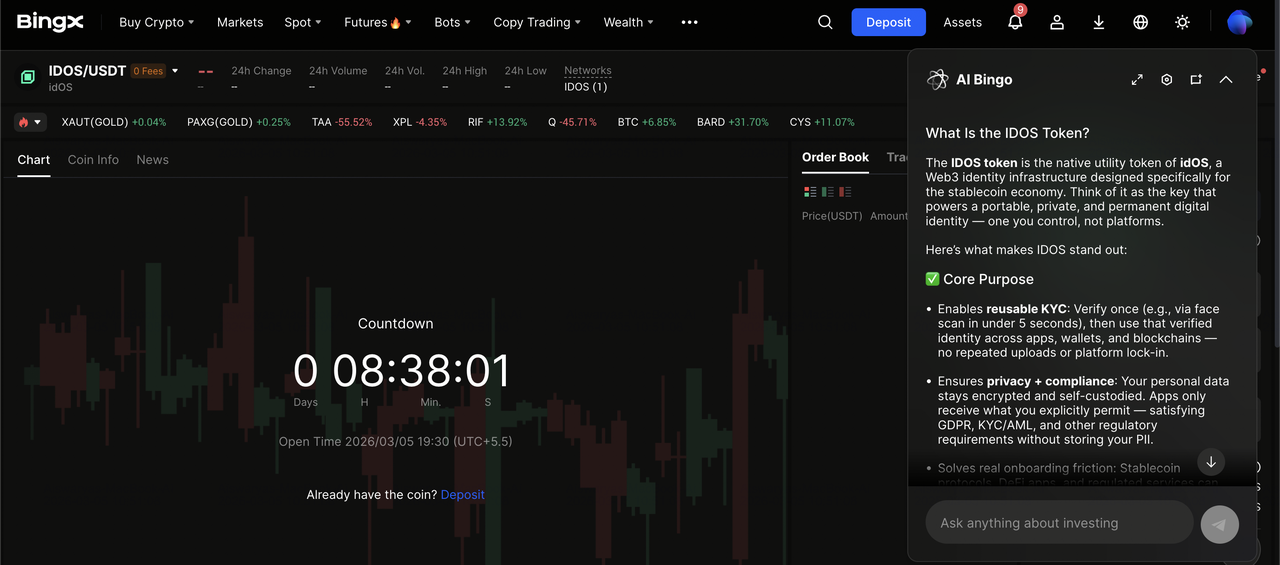
IDOS/USDT trading pair on the spot market powered by BingX AI insights
Capitalize on the growing demand for Web3 privacy and compliance by trading IDOS on BingX.
Buy IDOS/USDT on Spot Trading
For investors looking to hold IDOS as the Identity Layer of the Internet scales:
1. Fund Your Account: Deposit USDT into your BingX account.
2. Search for IDOS: Go to the Spot Market and search for IDOS/USDT.
3. Execute Trade: Use a Limit Order to set your entry price or a Market Order for instant execution.
4 Key Considerations Before Trading IDOS
Before committing capital to the decentralized identity narrative, investors must evaluate the technical utility, regulatory tailwinds, and supply dynamics that underpin the $IDOS token's market valuation.
1. The Regulatory Tailwinds: As jurisdictions like the EU (MiCA) and the US implement stricter on-chain identity rules, demand for idOS's compliant-yet-private solution is expected to scale.
2. Consortium Strength: Unlike ghost projects, IDOS is backed by Ripple and NEAR. The success of the token is tied to the integration of idOS into these major ecosystems.
3. Token Unlock Schedule: With a circulating supply currently around 20% as of March 2026, monitor upcoming vestings for early backers to manage potential sell-side pressure.
4. Privacy vs. Compliance Balance: The project sits in a delicate spot. If regulations become too restrictive, purely decentralized solutions like idOS might face pressure to add backdoors, which would affect its core value proposition.
Conclusion: Is idOS the Identity Standard for Web3?
idOS (IDOS) serves as a specialized infrastructure layer designed to reconcile the tension between global financial compliance and on-chain privacy. By establishing a decentralized identity operating system, the protocol enables the stablecoin economy to scale through KYC reusability, potentially reducing onboarding friction for billions of users across DeFi, RWA, and SocialFi sectors. Supported by a consortium of major networks like Arbitrum and NEAR, its chain-agnostic architecture and use of Verifiable Credentials position it as a primary contender for a standardized Web3 identity framework in 2026.
Despite its technical advantages and growing Annual Recurring Revenue (ARR) of over $500,000, the long-term adoption of idOS remains tied to the evolving landscape of international data regulations and the willingness of institutional players to move away from legacy centralized databases. Investors should note that as a nascent infrastructure project, IDOS carries inherent risks including smart contract vulnerabilities, potential shifts in the regulatory treatment of decentralized identity, and market volatility associated with new token launches. As with any early-stage utility token, thorough due diligence regarding the project's supply unlocks and integration milestones is essential.
Related Reading
1. What Is Humanity Protocol (H) and How to Get Started?
2. What Is Proof‑of‑Humanity (POH) and How Does It Work?
3. What is DeBox: A Pioneering Web3 Social Platform
4. How to Stake NEAR Protocol (NEAR) and Earn Passive Rewards in 2026