


Proof-of-Work (PoW) is the mechanism blockchains use to select the author of the next block by requiring verifiable computational work. While energy-intensive, it remains the gold standard for decentralized security, used by Bitcoin and major established chains. In April 2026, PoW assets continue to dominate the market; with Bitcoin’s dominance holding steady at 57%, the PoW category commands a total market cap of approximately $1.6 trillion, anchored by deep liquidity and growing institutional ETF support.
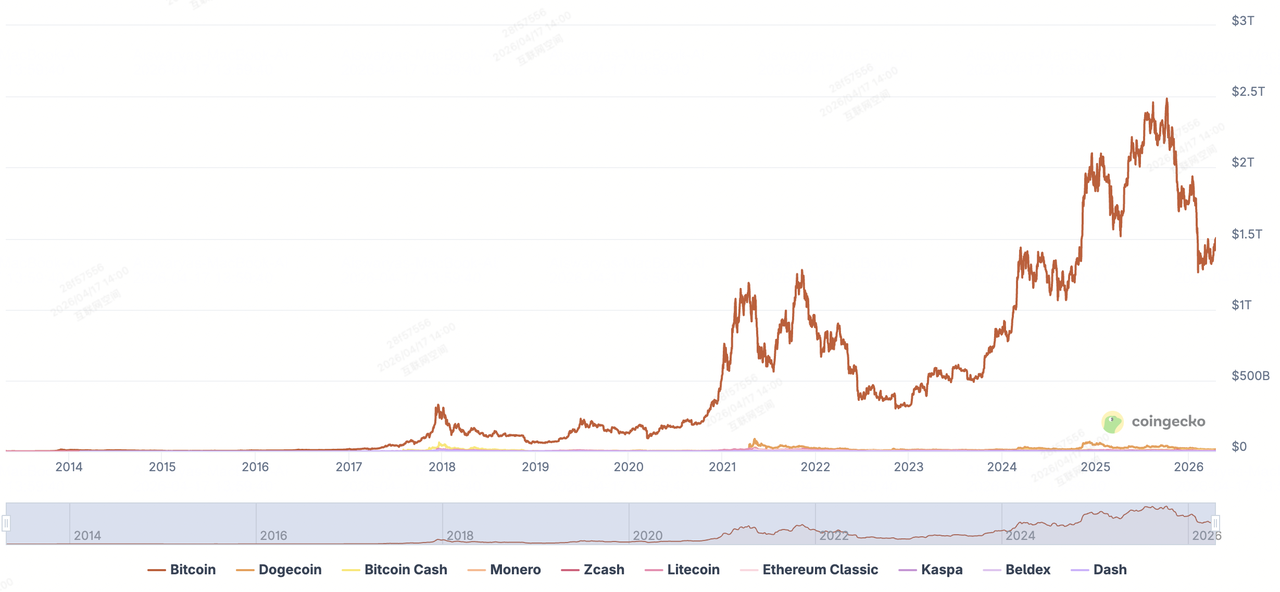
Market cap of top PoW cryptocurrencies | Source: CoinGecko
In this article, you’ll explore the top Proof-of-Work (PoW) cryptos to mine in 2026, how they differ in technology and profitability in a post-halving world, how to choose the right mining targets, and practical tips for trading PoW assets on BingX with advanced risk controls.
What Is Proof-of-Work (PoW) Consensus and How Does It Work?
Proof-of-Work (PoW) is a consensus mechanism that allows blockchains to operate without a central authority. Instead of trusting banks, the network relies on independent miners who use computing power to verify transactions and propose new blocks. To add a block, miners must solve a cryptographic puzzle by repeatedly hashing block data until they find a valid result below the network’s current Difficulty Target. The miner who succeeds first broadcasts the block, earning newly issued coins and transaction fees as a reward.
This process is intentionally resource-heavy to ensure security. Because altering past blocks would require re-doing the work for the entire chain, tampering is economically impossible. As of April 2026, Bitcoin’s total hashrate has surged to approximately 855 exahashes per second (EH/s), a staggering figure that reflects record-high network security compared to early years.
While most famous for Bitcoin, PoW is the foundation for other major networks like Litecoin, Dogecoin, Monero, and Kaspa. Despite high energy demands, it remains the most resilient approach for high-value settlement and censorship-resistant money.
How Does Mining Coins on a PoW Network Work?
- Broadcast: Users create transactions, e.g., sending BTC, and broadcast them to the peer-to-peer network.
- Packaging: Miners gather these pending transactions from the mempool and package them into a proposed block.
- Hashing Race: Every miner begins searching for a valid nonce, a specific number that makes the block’s hash meet the network's difficulty requirements.
- The Algorithm: They run the block data and nonce through a specific algorithm, e.g., SHA-256 for Bitcoin, kHeavyHash for Kaspa.
- Target Verification: If the resulting hash is below the current Difficulty Target, currently around 139 trillion for Bitcoin, the block is valid.
- Broadcast Success: The winning miner broadcasts the completed block to the network for immediate verification.
- Consensus: Other nodes verify the block’s legitimacy; once confirmed, they stop working on that block and move to the next.
- Reward: The block is added to the chain, and the winning miner receives the Block Subsidy, e.g., 3.125 BTC, plus accumulated Transaction Fees.
Why Are Proof-of-Work Cryptos Gaining Traction in 2026?
After several years of market experimentation with alternative consensus models, Proof-of-Work is regaining momentum as both institutions and retail traders seek proven security, transparent issuance, and high-liquidity networks that operate outside of purely virtual stake.
1. Institutional Capital is Anchoring in PoW Infrastructure
Proof-of-Work is seeing a massive institutional consolidation in 2026 as investors return to assets with physical security backing and deep liquidity. While the 2024 launch of Bitcoin Spot ETFs was the catalyst, the landscape has matured significantly. Over 2 years since launch, by mid-April 2026, Bitcoin ETFs like BlackRock’s IBIT have moved beyond retail hype into core portfolios, with total AUM (assets under management) across all spot products exceeding $180 billion.
Regulators have cleared the way for PoW-specific Commodity Baskets. These allow institutional access to a weighted index of Bitcoin, Litecoin, and Dogecoin, treating them as digital commodities under the CLARITY Act framework. Another defining narrative of 2026 is the emergence of sovereign nations adding PoW assets to their strategic reserves, citing Bitcoin’s decentralized hashrate as a hedge against geopolitical instability and supply shocks.
2. Privacy-Focused PoW Chains Are Seeing a Utility Rally
Retail traders have shifted toward PoW assets as 2026’s privacy season transitioned from an ideological movement to a structural requirement. As global surveillance and CBDC (Central Bank Digital Currency) pilots expanded, demand for censorship-resistant cash exploded. The total market capitalization for privacy-focused PoW assets surpassed $12.5 billion in 2026, signaling that traders are repricing privacy from a niche feature to a mandatory utility.
- Monero (XMR): Often cited as the gold standard, Monero reached new all-time highs in early 2026, touching an all-time high of $790 with a market cap over $14 billion, fueled by its anonymity by default status.
- Zcash (ZEC): ZEC saw a 700% rally in late 2025/early 2026, driven by its more institutional-friendly 'opt-in' privacy model (Halo 2) which allows for auditable but private transactions.
Read more: Zcash (ZEC) vs. Monero (XMR): Which is the Better Privacy Coin in 2026?
3. The Pi Network Mainnet Shift and the Real Mining Onramp
User-facing narratives are evolving as entry-level ecosystems bridge the gap to industrial mining. After entering its Open Network phase on February 20, 2025, Pi Network has migrated over 16 million KYC-verified users to its mainnet by mid-2026.
While Pi uses a federated consensus model (SCP), its massive user base has acted as a primary educational funnel. Millions of mobile miners are now graduating to specialized PoW mining like Kaspa or Dogecoin as they seek to understand the difference between social participation and computational security.
Pi’s rollout of a native DEX and DeFi tools in early 2026 has introduced a massive new retail demographic to the concepts of liquidity provision and on-chain settlement, further bolstering the PoW ecosystem's active user count.
PoW is gaining traction in 2026 because it provides a tangible security floor in an increasingly volatile global economy. Institutions are using PoW ETFs as a liquidity anchor, retail traders are using privacy coins as a financial safety net, and decentralized mobile ecosystems are onboarding a new generation into the mining economy. PoW is no longer just the old way; it is increasingly viewed as the most resilient way to secure high-value digital assets.
Read more: What Is Pi Network and How to Mine PI Coins in 2026?
What Are the Best PoW Cryptos to Mine?
With mining profitability swinging wildly based on hardware costs, electricity rates, and network difficulty, a handful of Proof-of-Work cryptocurrencies continue to stand out in 2025 for strong liquidity, predictable issuance, and active user demand.
1. Bitcoin (BTC)
As of April 2026, Bitcoin remains the definitive PoW asset, currently secured by a network hashrate that has stabilized around 855 EH/s after the intense computational peaks of late 2025. The network difficulty continues to hover near record highs of approximately 146 trillion, ensuring the protocol maintains its 10-minute block target. With the fixed 21 million supply cap intact, the network is now progressing through the 3.125 BTC block reward era, with the next halving projected for April 2028. Operational security is at its most robust level in history, even as the industry navigates a 'survival of the fittest' phase; notably, public miners offloaded a record 32,000 BTC in Q1 2026 to fund upgrades and manage debt as hashprices remain near record lows of $33/PH/s.
The institutionalization of Bitcoin has entered a mature phase, with the U.S. spot-ETF market serving as the primary liquidity anchor. BlackRock’s IBIT has solidified its lead with over $55 billion in AUM, while the total aggregate spot-ETF market has surpassed $85 billion, cementing BTC as the essential institutional gateway to PoW exposure. For beginners, the interplay between hashrate/difficulty trends and ETF flows is the most practical way to gauge market health. Rising difficulty signifies aggressive miner participation and network resilience, while consistent ETF inflows provide the necessary liquidity to offset the selling pressure from industrial miners who are currently pivoting portions of their infrastructure toward AI and high-performance computing.
Read more: How to Mine Bitcoin (BTC) in 2025: A Beginner's Guide
2. Dogecoin (DOGE)
As of April 2026, Dogecoin has evolved from a meme-inspired asset into a high-throughput Proof-of-Work (PoW) powerhouse, supported by record-breaking infrastructure. Dogecoin utilizes an AuxPoW (Auxiliary Proof-of-Work) design, which allows it to be "merged mined" alongside Litecoin. This architecture enables Litecoin miners to secure the Dogecoin network simultaneously at no additional energy cost, resulting in a massively resilient hashrate. Its monetary policy remains mechanically predictable, issuing a fixed 10,000 DOGE block reward every minute (approximately 5.26 billion DOGE annually). This one-minute block time ensures rapid settlement and high liquidity, which is now being leveraged by industrial-scale AI compute networks.
The year 2026 has brought a paradigm shift in how DOGE is mined and traded. On April 1, 2026, the high-performance Layer 1 network Qubic integrated native Dogecoin mining into its infrastructure. Unlike previous models that required a "toggle" between AI tasks and mining, Qubic’s architecture uses dedicated ASICs for DOGE while freeing up CPUs and GPUs for its Aigarth AI engine. Furthermore, regulated access is now a reality; following the successful September 18, 2025 launch of the REX-Osprey Dogecoin ETF (DOJE), institutional flow has deepened significantly. With DOGE now trading in a regulated ETF wrapper and being integrated into massive AI compute "Useful Proof of Work" loops, the asset has solidified its position as a mature digital commodity with a market cap holding steady around $15 billion.
Read more: $DOGE Price Prediction: Will Dogecoin Hit $1 in 2025?
3. Litecoin (LTC)
As of April 2026, Litecoin remains a cornerstone of the Proof-of-Work ecosystem, securing its network through the Scrypt algorithm with a robust global hashrate of 2.56 PH/s and a network difficulty of 95.97M. While maintaining its signature 2.5-minute block time and 6.25 LTC reward, the mining landscape has grown increasingly competitive; high-performance hardware like the Antminer L9, capable of 17,000 MH/s, is now the standard for industrial operations. Despite current mining profitability challenges due to high difficulty and power costs, Litecoin’s deep liquidity and decade-plus uptime continue to attract significant institutional interest. This momentum is further bolstered by active pursuits of Spot Litecoin ETFs, positioning Litecoin as the silver to Bitcoin's gold as a vital, regulated payment layer and a dominant participant in the AuxPoW ecosystem alongside Dogecoin.
4. Zcash (ZEC)
As of April 2026, Zcash (ZEC) has solidified its position as the premier protocol for auditable privacy, leveraging its Equihash algorithm and the Halo 2 zero-knowledge framework to offer high-security, shielded transactions without a trusted setup. Following a massive late-2025 rally that saw the asset reach an $11 billion market cap, ZEC has entered a mature phase, trading around $337 with a network difficulty of 138.78 million. While the current block reward stands at 1.25 ZEC, mining remains profitable for efficient operators using specialized Equihash ASICs, driven by a growing institutional narrative that prizes Zcash’s unique balance between total user anonymity and regulatory-friendly viewing key transparency.
Read more: What Is Zcash (ZEC) Privacy Coin Powered By zk-SNARKs?
5. Monero (XMR)
In April 2026, Monero (XMR) continues to secure its network with the RandomX algorithm, a CPU-optimized, ASIC-resistant PoW protocol that maintains a highly decentralized mining landscape with a current global hashrate of 5.44 GH/s. The network operates on 2-minute blocks with a permanent tail emission of 0.65 XMR per block, ensuring long-term miner incentives and a sub-1% annual inflation rate that avoids the "security budget cliffs" of hard-capped models. Trading at approximately $350, Monero remains a resilient market leader for private settlement, driven by its reputation for default privacy and a significant rotation of capital from other privacy coins amid tightening global financial reporting rules. Mining remains notably profitable for hobbyists and professionals alike; using high-end consumer hardware like the AMD Threadripper 3990X, miners can achieve a 58% profit margin, reinforcing Monero's status as the premier accessible PoW network for censorship-resistant transactions.
Read more: What Is Monero (XMR) Privacy Coin and How Does It Work?
6. Dash (DASH)
Dash continues to operate as a leading digital cash network, utilizing its unique two-tier architecture that pairs a Bitcoin-style Proof-of-Work (X11) chain with a specialized masternode layer. This structure powers InstantSend for near-instant transaction locking and ChainLocks to ensure block-level finality against reorganizations. Trading at approximately $37.05, the network remains a healthy environment for payments with a block reward of 1.5533 DASH and a current global hashrate of 3.03 PH/s. While Dash gained significant momentum during the late 2025 privacy-coin rally due to its optional CoinJoin feature and low fees, mining profitability is currently under pressure; industrial miners face a difficult environment with a network difficulty of 109.39M, making efficient operations essential as Dash competes to provide a fast, reorg-resistant settlement layer for day-to-day spending and remittances.
Read more: What Is Dash (DASH), the Bitcoin-Forked Privacy Coin?
7. Kaspa (KAS)
Kaspa (KAS) has solidified its position as the fastest decentralised Proof-of-Work engine as of April 2026, boasting a verified throughput of 15.52 million TPS and a massive global hashrate of approximately 428.5 PH/s. The network’s transition to the Crescendo 1.0.0 node has successfully enabled 10 blocks per second (BPS), significantly outpacing its original targets while maintaining sub-second block times (~0.1s). While mining the kHeavyHash algorithm remains a cornerstone of the ecosystem with a circulating supply of 27.37 billion KAS, current industrial competition has pushed the network difficulty to record levels, often making high-efficiency ASIC hardware necessary for profitability at standard electricity rates ($0.12/kWh). Despite these economic shifts, Kaspa continues to lead the PoW 2.0 narrative through a fair-launch model (no pre-mine) and a deflationary emission schedule that reduces rewards monthly, cementing its status as a high-performance, community-driven digital commodity.
Read more: What Is Kaspa (KAS) Proof-of-Work Blockchain: A Beginner's Guide
Alternate Crypo to Mine: Pi Network (PI)
Pi Network has transitioned into its Open Mainnet phase, following its official launch on February 20, 2025. Unlike traditional Proof-of-Work chains that rely on energy-intensive hashing, Pi utilizes a Federated Byzantine Agreement (FBA) model based on the Stellar Consensus Protocol (SCP), where network security is maintained through a global Trust Graph rather than competitive mining. While the project successfully onboarded millions of users through its mobile mining interface and cleared massive KYC backlogs throughout 2025, the network’s maturity is now defined by its live DeFi ecosystem, including integrated DEX and AMM tools within the Pi Wallet. For those evaluating the PoW landscape, it is critical to distinguish Pi as a planet-friendly, mobile-first social ledger; its Pi Network's mining represents a meritocratic distribution mechanism rather than computational work, and its value is derived from its massive peer-to-peer ecosystem and ISO-20022 alignment rather than hardware hashrate.
Read more: How to Buy, Trade & Sell Pi Network (PI) Coins in 2026: A Beginner's Guide
How to Choose the Best Cryptocurrencies to Mine
With mining difficulty at historic highs and the industry professionalizing, selecting the right asset requires looking beyond the block reward to the underlying network health.
- Prioritize Network Hashrate Resilience: High hashrate and rising difficulty indicate a robust security budget. As of mid-April 2026, Bitcoin’s hashrate is holding steady near 850+ EH/s, and Litecoin’s global hashrate has reached record peaks of 2.56 PH/s. These benchmarks signify a network that is economically impossible to attack. Conversely, monitor hashprice or revenue per unit of compute; in the current market, assets like Kaspa are leading the PoW 2.0 narrative with ultra-fast block times that allow for efficient solo mining even at lower individual hashrates.
- Evaluate Issuance and Inflation Models: Predictable issuance is the monetary policy of a coin. While Bitcoin and Litecoin have fixed caps and quadrennial halvings, Monero uses a permanent tail emission of 0.65 XMR per block to ensure miners are always incentivized to secure the chain. Modeling this future inflation is key to determining if your hardware will still be profitable when the market cycles change.
- Check Settlement Speed for Liquidity: Speed matters if you need to liquidate mined tokens to cover electricity bills. Kaspa’s BlockDAG now processes multiple blocks per second, targeting 10 BPS in 2026, offering near-instant confirmations. Dash continues to lead in finality with ChainLocks, preventing reorgs and making it a top choice for miners who prioritize fast, reorg-resistant settlement.
- Stay Updated on Compliance Shifts: Privacy coins like Monero (XMR) and Zcash (ZEC) are facing stricter scrutiny in 2026. While their utility for censorship-resistant cash is at an all-time high, many licensed exchanges have restricted their trading in certain regions. Always verify that your target exchange like BingX supports the deposit and withdrawal of your mined asset in your specific jurisdiction.
- A Note on the Pi Network Mainnet: Pi Network officially transitioned to Open Mainnet in early 2025/2026. While it still uses the Stellar Consensus Protocol (SCP) rather than PoW, PI is now a liquid asset listed on external exchanges. Treat PI as a utility and commerce token rather than a traditional mined asset; its value is driven by its 18 million+ verified users and ecosystem dApps rather than hardware hashing.
Beyond Crypto Mining: How to Buy and Trade PoW Coins on BingX
BingX makes it easy to trade mined assets using Spot or Futures markets, and traders can turn on BingX AI for automated support/resistance mapping, momentum signals, and real-time market analysis.
Buy, Sell, or HODL PoW Cryptos on the Spot Market
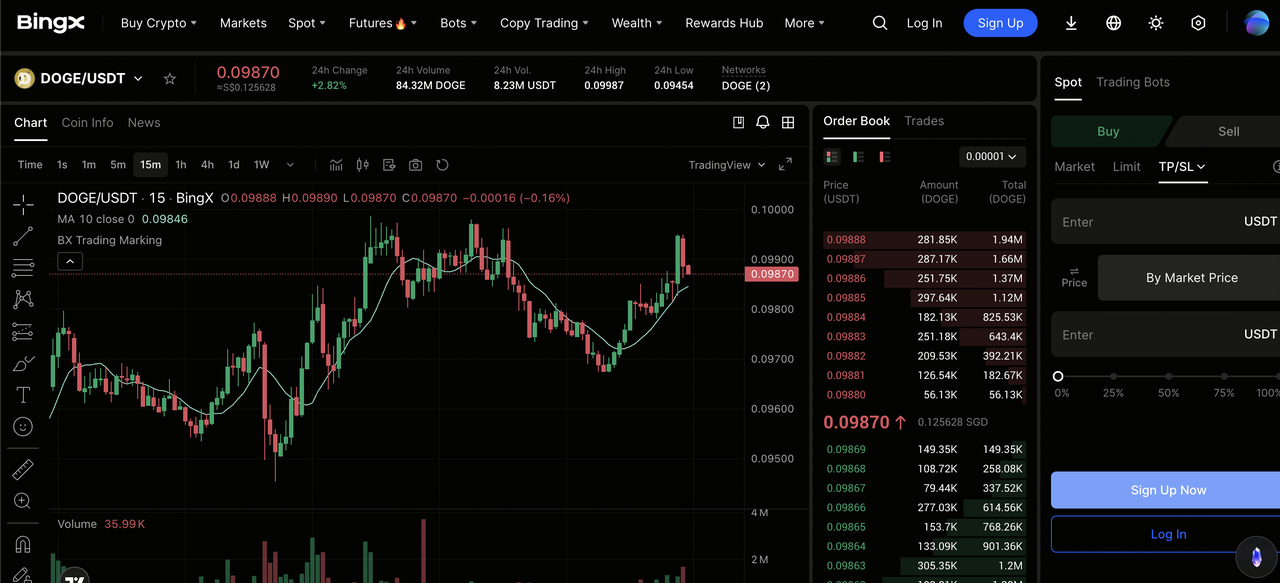
DOGE/USDT trading pair on the spot market
- Search for trading pairs such as BTC/USDT, LTC/USDT, DOGE/USDT, or KAS/USDT from the Spot section.
- Use Market Orders if you want instant execution at current price, or Limit Orders if you prefer to set your own entry price.
- For beginners, turning on BingX AI on the chart can highlight trend direction, support/resistance zones, and momentum shifts to help reduce emotional trading.
Read more: Top Ways to Buy Dogecoin (DOGE) in 2025
Long or Short Mining Cryptos with Leverage on the Futures Market
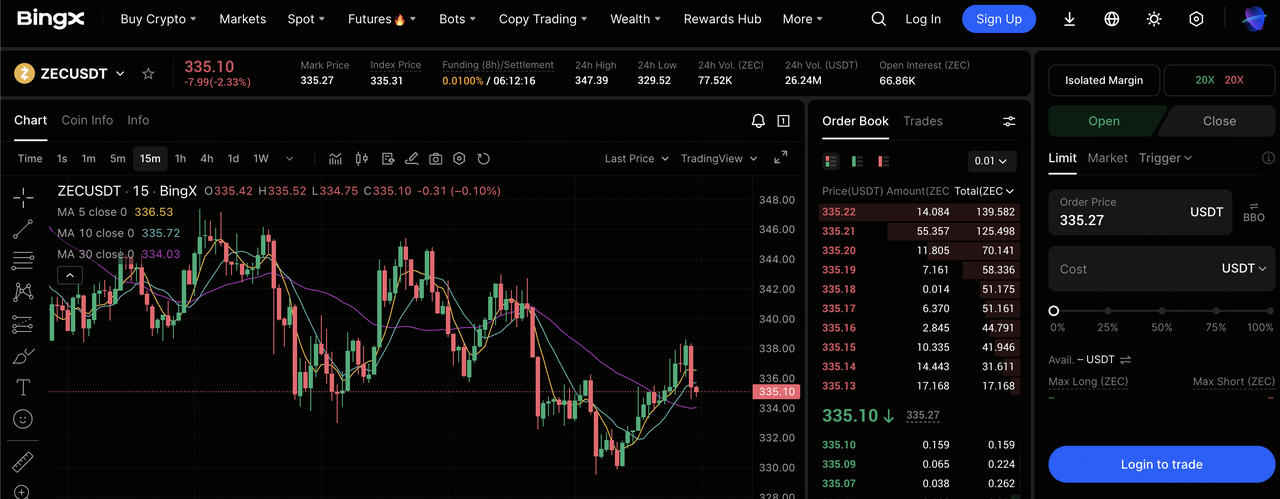
ZEC/USDT perpetual contract on the futures market
BingX Futures allows you to trade price direction, and not just buy and hold, so you can open long positions if you think price will rise or short positions if you expect a drop.
- Set stop-loss and take-profit before you enter the trade to manage risk, and start with low leverage until you are comfortable with volatility.
- Watch funding rates on pairs like BTC/USDT Perp, LTC/USDT Perp, DOGE/USDT Perp, and ZEC/USDT Perp, since these can affect long-term position costs.
Read more: Top Ways to Go Long Bitcoin (BTC) in 2026: A Comprehensive Guide
What Are the Top Risks of Crypto Mining?
In 2026, mining is a business of razor-thin margins and high technical complexity. Success is no longer guaranteed by simply owning hardware; you must manage the following systemic risks:
- The Hashprice Compression: Mining profit can flip from green to red in days. The key metric to watch is Hashprice (the dollar value of 1 PH/s per day). In Q1 2026, Bitcoin hashprice hit record lows near $30–$33/PH/s. When network hashrate surges (as it did recently to 855 EH/s) while the coin price remains stagnant, block rewards generate fewer dollars per kWh. For anyone paying retail electricity rates, a minor difficulty adjustment can turn a profitable rig into a liability overnight.
- Institutional Miner Sell Pressure: The 2026 market is dominated by public mining giants like MARA, CleanSpark, and Riot. These companies now sell massive amounts of BTC to fund operations and retire debt, a record 32,000 BTC was offloaded in Q1 2026 alone. This creates structural sell pressure that can suppress price rallies. Unlike hobbyists, industrial miners must sell regardless of market sentiment, which can accelerate drawdowns during bearish cycles.
- The Energy and Hardware Efficiency Gap: In 2026, 3nm ASIC technology has made older machines obsolete. Hardware like the Antminer S21 XP with 13.5 J/MH/s is the standard; running older gear is essentially donating electricity. Furthermore, energy costs are highly sensitive to global policy. At $0.05/kWh, you can stay competitive; at $0.10/kWh, you are likely mining at a loss. Always use real-time calculators like ASIC Miner Value before purchasing.
- Heightened Privacy Regulation (MiCA and AMLR): The regulatory landscape for privacy-focused PoW coins like Monero, Zcash, and Dash, is tightening. With the EU’s 2027 AML package and the full implementation of MiCA in 2026, many licensed exchanges have restricted privacy assets. If you mine these coins, you face off-ramp risk, the difficulty of converting your rewards into fiat or stablecoins. Always verify the status of these assets on BingX in your region.
- Liquidity and Order Book Slippage: Even if a coin like Kaspa (KAS) or Flux (FLUX) shows high theoretical profitability, thin order books can be treacherous. If a coin’s daily volume is below $5–$10 million, selling a large mining payout can cause significant slippage, where you receive a much lower price than the market average.
- Social vs. Computational Mining: Avoid confusing Pi Network with Proof-of-Work. Since Pi’s Open Mainnet launch on February 20, 2025, its value is driven by ecosystem utility and user KYC progress, not hashrate. There are no "rigs" for Pi; its risks are social and ecosystem-based, whereas PoW risks are physical and mathematical.
Final Word: Should You Mine Crypto in 2026?
If you’re new to Proof-of-Work, the safest path in 2026 is to stick with the "Liquid Big Three": BTC, LTC, and DOGE. These assets offer the deepest exchange liquidity and the most mature ETF-backed support. For those with high-efficiency hardware and low energy costs, specialized segments like Kaspa (KAS) or privacy leaders like Monero (XMR) and Zcash (ZEC) offer unique utility, but they require active monitoring of regulatory shifts.
Whatever your strategy, leverage BingX AI to automate your risk management. Use stop-loss and take-profit orders to protect your capital, and never commit more money than you can afford to lose. The PoW market of 2026 is more resilient than ever, but it rewards only those who treat mining as a disciplined financial operation.
Related Reading
- What Are the Top 10 Bitcoin Mining Stocks to Watch in 2025?
- What Are the Top Bitcoin Mining Pools to Mine BTC in 2026?
- Cloud Mining vs. Mining Pools vs. Solo Mining: What’s the Best Way to Mine Bitcoin in 2026?
- Is Bitcoin Mining Still Profitable in 2026: How to Calculate BTC Mining Profitability?
- Cloud Mining vs. Staking Crypto: What’s a Better Way to Earn Passive Income in 2026?
FAQs on Mining Cryptocurrencies
1. Is crypto mining still profitable in 2026?
Mining cryptocurrency has become a game of extreme efficiency. For Bitcoin, profitability is currently a challenge for anyone paying over $0.06/kWh, as the hashprice has hovered near record lows of $33/PH/s in early 2026. However, mining remains highly profitable for those with 3nm ASIC hardware and access to stranded or renewable energy. For mid-cap coins like Monero, CPU mining remains viable for hobbyists, while Kaspa continues to offer strong incentives for industrial-scale ASIC operations.
2. What hardware do I need to mine PoW coins?
The hardware landscape is now strictly segmented by algorithm. Bitcoin's SHA-256, Scrypt for Litecoin/Dogecoin, and Kaspa's kHeavyHash mining algorithms now exclusively require ASIC (Application-Specific Integrated Circuit) miners for any hope of profit. GPU mining has largely pivoted toward AI compute hosting or specialized PoW tokens like Flux and Ravencoin. If you are mining on a budget, high-end CPUs like the AMD Ryzen 9 or Threadripper are the standard for Monero's RandomX algorithm.
3. Can you really mine crypto coins from a phone?
Technically, no. High-performance PoW mining requires immense thermal management and specialized chips that mobile phones simply do not possess. Apps like Pi Network, which transitioned to Open Mainnet in 2025, use mobile mining as a social distribution and identity verification tool using the SCP consensus, not computational hashing. If an app claims your phone is solving hashes to mine Bitcoin, it is likely a simulation or a scam.
4. How do mining pools work?
Because the network difficulty for coins like Bitcoin is so high at around 146 trillion, the chance of a single miner finding a block is statistically negligible. In a pool, you combine your hashpower with thousands of other miners. When the pool finds a block, the reward is split proportionally based on your contribution. In 2026, many miners are moving to Stratum V2-compatible pools like Ocean or Braiins, which allow individual miners to select their own transactions, improving decentralization.
5. Which PoW coins have unique technology advantages?
Leading proof-of-work coins now differentiate through specialized innovation: Kaspa uses a BlockDAG (GHOSTDAG) design that processes blocks in parallel and, after its Crescendo upgrade, can sustain around 10 blocks per second for some of the fastest PoW finality; Dash leverages ChainLocks through Masternodes for near-instant, reorg-resistant confirmations; Zcash applies Halo 2 zero-knowledge proofs to enable private yet auditable transactions via viewing keys; while Monero remains known for default privacy and its RandomX mining algorithm, which resists ASIC dominance and supports decentralized CPU mining.