What Is a Fair Value Gap (FVG)?
A Fair Value Gap (FVG) is a specific three-candle sequence on a price chart where a rapid, impulsive move creates an imbalance between buyers and sellers. This displacement leaves behind a price vacuum (liquidity void) that the market, driven by institutional algorithms, seeks to rebalance. In the context of global uncertainty and war, these gaps act as magnets, offering high-probability entry points for traders who understand how Smart Money manages risk.
Why War Creates the Ultimate Institutional Playground
In the 2026 financial landscape, geopolitical tension is the primary catalyst for market inefficiencies. When War Headlines break, retail traders often react with panic selling or FOMO buying, leading to sharp price movements that bypass traditional limit orders.
These aren't just random spikes; they are large institutional trades hitting a thin order book. For a seasoned analyst, these Mega Gaps are not signs of chaos, but rather clear signals of institutional order flow. While the crowd sees a crash, the Smart Money sees a discount or a premium waiting to be filled.
Key Takeaways
• FVGs are magnets: Markets almost always return to fill at least 50% (the Consequent Encroachment) of a large gap.
• Liquidity is King: During war, Bitcoin often behaves as a high-beta risk asset; understanding liquidity voids is more important than basic support/resistance.
• Efficiency over Emotion: Trading the retrace into a gap is the most consistent way to capitalize on news-driven volatility.
Understanding Mechanics of the Fair Value Gap: The 3-Candle Rule
To trade successfully during a 2026 geopolitical crisis, you must understand that an FVG is more than just a gap; it is a footprint of displacement. When institutional algorithms reprice assets due to war headlines or economic shocks, they leave a specific sequence on the chart.
The Anatomy of an FVG Sequence
A valid Fair Value Gap is identified by observing three consecutive candles in the same direction:
1. Candle 1 (The Anchor): This candle establishes the boundary of the previous price range. In a bullish move, we focus on its High; in a bearish move, its Low.
2. Candle 2 (The Displacement): This is the Momentum Candle. It must be significantly larger (ideally 2-5x) than the surrounding candles, showing clear institutional intent. This candle creates the actual imbalance.
3. Candle 3 (The Confirmation): This candle completes the pattern. The gap is formed because the wick of Candle 3 fails to overlap with the wick of Candle 1.
Bullish vs. Bearish FVG: How to Mark Your Zones
Identifying the zone correctly is the difference between a sniper entry and a stop-out.
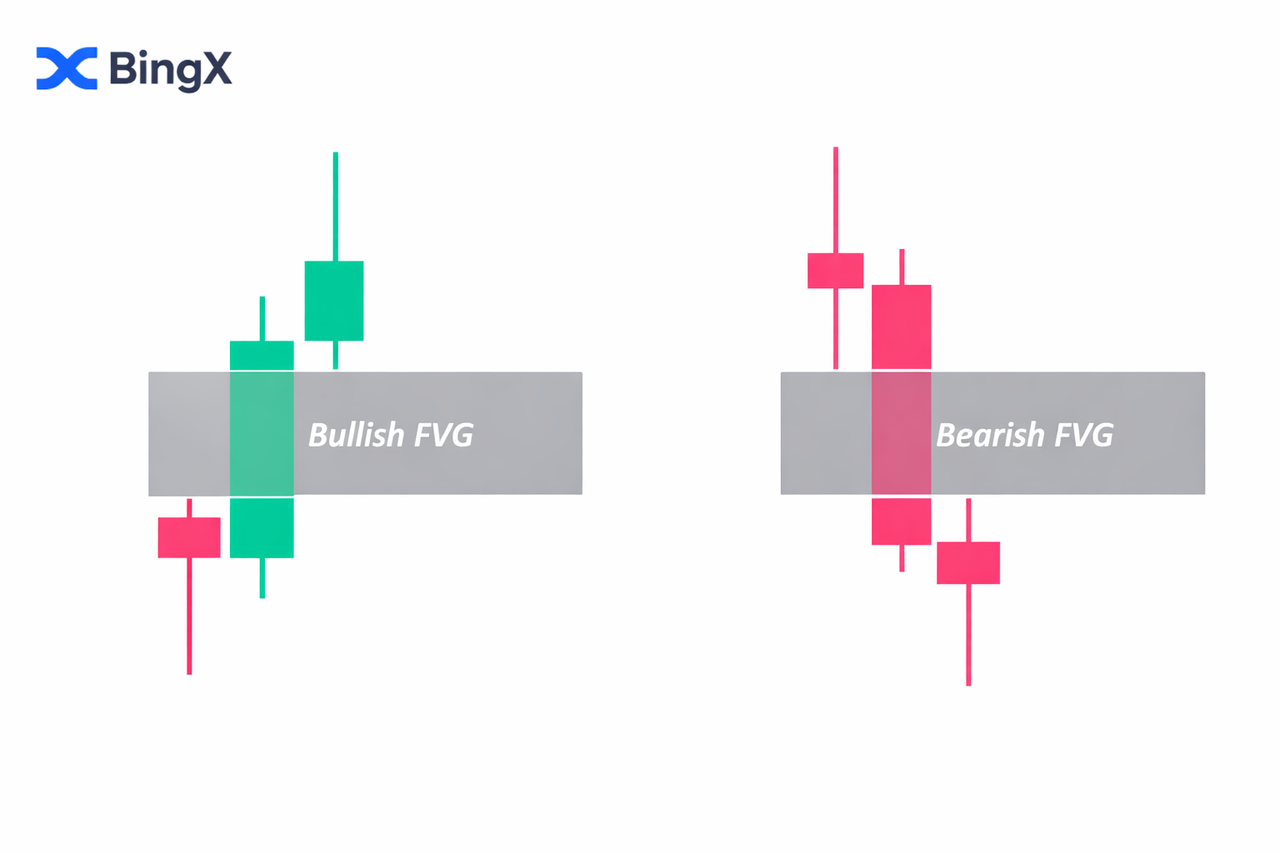
| Feature | Bullish FVG (Buy-Side Imbalance) | Bearish FVG (Sell-Side Imbalance) |
| Market Trend | Upward Impulse / Displacement | Downward Impulse / Displacement |
| Lower Boundary | High of Candle 1 | High of Candle 3 |
| Upper Boundary | Low of Candle 3 | Low of Candle 1 |
| Institutional Logic | Unfilled Buy Orders (Discount) | Unfilled Sell Orders (Premium) |
Smart Money Logic: The Magnet Effect
In a balanced market, price delivery is efficient, meaning wicks overlap and every price level is traded by both buyers and sellers. When a geopolitical shock occurs, the market becomes inefficient.
Institutional algorithms are programmed to return to these gaps to rebalance the price. They seek the Consequent Encroachment (the 50% midpoint of the FVG) to fill remaining orders. This is why these gaps act like magnets. The market must revisit them to ensure two-sided liquidity before continuing the primary trend.
In 2026, don't just look for any gap. The highest probability FVGs are those that occur immediately after a Liquidity Sweep (taking out old highs or lows) or a Market Structure Shift (MSS). If a gap forms without breaking structure, it is likely a trap or a minor exhaustion gap.
Why Geopolitical Uncertainty Triggers Mega Gaps
In 2026, the financial landscape is defined by fragile liquidity. Despite the maturation of Bitcoin ETFs, order book depth remains significantly lower than pre-2024 levels. When geopolitical shocks, such as the recent tensions in the Middle East or shifts in global trade policy, hit the wires, the result is the creation of Mega Gaps.
1. Institutional Order Flow vs. Thin Books
When War Headlines break, institutions don't just sell; they rebalance portfolios at scale. Because the current market has impaired order book depth (often 40% below historical averages), these large institutional trades don't just move the price, they teleport it. This creates a Liquidity Void, a massive gap where no actual trading occurred because the price moved too fast for retail limit orders to be filled.
2. The 2026 Flight to Quality Paradox
Historically, Bitcoin was viewed as a digital gold. However, current market dynamics show that in the initial minutes of a crisis, Bitcoin acts as a high-beta risk asset.
• The Initial Shock: Investors rush to the U.S. Dollar (DXY) and Treasuries for immediate liquidity, causing a sharp downward displacement in crypto.
• The Opportunity: This panic creates a Bearish FVG (Premium). Once the initial shock subsides, the market almost always retraces to this gap to provide the Smart Money an entry to short or to re-accumulate if the macro trend remains bullish.
3. Market Inefficiencies and Information Asymmetry
Geopolitical uncertainty creates Information Asymmetry. High-frequency trading (HFT) algorithms react to news sentiment in milliseconds, while human retail traders react in minutes.
• This lag creates price imbalances where the Fair Value of the asset is no longer reflected in the current bid/ask spread.
• As a professional trader, you aren't trading the news; you are trading the market inefficiency left behind by the algorithms' overreaction.
In a volatile 2026 environment, Mega Gaps are your map. They show you exactly where the Smart Money was forced to skip over price levels. These levels will be revisited because the market seeks equilibrium.
How to Trade the Fair Value Gap: Entering the Liquidity Gap
Trading FVGs during a geopolitical crisis requires a disciplined, three-step execution model. We don't market buy the moment a gap forms; we wait for the market to come to us.
Step 1: Identifying the Trend Context (HTF Bias)
Many retail traders make mistakes by spotting a Fair Value Gap and placing an order right away, without considering the bigger picture. In professional trading, the Higher Timeframe (HTF) Bias is your main guide. It helps you see which gaps are likely to hold and which ones are just liquidity traps.
Here’s a detailed breakdown of your images and how they relate to the 2026 market:
1. The Premium vs. Discount Rule (HTF Bias)
The idea of Premium and Discount comes from the 50% Fibonacci retracement level, which traders often call the equilibrium point.
The Logic: You don’t want to buy when the price is in the Premium zone, since that means it’s relatively expensive. Instead, you look for better value.
The Execution: When the higher time frame is bullish, it’s best if price pulls back into the Discount zone, which is below the 50% equilibrium.
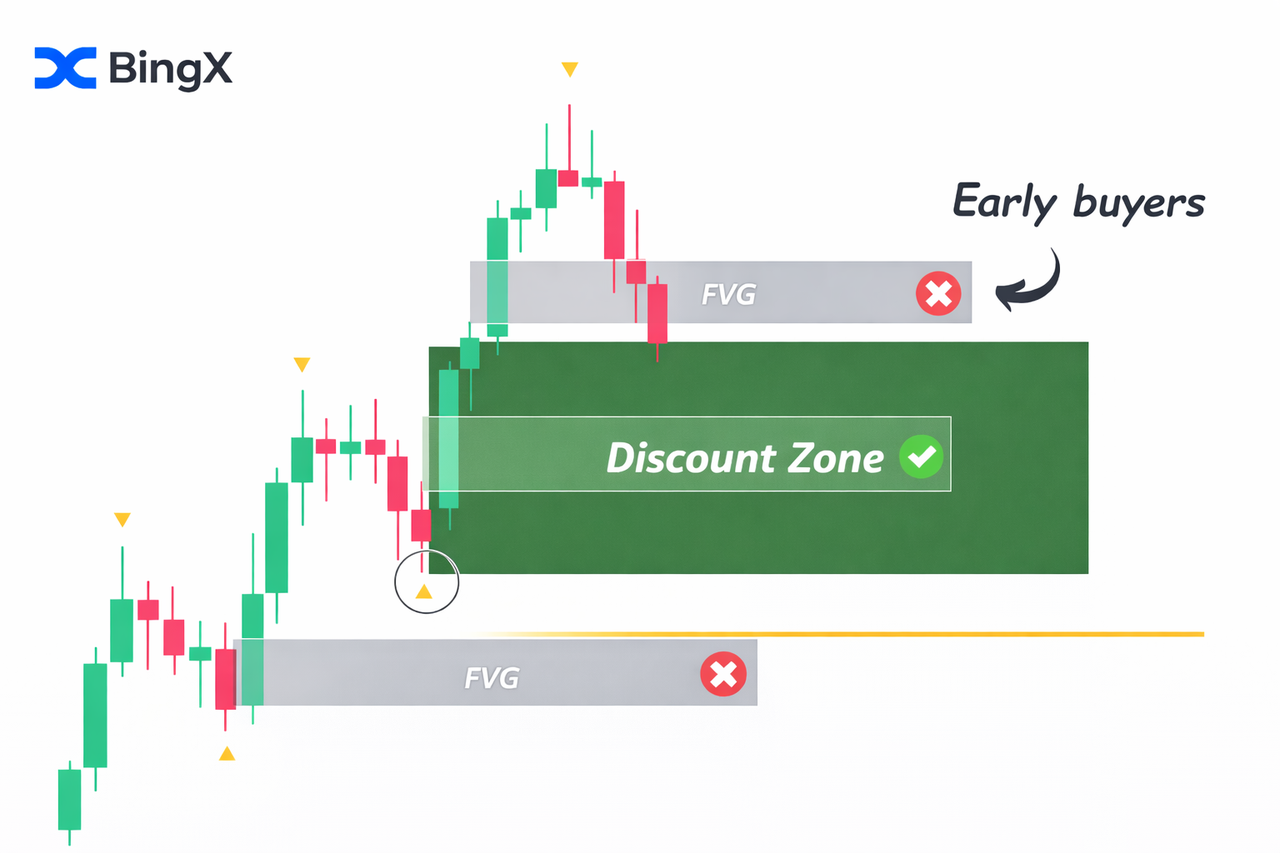
FVGs in the Premium zone usually have poor risk-to-reward. On the other hand, FVGs in the Discount zone match value-based buying and often give you better entry chances.
The main idea is simple: buy when there’s value, not when it’s expensive.
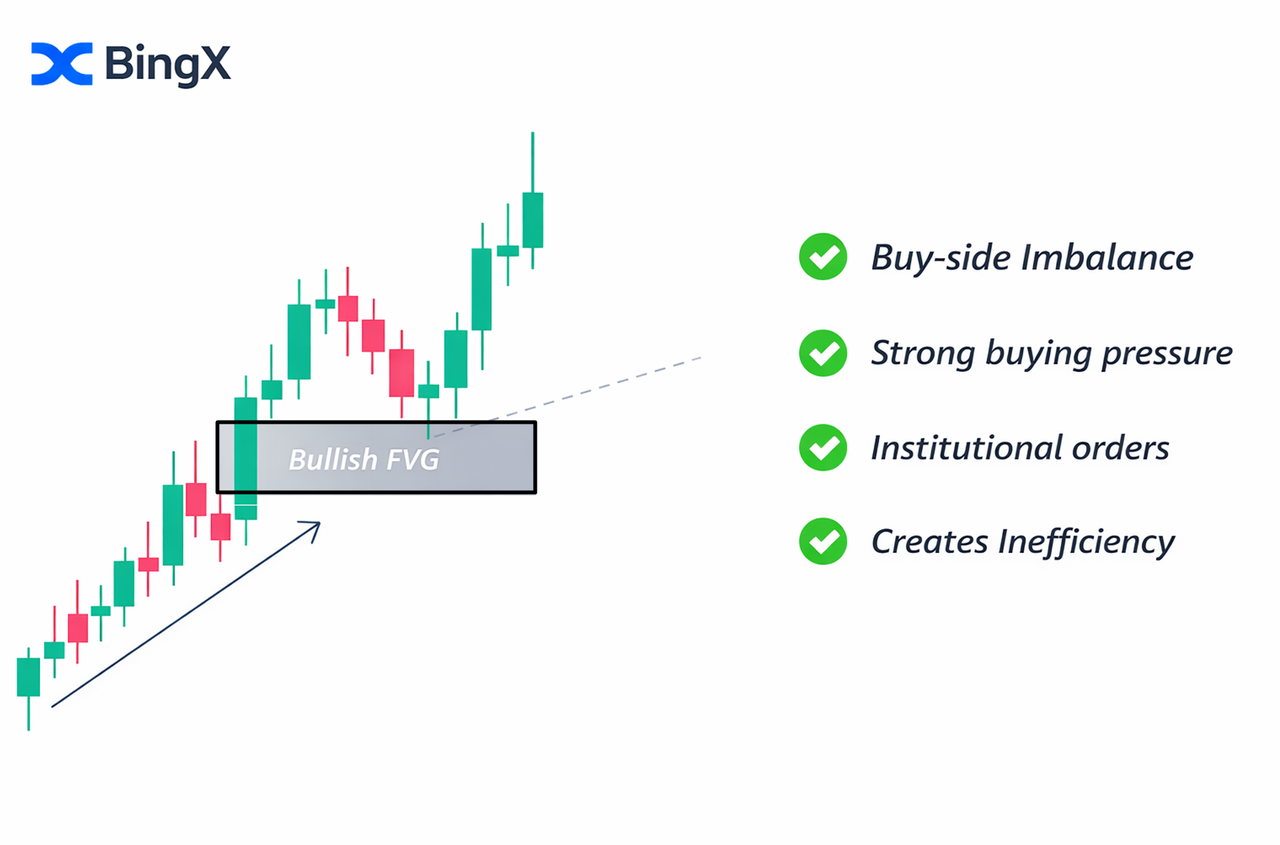
2. Identifying Early Buyers: The Trap
Big news events, like geopolitical headlines, often cause tricky early moves in the market.
The Trap: When price starts to bounce, early buyers jump into the first visible FVG without waiting for deeper liquidity.
The Institutional Move: Large players frequently push price lower to sweep the stop-losses of those early buyers. This liquidity grab often occurs before price taps into a deeper Discount FVG, where the true bullish expansion begins.
Patience matters in volatile markets. Waiting for a deeper imbalance, especially one in the Discount zone, usually gives you a better entry.
3. The Protected Low Concept
A key idea in Smart Money trading is the Protected Low.
Higher Time Frame Confirmation: In a bullish setup, a Protected Low is an important swing point that should stay unbroken. If price falls below it, the bullish outlook is no longer valid.
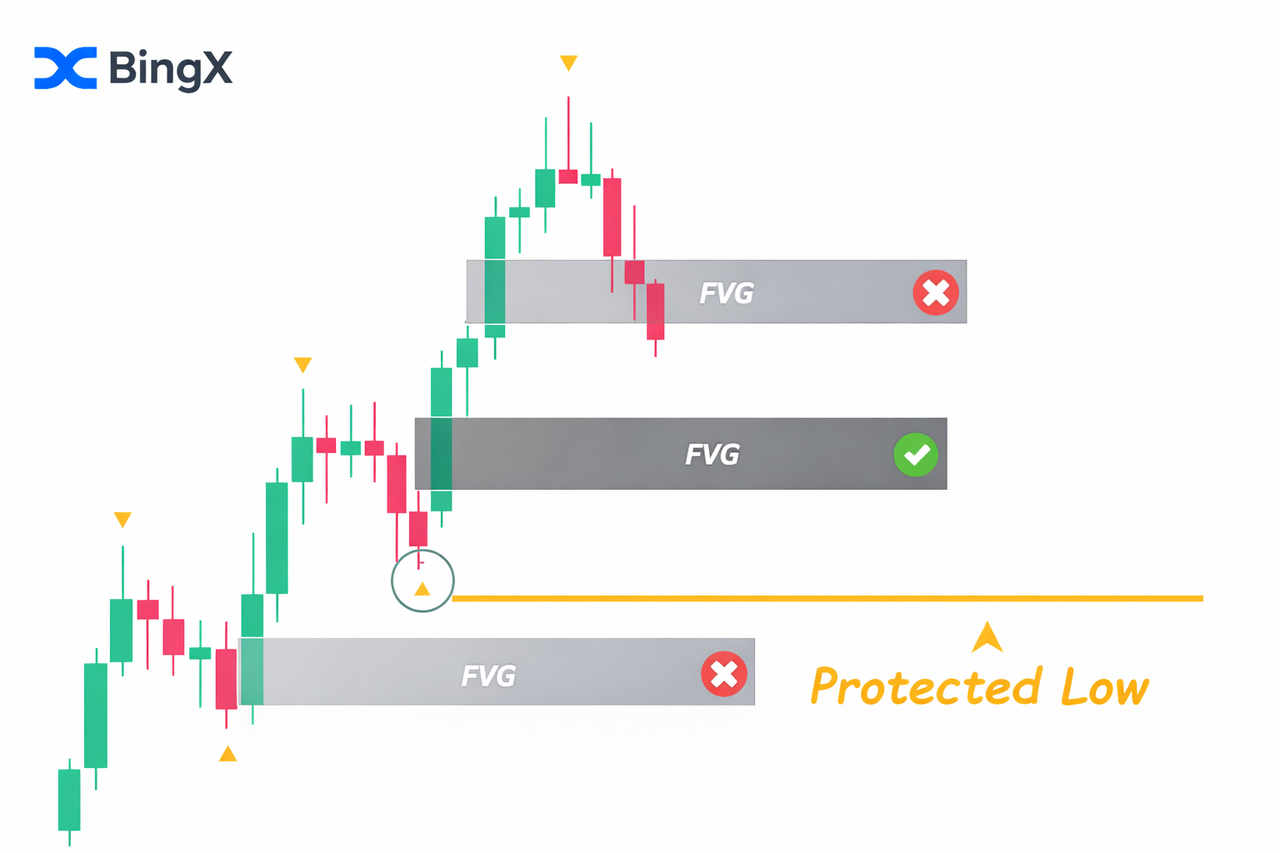
Strategic Entry: An FVG just above the Protected Low gives support for a long trade. If price drops into an imbalance below this level, it could break the Protected Low and change the market direction.
Rule of Thumb: The best FVG lines up with strong support and doesn’t put the higher time frame trend at risk.
4. Bearish Context: The Premium Short
In a bearish market, logic flips.
The Setup: Price makes Lower Highs and Lower Lows, showing that momentum is moving down.
The Execution: Now, you look for retracements into bearish FVGs in the Premium zone. In downtrends, price often moves up a bit before heading lower again.
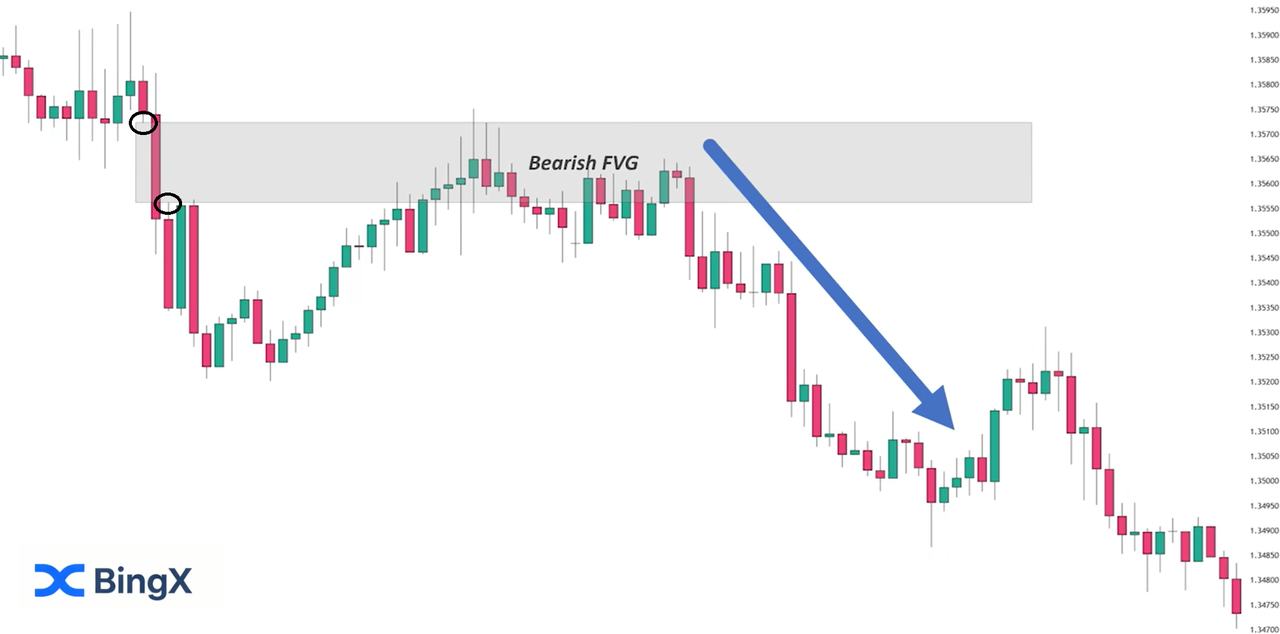
During sharp selloffs or flash crashes, several bearish imbalances can appear. The highest one, deepest in the Premium zone, usually gives the best risk position for short trades.
This follows the same logic as bullish setups: sell when price is expensive, not when it’s cheap.
5. The War Filter: DXY Correlation
When markets are risk-off, the U.S. Dollar Index (DXY) often acts as a big-picture filter.
Rising DXY = Pressure on Crypto: When the dollar strengthens due to global uncertainty, crypto assets frequently weaken. In this environment, bullish FVG setups carry higher failure risk.
Strategic Adjustment: If DXY maintains bullish structure, the focus should remain on bearish FVG opportunities in crypto markets. Long setups regain validity only after a clear Market Structure Shift (MSS), defined by price breaking a recent Lower High on the 1-hour or 4-hour chart.
Macro context doesn’t replace market structure, but it does help strengthen your directional bias.
Bearish Context: If the HTF is breaking support, focus exclusively on Bearish FVGs (Premium zones).
The War Filter: During a crisis, if the DXY (Dollar Index) is surging, crypto FVGs are high-probability short setups until a Market Structure Shift (MSS) occurs.
Step 2: The Retrace Entry (The 50% Rule)
Once a valid FVG is identified, mark the zone. Professional traders use the Consequent Encroachment (CE), the exact 50% midpoint of the FVG.
The Setup: Place your limit order at the beginning of the FVG or the CE level.
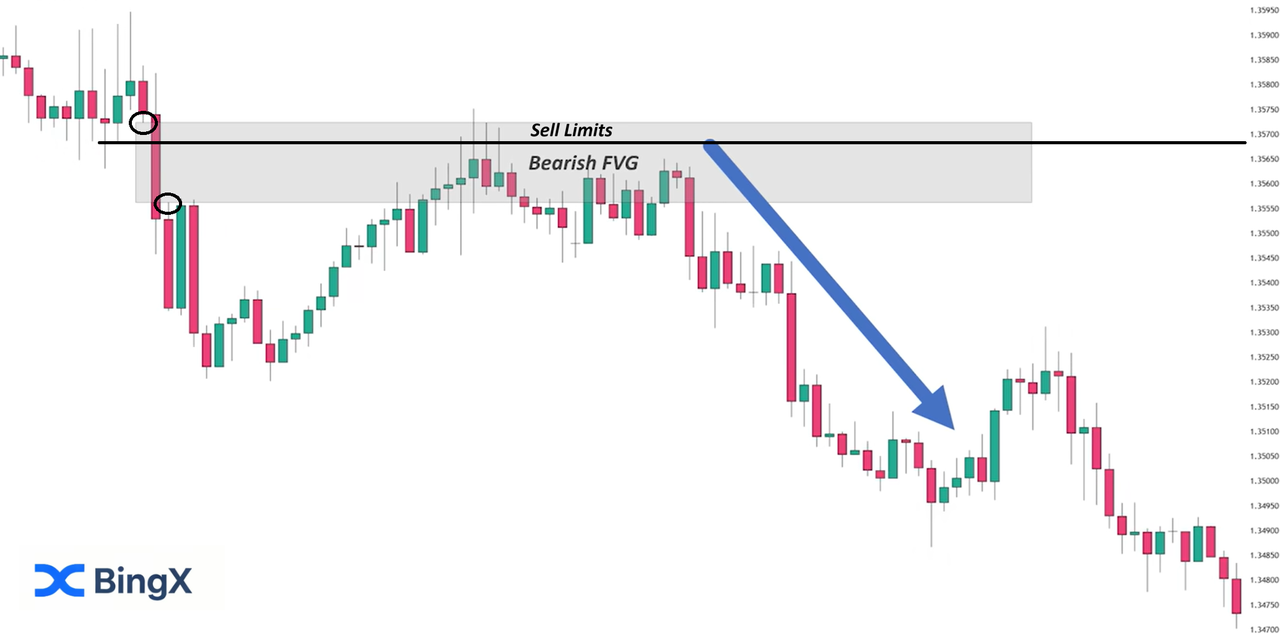
Why? Algorithms often rebalance the price by filling at least half of the imbalance before resuming the trend. If the price closes past the 50% mark and struggles to bounce, the gap may be invalidated.
Step 3: Confluence Factors for God-Tier Setups
To increase your win rate to institutional levels, look for these three overlays:
1. RSI Divergence: If price retraces into a Bullish FVG while the Relative Strength Index (RSI) shows an Oversold reading or bullish divergence, the probability of a bounce is over 70%.
2. Volume Spikes: Look for a surge in volume during the initial displacement (Candle 2) and decreasing volume during the retrace. This confirms retail is exhausted and Smart Money is waiting.
3. The Third Candle Secret: Watch the low of the third candle in a bullish sequence. If the market returns to the FVG but cannot close below the low of Candle 3, it is a strong signal that the gap is acting as a hard support.
How to Manage Risk in Volatile Markets
Managing risk is essential in volatile markets, especially when sudden price gaps happen during times of war. Your main goal should be to protect your capital. In 2026’s high-volatility period, keep your risk per trade to just 1% of your total capital.
Setting your stop-loss is just as important. Do not place it inside the gap. For bullish trades, set your stop just below the low of Candle 1. For bearish trades, place it just above the high of Candle 1.
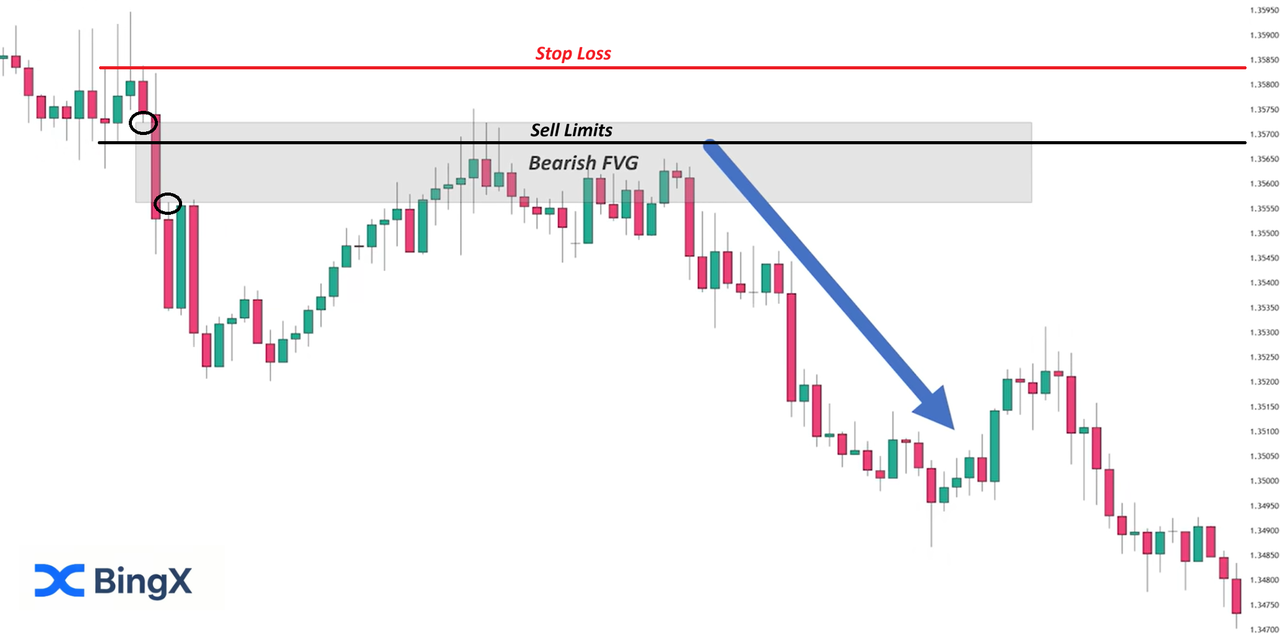
Another risk is the stop-hunt trap. This happens when institutions move the price just past the Fair Value Gap (FVG) to grab liquidity. If the 15-minute candle closes back inside the FVG, the setup is still valid even if there was a wick-out.
Comparison: FVG Entry vs. Retail Entry
| Feature | Retail (Panic) Entry | Smart Money (FVG) Entry |
| Timing | Enters during the Displacement (FOMO) | Enters during the Retrace (Discount) |
| Price | Buys at the High / Sells at the Low | Buys at the Fair Value |
| Risk/Reward | Poor (Chasing the move) | High (Defined by the Gap boundaries) |
Summary: Bullish vs. Bearish Setups
1. Market Condition: The Context
This tells you why the gap exists. These are categorized based on the news cycle:
• Bullish (Recovery/FOMO): Occurs after a dip is bought aggressively. For example, if Bitcoin drops on war news but then bounces vertically as the market realizes the news was priced in, that surge creates a Bullish FVG.
• Bearish (Initial Panic): This is the Flash Crash phase. When a headline hits (e.g., trade sanctions or escalation), the market drops so fast that it skips price levels. This is the institutional sell-off footprint.
2. Zone Type: Discount vs. Premium
Algorithms view the market as a retail store. They don't want to buy at high prices or sell at low prices.
• Discount (Buy Cheap): A Bullish FVG represents a price level that is now undervalued relative to the new trend. You are looking to buy at a discount.
• Premium (Sell High): A Bearish FVG is a Premium zone. When the price retraces back up into this gap, it is considered expensive again, making it the perfect spot for institutions to enter more short positions.
3. Entry Point: Top/Bottom vs. 50% CE
This is where you actually place your limit orders.
• The Boundaries: The Top of a Bullish gap or the Bottom of a Bearish gap is the most aggressive entry. You enter here if you think the trend is so strong it won't fill the whole gap.
• Consequent Encroachment (50% CE): This is the mathematical midpoint of the FVG. Institutions frequently target this exact level.
Strategy: If you want a better risk-to-reward ratio, place your entry at the 50% line. If the price closes past the 50% mark and doesn't bounce, the gap is weakening.
4. Stop Loss: The Invalidation Point
In Smart Money Concepts (SMC), a trade becomes invalid if the price moves completely through the Fair Value Gap and breaks the starting point of the move.
For a bullish setup, set your stop-loss just below the low of Candle 1. If the price falls below where the move started, the imbalance has failed and the bullish setup is no longer valid.
For a bearish setup, set your stop-loss just above the high of Candle 1. If the price rises above where the bearish move began, the downside momentum is lost and the setup does not work anymore.
The main idea is straightforward: if the price moves past where the imbalance started, the reasoning behind the setup is no longer valid.
Conclusion: Mastering Inefficiency
In the high-stakes trading environment of 2026, success is rarely found by following the herd into a War Headline. Instead, it is found in the quiet spaces, the Fair Value Gaps and Liquidity Voids, left behind by institutional algorithms.
Understanding the 3-candle rule and the Smart Money logic of rebalancing allows you to transform market chaos into a structured execution plan. By waiting for the retrace into a Discount or Premium zone, you shift from a retail mindset of chasing the move to an institutional mindset of providing liquidity at the right price.
The Mega Gaps triggered by global uncertainty are not barriers; they are maps. If you respect the Higher Timeframe bias, wait for the 50% Consequent Encroachment, and maintain a disciplined 1% risk profile, you can navigate even the most volatile geopolitical shifts with surgical precision.
The bottom line: In a market of teleporting prices and thin order books, the most profitable traders aren't the fastest, they are the ones who know exactly where the market has to return.
Related Articles
1. Mastering Candlestick Charts in Cryptocurrency Trading: A Complete Guide
2. How to Use the Relative Strength Index (RSI) in Crypto Trading
3. Understanding Trend Lines for Cryptocurrency Trading: A Visual Guide to Smarter Moves
4. 10 Top Technical Indicators for Cryptocurrency Trading
5. 10 Key Indicators to Signal a Crypto Bull Run
6. How to Use Moving Average Convergence Divergence (MACD) in Crypto Trading
FAQs on Fair Value Gaps
1. What is the most reliable timeframe for trading FVGs during market volatility?
While FVGs appear on all timeframes, the 1-Hour and 4-Hour charts are the most reliable for identifying institutional displacement during crises. Traders should use these higher timeframes to find the Mega Gaps and then drop down to the 5-minute chart for precision entries to manage risk effectively.
2. Why does the market always try to fill a Fair Value Gap?
Markets seek Fair Value or equilibrium. An FVG represents a price imbalance where only one side of the market (either buyers or sellers) was represented. Institutional algorithms are programmed to return to these liquidity voids to offer the other side of the trade, ensuring the market remains efficient and rebalanced.
3. What is the 50% Rule in FVG trading?
The 50% Rule refers to Consequent Encroachment (CE). It is the exact midpoint of a Fair Value Gap. Often, the market does not need to fill 100% of a gap to be considered rebalanced; reaching the 50% mark is frequently enough for institutional algorithms to consider the inefficiency satisfied before continuing the trend.
4. How does war affect Bitcoin’s liquidity and price gaps?
In 2026, geopolitical uncertainty often triggers a Flight to Quality, causing an initial spike in the U.S. Dollar and a flash sell-off in crypto. Because order books are thin during crises, large sell orders move the price through multiple levels instantly, creating Mega Gaps that serve as high-probability targets for a future retrace.
5. Can an FVG act as support or resistance?
Yes. Once a Fair Value Gap is filled or partially filled (at the CE level), the imbalance is removed, and the zone often flips into a Support or Resistance level. In a bullish trend, the top of a filled FVG often becomes a hard support where Smart Money re-accumulates positions.