
In April 2026, the Nasdaq 100 (NAS100) is at a critical technical and fundamental crossroads. After hitting a fresh intraday all-time high of 24,020 on April 15, the index is attempting to decouple from the geopolitical risk-off sentiment that defined the first quarter. While the tech sector confirmed a 10% correction in late March due to the U.S.-Iran conflict and surging energy costs, a recent ceasefire agreement has sparked a 9-session bullish streak. Investors are now weighing a massive 46.2% projected growth in IT earnings against the reality of a Fed that remains higher-for-longer due to energy-driven inflation.
As the Q1 2026 earnings season begins, the AI boom is entering its most scrutinized phase. With the CNN Fear and Greed Index rebounding to 62 at Greed, the market's appetite for risk has returned, but structural fragility remains. This guide breaks down the Nasdaq 100 price prediction for 2026 using data from Reuters, Fidelity, Morningstar, and StoneX.
You will also discover how to gain exposure to Nasdaq 100 (NAS100) stock futures through BingX TradFi.
Top 5 Things for Nasdaq 100 Investors to Know in 2026
As the Nasdaq 100 navigates a high-stakes environment of technological disruption and geopolitical tension, investors must keep these five market-moving factors at the forefront of their 2026 strategy.
- The 24,000 Reclaim: On April 15, 2026, the Nasdaq 100 closed at a record high, signaling that dip-buyers have officially returned to the AI trade following the March correction.
- The CapEx Scrutiny: Hyperscalers like Microsoft, Google, and Meta are pouring billions into AI infrastructure. Investors are no longer trading on hype but are demanding clear evidence of operating margin expansion from these investments.
- Energy vs. Tech Valuations: Historically, tech multiples compress when crude oil stays above $100. With Brent oil gyrating near triple digits, the cost of carry for high-growth stocks remains elevated.
- Concentration Extremes: The Magnificent Seven, especially NVIDIA and Microsoft, now command such a large portion of the index that a single earnings miss from one titan can swing the entire NAS100 by 2-3% in hours.
- The 10-Year Treasury Threshold: The yield on 10-year Treasuries is hovering near 4.5%. Analysts warn that breaking above this level could trigger a systemic de-rating of growth stock P/E ratios.
What Is the Nasdaq 100 Index (NAS100)?
The Nasdaq 100 or NAS100 is a stock market index comprising 100 of the largest non-financial companies listed on the Nasdaq Stock Exchange. Unlike the S&P 500, the NAS100 is almost entirely dominated by innovation and growth sectors, making it the primary global benchmark for the technology economy.
The index is currently anchored by the AI Giants: NVIDIA, Microsoft, Apple, Amazon, and Alphabet. In 2026, these firms represent the backbone of the decentralized and AI-driven digital economy. The index also includes key pick-and-shovel players like TTM Technologies (TTMI) and Broadcom (AVGO), which provide the hardware required for AI data centers. As of April 2026, the Nasdaq 100 is trading at a forward P/E of roughly 25x, a valuation that analysts describe as expensive but supported by record-high corporate profit margins currently hitting 15%.
Read more: How to Trade Stock Indices With Crypto as TradFi Goes On-Chain in 2026
Nasdaq 100's Performance in 2025: A Review
In 2025, the Nasdaq 100 continued its historic bull run, driven by the mass adoption of generative AI and agentic workflows. Tech stocks delivered a total return exceeding 24%, outperforming traditional indices. However, the year was not without its scares. In Q2 2025, the index faced a Liberation Day tariff shock that caused a brief 15% drawdown before rebounding to record highs by October.
The defining theme of 2025 was the transition of AI from experimentation to implementation. This allowed the Nasdaq to withstand three Federal Reserve rate holds as corporate earnings growth consistently outpaced inflation. By the end of December 2025, the NAS100 index had set the stage for the 24,000 milestone we are witnessing today.
Nasdaq 100's 2026 Strategy: How to Navigate the Volatility in Equity Markets
- The AI Multiplier Effect: Software and chip giants are now responsible for nearly 50% of the index's earnings growth. This secular trend acts as a buffer against cyclical economic slowdowns.
- The 23,000 Line in the Sand: Technical analysts at StoneX identify 23,000 as the key support level. As long as the index holds this floor, the long-term upward trendline remains intact.
- RSI Neutrality: With the Relative Strength Index (RSI) near 50, the Nasdaq is neither overbought nor oversold, suggesting a period of consolidation before the next major move.
Nasdaq 100 2026 Investment Outlook: 27,000 Bull Run vs. 22,000 Bear Case
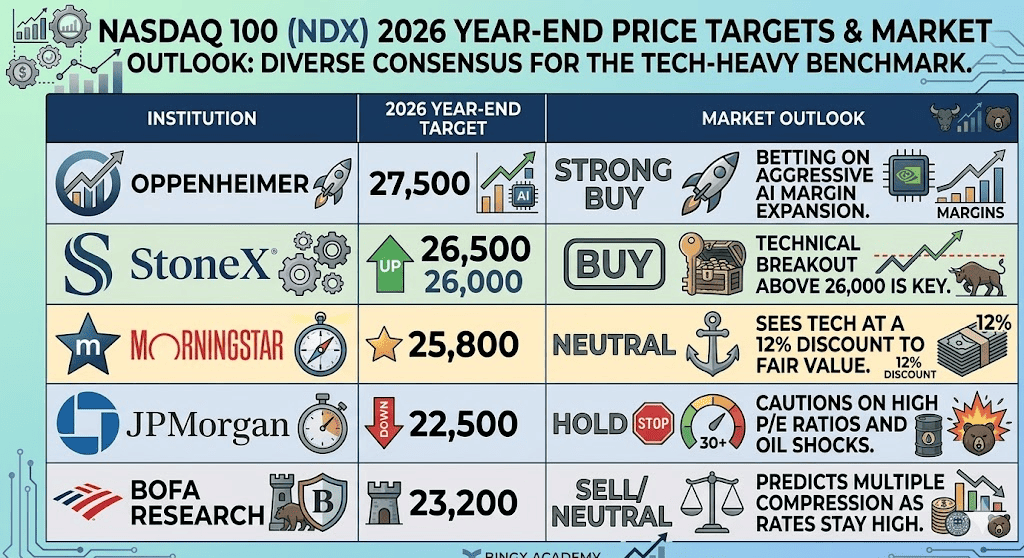
Nasqag 100 predictions for 2026 by Wall Street analysts
To navigate the current market uncertainty, investors must weigh these three distinct probability-weighted outcomes for the Nasdaq 100 through the remainder of 2026.
The Bull Case: Nasdaq's 27,000 AI Breakthrough
The bullish narrative, supported by Oppenheimer and Morgan Stanley, hinges on a Goldilocks macro environment where geopolitical tensions dissolve. If the Pakistan-mediated ceasefire leads to a permanent reopening of the Strait of Hormuz, a rapid decline in Brent oil toward $80 would likely trigger a massive relief rally. This shift would provide the Federal Reserve the necessary cover to pivot toward rate cuts in H2 2026, lowering the discount rate and aggressively boosting the present value of future tech earnings.
In this scenario, the projected 46.2% earnings growth for the IT sector moves from expected to realized, driving a powerful valuation re-rating. Practical exposure would focus on high-beta semiconductor plays and AI infrastructure providers that benefit from lower borrowing costs. If the AI Multiplier results in double-digit margin expansion across the Magnificent Seven, the NAS 100 index could decisively clear the 26,500 resistance, targeting a historic 27,000 year-end finish.
The Base Case: 24,500 – 25,500 Range-Bound Grind for NAS100
The base case positions the Nasdaq in a distribution phase as the market digests the initial AI surge amid higher-for-longer interest rates. Analysts at Fidelity and Morningstar suggest that while AI capital expenditure remains at multi-decade highs, the 10-year Treasury yield hovering near 4.5% acts as a persistent ceiling on price-to-earnings multiples. This creates a high-volatility environment where the index struggles to maintain a clean trend, instead oscillating between established support and resistance.
For investors, this stock-picker’s market requires a tactical rotation into Quality Growth. Insights suggest moving away from speculative AI hype names toward cash-rich titans like Alphabet and Microsoft, which boast the balance sheets to self-fund expansion without relying on easing credit markets. By maintaining a 15% profit margin across the index, the Nasdaq 100 would likely sustain its 24,000 floor, drifting toward a mean year-end target of 25,000 as earnings catch up to current valuations.
The Bear Case: Nasdaq 100's 22,000 Stagflation Trap
The bear case, warned by JPMorgan, is triggered by a macro-skunk scenario where Middle East negotiations collapse, sending oil prices north of $120. Such a supply-side shock would move beyond a mere inflationary nuisance, turning into a primary driver of demand destruction. As energy costs eat into consumer discretionary spending, the currently robust corporate margins would face a sharp contraction, forcing enterprise clients to slash multi-billion dollar AI CapEx plans to preserve liquidity.
Technically, this downside scenario centers on a decisive break below the 22,900 support level, which would likely activate systematic trend-following sell programs. A breach of this magnitude would open the door for a retest of the 21,500–22,000 zone, effectively wiping out over a year of tech gains. In this hard-landing environment, investors would need to pivot aggressively toward defensive hedges, utilizing Short Futures or Inverse ETFs to protect portfolios against a systemic de-rating of growth multiples.
Nasdaq 100 Price Forecasts for 2026 By Wall Street Analysts
|
Institution |
2026 Year-End Target |
Market Outlook |
|
Oppenheimer |
27,500 |
Strong Buy: Betting on aggressive AI margin expansion. |
|
StoneX |
26,500 |
Buy: Technical breakout above 26,000 is key. |
|
Morningstar |
25,800 |
Neutral: Sees tech at a 12% discount to fair value. |
|
JPMorgan |
22,500 |
Hold: Cautions on high P/E ratios and oil shocks. |
|
BofA Research |
23,200 |
Sell/Neutral: Predicts multiple compression as rates stay high. |
How to Trade the Nasdaq 100 (NAS100) on BingX
Navigate the tech-heavy volatility of 2026 using BingX TradFi tools and BingX AI integrations. Whether you are going long on the AI infrastructure boom or hedging against a tech correction, BingX offers high-liquidity perpetual contracts with 500x leverage combined with AI-driven market insights to help you identify optimal entry and exit points in the Nasdaq-100 market.
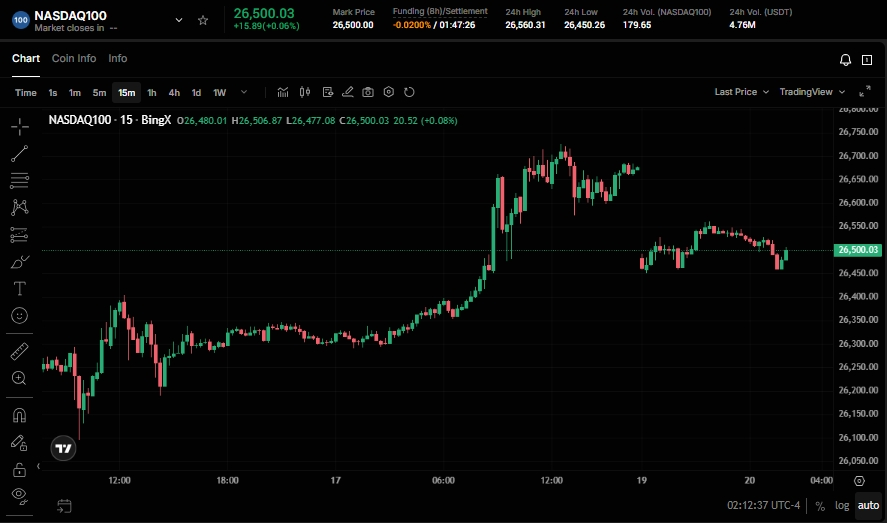
Long or Short Nasdaq 100 Futures on BingX TradFi
- Navigate to BingX TradFi and select Global Indices.
- Select the NASDAQ100/USDT perpetual contract.
- Set your leverage (e.g., 2x–20x). Select Open Long if you expect an AI earnings beat, or Open Short to hedge against energy-driven inflation.
- Set Take-Profit (TP) and Stop-Loss (SL) based on the key support and resistance levels.
Top 5 Risks to Watch for Nasdaq 100 Investors in 2026
- CapEx Fatigue: If the Big Three cloud providers signal a slowdown in AI server orders, the hardware sector like NVIDIA and TTM could face a sharp de-rating.
- The 10-Year Yield Spike: Any move in Treasury yields toward 5.0% would make growth stocks mathematically less attractive.
- Regulatory Headwinds: New AI safety guardrail bills in the U.S. and EU could slow the deployment of high-margin AI software.
- Geopolitical Sabotage: Renewed tension in the Persian Gulf or Taiwan Strait remains the Black Swan for global chip supply chains.
- Private Credit Stress: As rates stay high, a liquidity crunch in private markets could spill over into public tech equities.
Final Thoughts: Is the Nasdaq 100 a Buy at 24,000?
The Nasdaq 100 in 2026 is a barometer of the innovation economy. At the 24,000 level, the index is fairly valued if, and only if, the 16-17% fundamental earnings growth materializes. For long-term investors, the AI secular trend remains the strongest growth engine in financial history. However, for tactical traders, the current range is a battleground. Until the index decisively breaks above 26,200, expect sharp, energy-driven swings.
Risk Reminder: Trading tech indices involves high volatility. The Nasdaq 100 is hypersensitive to interest rate shifts and AI sector news. Always utilize stop-losses and perform your own due diligence.
Related Reading
- S&P 500 Forecast 2026: 7,600 Bull Run or a 6,000 Energy-Driven Crash?
- Crude Oil Price Forecast 2026: $140 War Premium or $60 Surplus Baseline?
- Is Gold a Good Investment in 2026? Risks & Returns Explained
- Goldman Sachs (GS) Price Prediction 2026: Strategic Renaissance or Value Trap at $860?
- JPMorgan Chase (JPM) Price Prediction 2026: Fortress Defense or AI-Driven Alpha at $330?
- How to Trade Stock Indices With Crypto as TradFi Goes On-Chain in 2026