Every trade executed on a cryptocurrency exchange carries embedded costs, even on platforms that advertise zero commissions. These costs generally fall into two categories: trading fees, which are explicit charges applied per transaction, and spreads, the implicit difference between bid and ask prices. Understanding how these two components interact is essential for accurately assessing the true cost of trading. Among major platforms, BingX stands out as one of the best options for low fees and tight spreads, offering a more cost-efficient trading environment.
As competition among exchanges intensifies in 2026, fee structures have become increasingly complex, and headline pricing can be misleading. Traders who focus solely on advertised fee rates, without accounting for spreads, funding rates, and network costs, may materially underestimate their total execution cost. In some cases, the effective cost per trade can be multiple times higher than expected, particularly on platforms that rely on hidden costs embedded in execution pricing.
This guide provides a structured breakdown of each cost layer within crypto trading, explains how spreads function independently from fees, and examines how these factors impact net returns across different trading strategies, while explaining how BingX delivers more transparent and cost-efficient pricing.
What Are Crypto Trading Fees?
A trading fee is an explicit charge levied by the exchange each time you place and fill an order. Unlike spreads, trading fees are stated as a percentage and deducted directly from your account when the transaction completes. Most major exchanges today use the maker-taker model, which charges different rates depending on the type of order you place and its effect on market liquidity.
What Is the Maker-Taker Fee Model and How Does It Work?
The maker-taker model divides orders into two categories based on their effect on market liquidity, with fees calculated as a percentage of the total order value at execution:
- Makers (limit orders): Makers place limit orders that rest on the order book without immediate execution, adding depth and improving market liquidity. As a result, exchanges typically offer lower fees or, in some cases, rebates.
- Takers (market orders): Takers place market orders that execute immediately against existing orders on the book, removing liquidity. As a result, they are charged higher fees for immediate execution.
- How fees are calculated: Trading Fee = Order Value x Fee Rate. For example, a trader who buys 0.5 BTC via a market order at $80,000 per BTC pays a taker fee of $40,000 x 0.001 = $40. The same order placed as a limit order qualifies for the lower maker fee instead.
For BingX Spot: The standard maker and taker fee is 0.1% for major pairs such as BTC/USDT and ETH/USDT. This is lower than typical industry levels, which average around 0.15% for makers and 0.194% for takers.
For BingX perpetual futures: The maker fee is 0.02% and the taker fee is 0.05%. Both are below global derivatives market averages of approximately 0.026% for makers and 0.062% for takers.
BingX VIP tier rates: The platform applies a volume-based tier system where fees decrease as 30-day trading volume increases. At advanced tiers, spot maker fees can be reduced to 0.014%, while perpetual futures maker fees may reach 0.0000 % at the SupremeVIP level, significantly lowering execution costs for high-frequency or large-volume traders.
What Other Key Crypto Trading Fees Should You Know?
Beyond maker-taker trading fees, additional costs apply depending on the product you use and how you move funds. These include funding rates for perpetual futures, withdrawal and deposit fees, and currency conversion charges. While less visible than trading fees, these costs can materially impact your total execution cost, especially for active traders or users moving across networks.
- Funding rate: A recurring cost specific to perpetual futures, exchanged directly between long and short traders to keep contract prices aligned with the spot market. It is not paid to the exchange. On BingX, funding is settled three times daily (0:00, 8:00, 16:00 SGT), and rates can increase during periods of strong directional sentiment. For traders holding positions over time, funding can become a meaningful component of total P&L.
- Withdrawal fee: A fee charged when withdrawing assets out of the platform, covering blockchain network costs and processing overhead. Fees vary by asset and network. On BingX, withdrawal fees are dynamically adjusted, with lower-cost options available on networks such as Solana, TRON (TRC-20), and Ethereum Layer 2 compared to Ethereum mainnet.
- Deposit fee: Fees associated with funding your account, depending on the payment method. Crypto deposits are typically free aside from network costs, while fiat deposits may involve third-party fees. On BingX, SEPA and SEPA Instant deposits are free, while card payments may incur additional charges.
- Conversion fee: A fee applied when converting between currencies within the platform, particularly for cross-currency deposits or asset swaps. On BingX, this is typically charged at a standard rate of 0.2%, which should be factored into total cost when moving between fiat and crypto or between different assets.
|
Fee Type |
What It Is |
When It Applies |
BingX Specifics |
|
Funding Rate |
Periodic payment between long and short traders to keep prices aligned with spot. Not paid to the exchange. |
Holding perpetual futures positions |
Settled 3× daily (0:00, 8:00, 16:00 SGT). Can spike in strong trends. |
|
Withdrawal Fee |
Network and processing cost for transferring assets out. |
Withdrawing crypto |
Varies by chain. Lower on Solana, TRON (TRC-20), and L2 vs Ethereum mainnet. |
|
Deposit Fee |
Fee for funding your account via fiat or crypto. |
Depositing funds |
SEPA and SEPA Instant are free. Card payments may incur fees. |
|
Conversion Fee |
Cost for converting between currencies. |
Cross-currency deposits or swaps |
Standard rate of 0.2%. |
What Is a Spread in Crypto Trading?
A spread is not an explicit fee charged by the exchange, but a structural trading cost embedded in market pricing. It represents the difference between the best ask price (lowest price a seller accepts) and the best bid price (highest price a buyer offers) at any given moment.
Unlike trading fees, spreads are not directly deducted from your account. Instead, they affect execution price, meaning every trade starts at a small unrealized loss. Spreads exist across all financial markets, including stocks, equities, forex, commodities, and crypto, and are an unavoidable component of market microstructure.
How Does the Bid-Ask Spread Work?
The spread reflects the gap between buyers and sellers in the order book. A tighter spread indicates high liquidity and efficient pricing, while a wider spread suggests lower liquidity or higher volatility.
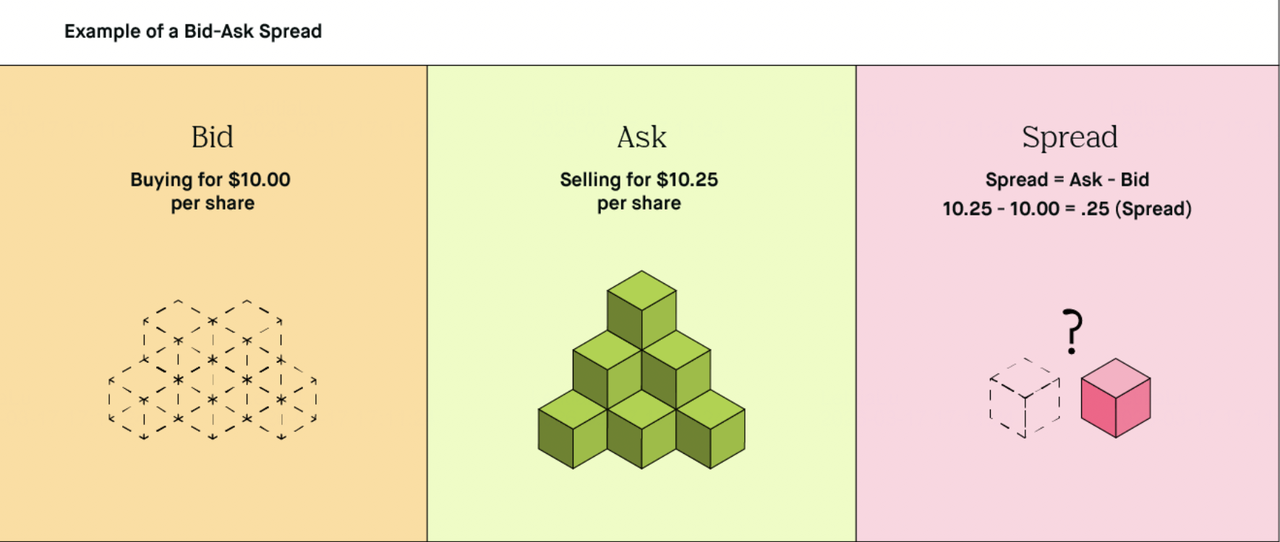
Source: Robinhood
Here is a simplified example using Bitcoin:
- Mid-market price: $100,000
- Best ask price: $100,200 (lowest seller)
- Best bid price: $99,800 (highest buyer)
- Spread: $400 (0.4%)
A trader who buys at the ask and immediately sells at the bid loses $400 per Bitcoin purely from the spread, before any commission is applied.
For the trade to break even, the market price must move at least $400 in the buyer's favor before the position is closed. This is why the spread matters most for short-term traders: the asset must appreciate beyond the spread amount before any profit is realized.
Why Do Crypto Spreads Widen or Narrow? 4 Key Drivers
Spread size fluctuates continuously based on market conditions, liquidity, and trading activity. Understanding these drivers helps traders anticipate execution costs and avoid unfavorable entries.
- Liquidity: Highly liquid pairs such as BTC/USDT typically maintain tight spreads due to dense order books and strong competition between buyers and sellers. In contrast, low-liquidity altcoins or newly listed tokens can exhibit spreads of 0.5% to 2% or more, even under normal conditions.
- Market volatility: During sharp price movements triggered by macro events, regulatory news, or liquidation cascades, market makers widen spreads to manage risk. Spreads that are normally around 0.05% on major pairs can temporarily expand to 0.3% or higher.
- Time of day: Spreads tend to be tightest during peak trading hours when global market participation is highest. During off-peak periods, thinner order books lead to moderately wider spreads.
- Order size and slippage: For large orders, the quoted spread often understates the true execution cost. Large market orders consume multiple levels of liquidity, filling at progressively worse prices. This slippage effectively widens the realized spread beyond what is visible at the top of the order book.
Are “Zero-Fee” Crypto Platforms Really Free? Understanding Spread as a Hidden Cost
Spreads become especially important when evaluating platforms that advertise zero-commission trading. While explicit fees may be removed, the cost of execution does not disappear. It is often embedded in wider bid-ask spreads. Market analysis shows that zero-fee platforms can widen spreads by 1% to 3% above typical market levels. On a $10,000 trade, this implies a hidden cost of $100 to $300, often exceeding the explicit fees charged by commission-based exchanges.
How Zero-Fee Platforms Monetize Trading
When trading fees are reduced or removed, platforms typically rely on alternative revenue mechanisms:
- Wider spreads: Execution prices are adjusted away from the true mid-market level, increasing implicit trading costs.
- Payment for Order Flow (PFOF): User orders are routed to market makers, who capture value through spread arbitrage.
- Product-based monetization: Higher fees embedded in leveraged trading, staking, or other premium services subsidize zero-fee spot trading.
Crypto Fees: Hidden vs. Transparent Costs of Trading Crypto
On platforms that separate fees from execution pricing, traders can clearly evaluate their cost structure. For example, BingX provides a transparent spread reference range for futures markets across major and emerging trading pairs, allowing users to assess typical execution conditions before entering a position.
Read More: Bitcoin Spread vs. Hidden Fees: Which Platforms Are Actually Cheapest to Buy Bitcoin?
Fees vs. Spreads: What Are the Key Differences?
Trading costs in crypto come from two sources: fees and spreads. Fees are visible, while spreads are embedded in price. Both directly affect your execution and overall profitability.
| Feature | Trading Fee | Spread |
| What it is | Explicit charge per trade set by the exchange | Difference between best bid and ask price |
| How it appears | Listed as a percentage; deducted at execution | Embedded in price; not separately itemized |
| Who receives it | The exchange | Market makers or counterparties |
| Does it change? | Tier-based; decreases with higher volume | Fluctuates with liquidity and volatility |
| Present on zero-fee platforms? | No | Yes, often widened to offset zero commissions |
| Visible before trading? | Yes, shown in fee schedule | Partially, visible in order book but may widen at execution |
How Do Fees and Spreads Affect Different Trading Styles?
The impact of fees and spreads varies significantly depending on trading frequency, position size, and strategy. Understanding how these costs accumulate across different trading styles is essential for effective cost management.
1. Short-Term and High-Frequency Trading
Frequent traders are highly sensitive to both fees and spreads. A 0.1% taker fee applied across multiple daily trades can quickly compound into meaningful cost, even before accounting for price movement. Each market order also incurs the spread on both entry and exit. To reduce total execution cost, traders typically rely on limit orders and focus on high-liquidity pairs with tighter spreads.
2. Futures and Leveraged Trading
In addition to fees and spreads, futures traders must account for funding rates. Positions held across multiple funding intervals can accumulate significant carrying costs, particularly in strongly directional markets. Spreads in derivatives markets also tend to widen during periods of high volatility, making entry timing a key cost consideration.
3. Long-Term Buy-and-Hold
Long-term investors execute fewer trades, so fees and spreads have a smaller impact on overall returns. Instead, costs such as withdrawal fees and network charges become more relevant, particularly when transferring assets off the exchange.
4. Large-Order and Institutional Trading
For large trades, market depth and slippage become the primary cost drivers. Even with low commission rates, executing across multiple order book levels pushes the average fill price away from the mid-market level. In lower-liquidity conditions, slippage from a single large order can exceed the combined cost of fees and spreads.
How to Optimize Trading Costs on BingX
BingX is designed with a cost-efficient fee structure and competitive spreads by default. In addition, the platform provides several built-in mechanisms that allow traders to further optimize execution costs depending on their trading style:
- Use limit orders for greater cost control: Limit orders qualify for lower maker fees and allow traders to set their own execution price, reducing reliance on the current spread.
- Unlock lower fees through VIP tiers: As trading volume increases, BingX’s VIP structure offers progressively reduced fee rates. At higher tiers, perpetual futures taker fees can drop to 0.028%, with maker fees reaching 0%.
- Trade high-liquidity pairs for tighter spreads: Major pairs such as BTC/USDT and ETH/USDT consistently maintain deep order books and tighter spreads, especially during peak trading hours.
- Stay aware of funding rates in futures markets: Monitoring funding rates before the 0:00, 8:00, and 16:00 SGT settlement windows helps traders manage holding costs more effectively.
- Select efficient networks for withdrawals: Choosingnetworks such as TRON (TRC-20), Solana, or Ethereum Layer 2 can significantly reduce transfer costs compared to Ethereum mainnet.
BingX Fee Rates vs. Industry Benchmarks (2026)
BingX maintains a competitive fee structure across both spot and derivatives markets. Compared with industry averages, its standard rates are consistently lower, particularly for high-frequency and leveraged trading.
| Fee Type | BingX Standard Rate | Industry Average |
| Spot Maker Fee | 0.10% | ~0.15% |
| Spot Taker Fee | 0.10% | ~0.194% |
| Perpetual Futures Maker Fee | 0.02% | ~0.026% |
| Perpetual Futures Taker Fee | 0.05% | ~0.062% |
| Standard Futures Fee | 0.045% (charged at close) | Varies |
| Crypto Deposit Fee | 0% | Typically free |
| Crypto Withdrawal Fee | Dynamic (varies by asset and network) | Varies by asset and network |
Note: Industry averages are based on publicly available market data as of early 2026. BingX fees may change over time. Refer to the official BingX fee schedule for the latest rates.
Final Thoughts: Why BingX Is the Best Platform for Low Fees and Tight Spreads
Trading fees and spreads are both core components of execution cost, but they impact performance in different ways. Fees are explicit and predictable, while spreads are embedded in execution price and often overlooked. Evaluating only one gives an incomplete picture of total trading cost. For traders across different strategies, from short-term execution to longer-term positioning, understanding the full cost structure is essential to preserving returns.
BingX stands out with low fees across spot and derivatives markets and tight, transparent spreads, particularly on high-liquidity pairs. Combined with clear fee schedules and spread references, this allows traders to estimate total cost more accurately before entering a position and avoid hidden costs commonly seen on zero-fee platforms. This level of transparency and consistency makes BingX one of the most cost-efficient trading environments available today.
Risk reminder: This content is for informational purposes only and does not constitute investment advice. Cryptocurrency trading involves risks, including market volatility, liquidity constraints, and leverage-related losses. Investors should conduct independent research and assess their risk tolerance before making any decisions.
Related Reading
- Bitcoin Spread vs. Hidden Fees: Which Platforms Are Actually Cheapest to Buy Bitcoin?
- How to Buy Bitcoin and Crypto on BingX with SEPA, Apple Pay & Google Pay
- How to Deposit Crypto with BingX: A Complete Guide
- Crypto Futures Funding Rate Explained: How It Affects Longs, Shorts, and Trading Costs
- What Is Slippage in Crypto and How Does BingX Guarantee Exact Prices?