

In early May 2026, Tagger ($TAG) has emerged as a high-octane leader in the DeFAI sector, surging over 75% and drastically outperforming the broader market. This rally underscores a massive institutional pivot toward solving AI’s "80% problem," the staggering reality that the majority of development resources are still trapped in manual data preparation. By transforming decentralized human intelligence into a verifiable, on-chain production line on the BNB Chain, Tagger (TAG) is no longer just a project; it is the liquid infrastructure powering the multi-billion dollar race for high-fidelity AI training sets.
This article explores the mechanics of Tagger’s crowdsourced ecosystem, the Proof-of-Human-Work incentive model, the utility of the $TAG token, and how to trade Tagger (TAG) on BingX.
What Is Tagger (TAG)?
Tagger (TAG) is an all-in-one AI data collaboration platform that synchronizes data collection, cleansing, labeling, and validation within a unified blockchain framework. Unlike traditional data labeling firms that operate behind closed doors, Tagger uses the immutability of blockchain to establish a global verification protocol.
The platform’s core mission is to create a Data Passport for information. By turning processed datasets into on-chain assets (NFTs), Tagger ensures that data owners maintain rights over their contributions while providing AI developers with a transparent, audit-ready supply chain of information. Tagger focuses on four key pillars:
- Decentralized Validation: Removing central gatekeepers to ensure data integrity through cryptographic proof.
- Web3 Crowdsourcing: Utilizing a global workforce to solve complex labeling tasks that purely automated systems cannot yet master.
- AI-Assisted Efficiency: Integrating AI Copilots to help workers achieve professional-grade accuracy in record time.
- Permissionless Trading: A marketplace where data can be licensed or sold without intermediary friction.
How Does the Tagger Ecosystem Work?
Tagger operates through a symbiotic relationship between human workers and AI tools, structured around its proprietary DeCorp (Decentralized Corporation) framework.
1. The Three-Module Platform
The technical infrastructure is divided into three distinct functional layers:
- Dataset Collection Module: AI researchers publish tasks. Using Natural Language Processing (NLP), the platform matches these tasks to contributors with the relevant geographic or linguistic background.
- Annotation & Cleansing Module: This is where the work happens. Contributors use the AI Copilot, a suite of intelligent tools, to label images, transcribe audio, or tag video. The AI handles the heavy lifting, while the human provides the nuanced ground truth validation.
- Data Trading Marketplace: Once validated, data is packaged as an NFT. These Data Passports record the provenance and ownership, allowing for secure, borderless trading between providers and AI enterprises.
2. Proof-of-Human-Work (PoHW) Model
To prevent bot manipulation and ensure quality, Tagger utilizes a Proof-of-Human-Work model. Every task completed is subject to a dual-verification process: an automated AI check followed by a peer-review mechanism. Contributors are rewarded instantly in $TAG tokens based on the quantity and quality of their verified output.
3. Data Rights and NFTs
By minting datasets as NFTs, Tagger restores ownership to the creators. In the Web2 world, big tech companies harvest user data for free; in the Tagger ecosystem, a user who contributes to a high-value medical or linguistic dataset retains a digital footprint of that contribution and can benefit from its subsequent sale or licensing.
What Is the TAG Token Used For?
Within the Tagger ecosystem, the $TAG token serves as both the medium of exchange and the governance tool.
- Incentive Rewards: $TAG is the primary currency for rewarding the global DeCorp workforce for their data processing tasks.
- Platform Payments: AI developers and enterprises must use TAG tokens to pay for data collection services, access premium labeling tools, or purchase datasets in the marketplace.
- Governance: Holders can participate in DeCorp decision-making, voting on protocol upgrades, fee structures, and which AI sectors, e.g., healthcare vs. autonomous driving, should receive priority funding.
- Staking and Access: Users may be required to stake $TAG to access higher-tier, higher-paying data tasks that require proven expertise.
What Is Tagger (TAG) Tokenomics?
The $TAG token has a fixed total supply of 405,380,800,000 tokens, designed to reward long-term participation rather than early venture capital speculation.
TAG Token Allocation
- Proof-of-Human-Work (74.00%): Dedicated to rewarding the global workforce for performing real-world data tasks, such as labeling and validation.
- Tag-to-Pump (21.06%): Allocated toward early community bootstrapping, ecosystem promotion, and experimental data initiatives.
- Liquidity (4.94%): Reserved for initial DEX liquidity on platforms like PancakeSwap, paired with $BNB to ensure stable trading.
By allocating the vast majority of tokens to the workforce, Tagger ensures that the token supply enters the market through actual utility and productivity rather than pre-mined team dumps.
How to Trade Tagger (TAG) on BingX
Tagger's recent volatility and AI-sector narrative make it a high-interest asset for traders; you can utilize BingX AI to analyze real-time market sentiment and technical indicators for $TAG before accessing the token through BingX’s institutional-grade trading terminal.
Buy, Sell, or HODL TAG on the Spot Market
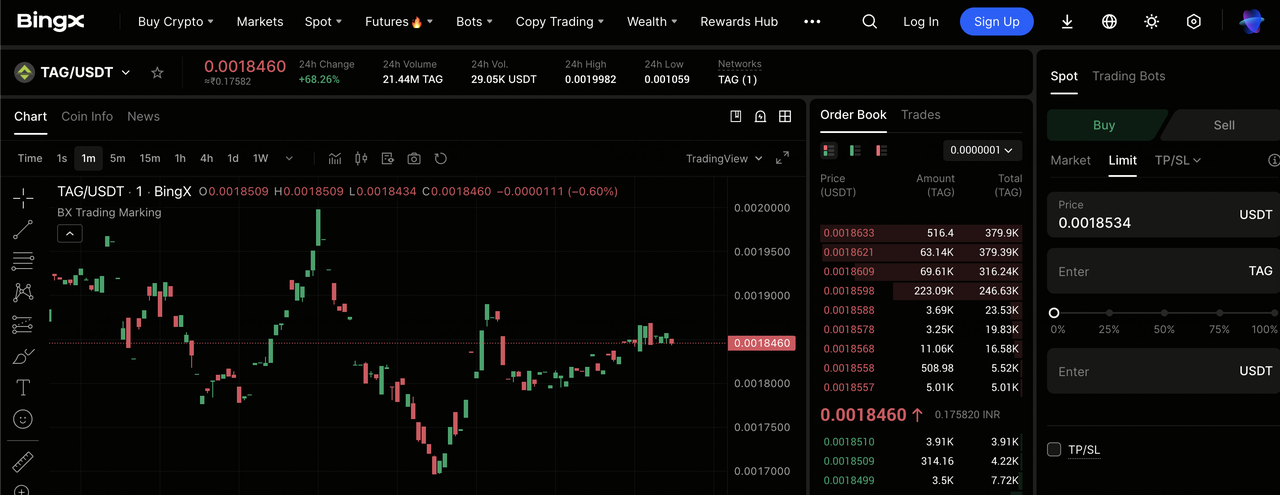
TAG/USDT trading pair on BingX spot market
- Log In: Access your account on the BingX app or website.
- Search Pair: Navigate to the Spot market and search for the TAG/USDT trading pair.
- Choose Order Type: Select Market Order for instant execution or Limit Order to set a specific entry price.
- Confirm: Enter the amount and tap Buy TAG.
Long or Short TAG Perpetuals on the Futures Market
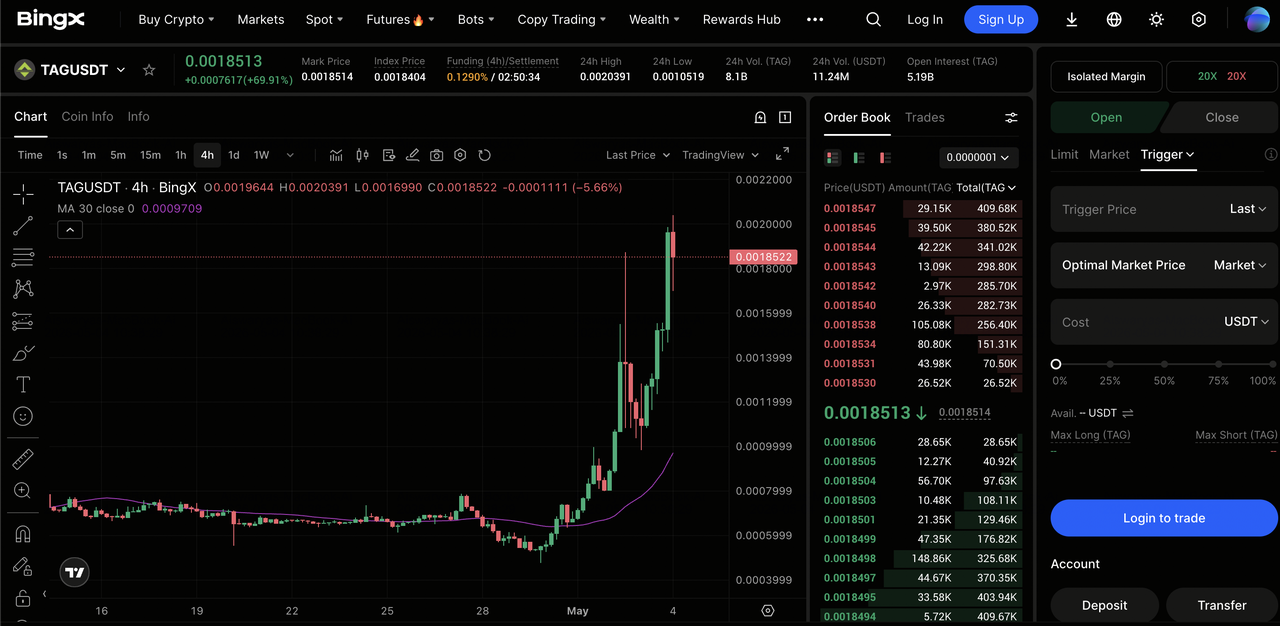
TAG/USDT perpetuals on BingX futures market
For those looking to capitalize on price swings with leverage:
- Navigate to Futures: Select Perpetual Futures and search for TAGUSDT perpetual contract.
- Set Margin: Choose between Isolated Margin for lower risk or Cross Margin for higher flexibility
- Leverage: Adjust your leverage, e.g., up to 20x, based on your risk tolerance.
- Execute: Open a Long if you believe the AI narrative will drive prices higher, or Short to hedge against potential corrections.
5 Key Considerations Before Investing in Tagger (TAG)
Before allocating capital to the $TAG ecosystem, it is essential to evaluate the structural risks of its crowdsourced data model and the technical nuances of its workforce-driven tokenomics.
- High Volatility: Like many AI-sector tokens, $TAG is subject to rapid price swings driven by social media hype and retail FOMO.
- Competitive Landscape: Tagger competes with other decentralized data protocols. Its success depends on maintaining its "DeCorp" workforce advantage.
- Token Supply: While the total supply is fixed, the circulating supply is currently around 27%. Monitor the rate at which PoHW rewards enter the market.
- Volume Divergence: Keep an eye on trading volume; sharp price increases on declining volume can signal a potential reversal.
- Technical Barrier: The Tagger AI platform relies on its AI Copilot effectively enabling non-experts to produce high-quality data. If the quality drops, institutional demand for the datasets may wane.
Final Thoughts: Is Tagger AI the Backbone of Decentralized AI?
As of May 2026, Tagger is evolving from a speculative asset into a functional piece of AI infrastructure. By linking token value directly to human productivity through the Proof-of-Human-Work model, it offers a more grounded alternative to pure hype AI tokens. Its ability to scale will depend on whether it can successfully bridge the gap between global retail workers and high-end AI developers who are hungry for clean, ethical, and verifiable data.
For the BingX community, Tagger represents a strategic entry into the DeFAI space. Whether you are participating as a data worker to earn rewards or a trader navigating the AI supercycle, Tagger (TAG) serves as a vital bridge between human effort and machine intelligence.
Risk Reminder: Investing in AI-sector digital assets involves significant risk. The value of $TAG is highly volatile and influenced by market sentiment and technological adoption. Always perform your own research and only trade what you can afford to lose.
Related Reading
- What Is USDai (CHIP) InfraFi for GPU-Backed Yield and How Does It Work?
- What Is Bitvia (BITVIA) AI-Powered Crypto Investing Platform for Automated Wealth Management?
- What Is Allora (ALLO), the Decentralized AI Network Powering Collective Intelligence?
- What Are the Top 7 DeFAI (AI + DeFi) Projects to Watch in 2026?
