

The global financial landscape of June 2026 presents a fascinating paradigm shift in how we conceptualize technology wealth. For decades, the fortunes of Silicon Valley elite were directly tied to the equity of the monolithic corporations they founded or led. However, at the epicenter of the artificial intelligence boom, the financial blueprint of Sam Altman, the Chief Executive Officer of OpenAI, presents a striking structural paradox.
As of mid-2026, Altman's inclusion in global billionaire rankings reflects a multi-billion-dollar valuation that stands in absolute contrast to his direct operational compensation. While he sits at the helm of the most geopolitically significant AI group on earth, Altman draws a modest annual salary and formally holds a 0% direct equity stake in OpenAI. This intentional corporate setup forces investors, analysts, and tech founders to examine a deeper trend: building wealth through specialized private venture portfolios, advanced physical infrastructure layers, and global cryptographic networks rather than standard corporate stock packages.
Who Is Sam Altman?
Sam Altman is an American entrepreneur, investor, and programmer who rose to tech prominence as a premier early-stage startup investor. After dropping out of Stanford University's computer science program in 2005, Altman founded the location-based social networking mobile application Loopt, which was later acquired in 2012 for $43.4 million.
His sharp eye for hyper-scale business models caught the attention of Peter Thiel and Paul Graham, leading to his appointment as a partner at the elite startup accelerator Y Combinator (YC). Altman served as YC's president from 2014 to 2019, an era during which the incubator minted global tech giants like Airbnb, Stripe, DoorDash, and Reddit.
In 2015, alongside Elon Musk, Ilya Sutskever, Greg Brockman, and Jessica Livingston, Altman co-founded OpenAI as a non-profit research laboratory dedicated to ensuring that artificial general intelligence (AGI) benefits all of humanity. Following a brief, highly publicized boardroom coup and eventual reinstatement in November 2023, Altman has emerged as the definitive corporate architect of the AI revolution, matching his influence over digital infrastructure with deep investments in physical power generation and digital identity networks.
How Did Sam Altman Build His Wealth?
Unlike traditional technology executives whose net worths expand and contract in perfect tandem with a single ticker symbol, Altman’s $3.4 billion fortune is entirely independent of OpenAI's balance sheet. His net worth is anchored on three clear strategic pillars:
1. The Early-Stage Venture Portfolio: Hydrazine and Apollo
The foundation of Altman’s wealth was built during his tenure at Y Combinator and expanded via his personal venture capital firms, Hydrazine Capital (backed by billionaire investor Peter Thiel) and Apollo Projects. Over the past decade, Altman has deployed capital into more than 400 early-stage private companies. By identifying secular shifts in infrastructure demands before they materialize in public markets, his portfolio captures exponential private equity appreciation across payment rails, social networks, and biotechnology sectors.
2. Physical Infrastructure Anchors: Energy and Compute
Altman’s venture architecture operates on a core thesis: Software intelligence requires unprecedented physical resources. To solve the compounding power constraints facing modern data centers, Altman has taken personal, concentrated stakes in next-generation clean energy providers. Rather than waiting for public utilities to scale, he has positioned himself as a key equity holder in the actual power generation layers designed to feed the artificial intelligence ecosystem.
3. Cryptographic Identity and Universal Basic Income: World Network (Worldcoin)
Anticipating a world proliferated by AI-generated content and deepfakes, Altman co-founded the World Network (formerly Worldcoin) to establish a global decentralized identity framework. Through the distribution of native utility tokens linked to biometric verification, this initiative introduces a cryptographic component to his estate that serves as a highly liquid, macroeconomic proxy for universal tech-adoption trends.
Read more: What Is Worldcoin (WLD) in 2026? Complete Beginner's Guide to the Orb-Powered Identity Network
Sam Altman's Net Worth in 2026: Key Estimates
|
Wealth Metric |
June 2026 Financial Status |
Qualitative Influence & Analytical Context |
|
Forbes Index Net Worth |
$3.4 Billion |
Real-time global registry ranking based on verified private holdings and liquid investments. |
|
OpenAI Direct Salary |
$76,001 / year |
Modest baseline compensation up from $73,546, characterized by Altman as the bare minimum for health insurance. |
|
OpenAI Direct Equity |
0% |
Formally documented across SEC and state regulatory filings, excluding him from direct share ownership. |
|
Primary Venture Holding |
Helion Energy ($1.7 Billion) |
Direct stake in clean fusion energy, serving as his single largest non-liquid private asset. |
|
Public Liquid Holding |
Oklo Inc. (~$201.6 Million) |
Traded under NYSE: OKLO, representing over 97% of his publicly filed liquid equity portfolio. |
|
Managed Asset Vehicle |
Reddit / RDDT ($2.14 Billion) |
Total value of share allocation managed under his venture umbrella across historical funding rounds. |
The baseline metric of $3.4 billion is universally validated across rigorous journalistic financial models, including the Forbes Real-Time Billionaires Index and independent institutional tracking. Because Altman's wealth is predominantly private, public valuations apply conservative liquidity and governance discounts to his venture fund allocations, excluding unconfirmed valuations of secondary entity stakes until an exit event occurs.
Analyzing the OpenAI Paradox: The S-1 Filing and Potential Wealth Catalysts
The primary point of discussion surrounding Altman's financial trajectory is the structural transformation of OpenAI itself. In October 2025, the organization finalized its evolution from a complex, capped-profit structure overseen by a non-profit board into a formal Delaware Public Benefit Corporation (PBC), legally recognized as the OpenAI Group PBC.
Under this structural realignment, the original non-profit wing was renamed the OpenAI Foundation, retaining core governance rights alongside a 26% equity stake valued at roughly $130 billion based on institutional assessments.
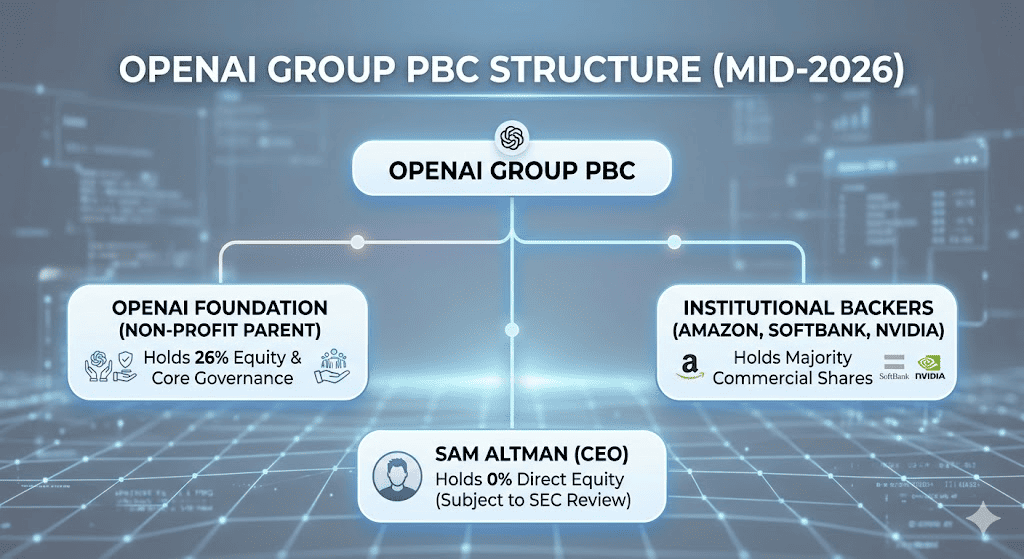
While internal corporate discussions initially weighed a proposed 7% direct equity allocation for Altman—which would instantly add $10.5 billion to his personal net worth at a conservative baseline—such a grant remains frozen. Regulatory documents, including a highly confidential S-1 registration statement submitted to the SEC on June 8, 2026, show that Altman continues to execute his executive duties without direct share ownership.
OpenAI Group PBC is actively moving forward with its highly anticipated initial public offering (IPO), targeted for late 2026 under lead financial underwriters Goldman Sachs, Morgan Stanley, and JPMorgan.
Read more: What Is OpenAI Pre-IPO and How to Trade It on BingX?
If the public market debut matches institutional demand and reaches the targeted $850 billion to $1 trillion valuation range, a standard founding-CEO equity allocation could be initialized by the PBC board. Under typical 2% to 5% executive compensation packages, such an implementation would immediately generate $17 billion to $50 billion in paper wealth for Altman overnight, fundamentally redrawing the global billionaire rankings.
The Regulatory Headwind: This structural evolution has caught the attention of regulators. On May 12, 2026, the Attorneys General of ten US states issued a joint memorandum to SEC Chairman Paul Atkins expressing formal concerns regarding potential conflicts of interest. The regulatory inquiry highlights that while Altman lacks direct equity on OpenAI’s balance sheet, he frequently navigates commercial agreements that directly benefit external ventures in his personal portfolio.
Cryptographic Exposure: World Network and WLD Tokenomics
Beyond traditional private venture capital structures, Altman’s digital asset exposure is driven by the World Network (originally launched as Worldcoin), a protocol he co-founded alongside technologist Alex Blania. Operated under the development firm Tools for Humanity (TFH), where Altman serves as Chairman of the Board, the project aims to construct a global decentralized identity layer using iris-scanning hardware ("Orbs") to issue native Worldcoin (WLD) tokens as an equitable distribution mechanism.
Throughout late 2025 and early 2026, the native utility token WLD experienced significant downward pressure due to international data-privacy regulatory reviews across European and Asian jurisdictions. On June 1, 2026, WLD reached a structural macro floor of $0.3917, representing a major decline from its March 2024 all-time high of $11.74. This price compression was accelerated by a substantial supply overhang, with roughly 67% of the total 10-billion token hard cap remaining locked or uncirculated within the foundation's treasury ecosystem.
The June 2026 WLD Structural Turnaround
The token's technical structure shifted dramatically during the first weeks of June 2026. On June 15, 2026, WLD experienced a sharp 20% single-day rally to $0.61, registering an intra-day swing high of $0.66 and securing a 154% net gain over a 30-day window.
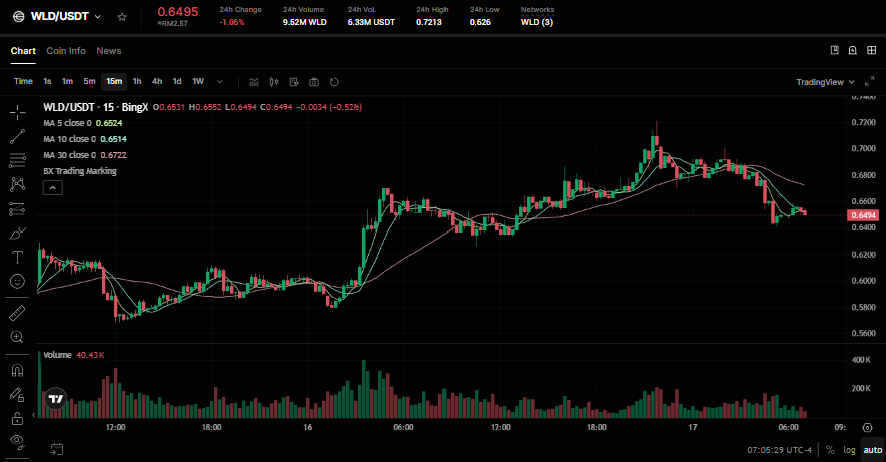
This macro turnaround was directly catalyzed by Nasdaq-listed Eightco Holdings (NASDAQ: ORBS), which announced the official completion of a dedicated WLD digital asset corporate treasury strategy funded via a $250 million private placement. Eightco disclosed an institutional holding of 283,452,700 WLD (valued at $406 million), instantly establishing itself as the largest publicly disclosed corporate holder of the token, controlling roughly 8.3% to 8.4% of the circulating market supply.
To support this market stabilization, Tools for Humanity simultaneously implemented a 43% programmatic reduction in daily token unlock rates, effective July 24, 2026. Under the updated supply schedule:
- Community Core Unlocks: Programmatically reduced by 50%, falling from 3.2 million WLD to 1.6 million WLD per day.
- Team & Investor Venture Unlocks: Programmatically reduced by 32%, dropping from 1.9 million WLD to 1.3 million WLD per day.
This aggressive supply tightening directly limits token dilution, strengthening the balance sheet of Tools for Humanity, where Altman's non-disclosed founder allocation is held.
Read more: The Sam Altman Proxy: Worldcoin Surges 15% as Eightco Discloses Massive 283M WLD Treasury Stake
How Does Sam Altman's Wealth Compare to Other Tech Leaders?
To accurately contextualize Sam Altman's financial profile within the broader digital economy, his wealth structure must be evaluated alongside other global technology and cryptocurrency leaders.
Tech and Crypto Executive Wealth Matrix (Mid-2026)
|
Executive / Leader |
Est. Net Worth (Mid-2026) |
Primary Strategy & Core Asset Base |
Core Wealth Composition Type |
Core Structural / Regulatory Vulnerability |
|
Elon Musk |
$839 Billion |
Tesla, SpaceX, xAI Infrastructure |
Public / Private Industrial Equity |
Executive pay package litigation; intense compute competition with OpenAI. |
|
Changpeng Zhao (CZ) |
$61B – $110 Billion |
Private Binance Equity, BNB Holdings |
Private Exchange Equity & Native Token |
Restricted corporate management following historical global settlements. |
|
Brian Armstrong |
$7.7B – $11 Billion |
Coinbase (COIN Equity), Base L2, NewLimit |
Public Market Exchange Equity |
Direct sensitivity to retail volumes and SEC security definitions. |
|
Justin Sun |
$8.5B – $11.1 Billion |
TRON Ecosystem, HTX Equity, Yield Assets |
Native Gas Tokens, Private Exchange Equity |
Ongoing SEC wash-trading litigation; capital settlement disputes. |
|
Sam Altman |
$3.4 Billion |
Hydrazine Portfolio, Helion Energy, RDDT |
Private Multi-Layer Venture Portfolio |
Regulatory scrutiny regarding self-dealing and multi-entity conflicts. |
|
Vitalik Buterin |
$467M – $750 Million |
Liquid Ethereum Address Holdings (ETH) |
Transparent Liquid On-Chain Equity |
Direct exposure to gas fee drawdowns and protocol development shifts. |
What Are the Key Risks Affecting Sam Altman's Net Worth?
- Self-Dealing & Conflict Regulatory Reviews: The primary threat to Altman's venture valuations stems from ongoing regulatory oversight regarding his multi-entity involvement. If the SEC or state attorneys general enforce formal structural firewalls separating OpenAI's corporate balance sheet from his private investments (e.g., Helion or Stoke Space), the core commercial growth engine of his portfolio could slow.
- Private Tech Illiquidity & Down-Rounds: Because the vast majority of Altman’s wealth is locked within private equity, his net worth is highly exposed to macro venture capital contractions. As demonstrated by Retro Biosciences' down-round adjustment from a $5 billion target to a $1.8 billion baseline, private assets face severe valuation corrections when capital costs remain elevated.
- Cryptographic Regulatory Bans: While the World Network token (WLD) has seen a June 2026 structural turnaround driven by institutional treasury adoptions, the asset faces continuous data-privacy regulatory scrutiny. Extended biometric processing bans across major economic zones would directly limit the real-world utility and long-term valuation of his digital asset allocation.
Conclusion
Sam Altman’s net worth in 2026 stands as a masterful case study in modern tech wealth diversification. At an estimated $3.4 billion, Altman has engineered an unconventional financial profile that keeps his personal balance sheet decoupled from direct OpenAI equity, insulating his baseline wealth from the immediate scrutiny, cash-burn volatility, and intense regulatory litigation tied to frontier LLM model development.
Instead of relying on standard corporate stock options, Altman has successfully constructed a highly integrated, private infrastructure ecosystem:
By controlling the essential resources required for the next phase of global technology development, Altman has ensured that whether OpenAI completes a historic public listing or remains a private public benefit corporation, his personal portfolio is fully optimized to capture the broader infrastructure value of the artificial intelligence era.
Related Reading
- What Is OpenAI Pre-IPO and How to Trade It on BingX?
- What Is OpenAI Venture Futures (OPENAI VNTL) and How to Trade OpenAI Venture Futures on BingX?
- What Is Worldcoin (WLD) in 2026? Complete Beginner's Guide to the Orb-Powered Identity Network
- What Is Elon Musk's Net Worth in 2026?
- What Is Changpeng Zhao(CZ)’s Net Worth in 2026?
- Vitalik Buterin’s Net Worth in 2026: How Much Does the Ethereum Co-Founder Own?
- What Is Brian Armstrong’s Net Worth in 2026?
FAQs on Sam Altman’s Net Worth
1. How much is Sam Altman worth in 2026?
As of June 2026, Sam Altman’s net worth is estimated at $3.4 billion by the Forbes Real-Time Billionaires Index, derived entirely from his private venture investments and independent asset holdings.
2. How much equity does Sam Altman own in OpenAI?
Sam Altman owns 0% direct equity in OpenAI. He has maintained this corporate structure across multiple regulatory filings and Congressional testimonies to align the entity with non-profit and public benefit goals.
3. What is Sam Altman’s single largest financial asset?
His single largest documented holding is his investment in the commercial fusion energy startup Helion Energy, which carries an estimated private valuation of $1.7 billion following its latest Series G funding round.
4. How does the World Network (Worldcoin) token impact his net worth?
Altman holds an undisclosed co-founder allocation within Tools for Humanity (TFH), the development firm behind World Network. The token's performance operates as a liquid, high-beta crypto asset proxy within his broader tech ecosystem.
5. Will the upcoming OpenAI IPO increase Sam Altman’s net worth?
While his current equity stake is zero, OpenAI’s transition into a Public Benefit Corporation and its upcoming S-1 filing could allow the board to issue a standard CEO equity package during the public listing. If initialized at a $1 trillion corporate valuation, this could add between $17 billion and $50 billion to his net worth.
