


The global artificial intelligence landscape in 2026 is undergoing a profound structural realignment. The speculative, high-flying phase of early generative AI deployment has given way to an era of strict capital discipline, infrastructure optimization, and aggressive platform monetization. In this macroeconomic climate, corporate value is no longer measured solely by raw frontier model capabilities, but by the efficiency of cloud ecosystems, localized data center scaling, and institutional platform control. At the absolute apex of this foundational enterprise transition stands Mark Zuckerberg, the founder, Chairman, and Chief Executive Officer of Meta Platforms, Inc.
Who Is Mark Zuckerberg?
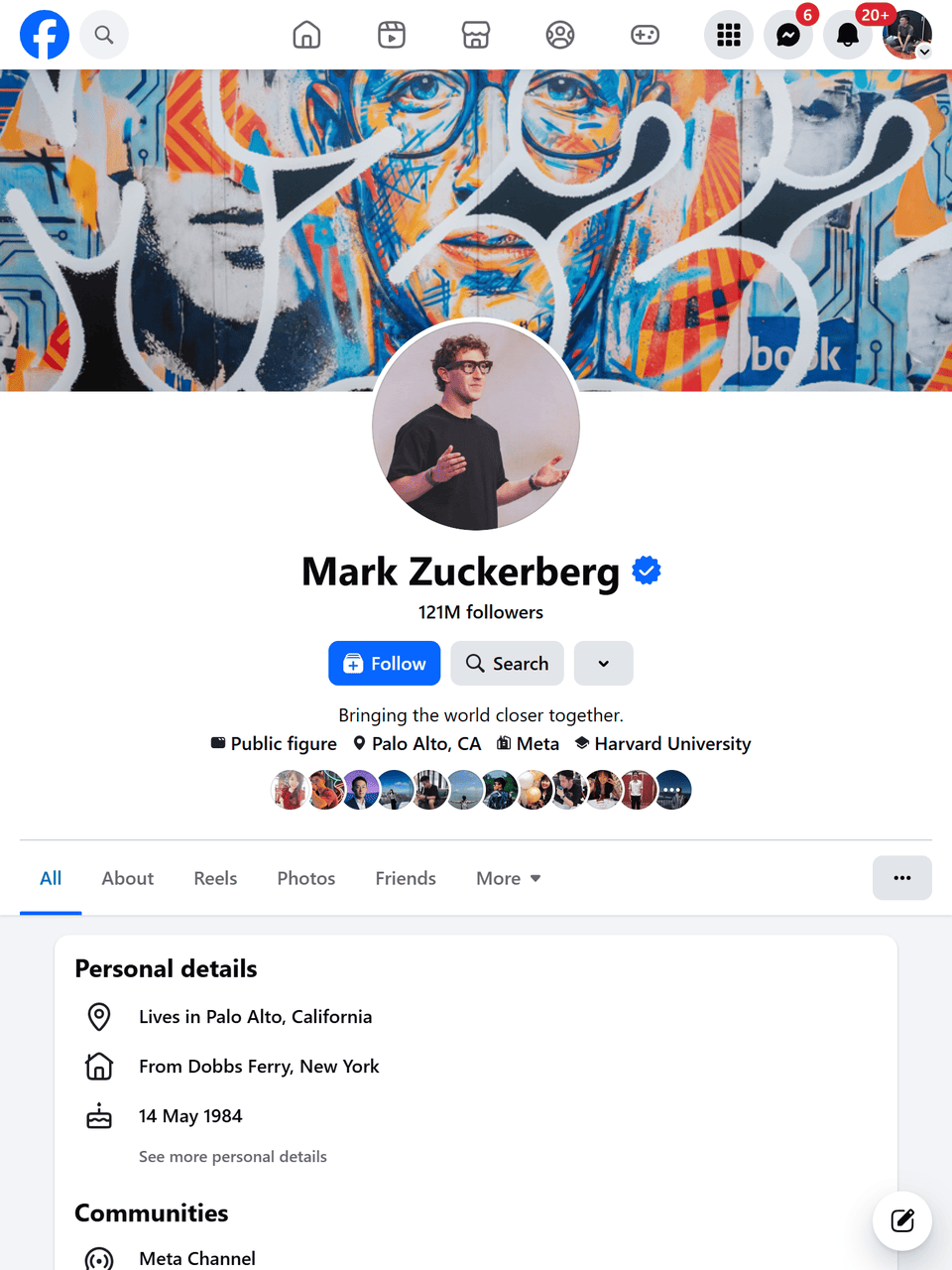
Mark Zuckerberg is an American technology entrepreneur and programmer who redefined global communication as the co-founder, Chairman, and CEO of Meta Platforms. While studying at Harvard University in 2004, he launched Facebook from his dorm room. The platform quickly exploded from a college networking tool into a global social media juggernaut, fundamentally altering how humanity interacts online.
Under his leadership, Zuckerberg transformed the company into a $1.7 trillion conglomerate through strategic acquisitions like Instagram and WhatsApp. Today, he operates as one of the few tech founders with absolute voting control over his empire, using Meta’s massive scale to drive the global shift into custom AI silicon and next-generation intelligence infrastructure.
Zuckerberg’s personal wealth accumulation presents a compelling and highly distinct case study within the technology sector. Unlike legacy corporate tech executives whose fortunes are built on multi-decade corporate ladders and salaried compensation grants, Zuckerberg’s financial architecture represents the absolute pinnacle of founder-controlled ownership paradigms. By anchoring himself to the voting control of a $1.7 trillion social media and computing empire and navigating the hyper-scale AI infrastructure cycles of the 2020s, Zuckerberg has secured immense personal liquidity and unilateral institutional leverage. As Meta navigates the complex capital demands of the 2026 AI compute loop, evaluating Zuckerberg's net worth offers critical insights into modern corporate governance, venture scale capitalization mechanics, and the financial structures driving global frontier intelligence.
Mark Zuckerberg's Net Worth in 2026: Key Estimates
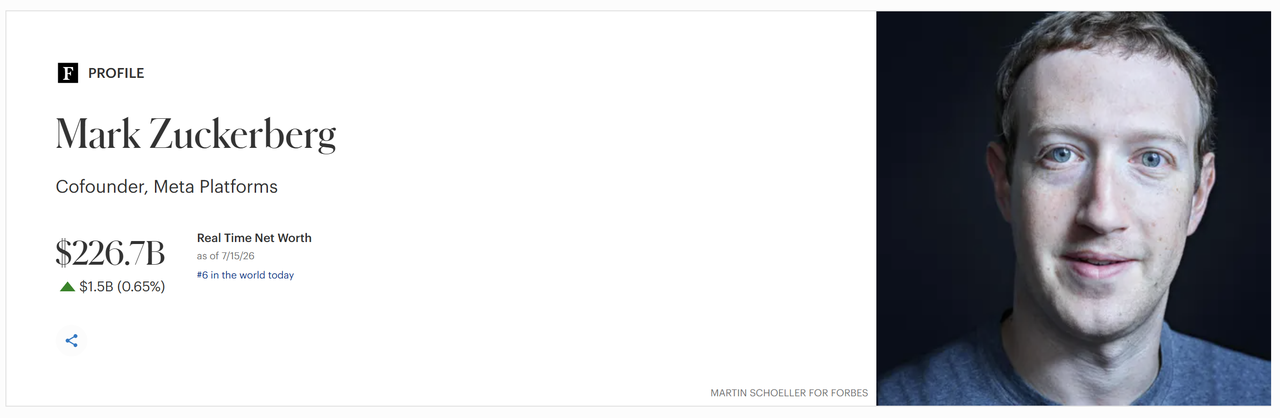
The baseline metrics of Mark Zuckerberg's personal wealth in 2026 establish him firmly within the ranks of the world's top five elite multi-billionaires. Because his net worth is fundamentally driven by the equity valuation of Meta Platforms public stock, top-tier global wealth trackers evaluate his financial standing through a combination of public SEC disclosures and real-time equity tracking.
1. Mark Zuckerberg Financial Status Registry (2026)
|
Holding Metric |
Value / Share Count |
Reporting Date / Context |
|
Bloomberg Billionaires Index |
~$237 Billion |
Real-Time Mid-2026 Registry Index |
|
Forbes Verified Net Worth |
$222 Billion |
40th Annual World's Billionaires List (March 2026) |
|
Global Billionaire Ranking |
Position #5 Globally |
Consolidated Global Wealth Registry |
|
Direct Economic Stake |
≈ 13% of Outstanding Equity |
Total Shares Held Across Class A & B |
|
Class B Voting Stock Control |
99.7% of Class B Shares |
Core Corporate Control Mechanism |
|
Total Consolidated Voting Power |
≈ 61% Control Block |
Unilateral Decision-Making Leverage |
|
Year-to-Date Wealth Appreciation |
+$4 Billion |
Real-Time Capital Expansion Gains |
On the 40th annual Forbes World's Billionaires list, published in March 2026, Zuckerberg was positioned at No. 5 globally with a verified net worth of $222 billion. This annual snapshot reflected a highly competitive technology landscape where Google co-founders Larry Page and Sergey Brin climbed to No. 2 and No. 3 with fortunes of $257 billion and $237 billion, respectively, pushing Amazon's Jeff Bezos to No. 4 at $224 billion.
By July 2026, real-time market fluctuations and a dramatic resurgence in Meta's share price pushed Zuckerberg’s personal wealth to approximately $237 billion according to the Bloomberg Billionaires Index. This real-time appreciation represented a net gain of roughly $4 billion since the beginning of the calendar year, securing his position as the fifth-richest person on Earth, trailing only Elon Musk, Larry Ellison, Sergey Brin, and Jeff Bezos.
2. Mark Zuckerberg’s Wealth Structure: Meta Stock and Voting Control
To understand Zuckerberg’s financial position in 2026, the key distinction is between paper wealth and corporate control. His paper wealth comes mainly from Meta equity. His corporate power comes from Meta’s dual-class voting structure.
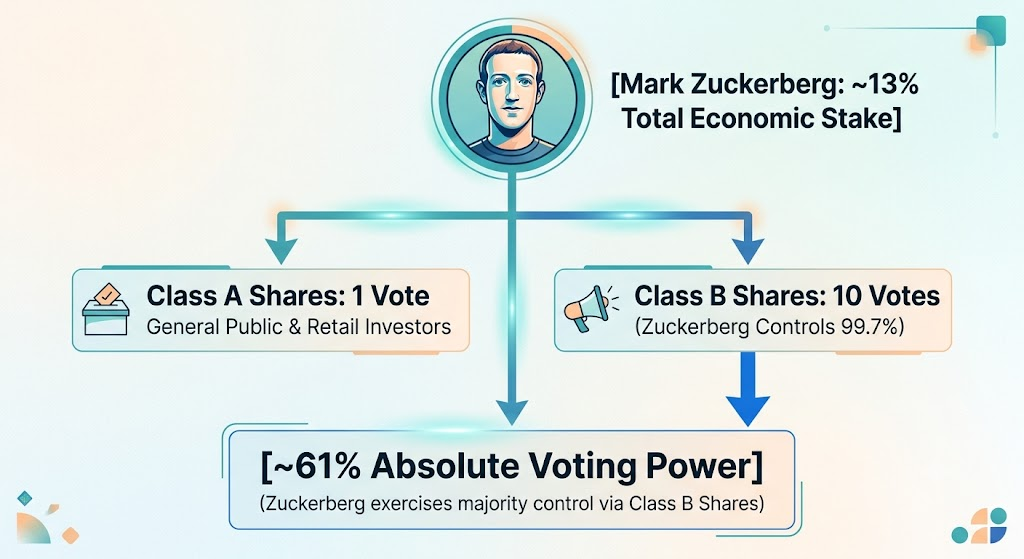
Meta’s Class A shares carry one vote per share, while Class B shares carry ten votes per share. Zuckerberg controls approximately 99.7% of all outstanding Class B shares. Based on Meta’s April 1, 2026 record date, with 1,758,006,749 Class A shares and 342,307,492 Class B shares outstanding, Zuckerberg commands about 61% of total voting control.
This gives him unilateral control over major corporate decisions, even when public Class A shareholders support a different direction. The result is a rare combination of extreme personal wealth and direct operating control over one of the world’s largest technology companies.
3. Zuckerberg’s Voting Power Defines Meta’s Governance Risk
Zuckerberg’s control structure remains a central governance issue for Meta in 2026. At the May 27, 2026 virtual shareholder meeting, public investors backed several governance reforms, including a campaign led by the Office of the Illinois State Treasurer and NorthStar Asset Management to phase out Meta’s dual-class structure over seven years. The proposal reflected investor concern that Zuckerberg’s voting insulation creates legal, reputational and accountability risks.
Despite strong support from public Class A shareholders, consistent with the 92% support seen in previous proxy cycles, Zuckerberg’s Class B voting bloc allowed him to reject the recapitalization plan. He also defeated shareholder proposals seeking deeper reporting on generative AI data usage, child safety metrics and executive pay alignment. As a result, Zuckerberg’s dual role as controlling shareholder and CEO remains the defining governance feature of Meta in 2026.
Meta Stock Price 2026: How AI Spending Could Affect Zuckerberg’s Net Worth
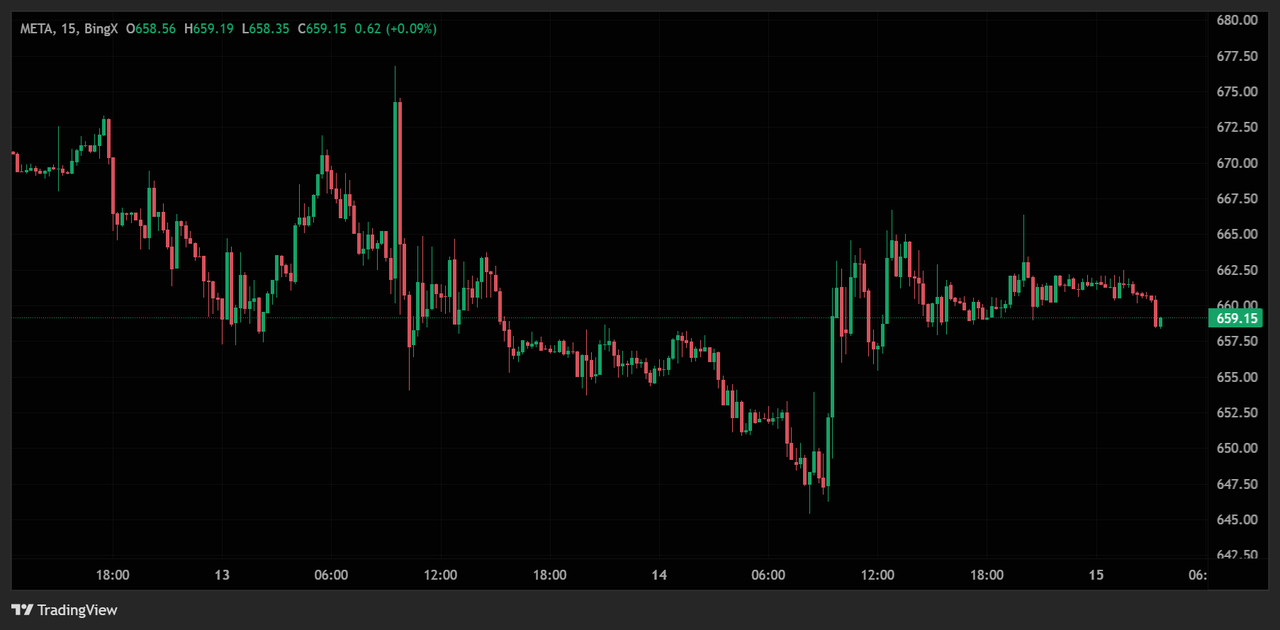
Meta’s stock volatility in 2026 directly affected Mark Zuckerberg’s wealth because most of his net worth is tied to Meta equity. Over the 52 weeks before July 2026, Meta traded between $520.26 and $796.25, creating large swings in his paper fortune. The main pressure came from AI CapEx concerns. In Q1 2026, Meta reported strong fundamentals, including $56.31 billion in revenue, up 33% year over year, and diluted EPS of $10.44. However, it also raised full-year CapEx guidance to $125 billion to $145 billion to fund AI infrastructure, increasing investor concern over near-term valuation pressure.
Meta Platforms Selected Stock Price History (2024–2026)
|
Date |
Adjusted Price (USD) |
Change % / Core Market Context |
|
July 14, 2026 |
$662.39 |
Ongoing market volatility post-Iris custom chip memo. |
|
July 10, 2026 |
$669.21 |
Jump of 5.97% following AI enterprise cloud reports. |
|
July 01, 2026 |
$612.91 |
Intraday surge of over 10% on the Meta Compute launch. |
|
June 30, 2026 |
$563.29 |
End of a volatile first-half tech stock underperformance. |
|
May 2026 |
$632.51 |
Market correction following massive upward CapEx guidance. |
|
January 2026 |
$715.89 |
Peak of early-year enterprise generative AI momentum. |
|
July 2025 |
$771.63 |
Multi-year advertising and cloud rally peak. |
|
October 2022 |
$92.44 |
Historical market trough during the early metaverse pivot. |
1. Meta Compute Reframes Zuckerberg’s AI Spending as a Revenue Story
The narrative shifted in July 2026 after reports that Meta was developing Meta Compute, a commercial initiative to lease excess data center and GPU capacity to external enterprises. The plan gave investors a clearer path to monetize Meta’s AI infrastructure instead of viewing it only as a cost burden. Meta shares surged more than 15% in one week, rising from $563 to $669.21 by July 10, adding billions of dollars to Zuckerberg’s net worth. The move also pressured GPU-rental firms such as CoreWeave, Nebius Group and IREN, since Meta’s entry could challenge their infrastructure-rental models.
2. Zuckerberg’s AI Control Strategy: Chips, MSL and Workforce Reallocation
Zuckerberg’s AI strategy also depends on reducing Meta’s reliance on third-party hardware. Under the Meta Training and Inference Accelerator (MTIA) program, Meta is developing custom in-house silicon, with its latest data-center processor, code-named “Iris,” scheduled for mass production in September 2026. Iris is designed to support recommendation systems, content ranking and multimodal inference, giving Meta a partial buffer against Nvidia’s pricing power and GPU supply constraints.
Nvidia GPUs will remain a core part of Meta’s AI stack, but custom silicon gives Zuckerberg more control over long-term compute costs. Meta plans a four-generation chip pipeline through 2027, with new iterations on an accelerated six-month cadence. The company also plans to deploy 7GW of active compute capacity in 2026 and aims to double that footprint to 14GW by 2027.
To support this buildout, Meta has secured long-term supply agreements with Samsung Electronics for advanced memory chips, SanDisk for high-density flash storage and Sumitomo Electric for specialized fiber-optic networking equipment. For Zuckerberg, these moves make AI infrastructure a strategic control point: lower dependency on external suppliers, more predictable compute capacity and a clearer path to monetize Meta’s AI spending.
3. Meta Superintelligence Labs and AI Market Impact
Zuckerberg consolidated Meta’s AI strategy through Meta Superintelligence Labs (MSL), which combined FAIR and other internal teams under a dedicated structure led by Alexandr Wang, founder of Scale AI, as Chief AI Officer. Meta’s $14.3 billion, 49% stake in Scale AI also secured key data-labeling capacity for model development.
On July 9, 2026, MSL launched Muse Spark 1.1, Meta’s proprietary multimodal reasoning model and main entry into the developer API market. Designed to compete with Anthropic and OpenAI, the model features a 1-million-token context window and is priced at $1.25 per million input tokens and $4.25 per million output tokens.
The push has also intensified workforce and governance pressure. Zuckerberg has reportedly offered select AI researchers compensation packages of up to $300 million over four years, while Meta cut about 10% of its workforce in May 2026 and reassigned 7,000 employees to AI-focused roles. A July 14 lawsuit from former employees alleged that Meta used AI-driven surveillance tools in layoff decisions, adding legal risk to Zuckerberg’s AI expansion strategy.
Meta Superintelligence Labs Ecosystem Matrix (2026)
|
Asset / Initiative |
Strategic Focus |
Operational Metrics |
Key Partners |
|
Muse Spark 1.1 |
Multimodal agentic reasoning API |
1M token context; $1.25/$4.25 pricing |
Integrated via OpenCode CLI |
|
Muse Image & Video |
Context-aware media generation |
Real-time native web search integration |
Rolled out to 3.56B DAP |
|
Iris Processor |
Custom AI inferencing silicon |
Mass production September 2026 |
Broadcom (design), TSMC (foundry) |
|
Titan Campuses |
Gigawatt-scale data-center clusters |
5 active campuses; Prometheus cluster |
SemiAnalysis backbone infrastructure |
How Does Mark Zuckerberg's Wealth Compare to Other Global AI Leaders?
To understand Zuckerberg’s relative position within the broader technology sector, his wealth and corporate control must be compared with other leading industry executives in mid-2026.
|
Executive |
Est. Net Worth (Mid-2026) |
Primary Corporate Entities |
Equity Control & Voting Power |
Core Strategic AI Integration Role |
|
Elon Musk |
$839B – $1.1T |
Tesla, SpaceX, xAI, X Corp |
~20% Tesla; 42% private SpaceX equity |
Supercomputing cluster monetization (Colossus); FSD neural nets. |
|
Mark Zuckerberg |
$222B – $237B |
Meta Platforms |
13% economic; 61% voting control |
Open-source models (Muse); data center scale; custom silicon. |
|
Jensen Huang |
$154B – $191.5B |
Nvidia Corporation |
3.0% – 3.6% direct & family trusts |
Universal hardware provider; GPU silicon architecture dominance. |
|
Liang Wenfeng |
$27B – $36B |
DeepSeek |
78% – 84% direct control stake |
Disrupting token economics with hyper-efficient model structures. |
|
Dario Amodei |
$8.0B – $15.5B |
Anthropic PBC |
1.8% fully diluted; Class B golden shares |
Enterprise-focused models (Claude); alignment research. |
|
Sam Altman |
$3.4B – $5.5B |
OpenAI, Helion Energy |
0% direct equity in OpenAI |
Consumer application ecosystems; sovereign wealth capitalization. |
|
Satya Nadella |
$1.3B – $1.56B |
Microsoft Corporation |
~0.01% of Microsoft; stock grants |
Enterprise Copilot integration; Azure cloud footprint scaling. |
|
Sir Demis Hassabis |
$500M – $1.0B |
Google DeepMind |
Alphabet GSU compensation packages |
Scientific AI discovery tools (AlphaFold); Gemini modeling. |
This comparative matrix illustrates several contrasting financial and governance profiles across the technology landscape:
- The Owner-Operator vs. The Venture Portfolio: The contrast between Zuckerberg and Sam Altman represents the polar extremes of modern technology executive compensation. Zuckerberg maintains absolute voting control over his $1.7 trillion enterprise. Conversely, Sam Altman famously holds 0% direct equity in OpenAI, drawing a modest base salary of $76,001. Altman’s personal wealth is instead anchored in his independent venture capital portfolio, highlighted by a major stake in the fusion startup Helion Energy.
- The Rise of Pure AI Wealth: The rise of pure AI founders represents a rapid reconfiguration of global wealth. Dario Amodei’s paper wealth expanded up to $15.5 billion in mid-2026 following Anthropic’s massive $965 billion Series H funding round. This development is mirrored globally by Liang Wenfeng, the founder of DeepSeek. Liang’s net worth jumped to an estimated $36 billion after a funding round valued DeepSeek at $50 billion. Unlike American founders whose equity is heavily diluted by venture capital, Liang retained an extraordinary 78% to 84% control stake, positioning him as the world's wealthiest pure-play AI founder.
- Institutional Execution vs. Founder Autonomy: Compared to legacy tech leaders like Satya Nadella and Demis Hassabis, whose wealth is heavily dependent on institutional employment, Zuckerberg operates with total autonomy. Nadella’s net worth is valued at $1.3 billion to $1.56 billion, derived from a tiny 0.01% equity holding in Microsoft and accumulated stock sales. Sir Demis Hassabis has a net worth between $500 million and $1.0 billion, which includes corporate executive equity at Alphabet, cash awards from his 2024 Nobel Prize in Chemistry, and personal angel investments.
Meta Crypto Strategy 2026: Stablecoin Payments After the Diem Reset
After the collapse of Diem/Libra in 2022, Zuckerberg’s crypto strategy shifted away from issuing a Meta-owned token. Diem had drawn heavy regulatory backlash from central banks, and its shutdown pushed key engineering talent toward independent Layer 1 blockchains such as Aptos and Sui.
By 2026, Meta is returning to digital assets through third-party stablecoin payments rather than a proprietary blockchain or currency. The company has issued RFPs to build stablecoin rails across Facebook, Instagram and WhatsApp, with Stripe seen as a key candidate after acquiring Bridge for $1.1 billion and crypto-wallet provider Privy.
The main use case is creator and merchant payouts. Stablecoins could reduce cross-border payment costs for smaller transactions, including creator payments around $100 across Instagram Reels, Facebook Marketplace and WhatsApp Business. Meta spokesperson Andy Stone has clarified that there is “no Meta stablecoin at this time,” allowing the company to benefit from stablecoin adoption and the GENIUS Act framework without reviving Diem-style regulatory risk.
Related Reading
- Top AI Data Center Stocks to Buy in 2026: Cloud, Servers, and AI Compute Infrastructure
- Top AI Hyperscaler Stocks to Watch in 2026: The $700 Billion Cloud Infrastructure Race
- Top 10 AI Infrastructure Stocks to Buy in 2026: Chip Manufacturing and Design Leaders
- What is Microsoft CEO Satya Nadella's Net Worth in 2026?
- What is Anthropic Co-Founder Ben Mann's Net Worth in 2026?
- What Is Sam Altman’s Net Worth in 2026?
FAQs on Mark Zuckerberg’s Net Worth
1. How much is Meta CEO Mark Zuckerberg worth in 2026?
As of mid-2026, Mark Zuckerberg’s personal net worth is estimated to be between $222 billion and $237 billion. This wealth places him firmly at Position #5 globally on major billionaire registries. His fortune is built almost entirely on his direct equity stake in Meta Platforms, Inc.
2. How much voting power does Mark Zuckerberg control in Meta?
While Mark Zuckerberg holds an approximate 13% economic stake in the company, he controls 99.7% of all outstanding Class B common shares. Because Class B shares carry ten votes per share compared to one vote for Class A shares, Zuckerberg commands a dominant 61% absolute voting control block, allowing him unilateral authority over corporate decisions.
3. What is the "Meta Compute" initiative launched in 2026?
Meta Compute is a newly reported commercial infrastructure initiative where Meta plans to lease its excess data center and graphics processing unit (GPU) capacity directly to external enterprise clients. This pivot transforms Meta’s massive AI infrastructure CapEx from a pure cost center into an active, high-margin revenue engine.
4. What is the "Iris" processor development timeline?
The Iris processor is Meta’s latest proprietary custom data-center AI chip developed under the Meta Training and Inference Accelerator (MTIA) program. Internal memos indicate it is scheduled to enter mass production in September 2026, serving as a core cost-reduction buffer against third-party silicon monopolies.
5. Does Meta Platforms have its own cryptocurrency stablecoin?
No. Following the collapse of the Diem (formerly Libra) project in 2022, Meta permanently abandoned plans to mint a proprietary token. Instead, in 2026, Meta is integrating third-party stablecoins via an "arm's length" operational model, partnering with infrastructure providers like Stripe to build cross-border payment rails for global content creators.
6. Who leads Meta Superintelligence Labs (MSL)?
Meta Superintelligence Labs was formed to consolidate Meta's various AI initiatives. The entity features specialized co-leadership, with Alexandr Wang (the founder of Scale AI) serving as Chief AI Officer, alongside senior corporate leadership managing structural partnership expansions.
