

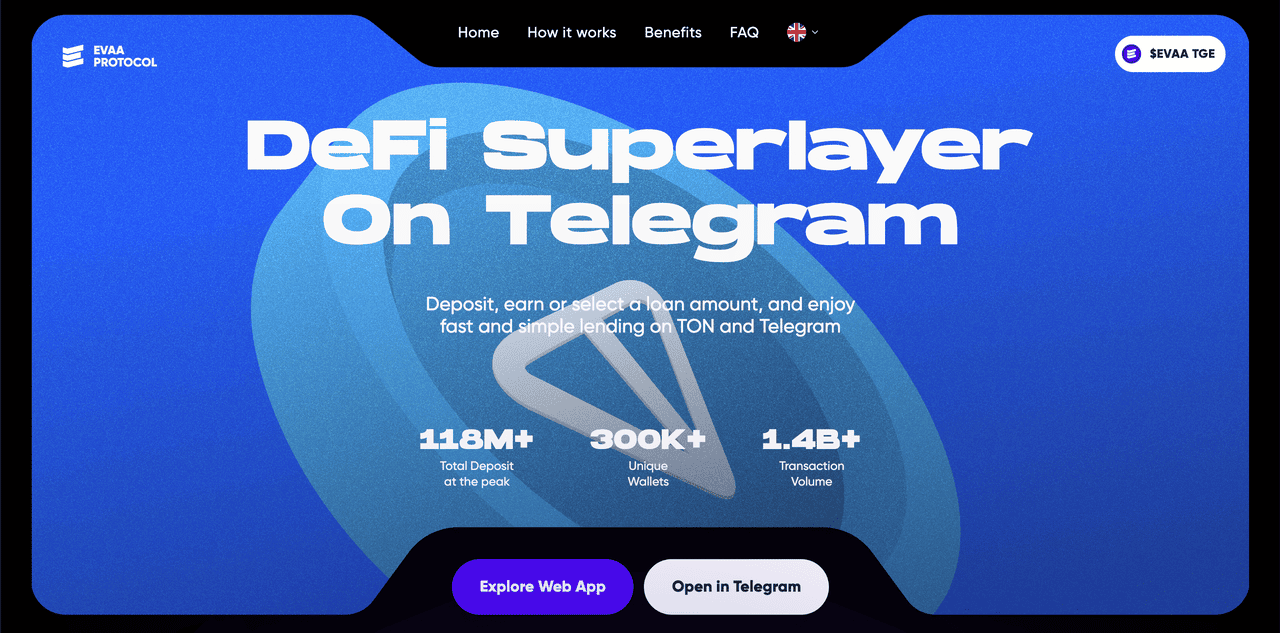
EVAA Protocol (EVAA) is a decentralized lending and borrowing platform native to The Open Network (TON) and integrated directly into Telegram. Instead of asking users to leave their messaging app and navigate complex DeFi dashboards, EVAA embeds lending, borrowing, and yield inside a Telegram Mini App, positioning itself as a "DeFi superlayer" on a platform people already use daily. It is widely described as the first and largest lending protocol on TON by total value locked.
EVAA raised private funding from backers including TON Ventures, Animoca Ventures, and CMT Digital before launching its native EVAA token in late 2025. The ecosystem has several key parts: EVAA is the governance and utility token, the lending markets let users supply and borrow assets natively on TON, leveraged liquid staking amplifies staking rewards, and the Telegram Mini App and EVAA Card bring DeFi to everyday users. This guide explains what EVAA is, how the protocol works, how EVAA tokenomics function, the main risks to consider, and how to trade EVAA on BingX.
What Is EVAA Protocol (EVAA)?
Source: EVAA Finance
EVAA Protocol (EVAA) is a decentralized liquidity protocol on the TON blockchain that lets users deposit digital assets to earn interest or borrow against collateral without a centralized intermediary. Depositors supply assets such as TON or USDT to liquidity pools and earn yield from borrowing demand, while borrowers take overcollateralized loans by pledging more value than they withdraw. All of this runs through smart contracts, with a Telegram Mini App and web interface lowering the barrier to entry for new users.
EVAA is the native governance and utility token of this system. It gives holders a say in selected protocol decisions and supports incentives, fee reductions, staking, and ecosystem participation. Future governance proposals may also consider limited token buybacks and burns. The project's co-founder introduced one of TON's earliest lending applications, and what began as a hackathon prototype scaled into TON's largest DeFi protocol, reporting more than one billion dollars in cumulative transactions and hundreds of thousands of connected wallets during its early growth.
The core idea behind EVAA is simple: DeFi adoption follows good user experience. By embedding lending inside Telegram, EVAA aims to make borrowing and earning as familiar as sending a message.
Key components of the EVAA ecosystem include:
- EVAA token: The governance and utility token that powers voting, incentives, and protocol functions.
- Lending and borrowing markets: Overcollateralized pools where users supply assets to earn yield or borrow against collateral natively on TON.
- Leveraged liquid staking: A mechanism that lets users borrow against staked assets to amplify staking rewards while keeping liquidity.
- Telegram Mini App: The @EvaaAppBot interface that brings lending, payments, and yield directly into Telegram.
- EVAA Card: An integration that bridges on-chain yield with real-world payments by letting users spend against deposited collateral.
Read More: Top 7 Telegram Mini-Apps in the TON Ecosystem (2026)
How Does EVAA Protocol Work?
EVAA works as a TON-native liquidity protocol whose lending markets, incentives, and governance are coordinated by the EVAA token and delivered through Telegram.
- Liquidity pools connect lenders and borrowers: Users deposit assets into pools to earn yield, while borrowers draw loans from those pools, with smart contracts handling matching and settlement automatically.
- Overcollateralization protects the protocol: Borrowers must deposit collateral worth more than their loan, reducing protocol risk and protecting depositors from bad debt.
- Dynamic interest rates adjust to demand: Borrowing rates and deposit yields move automatically based on how much of each pool's capital is being used, so rates respond to supply and demand.
- Automatic liquidation prevents insolvency: When collateral value falls below a safety threshold, the protocol initiates liquidation to protect the liquidity pool and depositors' funds.
- Telegram integration lowers the barrier: The @EvaaAppBot Mini App and TON Space wallet integration let users manage lending and borrowing inside Telegram, without leaving the app or setting up external tools.
EVAA Protocol vs. Ethereum Lending Protocols: Key Differences
EVAA and Ethereum lending protocols like AAVE both use overcollateralized lending pools and dynamic interest rates, but they differ in chain, distribution, and user experience.
|
Comparison |
EVAA |
Ethereum Lending Protocols |
|
Blockchain |
Built natively on TON |
Built primarily on Ethereum |
|
User access |
Telegram-integrated, mobile-first experience |
Web dashboards connected to external wallets |
|
Core audience |
Telegram and TON users |
Traditional DeFi users |
|
Lending model |
Overcollateralized lending with dynamic rates |
Overcollateralized lending with dynamic rates |
|
Main advantage |
Simple access inside Telegram |
Deeper liquidity and more collateral types |
|
Main tradeoff |
Younger protocol with a smaller ecosystem |
More complex onboarding and higher interaction costs |
EVAA focuses on simple, mobile-first lending through Telegram, while Ethereum lending protocols typically offer deeper liquidity, broader collateral support, and a longer operating history. The choice depends on whether users prioritize convenience within the TON ecosystem or the scale and maturity of established Ethereum markets.
What Are the EVAA Protocol (EVAA) Tokenomics?
EVAA tokenomics center on a fixed maximum supply of 50 million tokens, a gradual emission schedule, and allocations designed to support liquidity, ecosystem rewards, protocol development, and long-term governance. The supply is distributed across community incentives, market liquidity, the DAO treasury, investors, the team, advisors, and future funding rounds.
EVAA Token Utility and Supply Mechanisms
EVAA is the governance and utility asset of the protocol. Its utility spreads across governance, fee discounts, staking, and ecosystem incentives.
- Governance: Token holders can vote on selected platform-level technical proposals and feature updates. Future proposals may cover lending pools, supported collateral, incentives, risk-management policies, platform fees, and whether limited token buybacks and burns should be conducted.
- Fee reduction: Users who burn EVAA through selected supported mechanisms may receive discounted protocol or platform fees.
- Staking and security modules: EVAA may be staked or locked directly or through liquidity provider tokens to support protocol security and qualify for additional rewards.
- Boosted APY: Eligible users may receive additional EVAA rewards on top of the standard supply or borrowing APY generated by other assets.
- Ecosystem alignment: EVAA gives users a role in governance and incentivizes participation in the protocol’s lending and liquidity markets.
EVAA Token Allocation
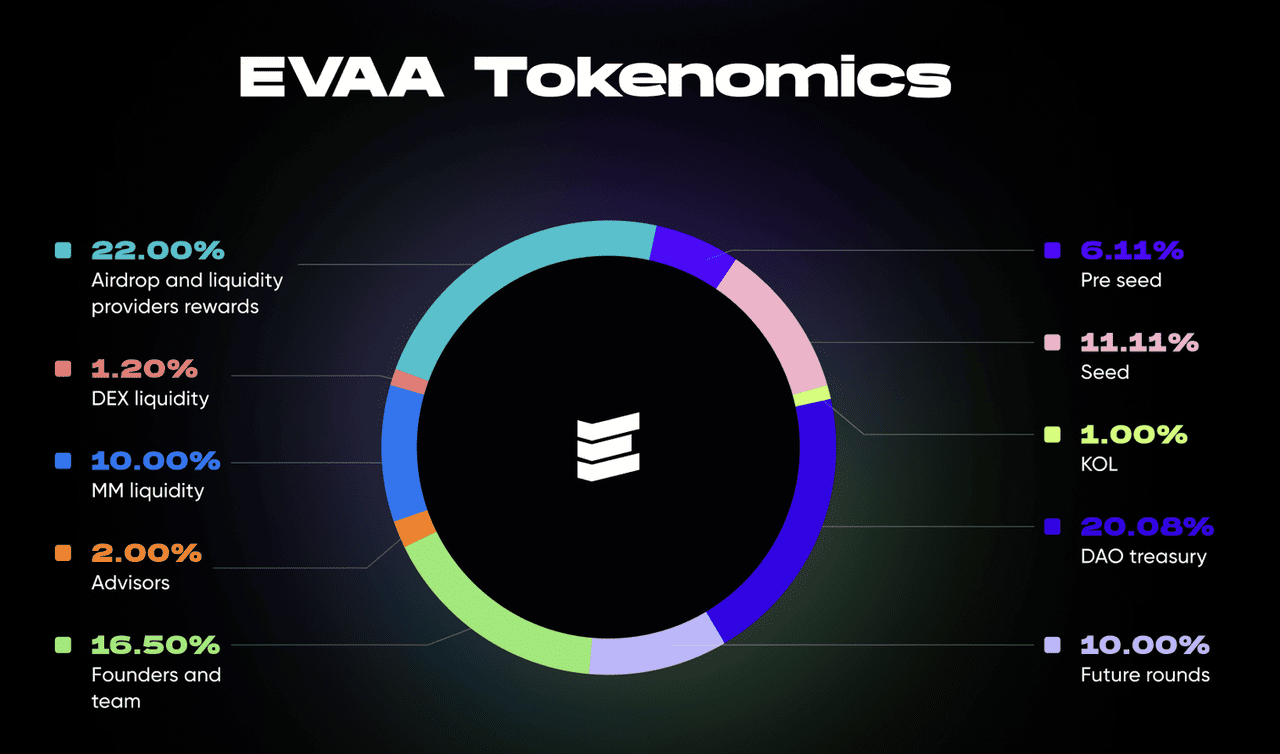
- Community and Liquidity: 33.20%, or 16.6 million EVAA. This combines airdrop and liquidity provider rewards at 22%, market-maker liquidity at 10%, and DEX liquidity at 1.2%.
- DAO Treasury and Future Rounds: 30.08%, or 15.04 million EVAA. This combines the DAO treasury at 20.08% and future funding rounds at 10%.
- Team and Advisors: 18.50%, or 9.25 million EVAA. This combines founders and team at 16.5% and advisors at 2%.
- Pre-seed and Seed Investors: 17.22%, or 8.61 million EVAA. This combines the pre-seed allocation at 6.11% and seed allocation at 11.11%.
- KOLs: 1%, or 500,000 EVAA. This allocation is reserved for key opinion leaders.
EVAA’s largest combined allocation supports community rewards and market liquidity, while the DAO treasury and future rounds account for another 30.08%. The remaining supply is distributed among the team, advisors, early token purchasers, and KOLs. Because these allocations follow different emission schedules, investors should monitor official token releases to understand how EVAA’s circulating supply may change over time.
EVAA’s supply dynamics depend primarily on scheduled token emissions, ecosystem rewards, and market demand. Future governance may authorize limited buybacks and burns, but the official documentation does not describe these as an active or automatic supply-reduction program.
How to Trade EVAA Protocol (EVAA) on BingX
BingX offers ways to gain exposure to EVAA Protocol depending on whether the goal is direct ownership or short-term trading. Spot trading suits users who want to buy and hold EVAA, while futures trading is designed for active traders who want long or short exposure to EVAA price movements.
Spot Trading: Buy and Own EVAA Directly
Spot trading is the most straightforward way to buy EVAA Protocol on BingX. When users buy EVAA on the spot market, they own the asset directly and can hold it in the BingX spot account, transfer it, or withdraw it to a TON-compatible self-custody wallet.
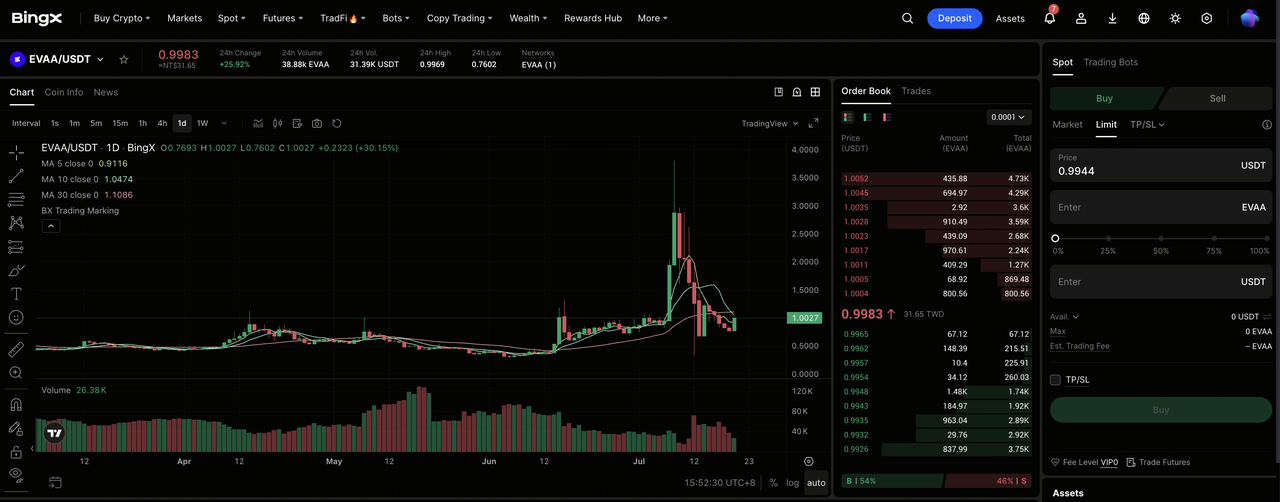
Step 1: Account setup and security. Sign up and log into your BingX account, complete the identity verification (KYC) required in your region, and enable two-factor authentication.
Step 2: Fund your spot account. Deposit USDT or another supported asset into your BingX spot account. Where available, users can also use supported fiat on-ramp options.
Step 3: Navigate to the spot market. Search for the EVAA/USDT trading pair.
Step 4: Place your order. Choose a market order to buy EVAA immediately at the current price, or use a limit order to set the price you want to pay.
Step 5: Manage your EVAA. Once filled, your EVAA appears in your spot account. You can keep it on BingX for convenience or withdraw it to a TON-compatible self-custody wallet for governance or ecosystem participation.
Futures Trading: Trade EVAA Price Movements
For active traders, BingX offers USDT-margined EVAA perpetual futures. Futures allow users to trade EVAA price movements without holding the underlying asset, with the flexibility to open long positions if they expect EVAA to rise or short positions if they expect EVAA to fall.
Because futures involve leverage, they can amplify both gains and losses. This approach is more suitable for traders who already have a clear risk plan and understand liquidation risk, particularly for an asset like EVAA that is sensitive to TON ecosystem sentiment, token unlocks, and low circulating supply.
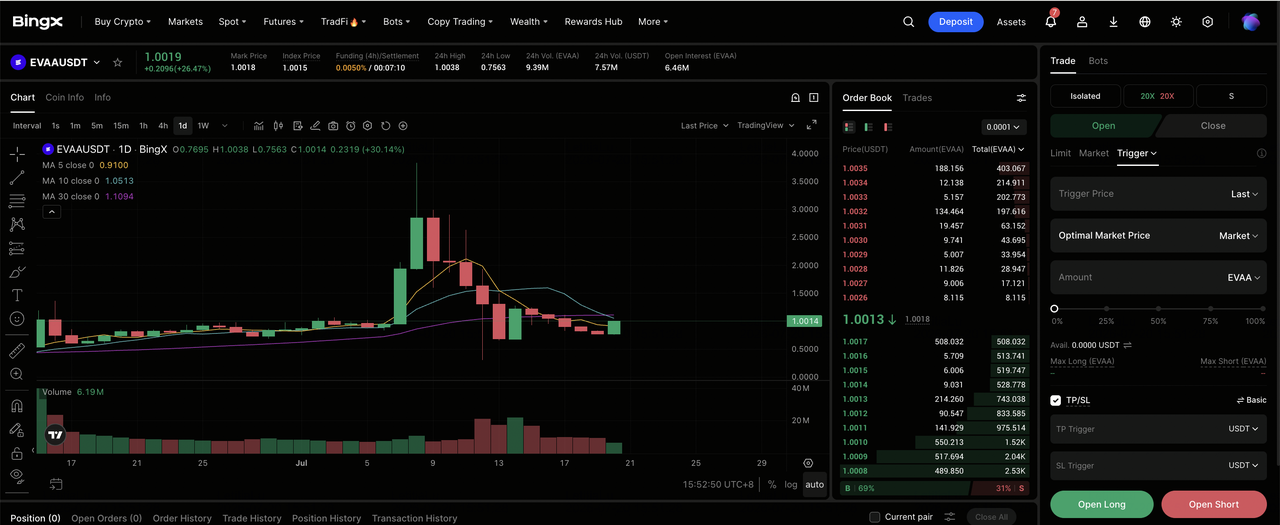
Step 1: Transfer collateral. Move USDT from your spot account into your futures account, where it will serve as margin.
Step 2: Select the contract. Search for the EVAA-USDT perpetual contract.
Step 3: Set direction and leverage. Open long if you expect EVAA to rise, or open short if you expect EVAA to decline. Choose leverage based on your risk tolerance and position size.
Step 4: Execute the trade. Enter the order amount and choose a market or limit order depending on your trading plan.
Step 5: Manage risk. Set stop-loss and take-profit orders before or immediately after entering the position. Profit and loss settle dynamically in USDT.
Risks and Considerations Before Investing in EVAA Protocol (EVAA)
EVAA has real product usage, strong TON ecosystem backing, and a clear Telegram distribution advantage. However, EVAA still carries risks tied to low circulating supply, token unlocks, ecosystem dependency, and DeFi mechanics.
- Low circulating supply and high volatility: A large majority of the 50 million supply remains locked, so a low float can create sharp price swings, and EVAA has already traded far below its all-time high.
- Token unlocks can pressure price: With most supply still locked, concentrated unlocks could add selling pressure if staking rewards and yield incentives do not offset them.
- Ecosystem dependency on TON: EVAA's utility, liquidity, and growth are tightly linked to TON and Telegram; a slowdown in TON DeFi activity would directly affect lending demand.
- DeFi and liquidation risk: As an overcollateralized lending protocol, EVAA is exposed to smart contract risk, oracle risk, and cascading liquidations during sharp market moves, even though it has pursued security audits.
- Early-stage token: EVAA's token launched relatively recently, so it has a limited on-chain price history, and past performance does not guarantee future results.
Final Thoughts: Should You Invest in EVAA Protocol (EVAA) in 2026?
EVAA is one of the more established DeFi projects in the TON ecosystem, combining the position of TON's largest lending protocol with a distribution edge through Telegram. Its 2026 story is anchored by Telegram-native DeFi adoption, a shift to DAO governance, and expansion into card payments and new loan products.
The key question for 2026 is whether EVAA can convert Telegram's large user base into sustained lending demand and token utility while managing a low float and upcoming unlocks. Its user experience, ecosystem backing, and governance-based token utility set it apart from many small-cap DeFi tokens, but EVAA is still exposed to supply pressure and TON ecosystem sentiment. For investors and traders, the most important metrics to watch are total value locked, active wallets, unlock schedules, token emissions, any governance-approved buyback activity, and TON DeFi sentiment.
Related Reading
- Top 7 Telegram Mini-Apps in the TON Ecosystem (2026)
- What Are the Best TON Wallets for Toncoin and Jetton Tokens in 2026?
- How to Create and Set Up a Tonkeeper Wallet for the TON Ecosystem
- What Are the Top 10 DeFi Lending Protocols to Watch in 2026?
- What Is Aave DeFi Lending Protocol and How Does it Work?
- What Is DOGS? Discover The Telegram-Native Memecoin Built on TON and How to Buy It On BingX
FAQs About EVAA Protocol (EVAA)
1. What makes EVAA Protocol different from other lending platforms?
EVAA is the first and largest lending protocol on the TON blockchain, and it is fully integrated into Telegram as a Mini App. This lets users lend, borrow, and earn yield inside an app they already use, rather than through a separate web dashboard, giving it a distribution advantage over many Ethereum-based lending protocols.
2. What blockchain is EVAA on?
EVAA is native to The Open Network (TON) and integrated with Telegram's non-custodial wallet, TON Space. Users should make sure their wallet is connected to the correct network before trading or transferring the token.
3. How does EVAA reduce its token supply?
Part of the fees collected by the protocol funds a buyback-and-burn program that gradually removes EVAA tokens from circulation. Protocol revenue is channeled to a DAO treasury, which may be used for buybacks or burns over time.
4. Does EVAA Have a Buyback-and-Burn Program?
EVAA’s official documentation does not confirm an active, automatic buyback-and-burn program funded by protocol fees. It states that future governance proposals may decide whether limited EVAA buybacks and burns should occur, including their timing, duration, and limits. Users who burn EVAA through selected utility mechanisms may also qualify for platform fee discounts.
5. Which wallets support EVAA?
EVAA can be stored in TON-compatible wallets, including Telegram's TON Space and the official Telegram Wallet. Users should always confirm they are using the TON network before transferring EVAA to avoid loss of funds.
