

In 2026, over 39 million ETH are locked in staking contracts, representing nearly one-third of the token's total circulating supply. This massive volume demonstrates that locking up Ether to validate the network has moved from a technical niche to a mainstream strategy for long-term holders. However, the direct question every investor asks before locking up their tokens remains: does the yield justify the risk and the tax reporting requirements?
Quick Answer: Ethereum staking is the process of locking up ETH to help validate network transactions in exchange for crypto rewards. It is highly viable for those who plan to hold ETH long-term, can tolerate price volatility, and are prepared to report earnings to tax authorities. To get started: choose a reputable exchange, select between flexible or fixed terms, calculate net yield after fees, and maintain precise tax records from day one.
What is Ethereum Staking in Practice?
Think of staking as placing money into a bank certificate of deposit (CD) or a high-yield savings account: you lock up your capital for a period, forgo immediate liquidity, and earn interest in return. In the case of Ethereum, instead of earning fiat interest, you receive rewards in the native cryptocurrency, paid out for participating in the network's block validation.
Since the milestone upgrade known as "The Merge" in September 2022, Ethereum has operated on a Proof-of-Stake (PoS) consensus mechanism. This means GPU mining is a thing of the past. Network security is now maintained by validators—individuals and entities that lock up ETH as collateral to guarantee honest behavior.
There are two primary ways to approach this concept:
- Solo (Native) Staking: The investor runs their own validator node, which requires exactly 32 ETH to be locked and demands full technical oversight of hardware and software uptime.
- Pool or Exchange Staking: The investor deposits any amount of ETH, and the platform handles the technical complexities, distributing the rewards proportionally.
For the vast majority of retail investors, the second option is the most viable. With ETH trading around $1,600 in June 2026, accumulating 32 coins to run a solo validator would require over $51,000 in locked capital, not including the overhead costs of running a dedicated server 24/7.
What is the Ethereum Staking Yield Today?
Before deciding if it's worth it, you need to understand the math behind the rewards. The annual staking return is not fixed; it fluctuates based on the total volume of ETH actively staked across the network.
Simplified Formula:
Estimated Annual Reward = Invested Capital × Network Yield Rate (APR/APY)
Currently, the staking participation rate sits around 32% to 33% of the circulating ETH supply, netting a base network reward rate of approximately 2.7% to 2.8% APY for pure validator operations. Meanwhile, centralized exchanges offering flexible staking options usually provide yields ranging from 3% to 4% APY, depending on whether you opt for a flexible plan (instant redemption) or a fixed term (higher yield with a locked duration).
Practical Example with Real Numbers:
Imagine an investor allocates $5,000 worth of ETH into a flexible staking product with a 3.5% annual yield.
| Item | Value |
|---|---|
| Invested Capital | $5,000 |
| Annual Percentage Yield (APY) | 3.5% |
| Estimated 12-Month Reward | $175 |
| Reward in ETH (at a $1,600 baseline) | ≈ 0.109 ETH |
These rewards are credited incrementally—often on a daily basis—and automatically compound into your staked balance. A crucial detail to note: depending on your jurisdiction, these rewards may be considered taxable income upon receipt, even before you sell or convert the asset.
Liquid staking, pioneered by protocols like Lido (which currently commands the lion's share of the liquid staking market), operates on a similar premise but issues a derivative wrapper token (like stETH). This token automatically accrues yield while remaining completely liquid, allowing it to be utilized simultaneously across various DeFi protocols.
Is Staking Worth It? The Real Pros and Cons
Key Advantages
- Passive Income without Liquidating: You retain full exposure to ETH's underlying price appreciation while generating an additional yield buffer.
- Low Barrier to Entry via Exchanges: There is no need to commit 32 ETH; most platforms allow you to start staking with minor fractions of a token.
- Supporting Network Security: The more ETH that is securely locked and distributed across global validators, the more decentralized and attack-resistant the Ethereum blockchain becomes.
- Streamlined Process: On a centralized platform, onboarding is reduced to a simple click-and-confirm process, completely bypassing the need to configure hardware or manage validator client software.
Risks to Account For
- Underlying Asset Volatility: Rewards are paid out in ETH. If the market value of the token drops significantly, your overall portfolio value in fiat terms could still end up in the red despite the yield.
- Custodial and Counterparty Risk: When staking via an exchange, you delegate asset custody to the platform. It is vital to choose top-tier exchanges with established security track records, robust cold storage architecture, and dedicated Proof of Reserves (PoR).
- Slashing Penalties: For solo staking or poorly managed validation pools, the network penalizes malicious behavior or prolonged offline status by burning a portion of the staked ETH.
- Limited Liquidity on Fixed Terms: Depending on the product architecture, early redemption may be restricted, or it could result in forfeiting a portion of your accumulated rewards.
- Tax Compliance Overheads: Every distribution event constitutes a trackable transaction that may require rigorous bookkeeping for capital gains or income tax compliance.
Ethereum Staking and Income Tax: What the Federal Revenue Requires
This is where most investors stumble, and it deserves extra attention moving into 2026.
Tax authorities generally treat staking rewards as newly acquired assets with a cost basis of zero. In practice, this implies two major things:
- You must report the ownership of these assets in your annual tax filings under the appropriate Cryptoassets category, whenever the total value per asset type reaches or exceeds the regulatory reporting threshold at the end of the fiscal year.
- When you eventually sell or convert these staking rewards, your capital gains tax will be calculated based on the full disposal value, since the entry cost is considered zero.
The good news for retail investors in many jurisdictions is the existence of tax exemptions: crypto sales that fall below a certain monthly threshold remain exempt from capital gains tax. Above this ceiling, progressive tax brackets apply depending on the total profit generated.
Another major shift for self-custody users and international platforms is the implementation of modernized digital asset reporting frameworks (such as DeCripto or updated monthly compliance protocols coming into effect in mid-2026). Staking, mining, airdrops, and crypto-backed lending are explicitly included in the scope of reportable operations once they exceed local monthly volume thresholds. While this rule does not alter the tax rates themselves, it significantly increases on-chain traceability, making meticulous record-keeping of every distribution event more critical than ever.
Practical Recommendation: Maintain a clean tracking sheet detailing the date, the precise amount of ETH received via staking, and its fiat value on the day it was credited. This prevents major bookkeeping headaches when calculating your future capital gains.
CEX vs. DeFi: Where to Stake Your ETH
| Criterion | Centralized Exchange (CEX) | DeFi Staking (e.g., Lido) |
|---|---|---|
| Ease of Use | High; accessible within a few clicks. | Requires a self-custody wallet and a baseline understanding of DeFi. |
| Custody | The platform manages and stores the underlying asset. | The user maintains ownership and control via smart contracts. |
| Liquidity | Depends on the product structure (flexible vs. fixed terms). | Liquid staking tokens (like stETH) can be traded or deployed in other protocols. |
| Minimum Requirement | Typically minor fractions of ETH. | Any amount; completely bypasses the 32 ETH solo-staking minimum. |
| Technical Risk | Low for the end user; managed by the platform. | Exposed to smart contract vulnerabilities or protocol exploits. |
For beginners, the sheer convenience of a centralized exchange like BingX usually tips the scale. Within the BingX Earn hub, users can choose between flexible ETH plans that offer instant redemption at any time, or fixed-term options that deliver a more competitive yield in exchange for a temporary commitment. The platform also reinforces user protections through dedicated cold storage security models and multi-factor authentication (2FA), directly mitigating the custodial risks outlined above.
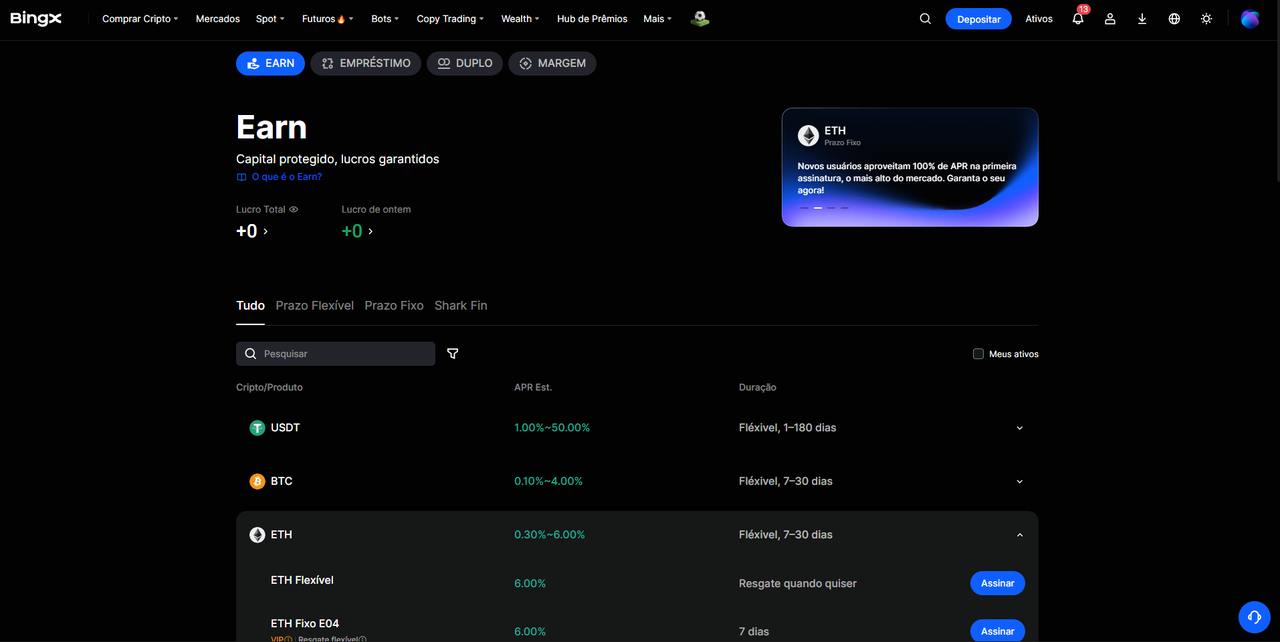
Conversely, those who prefer keeping their ETH in private storage without relying on an intermediary can opt for liquid staking via decentralized protocols. The primary advantage is absolute self-sovereignty; however, the trade-off is accepting smart contract risk and navigating the steeper learning curve of managing a non-custodial wallet or a native Web3 wallet.
Who Should Consider Ethereum Staking?
ETH staking is best suited for investor profiles who:
- Intend to hold ETH for at least a one-to-two-year horizon, regardless of short-term price fluctuations.
- Do not require immediate liquidity on that specific allocation of capital.
- Are prepared to handle the tracking and reporting overheads for tax purposes.
- Acknowledge that pure yield returns can be heavily outpaced by the underlying asset's market volatility.
On the flip side, short-term speculators, active day traders, or those who may need to liquidate their assets on short notice are better off keeping their ETH liquid on the spot market or utilizing derivative products like perpetual futures. For this active demographic, implementing sound risk management and utilizing precise stop-loss and take-profit orders is a far more effective use of capital than locking tokens away in staking contracts.
Frequently Asked Questions About Ethereum Staking
1. Is Ethereum staking safe?
The core Ethereum network protocol is highly secure, backed by years of stable operations since transitioning to Proof of Stake. The primary risk vectors do not stem from the blockchain itself, but rather from your choice of platform or pool: choosing an exchange with a proven security track record minimizes counterparty risks.
2. Do I need exactly 32 ETH to stake?
No. The 32 ETH requirement only applies if you intend to set up an independent, solo validator node. Centralized exchanges and staking pools aggregate user funds, enabling you to participate with micro-fractions of ETH.
3. How is Ethereum staking taxed?
Most jurisdictions treat staking rewards as income upon receipt, assigning them a zero cost basis. Capital gains tax kicks in when you sell or trade those tokens, often subject to local retail exemption thresholds.
4. What is the difference between flexible and fixed staking?
Flexible staking allows you to withdraw your assets instantly at any time, typically carrying a more modest yield. Fixed staking requires you to lock up your capital for a predetermined duration in exchange for a significantly higher APY.
5. Does staking ETH yield more than just holding it in a wallet?
In terms of pure token accumulation, yes—it consistently expands your total ETH balance. However, your ultimate return in fiat terms remains completely dependent on ETH's market valuation over the staking period.
6. Can I lose money by staking ETH?
Yes. While token accumulation is predictable, the overall purchasing power or fiat value of your portfolio can decline if Ethereum's market price drops more sharply than the percentage yield you earn.
7. Is staking the same as Ethereum mining?
No. Ethereum mining was fully phased out with the consensus transition in 2022. Staking replaced the Proof-of-Work model entirely, eliminating hardware overheads like GPUs and slashing the network's energy footprint.
Key Takeaways on Ethereum Staking
- Staking involves locking up ETH tokens to validate blockchain transactions in exchange for programmatic rewards.
- Solo validation demands 32 ETH, whereas exchange products and staking pools allow users to onboard with fractional amounts.
- Average yields hover between 3% and 4% APY on centralized platforms, shifting dynamically based on network participation and lock-up terms.
- Tax frameworks routinely value staking rewards with a zero-cost basis, creating taxable events upon disposal or liquidation.
- Regulatory frameworks in 2026 are tightening transaction tracking (such as the DeCripto mandate), amplifying the need for accurate transaction logging.
- Staking is structurally engineered for long-term holders rather than high-frequency speculative trading strategies.
Related Articles
- How to Stake Ethereum (ETH) and Earn Passive Income: A Complete Yield Guide
- Crypto Tax Guide 2026: Navigating Capital Gains and On-Ramp/Off-Ramp Compliance
- Evaluating Crypto Exchange Security: Understanding Proof of Reserves and Vault Architectures
- Liquid Staking vs. Native Staking vs. Pool Staking: Which Should You Choose?
- Understanding Spot Ethereum ETFs: What They Are and How to Trade Them
