The global technology sector in 2026 is defined by a profound paradigm shift. The industry has decisively moved away from the traditional software-as-a-service (SaaS) model to enter a hyper-capital-intensive infrastructure era. Today, global economic dominance is dictated by physical compute capacity, advanced semiconductor packaging, and highly protected sovereign cloud systems. At the absolute epicenter of this macroeconomic transformation stands Dario Amodei, the co-founder and Chief Executive Officer of Anthropic.
Amodei’s personal wealth accumulation over the first half of the 2020s mirrors the unprecedented global rush for advanced large language models (LLMs) and specialized enterprise AI software. Under his strategic guidance, Anthropic achieved an extraordinary milestone, crossing a private market valuation of $965 billion in May 2026. This historic valuation cemented the corporation’s status as the foundational safety and alignment architect of the machine intelligence era. As a result, Amodei's financial profile has transitioned from that of a highly respected research scientist into one of the most powerful modern industrial fortunes on earth.

Source: X.com
Who Is Dario Amodei?
Dario Amodei is an Italian-American physicist, computer scientist, and executive who has fundamentally altered the trajectory of modern artificial intelligence development. Born with a deep passion for empirical science, Amodei earned his undergraduate degree from Stanford University and a PhD in physics from Princeton University, later completing a postdoctoral fellowship at the Stanford University School of Medicine where he focused on neural networks and biophysics.
Before orchestrating the rise of Anthropic, Amodei steered critical research initiatives at tech giants like Baidu and Google. In 2016, he joined OpenAI, eventually rising to the position of Vice President of Research. During his tenure, Amodei led the foundational teams responsible for the creation of GPT-2 and GPT-3, serving as a primary architect of the early generative AI revolution.
However, as commercial pressures began to reshape OpenAI's core mission, Amodei, alongside his sister Daniela Amodei and five other prominent researchers, chose a separate path. In 2021, they established Anthropic with a core conviction: that the development of frontier intelligence must be mathematically aligned with human values. By pioneering Constitutional AI, a proprietary framework that allows AI models to align themselves according to a set of written principles, Amodei positioned Anthropic as the indispensable backbone of secure enterprise AI deployment, placing himself at the steering wheel of the global tech economy.
How Did Dario Amodei Build His Wealth?
Unlike traditional technology executives who diversify their assets across vast real estate empires and disparate venture capital funds, Amodei’s multi-billion-dollar fortune is highly concentrated and structurally linear. His net worth is anchored on three clear strategic pillars:
- High Founder Equity Retention: The primary vehicle for Amodei’s wealth accumulation is his direct, long-term ownership of Anthropic equity. By maintaining a significant founder stake through consecutive multi-billion-dollar private funding rounds, Amodei has ensured his net worth scales in lockstep with Anthropic's near-trillion-dollar valuation.
- Enterprise Market Capture: Amodei positioned Anthropic not merely as a research laboratory, but as a dominant enterprise software vendor. By anticipating that Fortune 500 companies would require strict security and reliability guarantees before deploying generative tools, Amodei directed corporate strategy toward building the highly trusted Claude model family. This foresight enabled Anthropic to capture 34.4% of the enterprise AI market by mid-2026.
- The Claude Code Agentic Moat: An architectural reality of the 2026 AI ecosystem is that raw models are rapidly commoditizing, making specialized agentic workflows the true drivers of revenue. By investing heavily in tools like Claude Code, an autonomous software development platform, Amodei created a massive corporate dependency. This software moat has driven unprecedented revenue scaling, protecting Anthropic's pricing power and consistently inflating the value of Amodei's equity.
Dario Amodei's Net Worth in 2026: Key Estimates
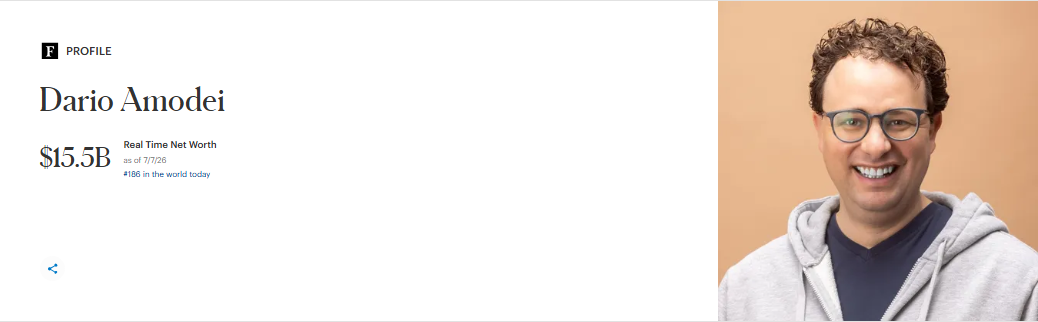
The baseline metric of Dario Amodei's wealth in 2026 positions him firmly within the elite tier of global technology leaders. Because his fortune is primarily tied to a privately held Public Benefit Corporation (PBC), leading financial publications track his net worth through funding round capitalizations and institutional private market appraisals.
Dario Amodei Financial Status Registry (2026)
|
Wealth Metric |
2026 Financial Status |
Qualitative Influence & Analytical Context |
|
Early 2026 Baseline |
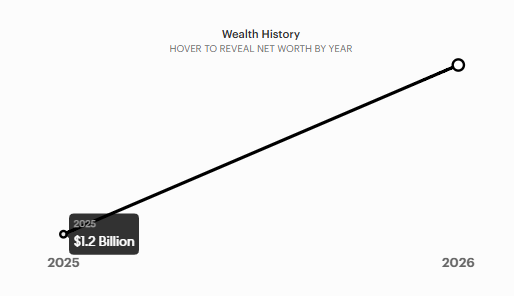
$7.0 Billion |
Estimated by Forbes following Anthropic’s early-year private capitalization assessments, ranking him at position #536 globally. |
|
Mid-2026 Forbes Real-Time Estimate |
$15.5 Billion |
Achieved following the close of Anthropic's historic Series H funding round in May 2026. |
|
Implied Post-IPO Peak Projection |
Over $18.0 Billion |
Projected by institutional analysts evaluating the expected impact of an October 2026 Nasdaq public debut at a $1+ trillion market cap. |
|
Anthropic Equity Control |
≈ $1.8 Billion |
Total proportional ownership of outstanding fully diluted common stock, secured via Class B "golden" voting shares. |
|
Daniela Amodei Peer Alignment |
$15.5 Billion |
Co-founder and President Daniela Amodei holds an identical net worth, ranking as the second-richest self-made woman in America. |
The Valuation Trajectory and Revenue Scaling of Anthropic
The velocity of Anthropic’s valuation scaling has compressed historical corporate development timelines, achieving in four years what took earlier internet giants nearly two decades to accomplish. This capital expansion has been closely tracked by a corresponding surge in annualized revenue run rates, largely driven by enterprise adoption of the Claude model family and specialized agentic products.
Valuation and Implied Wealth Metrics (2023–2026)
|
Date |
Funding Round |
Capital Raised |
Post-Money Valuation |
Implied Amodei Net Worth |
|
August 2023 |
Series D |
$235 Million |
$4.5 Billion |
≈ $80 Million |
|
January 2024 |
Undisclosed |
Undisclosed |
$18 Billion |
≈ $325 Million |
|
March 2025 |
Series E |
$3.5 Billion |
$61.5 Billion |
≈ $1.1 Billion |
|
September 2025 |
Series F |
$13 Billion |
$183 Billion |
≈ $3.3 Billion |
|
February 2026 |
Series G |
$30 Billion |
$380 Billion |
≈ $7.0 Billion |
|
May 2026 |
Series H |
$65 Billion |
$965 Billion |
≈ $15.5 Billion |
Anthropic's financial narrative is fundamentally supported by an unprecedented revenue trajectory. The company’s annualized revenue run rate climbed from a modest $87 million in January 2024 to $1 billion by December of that year, subsequently exploding to $9 billion by the end of 2025. By February 2026, the run rate had reached $14 billion, followed by a vertical surge to $19 billion in March, $30 billion in April, and ultimately surpassing $44 billion by May 2026.
A critical driver of this growth has been Claude Code, an agentic software development tool that surpassed $1 billion in annualized revenue within six months of its launch and reached a $2.5 billion run rate by mid-2026. This commercial traction has allowed Anthropic to capture 34.4% of the enterprise AI market as of April 2026, effectively overtaking OpenAI's 32.3% share for the first time. The number of corporate clients spending more than $1 million annually on Anthropic's tools doubled from 500 in February 2026 to over 1,000 by April, illustrating a highly concentrated and lucrative B2B customer base.
The Confidential S-1 Filing and Expected October 2026 Anthropic IPO Dynamics
To institutionalize its massive private valuation and secure permanent public capital, Anthropic confidentially submitted a draft S-1 registration statement with the Securities and Exchange Commission (SEC) on June 1, 2026. This move gave the company a distinct first-mover advantage over its primary rival, OpenAI, which filed its own confidential S-1 draft just days later. Led by lead underwriters Goldman Sachs, JPMorgan, and Morgan Stanley, the offering is targeted for an October 2026 listing on the Nasdaq or NYSE.
The public debut is structured to raise more than 60 billion, representing a ≈ 5% to 6% dilution of the company's equity—a standard percentage for a mega-cap transaction. Investment bankers project a debut valuation at or above the $1 trillion mark, which would establish Anthropic as the first pure-play AI safety company to enter the public markets at a trillion-dollar capitalization.
At a valuation of $965 billion and annualized revenues approaching 50 billion, Anthropic would list at an implied price-to-sales (P/S$) multiple of approximately 22x. While this is lower than the 32x multiple observed during earlier private rounds, market analysts note that it remains elevated compared to established enterprise software platforms like Salesforce (trading at ≈ 8 x) and Snowflake (trading at ≈ 15 x).
This high multiple is justified by institutional backers who point to Anthropic's ambitious long-term financial targets. The company aims to generate $70 billion in revenue and $17 billion in free cash flow by 2028, positioning itself to achieve cash-flow positivity ahead of OpenAI, which is not projected to turn a profit until 2030.
On secondary private markets, buyers on platforms such as Forge Global and Hiive have submitted bids valuing the company between 1.0 trillion and 1.1 trillion. However, early-stage employee and investor blocks have occasionally traded at wider spreads due to liquidity-seeking behaviors, prompting the company to reinforce strict anti-transfer policies, rendering unauthorized secondary market transactions completely void.
Read more: What Is Anthropic Pre-IPO and How to Trade It on BingX?
How Does Dario Amodei's Wealth Compare to Other Global Tech Leaders?
Evaluating Dario Amodei’s net worth, equity layout, and overall industry influence alongside other prominent technology leaders reveals distinct approaches to wealth accumulation and corporate governance in the AI era.
Peer Wealth and Organizational Governance Matrix (2026)
|
Tech Leader |
Associated Organization |
Estimated 2026 Net Worth |
Equity Control Mechanism |
Core AI Integration Role |
|
Elon Musk |
Tesla / SpaceX / xAI |
$839 Billion – $1.1 Trillion |
20% of Tesla; 42% of private SpaceX common equity. |
Supercomputing clusters, sovereign data infrastructure, FSD systems. |
|
Mark Zuckerberg |
Meta Platforms |
$196 Billion – $229 Billion |
≈ 13% direct equity with high-leverage dual-class voting control. |
Open-source distribution of foundational model weights. |
|
Jensen Huang |
Nvidia |
$154 Billion – $191.5 Billion |
3.0% - 3.6% direct and family trust equity holdings. |
Universal supplier of advanced GPU computing hardware. |
|
Dario Amodei |
Anthropic |
$15.5 Billion |
1.8% fully diluted equity via dual-class golden voting shares. |
Enterprise-focused models, software engineering, safety alignment. |
|
Sam Altman |
OpenAI |
$2.0 Billion – $3.5 Billion |
0% direct equity; wealth held via independent venture capital vehicles. |
Global sovereign fund design, consumer-facing generative applications. |
|
Satya Nadella |
Microsoft |
$1.3 Billion – $1.56 Billion |
≈ 0.01% of Microsoft; performance-linked stock grants. |
Cloud ecosystem expansion, strategic integration of OpenAI models. |
|
Sir Demis Hassabis |
Google DeepMind / Isomorphic Labs |
$500 Million – $1.0 Billion |
Corporate executive equity compensation, early external angel investments. |
"Science-first" physical modeling, multi-modal biological systems. |
Dario Amodei vs. Sam Altman: Two Divergent Philosophies
The structural differences in wealth generation between Dario Amodei and Sam Altman highlight two distinct corporate philosophies. While Altman led OpenAI to commercial prominence, his decision to retain 0% equity in the company means his estimated 2 billion to 3 billion net worth is derived entirely from early-stage personal investments in companies like Reddit, Uber, and Airbnb.
Conversely, Amodei retained a direct founder stake in Anthropic. By maintaining this equity structure alongside Class B "golden" voting shares, Amodei secured a personal fortune more than four times larger than Altman's while preserving operational control over his company's research direction.
Governance Architecture and Capital Immunity
This governance structure is reinforced by Anthropic’s Long-Term Benefit Trust, a five-member independent body of safety experts empowered to elect or remove a portion of the board of directors. This trust acts as a governance firewall, ensuring that major institutional investors, including Amazon and Google, which have committed up to 33 billion and 43 billion respectively, remain minority shareholders with no voting rights, board seats, or direct operational influence.
This stands in stark contrast to the traditional public equity structures of Meta, where Mark Zuckerberg wields near-absolute control through high-leverage dual-class shares, or Microsoft, where Satya Nadella operates as a professional executive with a tiny 0.01% equity stake, relying on performance-linked stock grants.
The Capital Bottleneck: The $15 Billion xAI Colossus Compute Agreement
Despite Anthropic’s near-trillion-dollar valuation, the company faces severe compute constraints that have forced it into an unexpected, high-stakes partnership with one of its direct competitors, Elon Musk's xAI. In mid-May 2026, SpaceX’s S-1 filing with the SEC revealed that Anthropic had signed an agreement to purchase compute capacity from xAI’s Memphis-based superclusters, Colossus 1 and Colossus 2.
Under the terms of this contract, which runs through May 2029, Anthropic is committed to paying xAI a staggering 1.25 billion monthly—representing an annualized expenditure of 15 billion. The deal represents one of the largest infrastructure transactions in corporate history and could generate over 40 billion in total revenue for xAI over the contract period.
The Neocloud Paradigm Shift
This partnership highlights a broader structural shift within the artificial intelligence ecosystem, which some industry analysts refer to as the neocloud model. In this paradigm, frontier labs that have overbuilt infrastructure acting ahead of their immediate demand lease their excess compute capacity to rivals.
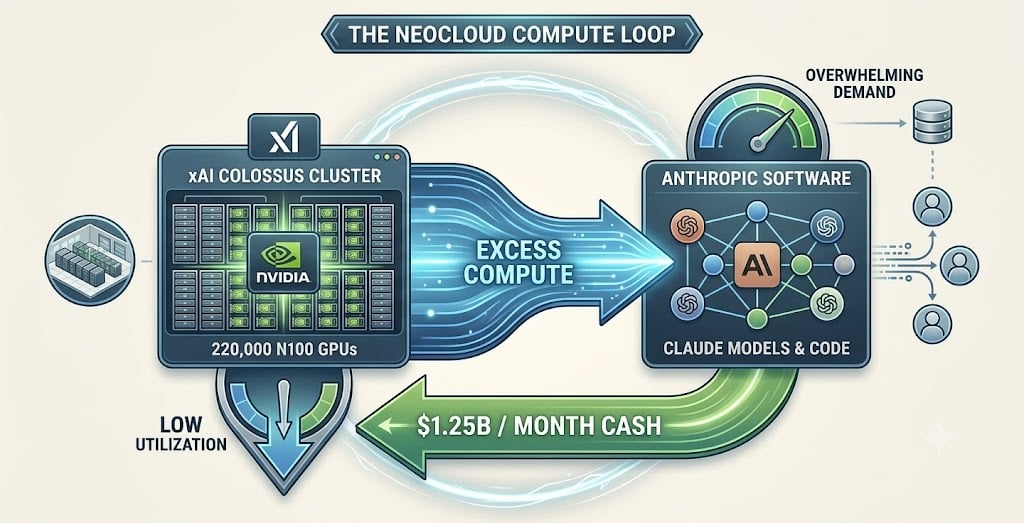
In this instance, xAI’s flagship model, Grok, had failed to capture a meaningful share of the developer or enterprise market, leaving xAI with an estimated 11% utilization rate on its massive, 220,000 Nvidia GPU Colossus 1 cluster. Conversely, Anthropic possessed overwhelming market demand for its Claude models but lacked the physical infrastructure to scale training and inference workloads.
Read more: Top AI Compute and GPU Stocks to Buy in 2026: The Shift to Inference and Custom Silicon
This arrangement introduces significant margin pressures for Anthropic. Paying 15 billion annually for compute represents nearly half of the company's annualized revenue run rate. While Anthropic's unit economics are improving as revenue outpaces compute growth, this contract represents a direct transfer of capital from a software-focused developer to a vertically integrated hardware rival, effectively funding the development of xAI's future models.
Crypto Involvement and the FTX Inheritance
Anthropic's early capitalization is deeply connected to the cryptocurrency sector through its relationship with Sam Bankman-Fried and the bankrupt crypto exchange FTX. In April 2022, Bankman-Fried led Anthropic's Series B funding round, investing 500 million of FTX and Alameda Research customer funds to acquire an initial 13.56% equity stake in the startup. At the time, Anthropic was valued at approximately 2.5 billion.
Following the collapse of FTX in November 2022, this equity stake was frozen as part of the bankruptcy estate. In early 2024, the FTX bankruptcy management team received court approval to liquidate the holdings to repay creditors. They successfully sold approximately two-thirds of the stake to a consortium of institutional investors, including Abu Dhabi's sovereign wealth fund Mubadala, for 884 million. In total, the bankruptcy estate recovered between 1.3 billion and 1.4 billion from its Anthropic position.
A Profound Missed Opportunity
This transaction represents one of the most profound missed opportunities in financial history. By the time the sale was finalized, subsequent dilutive funding rounds had reduced FTX’s ownership stake to approximately 8%. Had the bankruptcy administrators been structured to hold this 8% position until the May 2026 Series H valuation of 965 billion, the stake would have been worth approximately 77.2 billion. This single asset would have completely resolved the exchange's liabilities, generating a multi-billion-dollar surplus for victims.
For his part, Dario Amodei has consistently sought to distance both himself and the field of artificial intelligence from the cryptocurrency industry. In his May 2026 essay, “Policy on the AI Exponential,” Amodei observed that early policymakers frequently miscategorized frontier AI as a speculative hype cycle, treating it similarly to "the latest consumer app or cryptocurrency". He argued that unlike the speculative volatility of digital assets, artificial intelligence scaling is governed by highly predictable, empirical physical laws—such as the scaling of cognitive capabilities relative to compute power—which have held true for over a decade.
Conclusion
Dario Amodei’s net worth in 2026 stands as a definitive case study in modern technological industrialization and the monetization of alignment. At an estimated 15.5 billion, Amodei has constructed a fortune that is uniquely correlated with the market's demand for safety, predictability, and structural risk mitigation.
As Anthropic prepares for its landmark public listing in October 2026, Amodei’s financial and operational model faces a complex set of structural challenges. The company’s "safety-first" branding has proven highly effective in the B2B market, enabling it to secure a dominant 34.4% enterprise market share and drive annualized revenues past 44 billion. This commercial validation suggests that enterprise buyers are willing to pay a premium for models that prioritize alignment and reliability.
However, the financial sustainability of this model remains constrained by the extreme capital intensity of frontier AI development. The necessity of paying 1.25 billion monthly to a direct competitor for compute capacity underscores a critical vulnerability: Anthropic's software revenue is heavily taxed by its infrastructure dependencies. To justify its projected trillion-dollar valuation on the public markets, the company must demonstrate that it can transition to structural profitability while navigating these high infrastructure costs.
Ultimately, Amodei's 15.5 billion fortune is a direct measure of how highly the market values risk mitigation in the AI era. If Anthropic can successfully manage its compute costs and execute its public debut, it will establish a new model for corporate governance, proving that strict safety commitments and massive wealth generation can coexist at scale.
Related Reading
- What Is Sir Demis Hassabis’s Net Worth in 2026?
- What Is Anthropic Pre-IPO and How to Trade It on BingX?
- What Is Jensen Huang’s Net Worth in 2026?
- What Is Sam Altman’s Net Worth in 2026?
- What Is Elon Musk's Net Worth in 2026?
- Top AI Data Center Stocks to Buy in 2026: Cloud, Servers, and AI Compute Infrastructure
- Top AI Cloud Infrastructure Stocks to Buy in 2026 Amid Hyperscaler Capex and the Neocloud Boom
FAQs on Dario Amodei’s Net Worth
1. How much is Dario Amodei worth in 2026?
As of mid-2026, Dario Amodei’s net worth is estimated at $15.5 billion by Forbes. This fortune escalated from approximately $7 billion in early 2026 due to Anthropic’s massive $965 billion post-money valuation following its Series H funding round.
2. What percentage of Anthropic does Dario Amodei own?
Dario Amodei holds a fully diluted equity stake of approximately 1.8% in Anthropic. However, his operational control is protected via a highly structured dual-class share architecture that grants the co-founders significant voting control.
3. How does Dario Amodei's wealth compare to Sam Altman's?
Dario Amodei's net worth is more than four times larger than Sam Altman's (estimated at $2.0 billion to $3.5 billion). While Altman chose to hold 0% equity in OpenAI, Amodei retained direct founder equity in Anthropic, allowing his net worth to scale in tandem with his company's private valuation.
4. What is the 80% philanthropic pledge made by Dario Amodei?
In January 2026, Dario Amodei and Anthropic’s other six billionaire co-founders pledged to donate 80% of their personal fortunes to philanthropic efforts. Based on his mid-2026 valuation, Dario and his sister Daniela’s combined contributions represent a future philanthropic commitment of $24.8 billion focused on mitigating inequality and societal disruption caused by AI.
5. Why does Anthropic pay $1.25 billion a month to xAI?
Anthropic signed a compute capacity lease agreement running through May 2029 to utilize Elon Musk's xAI Memphis superclusters Colossus 1 and Colossus 2. This transaction helps Anthropic fulfill overwhelming corporate demand for its Claude models despite its own physical infrastructure limits, though it creates a significant $15 billion annualized margin pressure.
