Atlasbrary ($ATLAS) is a pioneering AI-Native Knowledge Network designed to solve the critical trust gap in the age of artificial intelligence. By integrating Large Language Models (LLMs) with Zero-Knowledge Proofs (ZKP), Atlasbrary transforms fragmented data into a verifiable, traceable, and economically sustainable public infrastructure.
As of May 2026, the Atlasbrary ecosystem is addressing the multi-billion dollar AI Hallucination problem by providing a decentralized alternative to centralized, opaque datasets. With its recent listing on BingX and a growing knowledge graph of over 100 million nodes, the protocol allows users to contribute to, verify, and earn from the world's most reliable AI memory bank.
This article examines the architecture of Atlasbrary, the Proof-of-Knowledge mechanics of its ATLAS token, and how to trade Atlasbrary (ATLAS) on BingX.
What Is Atlasbrary (ATLAS)?
Source: X
Atlasbrary is a decentralized knowledge protocol that serves as the verifiable memory for AI agents and human learners. Unlike traditional search engines or AI tools like ChatGPT, which often lack source provenance and suffer from hallucinations, Atlasbrary ensures every piece of information is cryptographically linked to its origin.
The platform's core mission is to upgrade knowledge from disposable information into a collaborative network. Atlasbrary offers:
- Verifiable Retrieval: Uses Zero-Knowledge (ZK) Proofs to guarantee that AI-generated answers are consistent with their sources.
- Decentralized Knowledge Graph: A multi-modal map of text, code, images that structures global data into logical relationships.
- Incentivized Co-construction: A Contribute-to-Verify model where data providers and editors are rewarded for accuracy rather than clicks.
How Does the Atlasbrary Ecosystem Work?
Atlasbrary operates through a sophisticated layered architecture to ensure that knowledge remains trustworthy and scalable:
- The Agent Layer for Autonomous Curation: A network of AI agents performs 24/7 maintenance. Collection Agents crawl academic and technical sources, while Verification Agents use ZK technology to validate update proposals.
- The Retrieval Layer Comprising RAG and Semantic Search: Utilizing Retrieval-Augmented Generation (RAG), the protocol converts data into 768-dimensional vectors. This allows AI to search for context with millisecond precision before generating an answer.
- The Verification Layer with ZK Proofs: This is the heart of Atlasbrary's Trust Engine. It generates retrieval validity proofs, ensuring that no key information was omitted during a query and that the AI didn't invent facts.
- Hybrid On-Chain/Off-Chain Storage Layer: While core knowledge indexes and ZK proofs are stored on-chain on BNB Smart Chain for immutability, heavy files are stored on IPFS or BNB Greenfield to maintain efficiency.
What Is the ATLAS Token Used For?
Within the ecosystem, the ATLAS token acts as the fuel for knowledge production and circulation:
- Network Incentives: Users earn ATLAS by uploading high-quality content, editing knowledge graphs, or running verification nodes.
- Service Payments: Developers pay in ATLAS to access the Verifiable Knowledge API, which they use to build hallucination-free DApps.
- Staking and Governance: Staking ATLAS grants Curator Status, allowing holders to vote on protocol upgrades and share in 50% of the network’s API revenue.
- Deflationary Pressure: 30% of all protocol income from API fees and enterprise services is used to buy back and burn ATLAS tokens monthly.
What Is Atlasbrary (ATLAS) Tokenomics?
The ATLAS token has a fixed total supply of 100,000,000 (100 million), structured to support a decade of ecosystem growth.
- Community Rewards (40%): The largest share, released over 4 years to incentivize data contributions and node operations.
- Team and Advisors (20%): Subject to a 12-month cliff and a 36-month linear release to ensure long-term alignment.
- Ecosystem Fund (15%): Reserved for partner incentives and incubating new AI projects on the Atlasbrary stack.
- Liquidity and Marketing (15%): Allocated for exchange depth and global user acquisition.
- DAO Reserves (10%): Managed by community vote for technical upgrades and emergency risk response.
How Atlasbrary Differs From Traditional AI Tools
|
Feature |
Atlasbrary (ATLAS) |
Traditional AI (ChatGPT/Google) |
|
Data Trust |
ZK-Verifiable (Mathematical Trust) |
Probabilistic (May Hallucinate) |
|
Incentives |
Direct Token Rewards for Creators |
Ad-Revenue or Subscription-Based |
|
Ownership |
Decentralized DAO |
Corporate Monopolies |
|
Structure |
Dynamic Knowledge Graph |
Flat Data or Index Lists |
Atlasbrary (ATLAS) represents a paradigm shift from traditional predictive AI tools like ChatGPT or Google Gemini by replacing probabilistic guessing with a mathematically verifiable knowledge layer. While traditional frontier models in 2026 still struggle with hallucination rates between 3.1% and 19.1%, particularly in citation accuracy where they often invent DOIs and titles, Atlasbrary utilizes ZKPs and RAG to verify that every output is 100% consistent with its source. This reduces the risk of AI fabrications to near zero, providing a Proof-of-Knowledge protocol that traditional tools, which function primarily as statistical next-token predictors rather than true knowledge bases, cannot currently match.
Practically, Atlasbrary operates as an AI-native decentralized infrastructure rather than a centralized software-as-a-service (SaaS). In traditional AI tools, the data is siloed and managed by a single corporation, leading to data decay and opaque updates. Atlasbrary, however, powers a decentralized knowledge graph with over 100 million nodes that are continuously updated by a global network of Analysis Agents and human contributors. This ensures that knowledge is not just stored, but dynamically linked and traceable. For an enterprise or researcher, the difference is functional: instead of receiving a black box answer from a traditional LLM, an Atlasbrary query returns a verified response backed by an on-chain audit trail, rewarding the original knowledge creators with LIBBY tokens and creating a sustainable, collaborative ecosystem for the AGI era.
How to Trade Atlasbrary (ATLAS) on BingX
Following its strategic listing in May 2026, LIBBY is available for trading with deep liquidity on BingX, where users can leverage BingX AI to analyze real-time market sentiment and technical indicators for the emerging AI sector.
Note: BingX has listed Atlasbrary (ATLAS) under the trading pair LIBBY/USDT on the spot market
Buy, Sell, or HODL ATLAS in the Spot Market
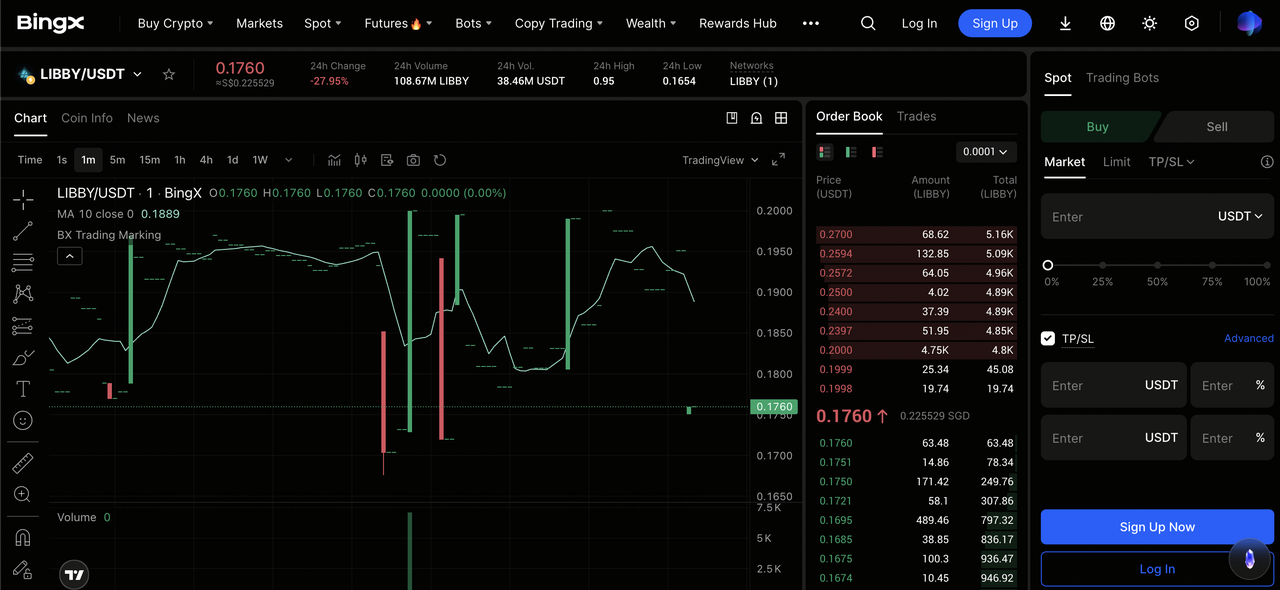
LIBBY/USDT trading pair on the BingX spot market
- Access the Market: Navigate to the Spot tab on BingX and search for the LIBBY/USDT trading pair.
- Choose Your Strategy: Use a Limit Order to buy at a specific entry point or a Market Order for instant execution.
- HODL and Earn: Once purchased, you can hold ATLAS in your fund account or stake it to participate in Atlasbrary governance.
5 Key Considerations Before Investing in ATLAS
While Atlasbrary (LIBBY) offers a unique intersection of AI and blockchain utility, navigating the investment landscape requires a strategic evaluation of both the protocol’s structural dependencies and the broader market volatility of the AI sector.
- AI Sector Volatility: The AI-crypto narrative is high-growth but subject to rapid shifts in market sentiment.
- Network Adoption: ATLAS’s value is directly tied to the number of developers calling its Knowledge APIs.
- Deflation Schedule: Monitor the monthly burn reports to track the reduction in circulating supply.
- Hardware Requirements: While node standards are optimized, future graph expansions may require higher-performance community nodes.
- Regulatory Climate: As a decentralized knowledge infrastructure, Atlasbrary must navigate evolving global AI governance laws.
Final Thoughts: Why Atlasbrary's Truth Layer Is Vital for the AGI Future
As of May 2026, Atlasbrary has successfully transitioned the AI + Blockchain narrative from speculative hype into a functional utility layer for the global knowledge economy. By integrating RAG with ZKP, the protocol provides a verifiable Truth Layer that is essential for deploying AI in high-stakes industries like law, medicine, and finance, where the margin for error is zero. For the strategic participant, $ATLAS functions as a foundational unit of a decentralized infrastructure that prevents data silos and ensures that the information powering autonomous agents remains transparent, traceable, and peer-reviewed.
From a practical perspective, the long-term viability of Atlasbrary depends on the continued scaling of its decentralized knowledge graph and the adoption of its Verifiable Knowledge APIs by third-party developers. As the AGI (Artificial General Intelligence) era approaches, the demand for hallucination-free data will likely drive the protocol's utility, moving it beyond simple information retrieval into a role as a global clearinghouse for verified human and machine intelligence. Users should focus on the protocol’s ability to maintain its Proof-of-Knowledge standards and the execution of its buyback-and-burn mechanism, which links the token’s economic value directly to the actual usage of the network's data services.
Risk Reminder: Digital asset investments carry significant risk. Always perform your own research and monitor the Verification Pass Rate on the Atlasbrary dApp before making large allocations. BingX is not responsible for trading losses.
Related Reading
- What Is USDai (CHIP) InfraFi for GPU-Backed Yield and How Does It Work?
- What Are the Top Zero-Knowledge (ZK) Crypto Projects of 2026?
- Understanding Model Context Protocol (MCP): Top 5 MCP Crypto Projects to Watch in 2026
- What Are the Top 10 AI Agent Crypto Projects of 2026?
- What Is DeAgentAI (AIA) and How Does This New AI Infrastructure Work?
