



The Walt Disney Company (DIS) sells stories and experiences through films, television, Disney+ and Hulu, ESPN, theme parks, cruises and merchandise. Its established franchises generate theatrical, subscription, advertising, licensing and guest spending, while streaming profitability and expanded cruise capacity widen the earnings opportunity. The same content can create value across several businesses, but sports rights inflation, expensive productions and consumer travel demand determine how much of that reach converts into durable profit.
The latest quarter showed streaming and parks lifting earnings even as Sports weakened. Disney fiscal Q3 revenue rose 7% to $25.248 billion, adjusted EPS increased 28% to $2.06, and Entertainment SVOD operating income more than doubled to $712 million. Experiences profit climbed 20%, though a roughly $100 million tariff refund helped, while Sports profit fell 17%. The unresolved test is whether margin and cash growth persist without one-time benefits or an extra fiscal week.
The DIS stock forecast for 2026 now centers on two competing views:
- The cross-business profit case: Higher streaming margin, repeat park spending and cruise capacity give Disney more ways to monetize its franchises while repurchases compound earnings per share.
- The cost and comparability case: Sports rights, weak advertising or costly films absorb the gains, while the 53rd week flatters the near-term comparison without establishing underlying growth.
This guide breaks down the DIS stock forecast, 2026 price scenarios, key risks and analyst outlooks, drawing on Disney's August 5 fiscal Q3 FY2026 earnings release, Form 10-Q and market data through October 20, plus how to buy DIS stocks on BingX TradFi with USDT.
Top 5 Things for Disney Investors to Know in October 2026
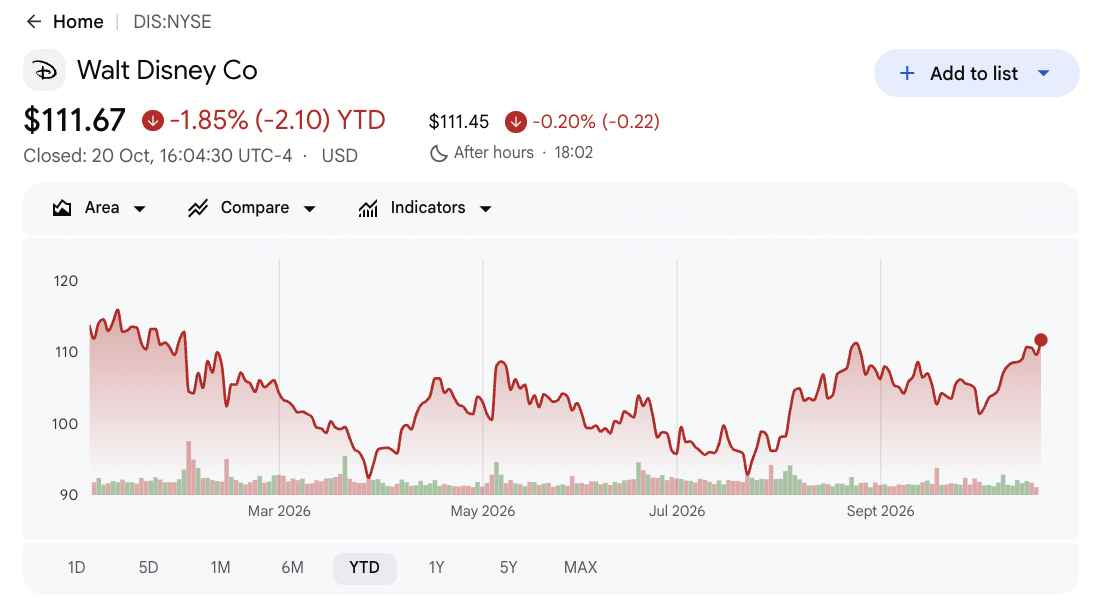
- DIS closed at $111.67 on October 20, down 1.85% YTD. Shares gained 1.90% that session but remained below the $117.09 52-week high. The recovery from the $92.18 low shows improving momentum, although a sustained breakout and stronger earnings remain important to further upside.
- Q3 revenue grew 7% to $25.248 billion. Sales missed the $25.41 billion consensus by $162 million, while adjusted EPS of $2.06 beat the $1.84 estimate. Stronger profitability despite the revenue miss highlights the importance of business mix, cost discipline, and tax effects.
- Entertainment streaming operating profit reached $712 million. SVOD revenue grew 11% to $5.53 billion, with operating margin reaching 12.9%. Subscription revenue rose 15%, supported by pricing and subscriber growth, although advertising increased only 3% and some margin gains reflected spending timing.
- Q4 segment profit guidance of $4.9 billion includes a $600 million calendar benefit. The extra 53rd week supports reported earnings, with FY2026 adjusted EPS growth expected around 16% including the benefit versus 12% excluding it. Separating this one-time lift from recurring performance is important.
- Disney raised its FY2026 share buyback target to at least $9 billion. Approximately $1.2 billion in expected A+E Global Media stake-sale proceeds will support additional repurchases. Operating cash flow guidance remains at least $19 billion, although cash generation fell 8% during the first nine months, making Q4 execution important.
What Is The Walt Disney Company (DIS)?
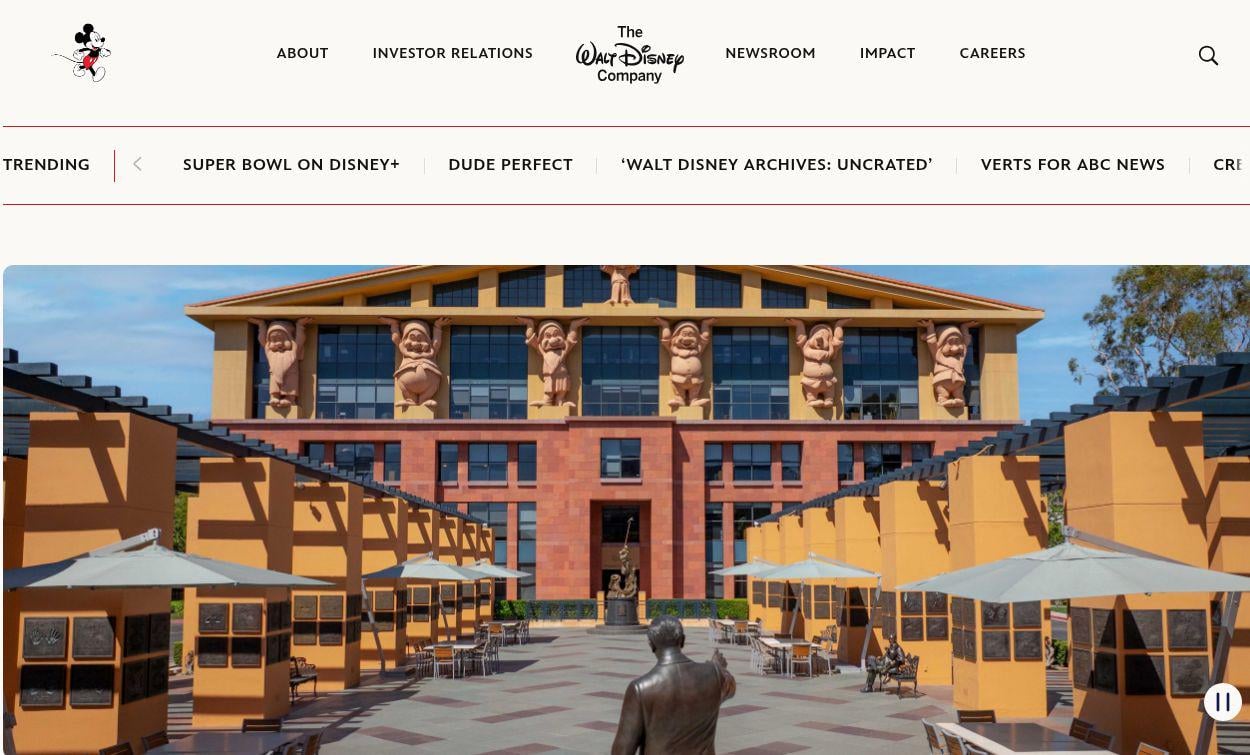
The Walt Disney Company is a global entertainment and media company operating across three main segments: Entertainment, Sports, and Experiences. Entertainment produces films and television, operates Disney+ and Hulu, and generates advertising and licensing revenue. Sports includes ESPN and its subscription and broadcasting businesses, while Experiences covers theme parks, resorts, cruises, and consumer products. Disney's franchises, including Marvel, Pixar, and Star Wars, connect these businesses through films, streaming, merchandise, and attractions, creating multiple revenue opportunities from its intellectual property.
Disney is expanding its entertainment and experiences businesses through new content, cruise capacity, and sports distribution partnerships. Toy Story 5 surpassed $1 billion at the global box office, supporting streaming engagement and merchandise demand, while Disney Destiny and Disney Adventure expanded cruise capacity by approximately 50% during the quarter. The Fubo combination and NFL equity transaction broaden its sports distribution network, while the planned A+E Global Media stake sale could generate approximately $1.2 billion for additional share repurchases. These initiatives support Disney's growth across streaming, experiences, and sports, with future profitability depending on subscriber monetization, consumer demand, and operating efficiency.
Disney (DIS) Q3 FY2026 Earnings Overview: Strong Streaming and Parks Profits Offset Sports Weakness
Disney reported Q3 FY2026 revenue of $25.248 billion, up 7% year over year but $162 million below consensus, while adjusted EPS of $2.06 beat expectations by $0.22. Total segment operating income rose 21% to $5.555 billion, driven by stronger Entertainment and Experiences profits despite a 17% decline in Sports. Q4 segment profit guidance of approximately $4.9 billion includes a $600 million benefit from an extra week, making underlying earnings growth and margin sustainability important to the outlook.
|
Financial Metric |
Guidance / Consensus |
Reported / Actual |
Surprise |
|
Q3 revenue |
$25.41B Visible Alpha consensus |
$25.248B |
Miss. $162M below consensus; up 7% YoY. |
|
Q3 adjusted EPS |
$1.84 Visible Alpha consensus |
$2.06 |
Beat. $0.22 above consensus; up 28% YoY. |
|
Q3 total segment OI |
$4.575B a year earlier |
$5.555B |
Higher. Up $980M, or 21%. |
|
Q3 Entertainment OI |
$1.022B a year earlier |
$1.680B |
Higher. Up $658M, or 64%. |
|
Q3 Experiences OI |
$2.516B a year earlier |
$3.017B |
Higher. Up $501M, or 20%. |
|
Q3 Sports OI |
$1.037B a year earlier |
$858M |
Lower. Down $179M, or 17%. |
|
Q3 free cash flow |
$1.889B a year earlier |
$3.072B |
Higher. Up $1.183B, or 63%. |
|
Q4 total segment OI outlook |
$3.480B Q4 FY2025 actual |
About $4.9B |
Guided. About $1.42B higher, including $600M extra week. |
- Q3 revenue grew 7% to $25.248 billion despite missing consensus. Sales increased $1.598 billion year over year but fell $162 million short of expectations. Experiences added $882 million in revenue and Entertainment contributed another $641 million, reflecting growth across Disney's largest businesses.
- Adjusted EPS rose 28% to $2.06, beating estimates by $0.22. Earnings increased from $1.61 a year earlier, while GAAP EPS declined to $1.51 from $2.92 due to a prior-year Hulu-related tax benefit. Adjusted results better reflect improving operating performance, although the difference from GAAP earnings remains relevant.
- Entertainment operating profit surged 64% to $1.680 billion. Streaming operating income reached $712 million from $329 million, with a 12.9% margin on $5.53 billion in SVOD revenue. Toy Story 5 supported theatrical and merchandise demand, although advertising growth of 3% and favorable spending timing make margin sustainability important.
- Experiences operating profit increased 20% to $3.017 billion. Revenue rose 10% to $9.968 billion, supported by approximately 4% guest growth and higher U.S. per-capita spending. A roughly $100 million tariff refund contributed to profit growth, while stronger park and cruise demand supported underlying performance.
- Sports operating profit fell 17% despite stronger overall cash flow. Sports revenue increased 4% to $4.500 billion, but higher rights costs, NBA playoff timing, and distribution disruptions pressured earnings. Q3 free cash flow rose 63% to $3.072 billion, making cash generation and sports cost management important to Disney's full-year outlook.
Disney (DIS) 2026 Investment Outlook: $145 Bull Case vs. $88 Bear Case
Disney's 2026 outlook depends on whether stronger streaming profitability, resilient theme park demand, and expanding cruise operations can sustain earnings and cash flow growth. Improving Entertainment and Experiences margins support the upside, while sports rights costs, advertising demand, and the sustainability of operating profits remain important to valuation.
The Bull Case: Strong Streaming and Parks Growth Pushes DIS Toward $145
The Bull Case assumes Disney+ and Hulu maintain double-digit revenue growth following Q3's 11% increase, with streaming margins holding near or above 12.9%. Higher cruise capacity and healthy theme park spending could strengthen Experiences profits, while slower Sports cost growth improves overall margins. Stronger cash generation and continued share repurchases would further support per-share earnings.
A move toward $145 would require Q4 underlying segment operating profit near $4.3 billion, excluding the $600 million extra-week benefit, and at least $19 billion in FY2026 operating cash flow. Sustained streaming margins above 10% and double-digit FY2027 adjusted EPS growth would reinforce the upside case.
The Base Case: Steady Entertainment Growth Keeps DIS Between $108 and $128
The Base Case assumes Disney+ subscriptions, franchise films, and theme park demand continue supporting growth, while higher Sports rights costs limit earnings expansion. Cruise operations add capacity, and the planned A+E stake sale could support repurchases after closing. Cash generation remains healthy, although the extra-week benefit complicates comparisons with future earnings.
DIS could trade between $108 and $128 if streaming margins remain in double digits, operating cash flow meets the $19 billion target, and Sports profit declines moderate. Stronger underlying Q4 earnings could support the upper end, while weaker margins or cash generation would pressure the range.
The Bear Case: Higher Sports Costs and Weaker Demand Pull DIS Toward $88
The Bear Case assumes streaming advertising remains soft after Q3's 3% growth, weaker film releases limit Entertainment profits, and rising sports rights costs outpace ESPN monetization. Slower theme park attendance and the absence of Q3's $100 million tariff refund could further pressure margins as cruise and content investment continue.
A move toward $88 would become more likely if FY2026 operating cash flow falls below $19 billion, streaming margins slip under 10%, or Q4 underlying segment profit misses approximately $4.3 billion. Continued Sports profit declines near 17% would also weaken confidence in Disney's FY2027 earnings growth.
DIS Stock Price Forecasts for 2026 By Wall Street Analysts
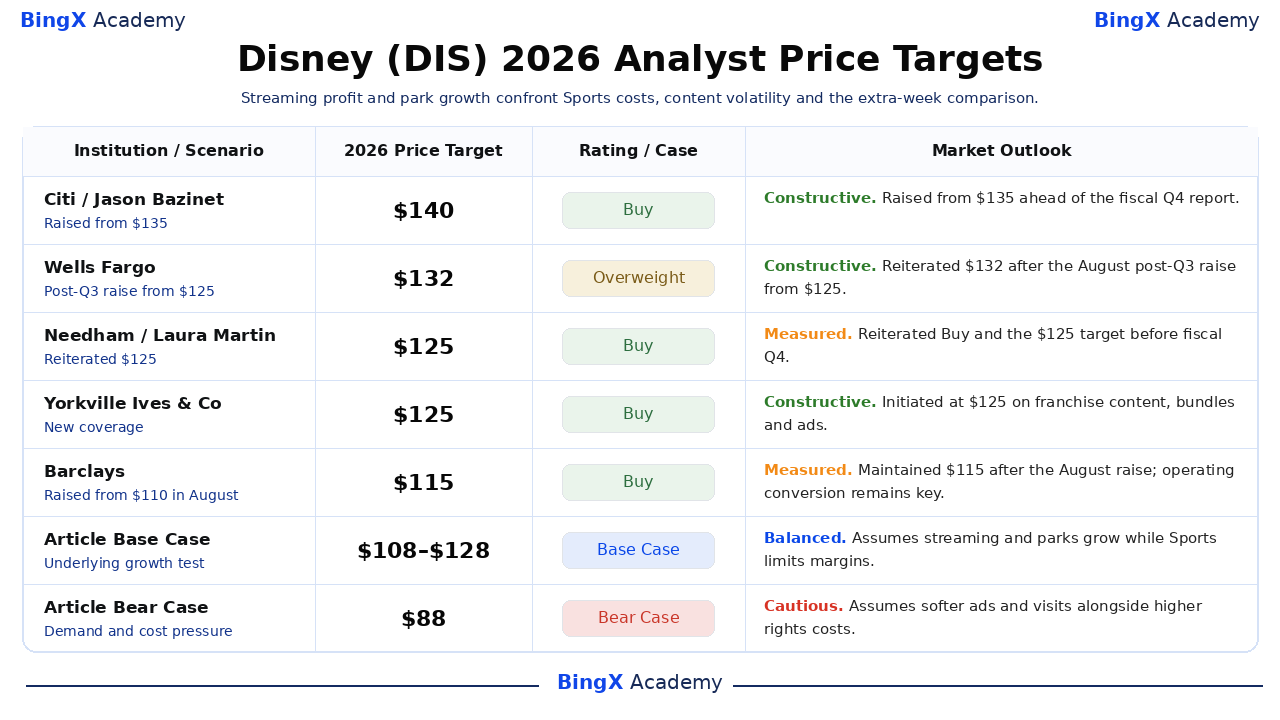
These dated targets are individual twelve-month analyst reference points available through October 20, rather than a single forecast for the calendar-year close. Citi's $140 and Barclays' $115 demonstrate meaningful disagreement about profit conversion. The $145 Bull, $108 to $128 Base and $88 Bear outcomes in this article are editorial scenarios, separate from every named institution.
|
Institution / Scenario |
2026 Price Target |
Rating / Case |
Market Outlook |
|
Citi / Jason Bazinet |
$140 |
Buy |
Constructive. October 16: Raised from $135 ahead of the November 17 fiscal Q4 report. |
|
Wells Fargo / Steven Cahall |
$132 |
Overweight |
Constructive. October 15: Reiterated $132 after the August 6 increase from $125 following Q3 results. |
|
Needham / Laura Martin |
$125 |
Buy |
Measured. October 9: Reiterated the $125 Buy rating ahead of fiscal Q4. |
|
Yorkville Ives & Co / Daniel Ives |
$125 |
Buy |
Constructive. October 7: Initiated coverage at $125 on franchise content, bundles and advertising. |
|
Barclays / Kannan Venkateshwar |
$115 |
Buy |
Measured. October 7: Maintained $115 after an August increase from $110; streaming and Sports remain operating tests. |
|
Article Base Case |
108–128 |
Base Case |
Balanced. Assumes double-digit SVOD margin and cash flow despite Sports cost pressure. |
|
Article Bear Case |
$88 |
Bear Case |
Cautious. Assumes softer ads and visits as rights costs reduce earnings conversion. |
How to Buy The Walt Disney Company (DIS) Stock on BingX
Buy and hold Disney shares through BingX Stocks Trading using USDT or USDC. Disney offers exposure to streaming growth, theme parks, cruise operations, and global entertainment franchises. With fractional investing and no leverage or funding fees, eligible users can build positions based on their investment goals and outlook for Disney's long-term growth.
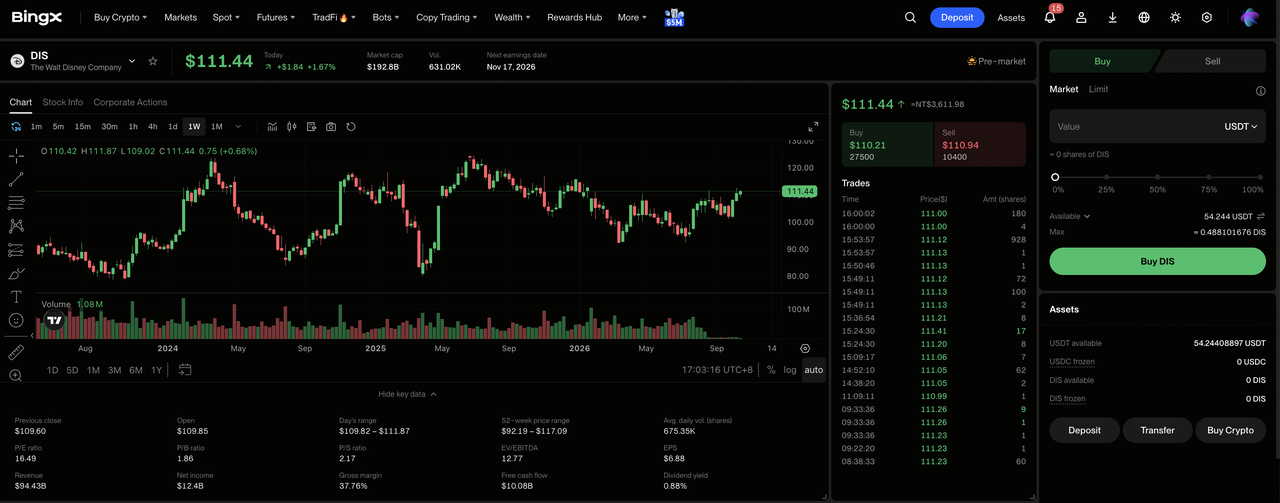
Step 1: Access BingX Stocks Trading. Sign up or log in to BingX, complete the required identity verification, and navigate to "TradFi > Stocks". Accept the Stock Trading Risk Disclosure if accessing the product for the first time.
Step 2: Prepare USDT or USDC. Ensure your Spot Account has sufficient funds for the purchase. Transfer USDT or USDC from your Fund or Wealth Account if needed. Fractional purchases start from 5 USDC or 0.0001 shares.
Step 3: Select The Walt Disney Company (DIS). Open the Stocks market, search for DIS, and select The Walt Disney Company (DIS). Review the current share price, trading session, and available order types.
Step 4: Buy Disney Shares. Select "Buy", enter the investment amount or share quantity, and choose a market or limit order. Market orders execute at available prices during supported trading hours, while limit orders execute at the specified price or better when sufficient liquidity is available.
Step 5: Review and Manage Your Holdings. Open "Stocks > Positions" to monitor your DIS shares and unrealized profit or loss. Use "All Orders" to review transactions or sell shares when needed. T+1 settlement generally affects when sale proceeds become available for withdrawal, rather than when shares can be sold.
Top 5 Risks to Watch for Disney Investors in 2026
Disney's strong streaming profitability, expanding cruise business, and established entertainment franchises support its long-term outlook. However, sports rights costs, consumer spending, content performance, and one-time financial benefits remain important factors determining how much of that growth translates into sustainable earnings and shareholder returns.
- Rising sports rights costs could pressure ESPN profitability. Sports revenue grew 4% in Q3, while operating profit fell 17%. If broadcasting costs outpace subscription, advertising, and distribution revenue, ESPN's margins and future cash flow could weaken.
- Streaming margins may be difficult to sustain. Q3 SVOD margin reached 12.9%, partly benefiting from spending timing. Advertising growth of just 3% and higher content costs could make double-digit margins harder to maintain.
- Slower park and cruise demand could affect profitability. Experiences revenue grew 10%, but international visits to U.S. parks and Asian demand softened. Expanding cruise capacity also raises fixed costs, making occupancy and guest spending important.
- Weaker film releases could reduce franchise earnings. Toy Story 5 surpassed $1 billion globally, while The Mandalorian and Grogu and live-action Moana missed box-office expectations. Disappointing releases can affect streaming, merchandise, and attractions.
- One-time benefits could overstate underlying earnings growth. An extra week contributes approximately $600 million to Q4's $4.9 billion profit outlook, while a $100 million tariff refund supported Q3 Experiences. Sustained organic growth remains essential to FY2027 earnings expectations.
Final Thoughts: Should You Invest in Disney in 2026?
Disney's Q3 showed that its connected franchises can lift several divisions at once. Revenue increased 7%, total segment profit rose 21%, streaming generated $712 million of operating income, and Experiences reached $3.017 billion of profit. Management is committing at least $9 billion to buybacks, but Sports costs and marketing timing mean the consolidated margin path still needs proof.
The $145 bull scenario requires streaming and parks to sustain cash growth while Sports stabilizes; the $88 bear case strengthens if advertising and travel soften while rights costs keep rising. Conservative investors can wait for Q4 segment profit excluding the roughly $600 million extra-week boost, FY2026 operating cash at or above $19 billion, and FY2027 adjusted EPS growth without that calendar aid.
Risk Reminder: Trading and investing in equities like DIS involves a high risk of capital loss. Content spending, sports-rights costs, consumer travel, advertising and derivative leverage can produce sharp price moves. Conduct independent research before allocating capital.
Related Reading
- Netflix (NFLX) Price Prediction 2026: Can NFLX Stock Rebound to $125 on Ads and Live Sports?
- Meta (META) Price Prediction 2026: Can AI Monetization Push META Toward $1,000?
- Reddit (RDDT) Price Prediction 2026: Can AI Data Opportunities Push RDDT Toward $300?
- Snap Inc. (SNAP) Price Prediction 2026: Can Advertising and Subscription Growth Push SNAP Toward $10?
- Alphabet (GOOGL) Price Prediction 2026: Can 82% Cloud Growth and AI Push GOOGL Stock to $430?
