


Vicor (VICR) designs power-conversion modules for computing equipment, industrial systems, electric vehicles and aerospace customers. Its manufactured components provide an established revenue base, while patented Vertical Power Delivery technology creates a route to licensing income from AI hardware. License adoption, product shipments and factory utilization determine whether that expanding demand translates into durable earnings and cash returns.
The latest quarter showed stronger product demand and royalty income alongside rising operating costs. Vicor Q3 FY2026 revenue rose 78.5% to $197.1 million, including $66.6 million in royalties. Gross margin reached 68.3%, while operating expenses increased to $62.5 million. The Q4 test is whether recurring licensing and product deliveries can preserve that profitability as manufacturing investment expands.
The VICR stock forecast for 2026 now centers on two competing views:
- The royalty-and-product growth case: Repeat licensing income and higher module shipments protect margins, allowing operating cash flow to fund additional manufacturing capacity.
- The uneven-royalty case: Licensing fluctuations and factory investment absorb product gains, reducing the earnings cushion if customer deliveries slow or legal costs rise.
This guide breaks down the VICR stock forecast, 2026 price scenarios, key risks and analyst outlooks, drawing on Vicor's October 20 Q3 FY2026 earnings release, October 26 filing and market data through October 26, plus how to buy VICR Stocks on BingX TradFi with USDT or USDC.
Top 5 Things for Vicor Investors to Know in October 2026
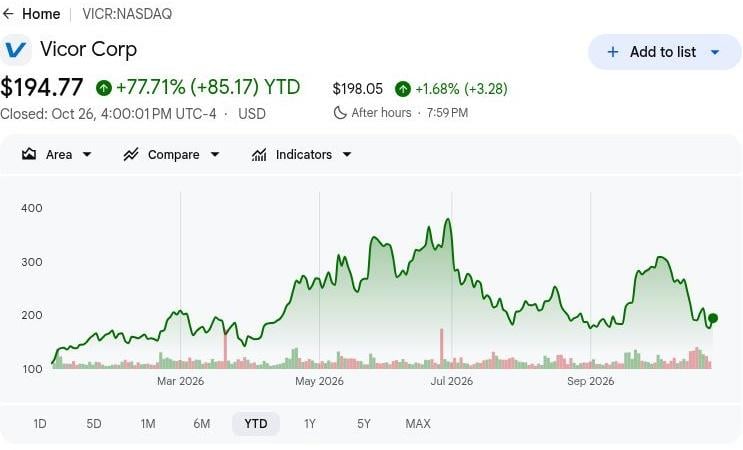
- VICR closed at $194.77 on October 26, up 77.71% YTD: Shares remain above their opening-year level, making the $300 bull scenario dependent on repeatable licensing income. Continued gains require product shipments and royalties to strengthen cash generation rather than relying on additional valuation expansion.
- Q3 revenue increased to $197.1 million from $110.4 million: Sales also rose from $143.4 million in Q2, showing sequential progress. However, royalties contributed $66.6 million, making it important to distinguish licensing-driven margin expansion from the manufacturing growth required to fill new factories.
- Backlog reached $406 million as customer orders expanded: The September 30 balance and $130.5 million in quarterly product revenue provide evidence of demand for power-conversion components. Shipment timing, customer acceptance, and production margins will determine how much of that pipeline translates into earnings.
- Additional ChiP fabs provide a manufacturing growth opportunity: Vicor secured sites in Merrimack and Hooksett to support Fab-2 and Fab-3, with initial Fab-2 deployment carrying a one-year lead time. Future production readiness and customer deliveries will determine whether expansion develops into sustained commercial growth.
- Approximately $513.1 million in cash supports capacity expansion: Vicor retained substantial liquidity after $16.1 million in third-quarter capital expenditures, while operating cash flow reached $69.7 million. This provides funding for manufacturing investment, although maintaining cash conversion and attractive factory utilization will be essential to long-term shareholder value.
What Is Vicor (VICR)?
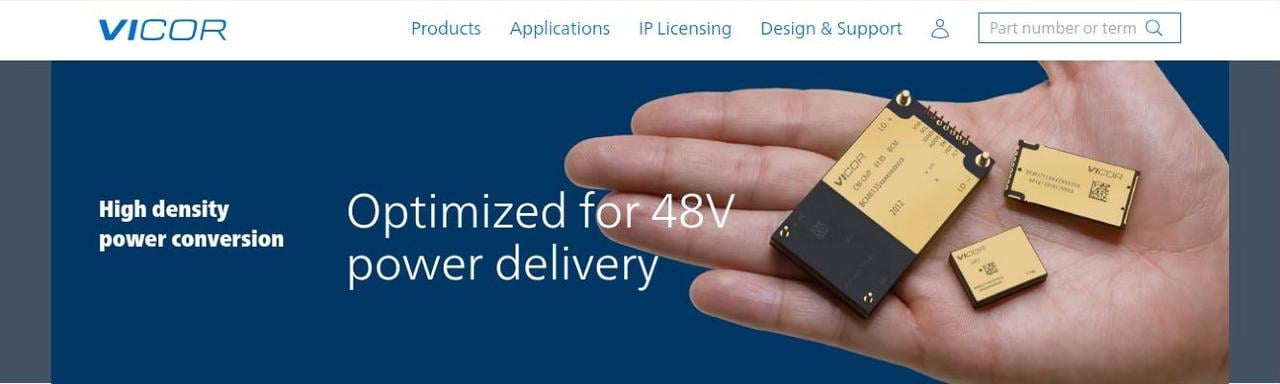
Vicor (VICR) is a Massachusetts-based power electronics company that designs and manufactures high-performance power conversion modules and systems. Its proprietary technologies help manage power efficiently across AI computing, industrial automation, electric vehicles, and aerospace and defense applications. Its vertically integrated manufacturing model combines advanced power architectures, controls, and packaging. Revenue comes from product sales and patent licensing, with Q3 2026 product revenue reaching $130.5 million and royalty income totaling $66.6 million, providing two complementary growth opportunities.
Vicor's growth strategy focuses on expanding AI data center power solutions, strengthening patent licensing, and increasing manufacturing capacity. In September 2026, South Korea's INFAC introduced an electric-vehicle battery system using Vicor's BCM6135 converters and PRM3735 regulators for efficient 800V-to-48V power conversion. Vicor is also preparing additional ChiP manufacturing facilities in New Hampshire to support growing demand for high-density power modules. With backlog reaching $406 million, these initiatives could expand AI infrastructure and automotive revenue while supporting long-term production growth.
Read More: Top AI Energy Stocks to Buy in 2026: Nuclear, Gas, Fuel Cells, and the AI Power Buildout
Vicor (VICR) Q3 FY2026 Earnings Overview: Product Sales Jump 47% as Royalty Income Triples
Vicor reported Q3 FY2026 revenue of $197.1 million, up 78.5% year over year and 37.5% sequentially, supported by product shipments and $66.6 million in royalty income. Operating expenses increased to $62.5 million, while operating income reached $72.1 million and gross margin expanded to 68.3%, reflecting a more profitable revenue mix. With $406 million in backlog and $513.1 million in cash, future growth depends on sustaining licensing income, converting customer orders and earning attractive returns on additional manufacturing capacity.
Read More: Vicor Corporation (VICR) Q3 FY2026 Earnings Overview: USD 197.1M Revenue Drives a 7.06% Price Rally
|
Financial Metric |
Guidance / Consensus |
Reported / Actual |
Surprise |
|
Total revenue |
$110.4M Q3 FY2025 |
$197.1M |
Improved. Up 78.5% YoY. |
|
Product revenue |
$88.7M Q3 FY2025 |
$130.5M |
Expanded. Up 47.1% YoY. |
|
Royalty revenue |
$21.7M Q3 FY2025 |
$66.6M |
Increased. About 3.1 times prior revenue. |
|
Gross margin |
57.5% Q3 FY2025 |
68.30% |
Improved. Up 10.8 percentage points. |
|
Operating income |
$20.9M Q3 FY2025 |
$72.1M |
Increased. About 3.5 times prior profit. |
|
Diluted EPS |
$0.63 Q3 FY2025 |
$1.33 |
Higher. Up $0.70 per share. |
|
Operating cash flow |
$38.5M Q3 FY2025 |
$69.7M |
Improved. Up $31.2M YoY. |
|
Order backlog |
$153M Q3 FY2025 |
$406M |
Expanded. Up 166% YoY. |
- Q3 revenue increased 78.5% to $197.1 million. Revenue increased 37.5% sequentially alongside annual growth, reflecting stronger shipments and licensing income. Sustained product demand and royalty collection will be important to maintaining earnings momentum.
- Royalty revenue increased to $66.6 million. Patent licensing and higher product revenue drove performance, lifting gross margin to 68.3%. Continued licensing adoption and module demand could support earnings, although royalty timing and legal costs influence profitability.
- Operating income reached $72.1 million despite higher expenses. Operating costs increased to $62.5 million, including contingency fees for intellectual-property enforcement. Stronger royalty and product revenue supported profitability, but maintaining cost efficiency will be important as manufacturing investment expands.
- Additional fab sites expanded Vicor's planned manufacturing capacity. The company expanded its planned footprint through sites in Merrimack and Hooksett. The investments support higher module production, with returns depending on customer demand and profitable factory utilization.
- Contract backlog reached $406 million at September 30. The pipeline supports future deliveries, although revenue recognition depends on shipment timing and customer acceptance. Converting orders, completing deliveries, and maintaining production margins will be important to future revenue growth.
Vicor (VICR) 2026 Investment Outlook: $300 Bull Case vs. $140 Bear Case
Vicor's 2026 outlook depends on whether AI power demand can sustain both manufacturing revenue and repeat patent royalties. Q3 gross margin of 68.3% shows the earnings benefit of that mix, while rising expenses and new fab plans make cash conversion central to valuation. The following editorial scenarios reflect how licensing, deliveries and investment could shape performance through December 2026.
The Bull Case: Repeat Royalties and Product Growth Push VICR Toward $300
Sustaining royalty growth alongside higher module shipments would give Vicor a direct route to stronger operating earnings. Q3 royalty revenue reached $66.6 million, helping lift gross margin to 68.3% despite higher expenses. Extending that mix would retain more revenue as profit while the product business converts its growing backlog into customer deliveries.
The $300 scenario would gain support if royalties remain near or above $66.6 million and product revenue exceeds $130.5 million. Gross margin near the Q3 level and continued operating cash generation would help fund expansion without sacrificing earnings quality.
The Base Case: Steady Shipments Keep VICR Between $180 and $220
Continued product growth could keep Vicor's earnings moving forward even if royalties fluctuate between quarters. Q3 product revenue reached $130.5 million, while the $406 million backlog provides orders awaiting delivery. The base case assumes shipments offset uneven licensing income, producing moderate progress while leaving the cost and timing of factory expansion unresolved.
A $180 to $220 range would fit sustained product demand, gross margin above the Q2 level of 58%, and gradual factory preparation. Stronger backlog conversion would support the upper end, while lower royalty income could absorb enough progress to limit upside.
The Bear Case: Lower Royalties and Rising Costs Pull VICR Toward $140
A decline in licensing income would expose Vicor more fully to its expanding operating and manufacturing costs. Royalties supplied $66.6 million in Q3 revenue, while operating expenses rose to $62.5 million. If customer licensing slows or module deliveries slip, Vicor could lose that high-margin earnings cushion before new production capacity contributes meaningful additional revenue.
The $140 scenario would become more likely if royalties fall and gross margin moves back toward the Q2 level of 58%. Product deliveries would then need to contribute more simply to stabilize operating earnings, leaving less support for valuation expansion.
VICR Stock Price Forecasts for 2026 By Wall Street Analysts
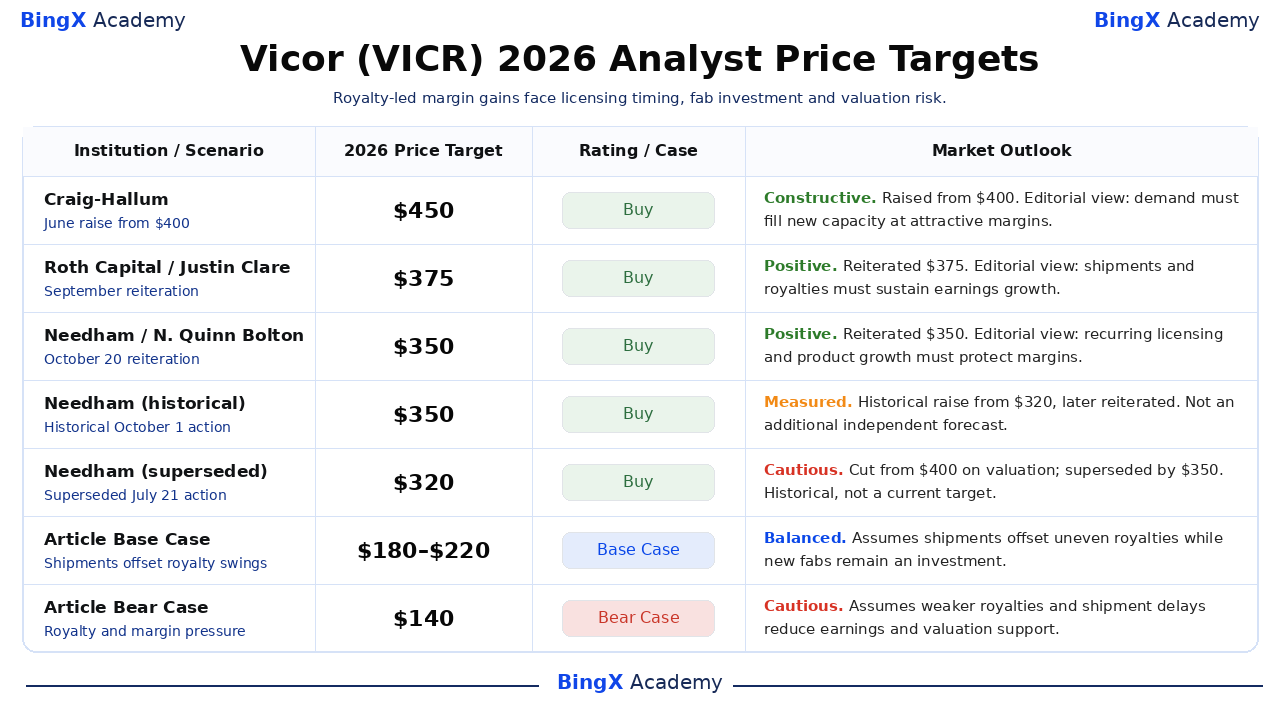
These named targets refer to Nasdaq-listed VICR and generally cover approximately 12 months, extending beyond December 2026. Five dated actions represent three institutions; two older Needham entries are historical, including a superseded $320 target. The current institutional range is 350–450; rationales are editorial interpretations, and the final rows show separate year-end scenarios.
|
Institution / Scenario |
2026 Price Target |
Rating / Case |
Market Outlook |
|
Craig-Hallum |
$450 |
Buy |
Constructive. June 22, 2026: Raised from $400; maintained Buy. Editorial interpretation: demand must fill the planned manufacturing capacity at attractive margins. |
|
Roth Capital |
$375 |
Buy |
Positive. September 22, 2026: Reiterated $375 and Buy. Editorial interpretation: product shipments and patent royalties need to sustain earnings expansion. |
|
Needham |
$350 |
Buy |
Positive. October 20, 2026: Reiterated $350 and Buy. Editorial interpretation: Q3 margin gains need recurring licensing and product growth to endure. |
|
Needham (historical) |
$350 |
Buy |
Measured. October 1, 2026: Historical raise from $320; later reiterated October20. Earlier guidance-related action, not an additional independent forecast; higher royalties drove revised estimates. |
|
Needham (superseded) |
$320 |
Buy |
Cautious. July 21, 2026: Historical cut from 400;supersededbyOctober1350 target. Historical valuation-related reduction; subsequently replaced by $350 and not a current target. |
|
Article Base Case |
180–220 |
Base Case |
Balanced. Assumes product shipments offset uneven royalties while additional fabs remain an investment through December 2026. |
|
Article Bear Case |
$140 |
Bear Case |
Cautious. Assumes lower royalties, shipment delays and higher costs reduce earnings and valuation support. |
How to Buy Vicor (VICR) Stock on BingX
Buy and hold Vicor shares through BingX Stocks Trading using USDT or USDC, subject to listing and account eligibility. Vicor offers exposure to power-conversion modules, AI hardware licensing and advanced manufacturing. Eligible users can size holdings according to their investment goals without using leverage or paying perpetual funding fees.
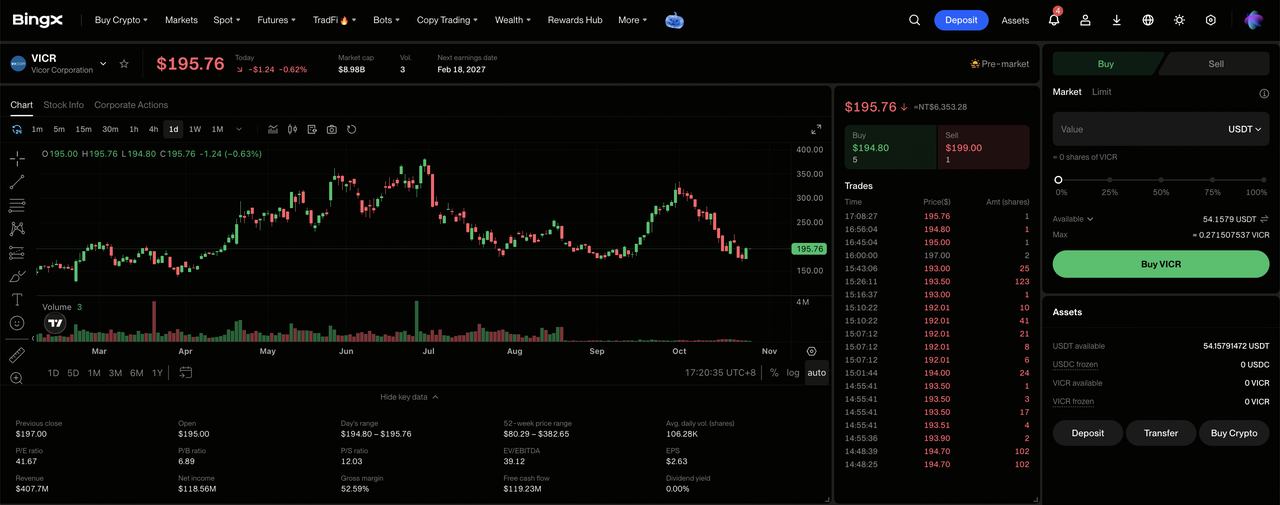
Step 1: Access BingX Stocks Trading. Sign up or log in to BingX, complete the required identity verification, and navigate to “TradFi > Stocks”. Accept the Stock Trading Risk Disclosure if accessing the product for the first time.
Step 2: Prepare USDT or USDC. Ensure your Spot Account has sufficient funds for the purchase. Transfer USDT or USDC from your Fund Account or Wealth Account if needed. Review the selected stock’s minimum order amount and fractional eligibility before choosing the investment size.
Step 3: Select Vicor (VICR). Open the Stocks market, search for Vicor (VICR), and confirm that the share is available to your account. Review the company identity, current share price, trading session and available order types.
Step 4: Buy Vicor Shares. Select “Buy”, enter an allowed investment amount or share quantity, and choose a supported market or limit order. Market orders use available prices during supported sessions, while limit orders require the specified price or better and sufficient liquidity to execute.
Step 5: Review and Manage Your Holdings. Open “Stocks > Positions” to monitor your VICR shares and unrealized profit or loss. Use All Orders to review transactions or sell shares when needed. T+1 settlement generally affects when sale proceeds become withdrawable, rather than when purchased shares can be sold.
Top 5 Risks to Watch for Vicor Investors in 2026
Vicor's patented power technology, expanding manufacturing plans, and substantial cash reserves support its growth outlook. However, royalty timing, operating expenses, backlog conversion, and factory utilization could pressure profitability and shareholder returns.
- Weaker licensing activity could pressure revenue: Q3 royalties reached $66.6 million, supported by patent licensing for power-conversion technology. Lower licensed-system volumes or delayed agreements could reduce operating earnings and weaken the profitability of the revenue mix.
- Rising legal costs could constrain margins: Q3 operating expenses increased to $62.5 million, including intellectual-property enforcement fees. Higher legal and engineering costs could weaken profitability if product shipments and royalty income grow more slowly.
- Shipment delays could limit revenue growth: September 30 backlog reached $406 million, but orders still require delivery and customer acceptance. Delayed manufacturing or customer schedules could reduce future revenue visibility.
- Factory expansion could weaken shareholder returns: Vicor expanded its planned manufacturing footprint through additional sites for ChiP Fab-2 and Fab-3. Construction delays or low utilization could limit cash generation and reduce returns on the new capacity.
- Weaker profitability could pressure valuation: Vicor's Q3 gross margin reached 68.3%, supported by a larger royalty contribution. Slower licensing, weaker module demand, or rising production costs could reduce earnings and trigger share-price declines.
Final Thoughts: Should You Invest in Vicor in 2026?
Vicor's $72.1 million in quarterly operating income and $69.7 million in operating cash flow show how royalty growth can improve business economics. Product shipments and patent licensing provide earnings support, while additional ChiP fabs create opportunities to expand manufacturing revenue. Sustaining that progress will depend on repeat licensing income and converting backlog into profitable deliveries as new capacity is prepared.
The $300 bull case assumes repeat royalties, higher module shipments, and sustained gross margins. The $180 to $220 base case reflects steady deliveries, while the $140 bear case accounts for weaker licensing and cost pressure. With VICR closing at $194.77 on October 26, investors should watch whether royalty-led earnings become durable cash generation throughout the manufacturing expansion.
Risk Reminder: Vicor's patented power technology does not eliminate investment risk. Weaker royalty income, delayed shipments, or underused factories could reduce earnings and shareholder returns. Investors should assess valuation, cash conversion, and their risk tolerance before buying VICR shares.
Related Reading
- Top AI Energy Stocks to Buy in 2026: Nuclear, Gas, Fuel Cells, and the AI Power Buildout
- Top AI Data Center Stocks to Buy in 2026: Cloud, Servers, and AI Compute Infrastructure
- Top AI Server Stocks to Buy in 2026: Rack-Scale Systems, GPU Servers, and AI Servers Infrastructure
- Top AI Semiconductor Stocks to Buy in 2026: AI Chips and Supply Chain Complete Guide
- Top 10 AI Infrastructure Stocks to Buy in 2026: Chip Manufacturing and Design Leaders
