


Tower Semiconductor (TSEM) manufactures specialty analog chips for communications, data centers, mobile devices, vehicles and industrial systems. Its established radio-frequency and power-process business remains important, while silicon photonics and silicon germanium expand its opportunity in high-speed AI interconnects. The new demand is converting into foundry contracts, but equipment installation, customer production schedules and manufacturing utilization determine whether higher revenue also becomes durable earnings and cash.
The latest quarter showed faster photonics sales and stronger foundry profits. Tower Semiconductor Q2 2026 revenue reached $460.08 million, up 23.7% year over year, as silicon photonics climbed to a $680 million annualized run rate from $180 million. Adjusted diluted EPS rose to $0.88 from $0.50, while $187 million of capital spending exceeded $177 million of operating cash flow. Capacity must ramp on schedule for the higher sales and profit targets to hold.
The TSEM stock forecast for 2026 now centers on two competing views:
- The contracted-photonics growth case: $1.3 billion of signed 2027 SiPho contracts and Semtech capacity commitments could raise utilization and earnings.
- The capacity-and-valuation case: delayed fab ramps, customer concentration and spending ahead of cash receipts could compress a stock still up 56.52% in 2026.
This guide breaks down the TSEM stock forecast, 2026 price scenarios, key risks and analyst outlooks, drawing on Tower's August 4 Q2 2026 earnings release, investor presentation and market data through October 20, plus how to buy TSEM stocks on BingX TradFi with USDT.
Top 5 Things for Tower Semiconductor Investors to Know in October 2026
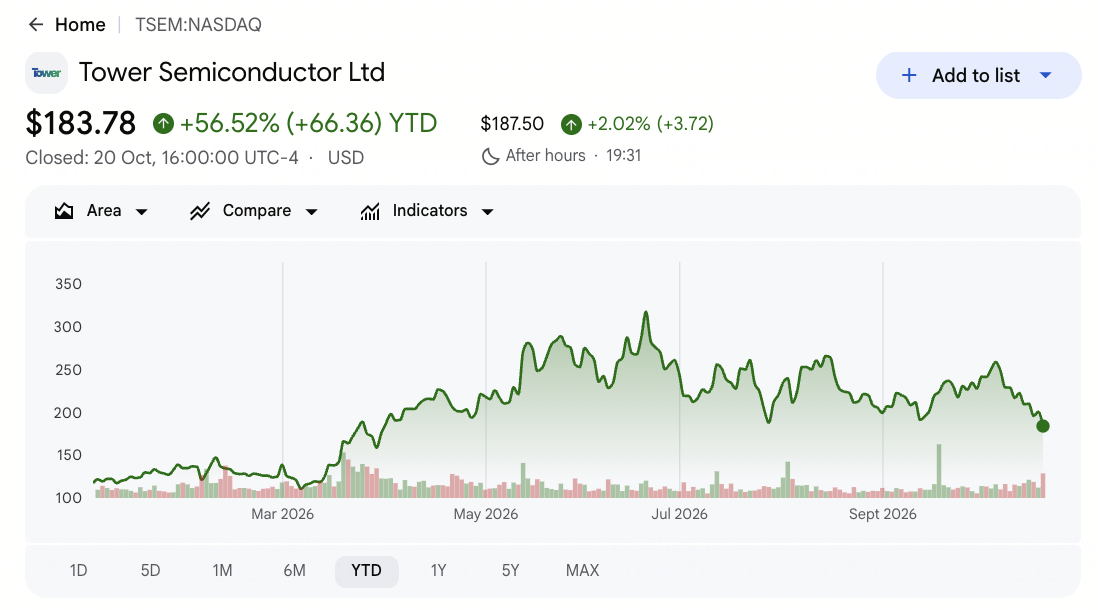
- TSEM closed at $183.78 on October 20, up 56.52% YTD. Shares fell 8.25% that session and remained below the $319.84 52-week high. The sharp pullback highlights valuation sensitivity despite strong operating results, making earnings execution important to sustaining the stock's gains.
- Q2 revenue grew 23.7% to $460.08 million. Sales exceeded the $454.68 million consensus by $5.40 million, while adjusted EPS of $0.88 beat the $0.76 estimate. Stronger earnings support the growth outlook, although future profitability depends on filling additional manufacturing capacity efficiently.
- Silicon photonics (SiPho) reached a $680 million annual revenue run rate. The pace nearly quadrupled from $180 million a year earlier, while $1.3 billion in 2027 customer contracts and $290 million in capacity prepayments improved visibility. Converting those commitments into wafer shipments remains the key growth test.
- Q3 revenue guidance reached $494 million to $546 million. The $520 million midpoint implies 31% year-over-year growth and exceeds the roughly $490 million consensus. Strong execution could support a SiPho revenue run rate above $1 billion in Q4, while shipment delays would pressure expectations.
- Tower raised its 2028 revenue model to $3.6 billion. Management targets $1.2 billion in net profit at 85% foundry utilization. Japan capacity expansion and a new Semtech SiGe agreement support growth, although reaching those targets depends on production ramps, customer demand, and manufacturing efficiency.
What Is Tower Semiconductor (TSEM)?
Tower Semiconductor is an Israel-based specialty semiconductor foundry that manufactures analog and mixed-signal chips designed by other companies. Unlike manufacturers focused on advanced processors, Tower specializes in silicon photonics (SiPho), silicon-germanium (SiGe) BiCMOS, RF CMOS, image sensors, and power-management technologies. Its chips support optical networking, wireless infrastructure, automotive electronics, and industrial applications. Tower also provides 200mm and 300mm manufacturing capacity and design tools, with revenue driven by wafer production, customer demand, and manufacturing utilization.
Tower is expanding its role in AI data center infrastructure through silicon photonics and high-speed optical connectivity. In 2026, it announced a collaboration with NVIDIA on 1.6T optical modules, while NewPhotonics began high-volume shipments using Tower's PH18DA platform. A multi-year agreement with Semtech also expands SiGe capacity for next-generation optical components. Alongside $1.3 billion in 2027 SiPho customer contracts and $290 million in capacity prepayments, these developments support Tower's AI networking growth, with future revenue depending on production ramps and wafer deliveries.
Read More: Top AI Optical Stocks to Buy in 2026: Photonics, Optics, Fiber, and Data Center Interconnects
Tower Semiconductor (TSEM) Q2 2026 Earnings Overview: Silicon Photonics Growth Drives Revenue and Profit Gains
Tower Semiconductor reported Q2 2026 revenue of $460.08 million, up 23.7% year over year and $5.40 million above consensus. Adjusted EPS reached $0.88, beating estimates by $0.12, while gross profit surged 72% to $137.8 million. Silicon photonics (SiPho) reached a $680 million annualized revenue run rate, supported by growing AI optical interconnect demand. Q3 guidance of $494 million to $546 million points to further growth, although heavy capital spending keeps cash conversion important.
|
Financial Metric |
Guidance / Consensus |
Reported / Actual |
Surprise |
|
Q2 2026 revenue |
$454.68M consensus |
$460.08M |
Beat. $5.40M above consensus; up 23.7% YoY. |
|
Q2 adjusted diluted EPS |
$0.76 consensus |
$0.88 |
Beat. $0.12 above consensus; up from $0.50. |
|
Q2 GAAP diluted EPS |
$0.41 a year earlier |
$0.79 |
Improved. Up $0.38 year over year. |
|
Q2 gross profit |
$80.0M a year earlier |
$137.8M |
Higher. Rose $57.8M, or 72%. |
|
Q2 operating profit |
$39.9M a year earlier |
$90.3M |
Higher. More than doubled year over year. |
|
SiPho annual revenue run rate |
$180M in Q2 2025 |
$680M in Q2 2026 |
Accelerated. Nearly 3.8 times the prior-year pace. |
|
Q2 operating cash flow |
$123M a year earlier |
$177M |
Higher. Increased $54M while capex reached $187M. |
|
Q3 revenue outlook |
$490.02M consensus |
494M–546M |
Above. $520M midpoint exceeds consensus by $29.98M. |
- Q2 revenue grew 23.7% to $460.08 million. Sales increased $88.02 million year over year and exceeded the $454.68 million consensus by $5.40 million. Strong silicon photonics (SiPho) demand supported growth, while the modest beat makes Q3 production execution the next important test.
- Adjusted EPS of $0.88 beat estimates by $0.12. Earnings rose from $0.50 a year earlier, while GAAP diluted EPS increased to $0.79 from $0.41. Faster earnings growth than revenue indicates improving operating leverage as manufacturing capacity utilization increases.
- SiPho's $680 million annualized revenue run rate nearly quadrupled. The figure rose from $180 million a year earlier, supported by AI optical interconnect demand. Signed 2027 contracts of $1.3 billion and $290 million in capacity prepayments strengthen visibility, with future revenue dependent on equipment qualification and wafer shipments.
- Gross profit surged 72% to $137.8 million. Operating profit more than doubled to $90.3 million from $39.9 million, while gross margin approached 30%, up from approximately 21.5%. Maintaining these gains as Tower expands manufacturing capacity will be important to sustained profitability.
- Q3 revenue guidance reached a $520 million midpoint. The $494 million to $546 million range implies 31% year-over-year growth. Q2 operating cash flow of $177 million remained below $187 million in capital spending, making stronger cash conversion essential as production expands.
Tower Semiconductor (TSEM) 2026 Investment Outlook: $320 Bull Case vs. $140 Bear Case
Tower Semiconductor's 2026 outlook depends on converting strong silicon photonics (SiPho) demand and expanding manufacturing capacity into sustained revenue and cash flow growth. Its $1.3 billion in 2027 SiPho contracts supports future demand, while equipment qualification, production utilization, and capital spending remain important to profitability.
The Bull Case: Strong Silicon Photonics Demand Pushes TSEM Toward $320
The Bull Case assumes Tower converts its $1.3 billion in 2027 SiPho contracts into production shipments, while Semtech's SiGe capacity agreement expands demand for high-speed optical components. SiPho's $680 million annualized revenue run rate could exceed management's $1 billion Q4 target, with higher utilization and a stronger product mix supporting gross profit growth.
A move toward $320 would require Q3 revenue near the $546 million guidance ceiling, a Q4 SiPho run rate above $1 billion, and gross margin holding near or above 30%. Operating cash flow exceeding capital spending would further strengthen the upside case.
The Base Case: Steady SiPho Growth Keeps TSEM Between $210 and $270
The Base Case assumes SiPho contracts convert gradually while Tower's broader analog semiconductor business remains stable. Japan's 300mm expansion and new manufacturing equipment take time to qualify, limiting near-term cash generation. Q2 revenue of $460.08 million and the $520 million Q3 guidance midpoint support continued growth, although quarterly capital spending of $187 million remains substantial.
TSEM could trade between $210 and $270 if Q3 revenue stays within the $494 million to $546 million range and SiPho approaches its Q4 target. Stronger cash conversion could support the upper end, while slower production utilization or higher costs would pressure the range.
The Bear Case: Production Delays Pull TSEM Toward $140
The Bear Case assumes customers delay optical product launches or new SiPho and SiGe manufacturing capacity takes longer to qualify. Slower production growth would limit progress beyond the $680 million SiPho run rate, while fixed manufacturing costs and equipment investment continue. Lower utilization could pressure margins and weaken confidence in Tower's $3.6 billion 2028 revenue model.
A move toward $140 would become more likely if Q3 revenue falls below $494 million or the Q4 SiPho run rate misses $1 billion significantly. Continued operating cash flow below capital spending would further pressure profitability expectations and valuation.
TSEM Stock Price Forecasts for 2026 By Wall Street Analysts
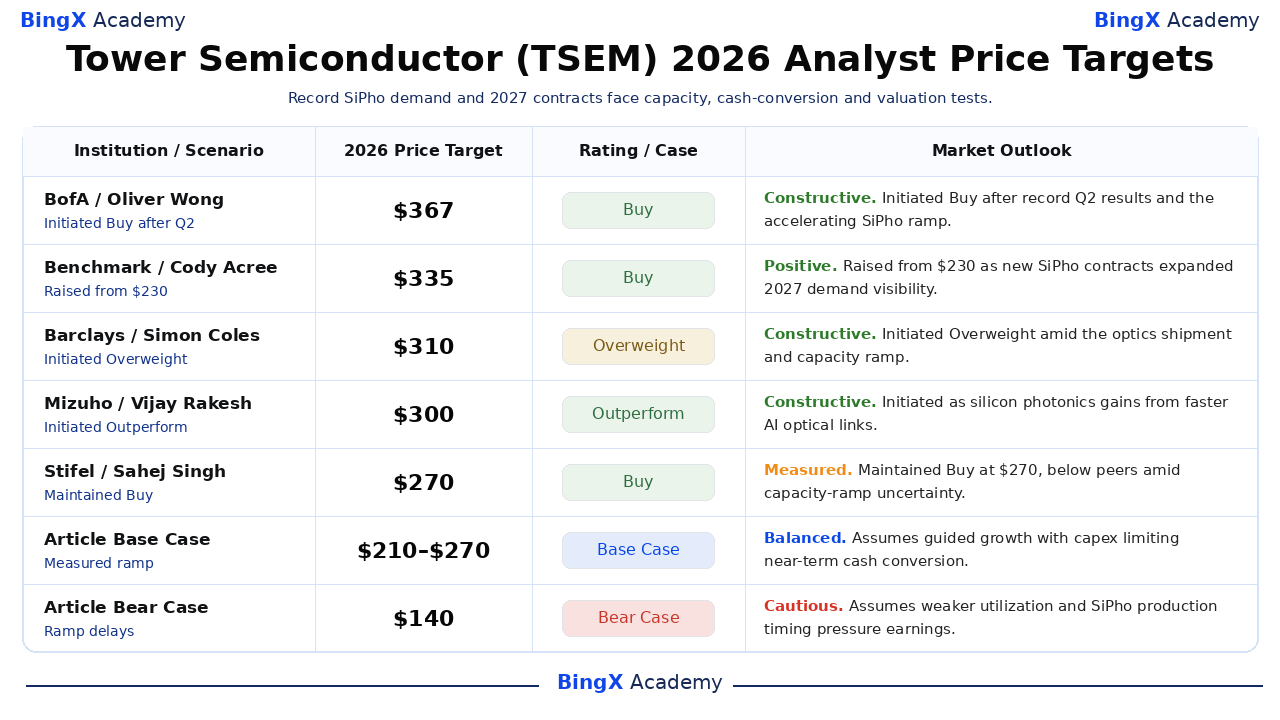
Five dated analyst actions span $270 to $367, a wide range beside the $183.78 October 20 close. The institutions are assessing different rates of SiPho adoption, fab utilization and profit conversion, and their targets are 12-month reference points issued on different dates. The Article Base and Bear Case rows below are editorial scenarios, not analyst forecasts or guaranteed outcomes.
|
Institution / Scenario |
2026 Price Target |
Rating / Case |
Market Outlook |
|
BofA / Oliver Wong |
$367 |
Buy |
Constructive. August 7: Initiated Buy after record Q2 foundry results; a high target prices in continued SiPho growth. |
|
Benchmark / Cody Acree |
$335 |
Buy |
Positive. May 14: Raised from $230 after Tower disclosed the $1.3 billion 2027 SiPho contracts and higher growth outlook. |
|
Barclays / Simon Coles |
$310 |
Overweight |
Constructive. September 18: Initiated Overweight as announced high-volume photonics shipments and capacity expansion formed the operating backdrop. |
|
Mizuho / Vijay Rakesh |
$300 |
Outperform |
Constructive. September 25: Initiated Outperform, citing Tower silicon-photonics leadership as optical data-center bandwidth rises. |
|
Stifel / Sahej Singh |
$270 |
Buy |
Measured. October 9: Maintained Buy at $270; the lower target than peers leaves more caution around the ramp despite positive rating. |
|
Article Base Case |
210–270 |
Base Case |
Balanced. Assumes guided growth with capex limiting near-term cash conversion. |
|
Article Bear Case |
$140 |
Bear Case |
Cautious. Assumes weaker utilization and SiPho production timing pressure earnings. |
How to Buy Tower Semiconductor (TSEM) Stock on BingX
Buy and hold Tower Semiconductor shares through BingX Stocks Trading using USDT or USDC. Tower offers exposure to silicon photonics, AI optical networking, and expanding semiconductor manufacturing capacity. With fractional investing and no leverage or funding fees, eligible users can build positions based on their investment goals and outlook for Tower's long-term growth.
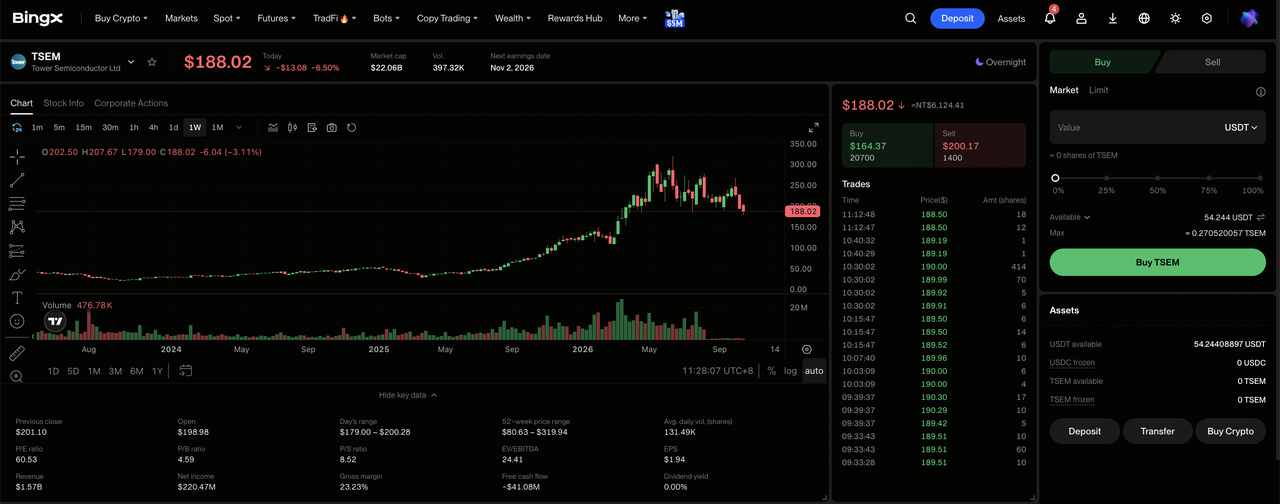
Step 1: Access BingX Stocks Trading. Sign up or log in to BingX, complete the required identity verification, and navigate to "TradFi > Stocks". Accept the Stock Trading Risk Disclosure if accessing the product for the first time.
Step 2: Prepare USDT or USDC. Ensure your Spot Account has sufficient funds for the purchase. Transfer USDT or USDC from your Fund or Wealth Account if needed. Fractional purchases start from 5 USDC or 0.0001 shares.
Step 3: Select Tower Semiconductor (TSEM). Open the Stocks market, search for TSEM, and select Tower Semiconductor (TSEM). Review the current share price, trading session, and available order types.
Step 4: Buy Tower Semiconductor Shares. Select "Buy", enter the investment amount or share quantity, and choose a market or limit order.. Market orders execute at available prices during supported trading hours, while limit orders execute at the specified price or better when sufficient liquidity is available.
Step 5: Review and Manage Your Holdings. Open "Stocks > Positions" to monitor your TSEM shares and unrealized profit or loss. Use "All Orders" to review transactions or sell shares when needed. T+1 settlement generally affects when sale proceeds become available for withdrawal, rather than when shares can be sold.
Top 5 Risks to Watch for Tower Semiconductor Investors in 2026
Tower's strong silicon photonics demand, expanding customer contracts, and growing manufacturing capacity support its long-term outlook. However, production schedules, customer adoption, capital spending, and valuation remain important factors determining how much of that growth translates into profitability and shareholder returns.
- SiPho customer concentration could affect revenue growth. Tower's $680 million annualized run rate and $1.3 billion in 2027 contracts make optical demand central to expectations. Customer delays could reduce wafer shipments, fab utilization, and margins.
- Manufacturing expansion could pressure cash flow. Q2 capital spending of $187 million exceeded operating cash flow of $177 million. Delays in Japan's 300mm expansion could increase costs before new capacity generates revenue.
- Semtech agreements depend on production demand. The October SiGe capacity agreement supports high-speed optical component growth. Customer design wins and data-center deployments must translate into sustained wafer orders to improve profitability.
- Weaker analog demand could offset SiPho growth. Tower serves automotive, mobile, and industrial markets with different demand cycles. Slower orders outside photonics could limit overall revenue growth despite stronger AI demand.
- High growth expectations could increase valuation risk. TSEM remained up 56.52% YTD despite an 8.25% October 20 decline. Its 2028 targets of $3.6 billion in revenue and $1.2 billion in profit require strong utilization, making execution delays a risk to valuation.
Final Thoughts: Should You Invest in Tower Semiconductor in 2026?
Tower has real production progress rather than only an AI design narrative: Q2 revenue rose 23.7%, adjusted EPS reached $0.88 and SiPho achieved a $680 million annual run rate. Signed $1.3 billion 2027 contracts and a Semtech capacity agreement add visibility, while NewPhotonics shipments show a program already at volume. The operating opportunity is substantial, although new equipment must yield qualifying wafers and cash after investment.
The $320 Bull Case needs Q3 revenue near the high end and a Q4 SiPho pace above $1 billion with better cash conversion; the $140 Bear Case gains weight if utilization or customer schedules slip. A conservative investor can watch the November 2 Q3 results, gross margin and operating cash against capex before deciding whether the growth already priced into TSEM is becoming durable profit.
Risk Reminder: Trading and investing in equities like TSEM involves a high risk of capital loss. Foundry cycles, customer concentration, qualification delays, capex and geopolitical exposure can create sharp price moves. Conduct independent research before allocating capital.
Related Reading
- Top AI Optical Stocks to Buy in 2026: Photonics, Optics, Fiber, and Data Center Interconnects
- Top AI Chip Manufacturing Stocks to Buy in 2026: TSMC, ASML, and Advanced Chipmaking
- Top AI Networking Stocks 2026: AI Fabric, Switches, Copper, Fiber, and Optics Connectivity
- Marvell Technology (MRVL) Price Prediction 2026: Can Custom AI Silicon Push MRVL Toward $350?
- Coherent (COHR) Price Prediction 2026: Can AI Optics Demand Push COHR Toward $500?
- Lumentum (LITE) Price Prediction 2026: Can AI Optics Push LITE Toward $1,300?
