In the 2026 digital asset ecosystem, automated social trading has achieved massive adoption, with over 11.4 million active users utilizing copy trading networks. While mirroring experienced traders offers an efficient shortcut to crypto markets, chasing raw, short-term percentage yields without structural risk parameters is a critical error. Long-term profitability relies entirely on an investor's ability to minimize capital drawdowns and establish systematic portfolio guardrails.
As a premier destination for social trading, trusted by over 20 million users worldwide, BingX provides an institutional-grade security framework via its Copy Trading 2.0 architecture. By combining advanced AI-driven trader analytics with real-time risk mitigation features, the platform shifts copy trading from blind speculation to strategic asset allocation. Succeeding in this environment requires mastering the technical parameters that keep your capital safe when market dynamics change.
This guide details the top risk management strategies for crypto copy trading, explaining how to utilize built-in protection tools to shield your subaccounts from unexpected volatility and liquidation risks.
What Are the Top 5 Risks in Crypto Copy Trading?
|
Specific Risk Category |
Core Operational Impact |
Dedicated Protection Tool |
Associated Surcharge / Friction |
|
Market Volatility Spikes |
Sudden capital drawdowns and losses |
Customized Stop-Loss (SL) |
Regular market execution slippage |
|
Execution Latency Gaps |
Entry/exit price degradation (slippage) |
Copy with 0 Slippage |
Small guaranteed price fee |
|
Capital Concentration |
Single-trader strategy failure |
Multi-strategy diversification |
Increased tracking overhead |
|
Account Cross-Liquidation |
Single trade wipes entire balance |
Copy Trading 2.0 Subaccounts |
Zero platform fee cost |
|
Position Sizing Drifts |
Inconsistent margin distribution |
Position Ratio alignment |
Minimum open margin thresholds |
Many retail participants enter social trading expecting completely passive profits, only to be caught off guard by rapid market liquidations. Because crypto asset classes are highly volatile, even top-tier lead traders can experience extended drawdown phases or emotional lapses during sudden macroeconomic shifts. When you copy a strategy blindly, you are inherently replicating the master trader's behavioral risk profile, meaning their over-leveraged errors become your direct financial losses.
- Market Volatility and Sudden Losses: Even elite traders can suffer big losses during rapid price swings. Crypto markets are highly volatile, and while a trader may have a strong track record, past performance is never a guarantee of future results.
- FOMO and Emotional Copying: It’s easy to copy traders who show high ROI or have huge followings — especially during hype or FOMO cycles. But many use risky, high-leverage strategies that can backfire fast. When you copy them blindly, you also mirror their behavior. If they panic or chase losses, your portfolio follows. Always assess a trader’s strategy, risk level, and discipline, not just their recent profits.
- Putting All Eggs in One Basket: Allocating all your copy funds to a single trader or strategy increases your exposure. If that trader hits a losing streak, your portfolio takes the full impact. Diversifying across multiple traders with different styles helps reduce this risk.
- Slippage and Delays in Fast Markets: Your copied trades may not execute at the exact same price or time as the lead trader’s. In fast markets, this can lead to slippage, entering or exiting a position at a worse price, which affects your profitability.
- Misaligned Strategies and Risk Profiles: Not every trader’s strategy fits your financial goals or risk appetite. Some focus on short-term scalping, others on long-term holds or high-leverage futures. Before copying, study their trading history, leverage level, and drawdown rate to ensure their approach aligns with your strategy.
Read more: What Are the Top Risks in Copy Trading and How to Copy Trade Securely in 2026?
Top 5 BingX Product Features to Manage Copy Trading Risk
Establishing custom protective parameters is the only way to decouple your capital's survival from a single trader's mistakes. In fast-moving markets, relying entirely on a lead trader's manual stop-loss configurations can expose your account to significant pricing drag. Implementing personalized portfolio caps ensures that your isolated subaccount remains structurally sound, regardless of whether a master trader faces a temporary losing streak.
BingX equips you with powerful, built-in tools to help you manage copy trading risk, whether you're a beginner or experienced user. These five standout features give you more control over your capital, execution quality, and exposure to volatile markets.
1. Choose the Right Copy Trader Fit for Your Risk Appetite
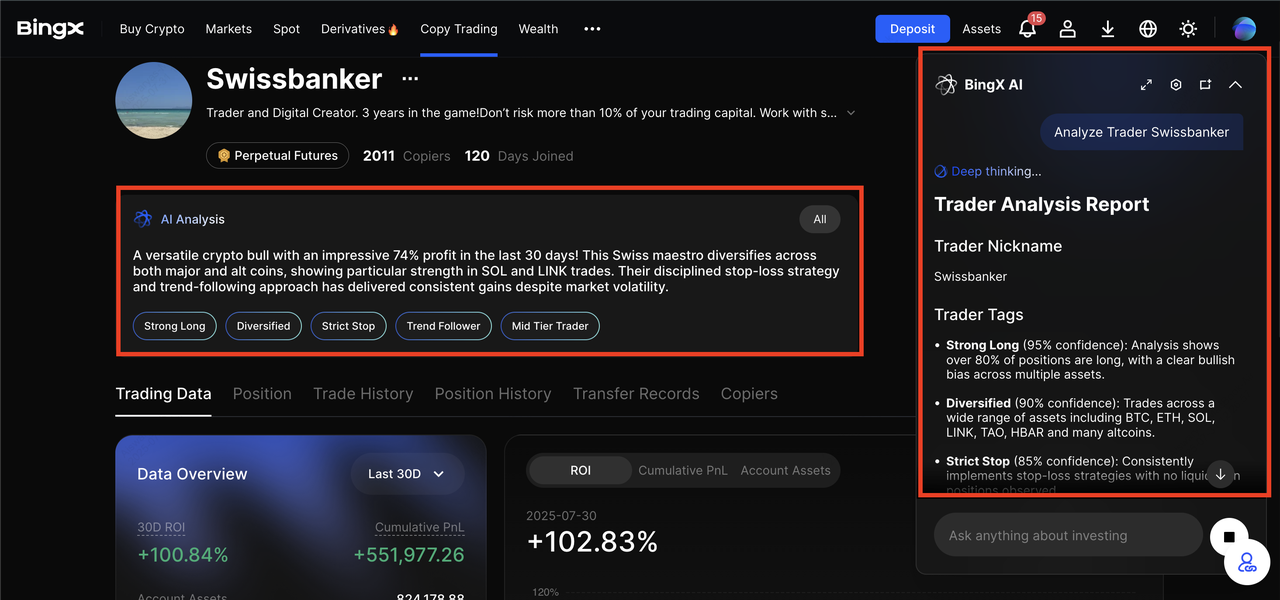
Before selecting your lead trader, take time to analyze their trading style, risk appetite, and leverage level, not just their ROI. A trader with high short-term gains might use risky, high-leverage strategies that don’t suit your comfort level or long-term goals.
Look deeper into copy trading performance metrics like average drawdown, trade frequency, and asset type. Consistent, moderate performers are often safer than traders chasing big wins. Avoid relying 100% on ROI or follower counts, as they can be misleading during market hype or FOMO cycles.
BingX AI can simplify this process by helping you filter traders based on risk-adjusted metrics, such as ROI stability, win/loss ratio, and behavior patterns. It also alerts you if a trader’s strategy changes suddenly, helping you stay aligned with your personal trading goals and avoid unnecessary exposure.
Read more: How to Use BingX AI for Smarter Copy Trading
2. Try Copy Trading 2.0 Subaccounts
The foundational step toward structural security is isolating your copy capital from your primary trading balances. Every time you initialize a new copy trading relationship, BingX establishes a dedicated Copy Trading 2.0 subaccount for that specific master trader. This architecture ensures complete financial segmentation, keeping your core spot, fund, and futures wallets isolated from automated trading activity.
By containing each strategy within an isolated subaccount, you ensure that an aggressive drawdown or liquidation event in one master trader's position will never contaminate your broader account balance. This framework provides clear data visibility, enabling you to track specific leverage rates, margin utilization, and floating paper PnL for each trader independently. You retain the power to pause or permanently terminate individual subaccounts instantly without disrupting your main capital or concurrent strategies.
3. Configure Custom Take-Profit and Stop-Loss (TP/SL) Boundaries
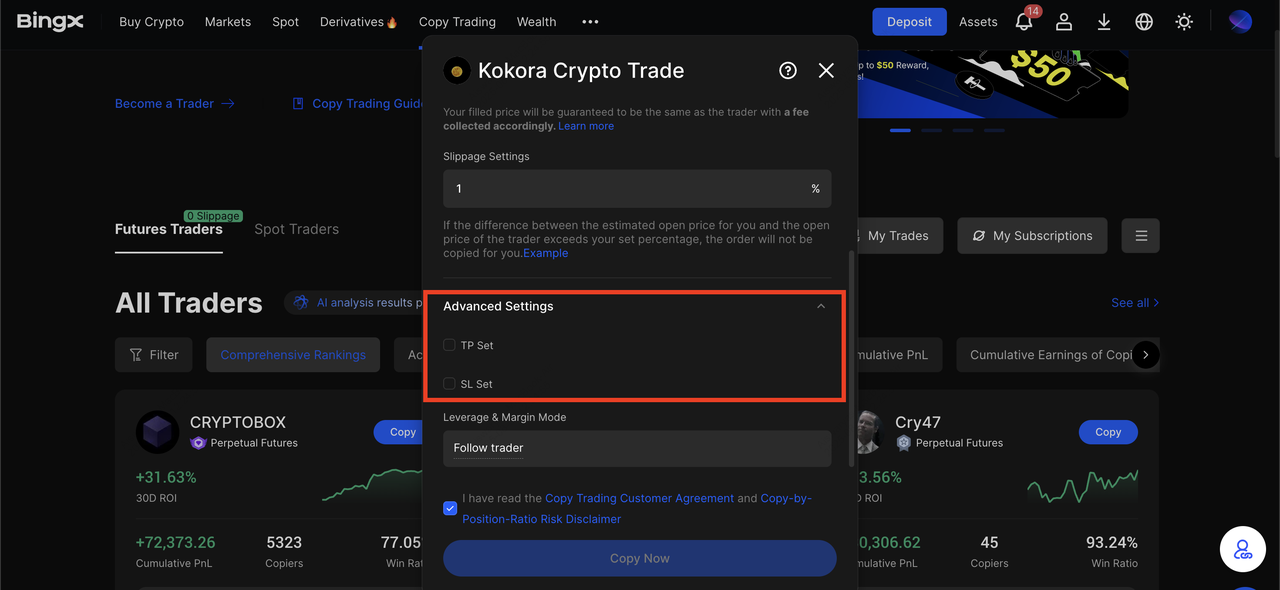
While lead traders implement their own exit parameters, market conditions require copiers to establish independent risk ceilings. Under the Advanced Settings menu, BingX allows you to define custom Take-Profit (TP) and Stop-Loss (SL) percentages that apply to your specific copy allocation. For example, setting an absolute stop-loss trigger at -10% ensures the system will automatically liquidate your copied contracts the moment that threshold is crossed.
Predefining these automated limits serves as an essential guard against emotional trading or a lead trader abandoning their discipline , .g., trying to average down a losing position. These triggers execute automatically via server-side market orders, insulating your subaccount from deep drawdowns during flash crashes or extended weekend corrections when manual tracking isn't possible.
4. Specify Capital Allocation and Daily Copy Limits
Capital preservation relies on strict volume sizing rules. BingX Standard Futures copy trading provides two specific margin-capping mechanisms to control asset allocation scales:
- Max Copy Amount: This parameter caps the total cumulative margin allocated to a specific trader. Once the aggregate value of your active positions reaches this limit, the system blocks further trade replication until existing positions are closed.
- Daily Copy Amount: This acts as a rolling 24-hour volumetric cap, resetting at 00:00 UTC+8. It prevents high-frequency scalpers or high-volume strategies from over-trading your balance and consuming your liquidity through compounding transaction fees.
Implementing these dual caps prevents sudden overexposure to a single market view, helping you maintain a structured budget even when following aggressive, multi-position traders.
5. Activate the Copy with 0 Slippage Protection Feature
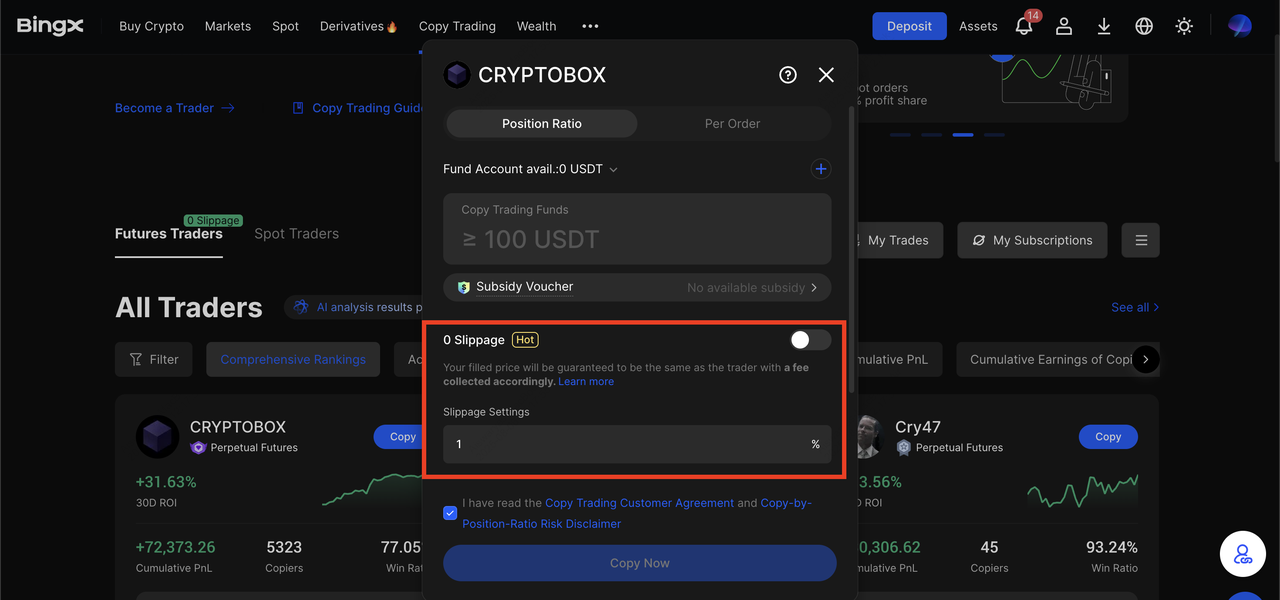
During periods of high volatility or when copying popular traders with large Assets Under Management (AUM), the time gap between a leader's execution and a copier's replication can cause execution slippage. This price gap means your trades often fill at a less favorable price, creating a performance drag that can erode your profit margins over time.
To eliminate this execution gap, advanced copiers activate the Copy with 0 Slippage protection feature. Backed by BingX's guaranteed price engine, this tool ensures your copied positions execute at the exact same fill price as the lead trader's original entry and exit points. While a small guaranteed execution surcharge applies, the mitigation of entry price drift makes it a highly valuable tool for capturing precise, risk-adjusted returns during fast market breaks.
Read more: What Is Copy with 0 Slippage?
Final Thoughts
Social trading on BingX bridges professional execution with retail accessibility, but long-term success requires combining automation with strict risk discipline. Successful copiers treat the platform as a multi-strategy portfolio manager, spreading their capital across 3 to 5 complementary traders, enforcing strict stop-loss limits, and using zero-slippage execution tools.
By managing copy metrics as an asset allocation practice rather than short-term speculation, you can effectively navigate market shifts while protecting your capital from unnecessary risk exposure.
Risk Reminder: Digital asset trading carries high market risk and price volatility. Past performance records are for reference only and do not guarantee future returns. Never allocate more capital than you are prepared to lose.
Related Reading
- What Are the Top Risks in Copy Trading and How to Copy Trade Securely in 2026?
- How to Use BingX AI for Smarter Copy Trading
- How to Become an Elite Copy Trader on BingX
- How to Choose the Right BingX Lead Trader: ROI, Drawdown, Win Rate, and Risk Metrics Explained
- How to Set Up BingX Copy Trading Parameters: Fixed Amount, Copy Ratio, Leverage, and Fund Management
- How to Read BingX Copy Trading Performance: ROI, PnL, Fees, Profit Sharing, and Performance Review
FAQs on Managing Risks in BingX Copy Trading
1. Can BingX copy trading lead to liquidations?
Yes. If a lead trader uses high leverage or holds a losing trade through an adverse market shift, your copied position can face forced liquidation. This occurs if your subaccount's equity drops below the mandatory maintenance margin requirement, which is why establishing custom stop-loss boundaries is essential.
2. What should I do if my copy trading positions lose money?
First, check the trader's historical Max Drawdown (MDD) on their profile to see if the current dip falls within their normal strategy boundaries. If the loss stems from a sudden change in behavior, high-leverage revenge trading, or an unexpected strategy shift, you should stop copying and manually close out the trades.
3. How to reduce liquidation risk in copy trading?
The most practical way to lower liquidation risk is to use Position Ratio mode with low leverage settings, and implement a strict, custom Stop-Loss (SL) threshold. Additionally, setting a conservative Max Copy Amount ensures that a single losing trade sequence cannot deplete your core capital.
4. If a lead trader gets liquidated, will it affect the copier trader?
Yes. Because copy trading replicates execution signals in real time, if a lead trader fails to manage risk and triggers a full position liquidation, your corresponding copied trades will also face liquidation. Using Copy Trading 2.0 guarantees that the damage is contained strictly within that isolated subaccount.
5. Can copy trading delays and slippage create additional risk?
Absolutely. During sharp market swings, execution delays can cause your positions to open or close at significantly worse prices than the lead trader's entries. This pricing gap can be completely mitigated by activating BingX’s Copy with 0 Slippage protection feature.
6. Should I manually close copied positions?
Generally, it is best to let the lead trader manage the entry and exit cycle, as manual intervention can disrupt their strategy's logic. However, if a trader exhibits emotional behavior, holds large floating losses without a stop-loss, or you need to secure immediate wallet liquidity, you can go to your dashboard and manually close the trades via market order.
