
SentinelOne (S) sells subscription security software that protects enterprise endpoints, cloud workloads and identities. Its recurring customer base provides the established engine, while Purple AI and broader Singularity modules aim to expand spending within those accounts. The return depends on whether paid platform adoption can sustain growth while improving delivery margins and reducing the gap between adjusted profit and GAAP losses.
The latest quarter showed subscription growth and stronger adjusted profitability alongside weaker gross margins. SentinelOne Q2 FY2027 revenue rose 21% to $292 million and ARR increased 22% to $1.218 billion. Adjusted operating margin reached 10%, but GAAP gross margin fell to 72% from 75%. The next test is delivery against the $309 million to $311 million Q3 revenue guide with healthier subscription economics.
The S stock forecast for 2026 now centers on two competing views:
- The platform expansion case: Larger customers add cloud and AI modules, lifting recurring revenue while recovering gross margins turn existing adjusted leverage into better earnings quality.
- The margin pressure case: Slower account expansion and lower gross profit leave product spending and share-based compensation consuming too much of the subscription growth benefit.
This guide breaks down the S stock forecast, 2026 price scenarios, key risks and analyst outlooks, drawing on SentinelOne earnings, official product information and Stock Analysis records through October 21, plus how to buy S stock on BingX TradFi with USDT or USDC.
Top 5 Things for SentinelOne Investors to Know in October 2026
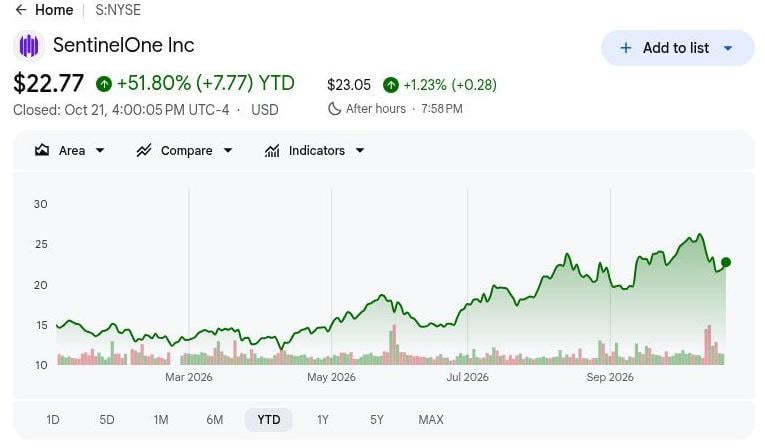
- S closed at $22.77 on October 21, up 51.80% YTD: Shares remain above their opening-year level, making the $32 bull scenario dependent on paid platform expansion and healthier margins. Continued gains require Singularity adoption to improve per-share profitability alongside recurring revenue growth.
- Q2 FY2027 revenue increased 21% to $292 million: Adjusted operating margin also improved from 2% to 10%, showing stronger expense leverage. However, GAAP gross margin fell from 75% to 72%, making it important to distinguish operating cost control from the economics of delivering additional subscriptions.
- ARR reached $1.218 billion as larger customer accounts expanded: The Q2 recurring base grew 22%, while customers with at least $100,000 ARR increased 13% to 1,715. Renewals, paid module adoption, and delivery margins will determine how much that subscription scale translates into durable earnings growth.
- Q3 revenue guidance sets a $309 million to $311 million test: Management projected $38 million to $40 million in adjusted operating income, requiring continued growth alongside expense leverage. Recognized subscription sales and gross-margin stabilization will determine whether that outlook supports sustained improvements in platform profitability.
- GAAP operating losses remain a constraint on shareholder returns: SentinelOne reported a negative 31% operating margin alongside a positive 10% adjusted result, while diluted GAAP loss reached $0.27 per share. Subscription growth must cover delivery and compensation costs before adjusted progress translates into per-share economics.
What Is SentinelOne?
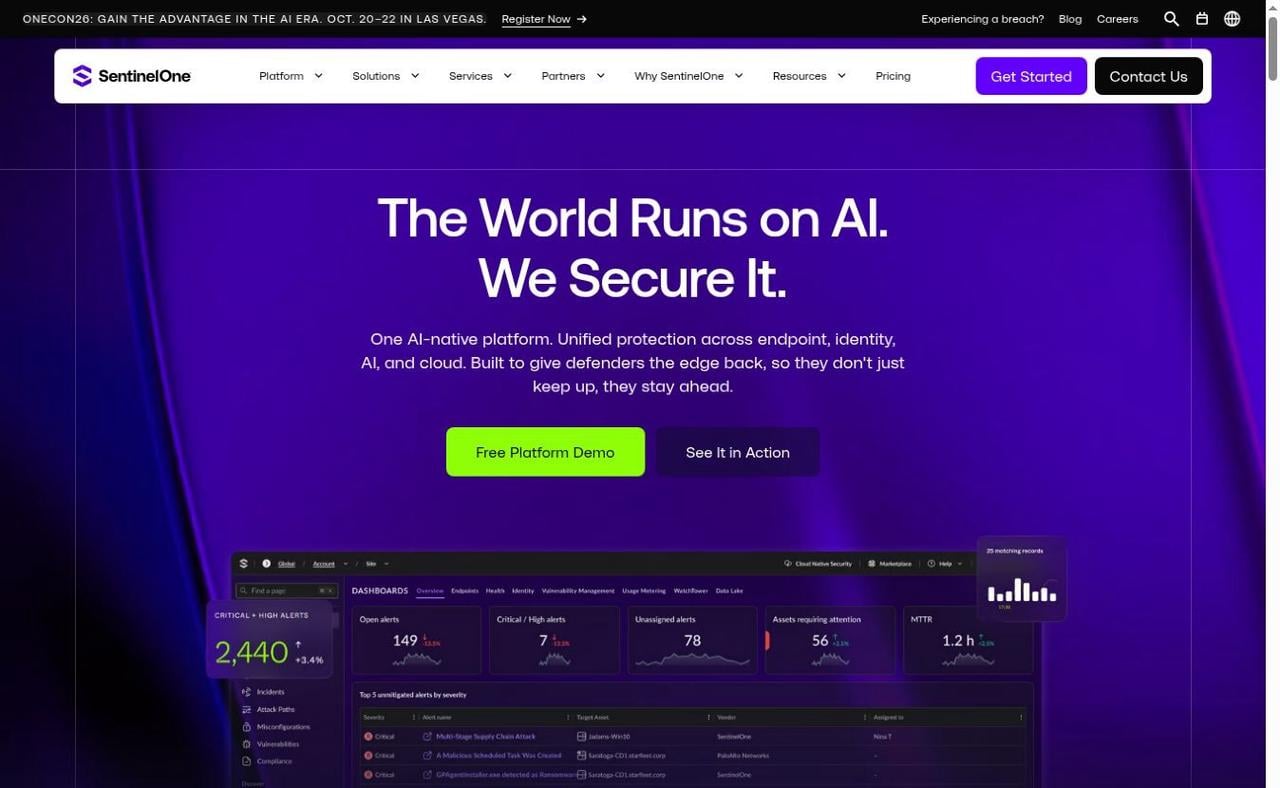
Founded in 2013, SentinelOne (S) develops AI-powered cybersecurity software through its Singularity platform, which protects enterprise endpoints, cloud workloads, and identities while helping security teams detect and respond to threats. Its subscription-based business generates recurring revenue from enterprises, managed security providers, and channel partners. Annual recurring revenue (ARR), large customer growth, and subscription expansion are key measures of performance as SentinelOne competes with established cybersecurity providers.
SentinelOne's growth strategy focuses on expanding beyond endpoint protection into cloud security, identity protection, and autonomous security operations. Its Purple AI technology helps security teams investigate threats, while the Singularity platform encourages broader enterprise adoption. Notable customers include NVIDIA, Mastercard, Lockheed Martin, Aston Martin, and Carnival Corporation, demonstrating adoption across technology, financial services, defense, and travel. By July 31, 2026, ARR reached $1.218 billion, with 1,715 customers generating more than $100,000 annually. Further growth depends on expanding enterprise subscriptions and improving profitability.
SentinelOne (S) Q2 FY2027 Earnings Overview: Stronger Subscriptions Face Rising Costs and Soft Q3 Outlook
SentinelOne reported Q2 FY2027 revenue of $292 million, up 21% year over year, alongside 22% ARR growth to $1.218 billion and expansion of larger customer accounts. Adjusted operating margin improved from 2% to 10%, while GAAP gross margin fell from 75% to 72% and diluted loss widened to $0.27 per share. With Q3 revenue guidance of $309 million to $311 million, future growth depends on converting paid platform adoption into healthier subscription margins and reduced GAAP losses.
|
Financial Metric |
Guidance / Consensus |
Reported / Actual |
Surprise |
|
Revenue |
$242M Q2 FY2026 |
$292M |
Improved. Up 21% YoY. |
|
Annualized recurring revenue |
~$1.0B Q2 FY2026 |
$1.218B |
Expanded. Up 22% YoY. |
|
Customers ≥$100K ARR |
1,513 Q2 FY2026 |
1,715 |
Expanded. Up 13% YoY. |
|
GAAP gross margin |
75% Q2 FY2026 |
72% |
Lower. Down three points. |
|
Non-GAAP gross margin |
79% Q2 FY2026 |
77% |
Lower. Down two points. |
|
Non-GAAP operating margin |
2% Q2 FY2026 |
10% |
Improved. Up eight points. |
|
GAAP diluted EPS |
-$0.22 Q2 FY2026 |
-$0.27 |
Widened. Loss per share grew. |
|
Q3 revenue guidance |
New forward guidance |
309M–311M |
Outlook. Next-quarter range. |
- Q2 FY2027 revenue increased 21% to $292 million. Annual recurring revenue (ARR) rose 22% to $1.218 billion, reflecting continued subscription growth. Sustained revenue recognition and cash generation will be important to confirming the strength of enterprise demand.
- Large enterprise customers increased 13% to 1,715. Accounts generating at least $100,000 in ARR expanded, supporting SentinelOne's enterprise growth. Broader adoption of Singularity's cloud, identity, and AI capabilities could drive larger contracts and recurring revenue.
- Adjusted operating margin improved to 10% from 2%. Operating efficiency strengthened despite GAAP gross margin declining to 72% from 75%. With GAAP operating margin still negative at 31%, further cost discipline and gross-margin recovery remain essential.
- Platform expansion strengthened SentinelOne's cybersecurity offering. Singularity integrates endpoint, cloud, and identity protection, while Purple AI and autonomous security operations create additional opportunities for subscription expansion. Future growth depends on converting these capabilities into paid adoption and improving margins.
- Q3 revenue guidance of $309 million to $311 million signals continued growth. Management also expects $38 million to $40 million in adjusted operating income. Sustained subscription demand, stronger gross margins, and narrowing GAAP losses will be key measures of progress toward profitability.
SentinelOne (S) 2026 Investment Outlook: $32 Bull Case vs. $17 Bear Case
The central test for S is whether Singularity's broader AI and cloud modules lift customer expansion while gross margin recovers from 72%. Q2's 10% adjusted operating margin shows progress, but the GAAP loss and share-count effects remain material. The three editorial year-end cases combine ARR conversion, Q3 guide delivery and margin quality; they are separate from analysts' approximately 12-month targets.
The Bull Case: Paid Platform Expansion and Margin Recovery Support $32
Broader paid adoption of Singularity modules would raise subscription gross profit while the existing recurring base supports operating leverage. Q2 ARR grew 22% to $1.218 billion and adjusted operating margin reached 10%, despite lower gross margins. Recovering delivery economics would allow more incremental revenue to fund earnings rather than simply offset the cost of expanding the platform.
The $32 scenario would gain support if Q3 revenue exceeds $311 million, large accounts keep expanding and gross margins stabilize. Stronger gross profit alongside narrower GAAP losses would make the platform's growth more valuable per share.
The Base Case: Recurring Growth Offsets Profitability Gaps at 23–27
Recurring subscription expansion would support moderate adjusted profit growth while weak gross margins continue limiting GAAP progress. Q2 revenue rose 21% and adjusted operating margin reached 10%, but GAAP operating margin remained negative 31%. Meeting the next sales guide would preserve the growth engine without resolving the expense and compensation burden carried by existing shareholders.
A 23–27 range would fit Q3 revenue within $309 million to $311 million and stable gross margins alongside continuing GAAP losses. Those conditions would justify paying for recurring growth while restraining a larger premium for near-term profitability.
The Bear Case: Slower Expansion Exposes Delivery Costs at $17
Slower customer expansion would reduce incremental subscription profit and expose delivery costs that are already pressuring margins. Q2 GAAP gross margin fell to 72% from 75%, while diluted loss widened to $0.27 per share. If competitive discounts or delayed module purchases weaken ARR additions, product spending would absorb a larger share of the remaining revenue gain.
The $17 scenario would become more likely if Q3 sales miss the $309 million floor and gross margins deteriorate further. Weaker recurring growth with persistent GAAP losses would undermine the earnings improvement needed to sustain the stock's earlier recovery.
S Stock Price Forecasts for 2026 By Wall Street Analysts
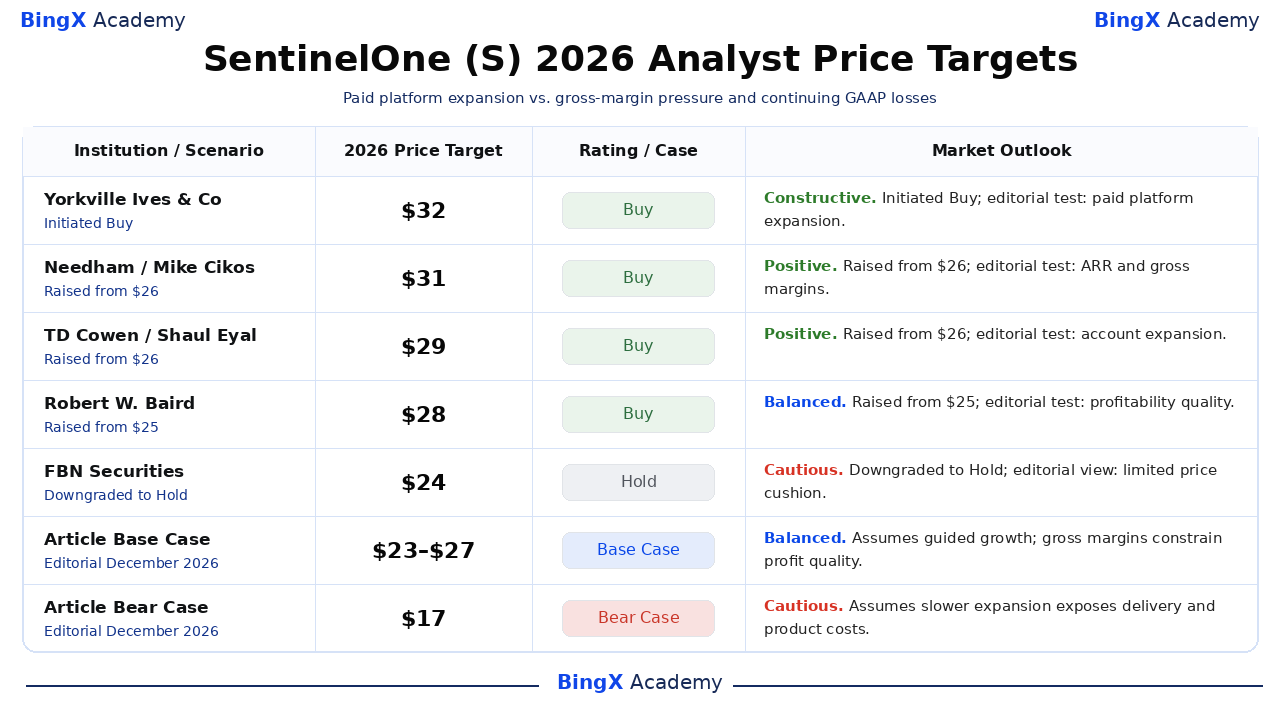
The selected calls concern S common shares on NYSE and span approximately 12-month analyst horizons, often beyond December 2026. Stock Analysis records the dated actions; ratings use its standardized labels. The spread reflects differing valuation assessments, while the explanations marked editorial are this article’s interpretation. Base and Bear rows are separate editorial year-end scenarios.
|
Institution / Scenario |
2026 Price Target |
Rating / Case |
Market Outlook |
|
Yorkville Ives & Co |
$32 |
Buy |
Constructive. October 7, 2026: Initiated Buy at $32. Editorial view: Paid AI and cloud adoption must strengthen earnings. |
|
Needham |
$31 |
Buy |
Positive. October 13, 2026: Raised from $26; maintained Buy. Editorial view: Recurring expansion needs better gross margins. |
|
TD Cowen |
$29 |
Buy |
Positive. October 2, 2026: Raised from $26; reiterated Buy. Editorial view: Large-account growth must translate into profit. |
|
Robert W. Baird |
$28 |
Buy |
Balanced. October 14, 2026: Raised from $25; reiterated Buy. Editorial view: Growth must narrow the GAAP-to-adjusted profit gap. |
|
FBN Securities |
$24 |
Hold |
Cautious. October 6, 2026: Downgraded to Hold with a $24 target. Editorial view: Limited upside leaves less room for execution setbacks. |
|
Article Base Case |
23–27 |
Base Case |
Balanced. Editorial December 2026 scenario. Assumes guided growth; gross margins constrain profit quality. |
|
Article Bear Case |
$17 |
Bear Case |
Cautious. Editorial December 2026 scenario. Assumes slower expansion exposes delivery and product costs. |
How to Buy SentinelOne (S) Stock on BingX
Buy and hold SentinelOne shares through BingX Stocks Trading using USDT or USDC, subject to listing and account eligibility. SentinelOne offers exposure to endpoint protection, cloud security, identity protection and AI-assisted security operations. Eligible users can size holdings according to their investment goals without using leverage or paying perpetual funding fees.
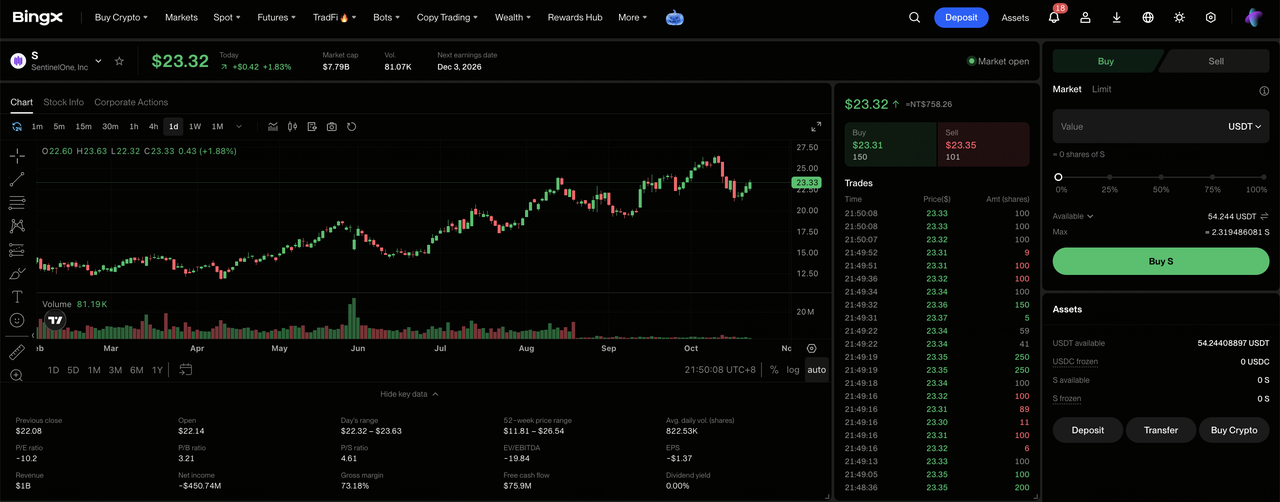
Step 1: Access BingX Stocks Trading. Sign up or log in to BingX, complete the required identity verification, and navigate to “TradFi > Stocks”. Accept the Stock Trading Risk Disclosure if accessing the product for the first time.
Step 2: Prepare USDT or USDC. Ensure your Spot Account has sufficient funds for the purchase. Transfer USDT or USDC from your Fund Account or Wealth Account if needed. Review the selected stock’s minimum order amount and fractional eligibility before choosing the investment size.
Step 3: Select SentinelOne (S). Open the Stocks market, search for Sentinel One (S), and confirm that the share is available to your account. Review the company identity, current share price, trading session and available order types.
Step 4: Buy SentinelOne Shares. Select “Buy”, enter an allowed investment amount or share quantity, and choose a supported market or limit order. Market orders use available prices during supported sessions, while limit orders require the specified price or better and sufficient liquidity to execute.
Step 5: Review and Manage Your Holdings. Open “Stocks > Positions” to monitor your S shares and unrealized profit or loss. Use All Orders to review transactions or sell shares when needed. T+1 settlement generally affects when sale proceeds become withdrawable, rather than when purchased shares can be sold.
Top 5 Risks to Watch for SentinelOne Investors in 2026
SentinelOne's recurring subscriptions, expanding Singularity platform, and larger enterprise accounts support its growth plans. However, customer expansion, delivery costs, subscription conversion, and product investment remain key risks to profitability and shareholder returns.
- Slower customer expansion could make growth volatile: Large accounts reached 1,715 in Q2, but subscription growth remains sensitive to enterprise budgets and paid module purchases. Delayed renewals or expansion orders could cause significant ARR fluctuations and pressure valuation.
- Delivery costs could outpace subscription revenue growth: Q2 GAAP gross margin fell to 72% from 75%, reducing profit from each sales dollar. Continued cloud and platform spending could extend losses if sales and subscription economics fail to improve quickly enough.
- Subscription conversion could delay future earnings: SentinelOne's $1.218 billion ARR supports revenue visibility, but renewal and expansion timing remain uncertain. Slower conversion could weaken near-term growth expectations despite its recurring base and the $309 million to $311 million Q3 guide.
- Product expansion could deliver weaker-than-expected returns: SentinelOne expanded Singularity across endpoint, cloud and identity protection, alongside Purple AI and autonomous security operations. Weak paid adoption, deployment challenges, or additional engineering needs could limit gross profit growth and reduce shareholder value.
- High growth expectations could amplify share-price swings: S's 51.80% YTD gain leaves its valuation dependent on continued subscription expansion and profitability improvements. Changing investor sentiment, competition, or disappointing guidance could trigger significant declines even without major changes in current sales.
Final Thoughts: Should You Invest in SentinelOne in 2026?
SentinelOne's $292 million in quarterly revenue and $1.218 billion in ARR demonstrate the scale of its recurring security business. Large-account expansion and broader Singularity adoption support subscription growth, while a 10% adjusted operating margin shows improving expense leverage. Sustaining that progress will depend on stabilizing gross margins and turning subscription expansion into better GAAP profitability.
The $32 bull case assumes stronger paid module adoption, recovering gross margins, and sales above Q3 guidance. The $23 to $27 base case reflects guided subscription growth, while the $17 bear case accounts for slower expansion and margin pressure. With S closing at $22.77 on October 21, investors should watch whether platform growth produces sustained improvements in per-share profitability.
Risk Reminder: SentinelOne's recurring subscription revenue does not eliminate investment risk. Slower customer expansion, sustained gross-margin pressure, or continued GAAP losses could limit profitability and shareholder returns. Investors should assess valuation, subscription growth, and their risk tolerance before buying S shares.
Related Reading
- What Is BingX Stocks Trading? A Beginner's Guide to Trading U.S. Stocks and ETFs With Crypto
- How to Buy U.S. Stocks on BingX With USDT or USDC: A Beginner's Guide
- CrowdStrike (CRWD) Price Prediction 2026: Can AI Security and Falcon Flex Push CRWD Toward $280?
- Palo Alto Networks (PANW) Price Prediction 2026: Can AI Security Growth Push PANW Toward $475?
- Cisco (CSCO) Stock Price Outlook for 2026: Can AI Growth and Splunk Drive CSCO Back to $90?
- Palantir (PLTR) Stock Price Prediction 2026: Can 149% U.S. Commercial Growth Push PLTR Toward $255?
